

ASTM D3238-22a
(Test Method)Standard Test Method for Calculation of Carbon Distribution and Structural Group Analysis of Petroleum Oils by the n-d-M Method
General Information
- Abstract
SIGNIFICANCE AND USE
5.1 The carbon distribution and ring content serve to express the gross composition of the heavier fractions of petroleum. These data can be used as an adjunct to the bulk properties in monitoring the manufacture of lubricating oil base stocks by distillation, solvent refining or hydrogenation, or both, and in comparing the composition of stocks from different crude sources. Furthermore, the data can often be correlated with critical product performance properties.
SCOPE
1.1 This test method covers the calculation of the carbon distribution and ring content (Note 1) of olefin-free petroleum oils from measurements of refractive index, density, and molecular weight (n-d-M).2 This test method should not be applied to oils whose compositions are outside the following ranges:
1.1.1 In terms of carbon distribution—up to 75 % carbon atoms in ring structure; percentage in aromatic rings not larger than 1.5 times the percentage in naphthenic rings.
1.1.2 In terms of ring content—up to four rings per molecule with not more than half of them aromatic. A correction must be applied for oils containing significant quantities of sulfur.
Note 1: The composition of complex petroleum fractions is often expressed in terms of the proportions of aromatic rings (RA), naphthene rings (RN), and paraffin chains (CP) that would comprise a hypothetical mean molecule. Alternatively, the composition may be expressed in terms of a carbon distribution, that is, the percentage of the total number of carbon atoms that are present in aromatic ring structures (% CA), naphthene ring structures (% CN), and paraffin chains (% Cp).
1.2 The values stated in SI units are to be regarded as the standard.
1.2.1 Exception—The values in parentheses are for information only.
1.3 This standard does not purport to address all of the safety concerns, if any, associated with its use. It is the responsibility of the user of this standard to establish appropriate safety, health, and environmental practices and determine the applicability of regulatory limitations prior to use.
1.4 This international standard was developed in accordance with internationally recognized principles on standardization established in the Decision on Principles for the Development of International Standards, Guides and Recommendations issued by the World Trade Organization Technical Barriers to Trade (TBT) Committee.
- Status
- Published
- Publication Date
- 31-Oct-2022
- Technical Committee
- D02 - Petroleum Products, Liquid Fuels, and Lubricants
- Drafting Committee
- D02.04.0K - Correlative Methods
Buy Documents
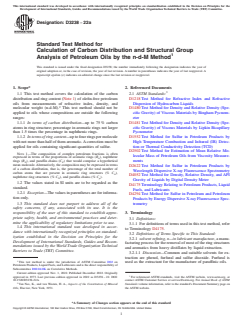
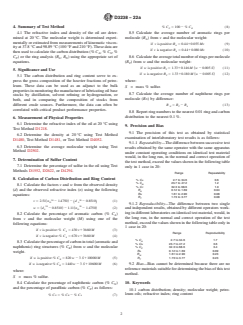


ASTM D3238-22a - Standard Test Method for Calculation of Carbon Distribution and Structural Group Analysis of Petroleum Oils by the n-d-M Method
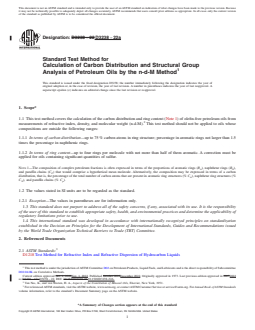
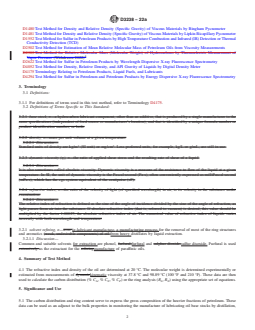
REDLINE ASTM D3238-22a - Standard Test Method for Calculation of Carbon Distribution and Structural Group Analysis of Petroleum Oils by the n-d-M Method
Overview
ASTM D3238-22a is the Standard Test Method for Calculation of Carbon Distribution and Structural Group Analysis of Petroleum Oils by the n-d-M Method. Published by ASTM International, this standard provides a consistent approach for determining carbon distribution and ring content in olefin-free petroleum oils using measurements of refractive index, density, and molecular weight. The analysis of the structural composition of petroleum fractions offers key insights for refining processes and the evaluation of lubricating oil base stocks.
Key Topics
Carbon Distribution Analysis
Determines the percentage of carbon atoms in aromatic rings, naphthene rings, and paraffinic chains. This information helps express the gross molecular composition of petroleum oil fractions.Structural Group Analysis
Provides detailed ring content (aromatic and naphthenic) for complex hydrocarbons, reporting the number of rings per molecule.n-d-M Method
Utilizes refractive index (n), density (d), and molecular weight (M) measurements as the basis for calculations.Applicable Compositional Range
Intended for oils with up to 75% ring carbon, and not more than four rings per molecule (with no more than half being aromatic rings).Correction for Sulfur Content
Includes protocols for adjusting calculations when significant sulfur is present.Precision and Reproducibility
Details repeatability and reproducibility for consistent laboratory results.Referenced Standardized Methods
Requires or refers to established ASTM methods for component measurements, such as refractive index (D1218), density (D1480, D1481, D4052), molecular weight (D2502), and sulfur content (D1552, D2622, D4294).
Applications
Lubricating Oil Manufacturing
Carbon distribution and ring analysis are valuable for monitoring and controlling the bulk properties of base stocks during distillation, solvent refining, or hydrogenation. This aids in producing oils of desired structural character and performance.Crude Oil Source Comparison
Enables direct comparison of structural group composition between stocks sourced from different crude oils, supporting raw material selection and procurement.Product Performance Correlation
Structural attributes determined by this method can often be correlated with critical performance properties of the final product, such as viscosity, oxidation stability, and lubricity.Process Optimization
Data obtained supports optimization of refining processes by providing a molecular-level perspective, which is essential for adjusting process parameters and achieving targeted product specifications.
Related Standards
Several ASTM standards complement or are referenced by ASTM D3238-22a, including:
- ASTM D1218: Test Method for Refractive Index of Hydrocarbon Liquids
- ASTM D1480, D1481, D4052: Test Methods for Density and Relative Density
- ASTM D2502: Estimation of Mean Molecular Weight from Viscosity
- ASTM D1552, D2622, D4294: Test Methods for Sulfur Content in Petroleum Products
- ASTM D4175: Terminology Relating to Petroleum Products and Lubricants
Reviewing these related standards ensures accuracy and consistency in the broader context of petroleum product characterization.
Keywords: ASTM D3238-22a, petroleum oil analysis, carbon distribution, ring content, n-d-M method, structural group analysis, lubricating oil base stocks, refractive index, density, molecular weight, petroleum refining, ASTM standards
Relations
- Refers
ASTM D4175-23a - Standard Terminology Relating to Petroleum Products, Liquid Fuels, and Lubricants - Effective Date
- 15-Dec-2023
- Refers
ASTM D4175-23e1 - Standard Terminology Relating to Petroleum Products, Liquid Fuels, and Lubricants - Effective Date
- 01-Jul-2023
- Effective Date
- 01-May-2019
- Effective Date
- 01-May-2019
- Effective Date
- 01-Jun-2017
- Effective Date
- 01-Jul-2016
- Effective Date
- 01-Jan-2016
- Effective Date
- 15-Jun-2014
- Effective Date
- 01-Nov-2012
- Effective Date
- 01-Oct-2009
- Refers
ASTM D1552-08 - Standard Test Method for Sulfur in Petroleum Products (High-Temperature Method) - Effective Date
- 01-Dec-2008
- Effective Date
- 15-Oct-2008
- Effective Date
- 01-Mar-2008
- Effective Date
- 01-Dec-2007
- Refers
ASTM D1552-07 - Standard Test Method for Sulfur in Petroleum Products (High-Temperature Method) - Effective Date
- 01-Dec-2007
Buy Documents
ASTM D3238-22a - Standard Test Method for Calculation of Carbon Distribution and Structural Group Analysis of Petroleum Oils by the n-d-M Method
REDLINE ASTM D3238-22a - Standard Test Method for Calculation of Carbon Distribution and Structural Group Analysis of Petroleum Oils by the n-d-M Method
Get Certified
Connect with accredited certification bodies for this standard

Element Materials Technology
Materials testing and product certification.

ABS Group Brazil
ABS Group certification services in Brazil.

ABS Quality Evaluations Inc.
American Bureau of Shipping quality certification.
Sponsored listings
Frequently Asked Questions
ASTM D3238-22a is a standard published by ASTM International. Its full title is "Standard Test Method for Calculation of Carbon Distribution and Structural Group Analysis of Petroleum Oils by the n-d-M Method". This standard covers: SIGNIFICANCE AND USE 5.1 The carbon distribution and ring content serve to express the gross composition of the heavier fractions of petroleum. These data can be used as an adjunct to the bulk properties in monitoring the manufacture of lubricating oil base stocks by distillation, solvent refining or hydrogenation, or both, and in comparing the composition of stocks from different crude sources. Furthermore, the data can often be correlated with critical product performance properties. SCOPE 1.1 This test method covers the calculation of the carbon distribution and ring content (Note 1) of olefin-free petroleum oils from measurements of refractive index, density, and molecular weight (n-d-M).2 This test method should not be applied to oils whose compositions are outside the following ranges: 1.1.1 In terms of carbon distribution—up to 75 % carbon atoms in ring structure; percentage in aromatic rings not larger than 1.5 times the percentage in naphthenic rings. 1.1.2 In terms of ring content—up to four rings per molecule with not more than half of them aromatic. A correction must be applied for oils containing significant quantities of sulfur. Note 1: The composition of complex petroleum fractions is often expressed in terms of the proportions of aromatic rings (RA), naphthene rings (RN), and paraffin chains (CP) that would comprise a hypothetical mean molecule. Alternatively, the composition may be expressed in terms of a carbon distribution, that is, the percentage of the total number of carbon atoms that are present in aromatic ring structures (% CA), naphthene ring structures (% CN), and paraffin chains (% Cp). 1.2 The values stated in SI units are to be regarded as the standard. 1.2.1 Exception—The values in parentheses are for information only. 1.3 This standard does not purport to address all of the safety concerns, if any, associated with its use. It is the responsibility of the user of this standard to establish appropriate safety, health, and environmental practices and determine the applicability of regulatory limitations prior to use. 1.4 This international standard was developed in accordance with internationally recognized principles on standardization established in the Decision on Principles for the Development of International Standards, Guides and Recommendations issued by the World Trade Organization Technical Barriers to Trade (TBT) Committee.
SIGNIFICANCE AND USE 5.1 The carbon distribution and ring content serve to express the gross composition of the heavier fractions of petroleum. These data can be used as an adjunct to the bulk properties in monitoring the manufacture of lubricating oil base stocks by distillation, solvent refining or hydrogenation, or both, and in comparing the composition of stocks from different crude sources. Furthermore, the data can often be correlated with critical product performance properties. SCOPE 1.1 This test method covers the calculation of the carbon distribution and ring content (Note 1) of olefin-free petroleum oils from measurements of refractive index, density, and molecular weight (n-d-M).2 This test method should not be applied to oils whose compositions are outside the following ranges: 1.1.1 In terms of carbon distribution—up to 75 % carbon atoms in ring structure; percentage in aromatic rings not larger than 1.5 times the percentage in naphthenic rings. 1.1.2 In terms of ring content—up to four rings per molecule with not more than half of them aromatic. A correction must be applied for oils containing significant quantities of sulfur. Note 1: The composition of complex petroleum fractions is often expressed in terms of the proportions of aromatic rings (RA), naphthene rings (RN), and paraffin chains (CP) that would comprise a hypothetical mean molecule. Alternatively, the composition may be expressed in terms of a carbon distribution, that is, the percentage of the total number of carbon atoms that are present in aromatic ring structures (% CA), naphthene ring structures (% CN), and paraffin chains (% Cp). 1.2 The values stated in SI units are to be regarded as the standard. 1.2.1 Exception—The values in parentheses are for information only. 1.3 This standard does not purport to address all of the safety concerns, if any, associated with its use. It is the responsibility of the user of this standard to establish appropriate safety, health, and environmental practices and determine the applicability of regulatory limitations prior to use. 1.4 This international standard was developed in accordance with internationally recognized principles on standardization established in the Decision on Principles for the Development of International Standards, Guides and Recommendations issued by the World Trade Organization Technical Barriers to Trade (TBT) Committee.
ASTM D3238-22a is classified under the following ICS (International Classification for Standards) categories: 75.080 - Petroleum products in general. The ICS classification helps identify the subject area and facilitates finding related standards.
ASTM D3238-22a has the following relationships with other standards: It is inter standard links to ASTM D4175-23a, ASTM D4175-23e1, ASTM D2502-14(2019), ASTM D2502-14(2019)e1, ASTM D1481-17, ASTM D1552-16, ASTM D4294-16, ASTM D1552-08(2014), ASTM D1481-12, ASTM D2502-04(2009), ASTM D1552-08, ASTM D4294-08a, ASTM D2622-08, ASTM D1480-07, ASTM D1552-07. Understanding these relationships helps ensure you are using the most current and applicable version of the standard.
ASTM D3238-22a is available in PDF format for immediate download after purchase. The document can be added to your cart and obtained through the secure checkout process. Digital delivery ensures instant access to the complete standard document.
Standards Content (Sample)
This international standard was developed in accordance with internationally recognized principles on standardization established in the Decision on Principles for the
Development of International Standards, Guides and Recommendations issued by the World Trade Organization Technical Barriers to Trade (TBT) Committee.
Designation: D3238 − 22a
Standard Test Method for
Calculation of Carbon Distribution and Structural Group
Analysis of Petroleum Oils by the n-d-M Method
This standard is issued under the fixed designation D3238; the number immediately following the designation indicates the year of
original adoption or, in the case of revision, the year of last revision. A number in parentheses indicates the year of last reapproval. A
superscript epsilon (´) indicates an editorial change since the last revision or reapproval.
1. Scope* 2. Referenced Documents
1.1 This test method covers the calculation of the carbon 2.1 ASTM Standards:
distribution and ring content (Note 1) of olefin-free petroleum D1218 Test Method for Refractive Index and Refractive
oils from measurements of refractive index, density, and Dispersion of Hydrocarbon Liquids
molecular weight (n-d-M). This test method should not be D1480 Test Method for Density and Relative Density (Spe-
applied to oils whose compositions are outside the following cific Gravity) of Viscous Materials by Bingham Pycnom-
ranges: eter
1.1.1 In terms of carbon distribution—up to 75 % carbon D1481 Test Method for Density and Relative Density (Spe-
atoms in ring structure; percentage in aromatic rings not larger cific Gravity) of Viscous Materials by Lipkin Bicapillary
than 1.5 times the percentage in naphthenic rings. Pycnometer
1.1.2 In terms of ring content—uptofourringspermolecule D1552 Test Method for Sulfur in Petroleum Products by
with not more than half of them aromatic.Acorrection must be High Temperature Combustion and Infrared (IR) Detec-
applied for oils containing significant quantities of sulfur. tion or Thermal Conductivity Detection (TCD)
D2502 Test Method for Estimation of Mean Relative Mo-
NOTE 1—The composition of complex petroleum fractions is often
lecular Mass of Petroleum Oils from Viscosity Measure-
expressed in terms of the proportions of aromatic rings (R ), naphthene
A
ments
rings (R ), and paraffin chains (C ) that would comprise a hypothetical
N P
mean molecule.Alternatively, the composition may be expressed in terms
D2622 Test Method for Sulfur in Petroleum Products by
of a carbon distribution, that is, the percentage of the total number of
Wavelength Dispersive X-ray Fluorescence Spectrometry
carbon atoms that are present in aromatic ring structures (% C ),
A
D4052 Test Method for Density, Relative Density, and API
naphthene ring structures (% C ), and paraffin chains (% C ).
N p
Gravity of Liquids by Digital Density Meter
1.2 The values stated in SI units are to be regarded as the
D4175 Terminology Relating to Petroleum Products, Liquid
standard.
Fuels, and Lubricants
1.2.1 Exception—Thevaluesinparenthesesareforinforma-
D4294 Test Method for Sulfur in Petroleum and Petroleum
tion only.
Products by Energy Dispersive X-ray Fluorescence Spec-
1.3 This standard does not purport to address all of the
trometry
safety concerns, if any, associated with its use. It is the
responsibility of the user of this standard to establish appro- 3. Terminology
priate safety, health, and environmental practices and deter-
3.1 Definitions:
mine the applicability of regulatory limitations prior to use.
3.1.1 For definitions of terms used in this test method, refer
1.4 This international standard was developed in accor-
to Terminology D4175.
dance with internationally recognized principles on standard-
3.2 Definitions of Terms Specific to This Standard:
ization established in the Decision on Principles for the
3.2.1 solvent refining, n—in lubricant manufacture, a manu-
Development of International Standards, Guides and Recom-
facturing process for the removal of most of the ring structures
mendations issued by the World Trade Organization Technical
and aromatics from heavy distillates by liquid extraction.
Barriers to Trade (TBT) Committee.
3.2.1.1 Discussion—Common and suitable solvents for ex-
traction are phenol, furfural and sulfur disoxide. Furfural is
This test method is under the jurisdiction of ASTM Committee D02 on
used as the extractant for the manufacture of paraffinic oils.
Petroleum Products, Liquid Fuels, and Lubricants and is the direct responsibility of
Subcommittee D02.04.0K on Correlative Methods.
Current edition approved Nov. 1, 2022. Published December 2022. Originally
approved in 1973. Last previous edition approved in 2022 as D3238 – 22. DOI: For referenced ASTM standards, visit the ASTM website, www.astm.org, or
10.1520/D3238-22A. contact ASTM Customer Service at service@astm.org. For Annual Book of ASTM
Van Nes, K., and van Westen, H. A., Aspects of the Constitution of Mineral Standards volume information, refer to the standard’s Document Summary page on
Oils, Elsevier, New York, 1951. the ASTM website.
*A Summary of Changes section appears at the end of this standard
Copyright © ASTM International, 100 Barr Harbor Drive, PO Box C700, West Conshohocken, PA 19428-2959. United States
D3238 − 22a
4. Summary of Test Method % C 5 100 2 % C (8)
P R
4.1 The refractive index and density of the oil are deter- 8.5 Calculate the average number of aromatic rings per
mined at 20 °C. The molecular weight is determined experi- molecule (R ) from v and the molecular weight:
A
mentally or estimated from measurements of kinematic viscos-
if v is positive:R 5 0.4410.055 Mv (9)
A
ityat37.8 °Cand98.89 °C(100 °Fand210 °F).Thesedataare
if v is negative:R 5 0.4410.080 Mv (10)
A
then used to calculate the carbon distribution
...
This document is not an ASTM standard and is intended only to provide the user of an ASTM standard an indication of what changes have been made to the previous version. Because
it may not be technically possible to adequately depict all changes accurately, ASTM recommends that users consult prior editions as appropriate. In all cases only the current version
of the standard as published by ASTM is to be considered the official document.
Designation: D3238 − 22 D3238 − 22a
Standard Test Method for
Calculation of Carbon Distribution and Structural Group
Analysis of Petroleum Oils by the n-d-M Method
This standard is issued under the fixed designation D3238; the number immediately following the designation indicates the year of
original adoption or, in the case of revision, the year of last revision. A number in parentheses indicates the year of last reapproval. A
superscript epsilon (´) indicates an editorial change since the last revision or reapproval.
1. Scope*
1.1 This test method covers the calculation of the carbon distribution and ring content (Note 1) of olefin-free petroleum oils from
measurements of refractive index, density, and molecular weight (n-d-M). This test method should not be applied to oils whose
compositions are outside the following ranges:
1.1.1 In terms of carbon distribution—up to 75 % carbon atoms in ring structure; percentage in aromatic rings not larger than 1.5
times the percentage in naphthenic rings.
1.1.2 In terms of ring content—up to four rings per molecule with not more than half of them aromatic. A correction must be
applied for oils containing significant quantities of sulfur.
NOTE 1—The composition of complex petroleum fractions is often expressed in terms of the proportions of aromatic rings (R ), naphthene rings (R ),
A N
and paraffin chains (C ) that would comprise a hypothetical mean molecule. Alternatively, the composition may be expressed in terms of a carbon
P
distribution, that is, the percentage of the total number of carbon atoms that are present in aromatic ring structures (% C ), naphthene ring structures (%
A
C ), and paraffin chains (% C ).
N p
1.2 The values stated in SI units are to be regarded as the standard.
1.2.1 Exception—The values in parentheses are for information only.
1.3 This standard does not purport to address all of the safety concerns, if any, associated with its use. It is the responsibility
of the user of this standard to establish appropriate safety, health, and environmental practices and determine the applicability of
regulatory limitations prior to use.
1.4 This international standard was developed in accordance with internationally recognized principles on standardization
established in the Decision on Principles for the Development of International Standards, Guides and Recommendations issued
by the World Trade Organization Technical Barriers to Trade (TBT) Committee.
2. Referenced Documents
2.1 ASTM Standards:
D1218 Test Method for Refractive Index and Refractive Dispersion of Hydrocarbon Liquids
This test method is under the jurisdiction of ASTM Committee D02 on Petroleum Products, Liquid Fuels, and Lubricants and is the direct responsibility of Subcommittee
D02.04.0K on Correlative Methods.
Current edition approved Oct. 1, 2022Nov. 1, 2022. Published October 2022December 2022. Originally approved in 1973. Last previous edition approved in 20172022
as D3238 – 17a.D3238 – 22. DOI: 10.1520/D3238-22.10.1520/D3238-22A.
Van Nes, K., and van Westen, H. A., Aspects of the Constitution of Mineral Oils, Elsevier, New York, 1951.
For referenced ASTM standards, visit the ASTM website, www.astm.org, or contact ASTM Customer Service at service@astm.org. For Annual Book of ASTM Standards
volume information, refer to the standard’s Document Summary page on the ASTM website.
*A Summary of Changes section appears at the end of this standard
Copyright © ASTM International, 100 Barr Harbor Drive, PO Box C700, West Conshohocken, PA 19428-2959. United States
D3238 − 22a
D1480 Test Method for Density and Relative Density (Specific Gravity) of Viscous Materials by Bingham Pycnometer
D1481 Test Method for Density and Relative Density (Specific Gravity) of Viscous Materials by Lipkin Bicapillary Pycnometer
D1552 Test Method for Sulfur in Petroleum Products by High Temperature Combustion and Infrared (IR) Detection or Thermal
Conductivity Detection (TCD)
D2502 Test Method for Estimation of Mean Relative Molecular Mass of Petroleum Oils from Viscosity Measurements
D2503 Test Method for Relative Molecular Mass (Molecular Weight) of Hydrocarbons by Thermoelectric Measurement of
Vapor Pressure (Withdrawn 2022)
D2622 Test Method for Sulfur in Petroleum Products by Wavelength Dispersive X-ray Fluorescence Spectrometry
D4052 Test Method for Density, Relative Density, and API Gravity of Liquids by Digital Density Meter
D4175 Terminology Relating to Petroleum Products, Liquid Fuels, and Lubricants
D4294 Test Method for Sulfur in Petroleum and Petroleum Products by Energy Dispersive X-ray Fluorescence Spectrometry
3. Terminology
3.1 Definitions:
3.1.1 For definitions of terms used in this test method, refer to Terminology D4175.
3.2 Definitions of Terms Specific to This Standard:
3.2.1 base stock, n—a hydrocarbon lubricant component, other than an additive, that is produced by a single manufacturer to the
same specifications (independent of feed source or manufacturer’s location), and that is identified by a unique formula number or
product identification number, or both.
3.2.2 density, n—mass per unit volume at a given temperature.
3.2.2.1 Discussion—
3 3
Standard units of density are kg/m (SI unit) or mg/cm . Less preferred units, for example, kg/L or g/mL, are still in use.
3.2.3 dynamic viscosity (η), n—the ratio of applied shear stress and the resulting rate of shear of a liquid.
3.2.3.1 Discussion—
It is also sometimes called absolute viscosity. Dynamic viscosity is a measure of the resistance to flow of the liquid at a given
temperature. In SI, the unit of dynamic viscosity is the Pascal·second (Pa·s), often conveniently expressed as milliPascal·second
(mPa·s), which has the cgs system equivalent of the centipoise (cP).
3.2.4 refractive index, n—the ratio of the velocity of light (of specified wavelength) in air, to its velocity in the substance under
examination.
3.2.4.1 Discussion—
The relative index of refraction is defined as the sine of the angle of incidence divided by the sine of the angle of refraction, as
light passes from air into the substance. If absolute refractive index (that is, referred to vacuum) is desired, this value should be
multiplied by the factor 1.00027, the absolute refractive index of air. The numerical value of refractive index of liquids varies
inversely with both wavelength and temperature.
3.2.1 solvent refining, n—term in lubricant manufacture, a manufacturing process for the removal of most of the ring structures
and aromatics (weak, und
...