

ASTM C547-22a
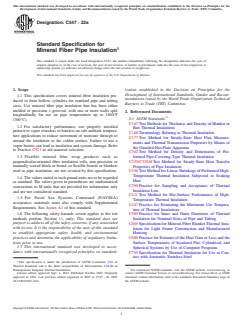
(Specification)Standard Specification for Mineral Fiber Pipe Insulation
General Information
- Abstract
ABSTRACT
This specification covers mineral fiber pipe insulation that are formed into hollow cylinders for standard pipe and tubing sizes. The pipe insulation may be molded or precision v-grooved with one or more walls split longitudinally and used up to a specified temperature. The materials are classified into five types according to the processing method used to form the material and the operating temperatures and into two grades according to heating requirements. The mineral fiber insulation should be manufactured from molten mineral substances such as rock, slag, or glass and processed into fibrous form using a binder, and adhesives when preferred. All products should conform to the required values of hot surface performance, non-fibrous content, use temperature, sag resistance, linear shrinkage, water vapor sorption, surface-burning characteristics, apparent thermal conductivity, and mean temperature.
SCOPE
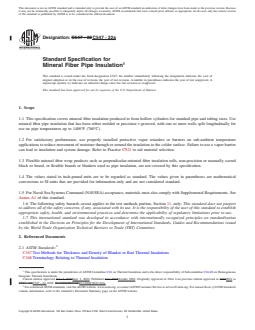
1.1 This specification covers mineral fiber insulation produced to form hollow cylinders for standard pipe and tubing sizes. Use mineral fiber pipe insulation that has been either molded or precision v-grooved, with one or more walls split longitudinally for use on pipe temperatures up to 1400°F (760°C).
1.2 For satisfactory performance, use properly installed protective vapor retarders or barriers on sub-ambient temperature applications to reduce movement of moisture through or around the insulation to the colder surface. Failure to use a vapor barrier can lead to insulation and system damage. Refer to Practice C921 to aid material selection.
1.3 Flexible mineral fiber wrap products such as perpendicular-oriented fiber insulation rolls, non-precision or manually scored block or board, or flexible boards or blankets used as pipe insulation, are not covered by this specification.
1.4 The values stated in inch-pound units are to be regarded as standard. The values given in parentheses are mathematical conversions to SI units that are provided for information only and are not considered standard.
1.5 For Naval Sea Systems Command (NAVSEA) acceptance, materials must also comply with Supplemental Requirements. See Annex A1 of this standard.
1.6 The following safety hazards caveat applies to the test methods portion, Section 11, only: This standard does not purport to address all of the safety concerns, if any, associated with its use. It is the responsibility of the user of this standard to establish appropriate safety, health, and environmental practices and determine the applicability of regulatory limitations prior to use.
1.7 This international standard was developed in accordance with internationally recognized principles on standardization established in the Decision on Principles for the Development of International Standards, Guides and Recommendations issued by the World Trade Organization Technical Barriers to Trade (TBT) Committee.
- Status
- Published
- Publication Date
- 31-Aug-2022
- Technical Committee
- C16 - Thermal Insulation
- Drafting Committee
- C16.20 - Homogeneous Inorganic Thermal Insulations
Overview
ASTM C547-22a: Standard Specification for Mineral Fiber Pipe Insulation provides requirements for preformed mineral fiber insulation made into hollow cylindrical shapes to fit standard pipe and tubing sizes. This specification by ASTM International ensures that mineral fiber pipe insulation, either molded or precision v-grooved, meets key performance and safety criteria for use on pipes operating at temperatures up to 1400°F (760°C). The document classifies materials by type and grade based on formation process and thermal performance.
ASTM C547-22a is widely referenced in the industrial, commercial, and institutional sectors, promoting reliable thermal insulation for piping systems, consistent product quality, and regulatory compliance.
Key Topics
- Product Classification: Materials are classified into five types based on processing method and operating temperature, and into two grades depending on heat-up requirements.
- Material Requirements: Specifies that mineral fiber insulation must be made from processed rock, slag, or glass and excludes asbestos.
- Performance Criteria: Covers parameters such as hot surface performance, sag resistance, linear shrinkage, water vapor sorption, non-fibrous content, apparent thermal conductivity, surface burning characteristics, and corrosiveness to steel.
- Dimensional Standards: Provides guidance on standard inner and outer diameters, wall thicknesses, and tolerances for preformed insulation to ensure proper fit and performance on piping systems.
- NAVSEA Requirements: Additional compression resiliency tests for acceptance by the U.S. Naval Sea Systems Command (NAVSEA) are included in the annex.
- Safety Considerations: Reminds users to follow appropriate health, safety, and environmental practices when working with mineral fiber pipe insulation.
Applications
Mineral Fiber Pipe Insulation specified by ASTM C547-22a is used in a range of thermal insulation applications to:
- Reduce heat loss or heat gain in piping systems, improving energy efficiency in industrial plants, commercial buildings, and institutional facilities.
- Control condensation on chilled water piping and refrigeration lines by using proper vapor barriers according to sub-ambient temperature requirements.
- Provide personnel protection by reducing pipe surface temperatures and minimizing the risk of burns.
- Support system longevity by maintaining consistent thermal performance and preventing moisture ingress, which can lead to insulation and system damage.
- Meet fire safety requirements thanks to the defined limits on surface burning characteristics such as flame spread and smoke developed index.
- Ensure compliance with government projects and contracts, including military and NAVSEA applications where additional resiliency testing is required.
Common environments include HVAC systems, process piping, plumbing, hot water and steam pipelines, and mechanical service lines.
Related Standards
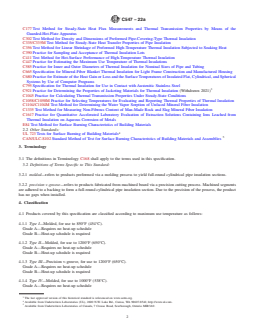
- ASTM C585 – Standard Practice for Inner and Outer Diameters of Thermal Insulation for Nominal Sizes of Pipe and Tubing
- ASTM C335/C335M – Test Method for Steady-State Heat Transfer Properties of Pipe Insulation
- ASTM C411 – Test Method for Hot-Surface Performance of High-Temperature Thermal Insulation
- ASTM C665 – Specification for Mineral-Fiber Blanket Thermal Insulation for Light Frame Construction
- ASTM C1617 – Practice for Quantitative Accelerated Laboratory Evaluation of Extraction Solutions Containing Ions Leached from Thermal Insulation on Aqueous Corrosion of Metals
- UL 723 – Tests for Surface Burning Characteristics of Building Materials
- CAN/ULC-S102 – Standard Method of Test for Surface Burning Characteristics of Building Materials and Assemblies
ASTM C547-22a is essential for professionals involved in designing, specifying, installing, or inspecting thermal insulation on pipes, helping to ensure energy savings, safety, and regulatory adherence. Proper implementation of this standard supports robust and consistent thermal insulation in demanding environments.
Relations
- Effective Date
- 15-Apr-2024
- Effective Date
- 01-Mar-2024
- Effective Date
- 01-Dec-2023
- Effective Date
- 01-Nov-2023
- Effective Date
- 01-Sep-2023
- Effective Date
- 01-Sep-2019
- Effective Date
- 01-Sep-2019
- Effective Date
- 01-Jul-2019
- Effective Date
- 01-May-2019
- Effective Date
- 15-Apr-2019
- Effective Date
- 01-Apr-2019
- Effective Date
- 01-Mar-2019
- Effective Date
- 01-Mar-2019
- Effective Date
- 01-Oct-2018
- Effective Date
- 01-Sep-2018
Get Certified
Connect with accredited certification bodies for this standard

DIBt (Deutsches Institut für Bautechnik)
German Institute for Building Technology.
DIN CERTCO
DIN Group product certification.

Aboma Certification B.V.
Specialized in construction, metal, and transport sectors.
Sponsored listings
Frequently Asked Questions
ASTM C547-22a is a technical specification published by ASTM International. Its full title is "Standard Specification for Mineral Fiber Pipe Insulation". This standard covers: ABSTRACT This specification covers mineral fiber pipe insulation that are formed into hollow cylinders for standard pipe and tubing sizes. The pipe insulation may be molded or precision v-grooved with one or more walls split longitudinally and used up to a specified temperature. The materials are classified into five types according to the processing method used to form the material and the operating temperatures and into two grades according to heating requirements. The mineral fiber insulation should be manufactured from molten mineral substances such as rock, slag, or glass and processed into fibrous form using a binder, and adhesives when preferred. All products should conform to the required values of hot surface performance, non-fibrous content, use temperature, sag resistance, linear shrinkage, water vapor sorption, surface-burning characteristics, apparent thermal conductivity, and mean temperature. SCOPE 1.1 This specification covers mineral fiber insulation produced to form hollow cylinders for standard pipe and tubing sizes. Use mineral fiber pipe insulation that has been either molded or precision v-grooved, with one or more walls split longitudinally for use on pipe temperatures up to 1400°F (760°C). 1.2 For satisfactory performance, use properly installed protective vapor retarders or barriers on sub-ambient temperature applications to reduce movement of moisture through or around the insulation to the colder surface. Failure to use a vapor barrier can lead to insulation and system damage. Refer to Practice C921 to aid material selection. 1.3 Flexible mineral fiber wrap products such as perpendicular-oriented fiber insulation rolls, non-precision or manually scored block or board, or flexible boards or blankets used as pipe insulation, are not covered by this specification. 1.4 The values stated in inch-pound units are to be regarded as standard. The values given in parentheses are mathematical conversions to SI units that are provided for information only and are not considered standard. 1.5 For Naval Sea Systems Command (NAVSEA) acceptance, materials must also comply with Supplemental Requirements. See Annex A1 of this standard. 1.6 The following safety hazards caveat applies to the test methods portion, Section 11, only: This standard does not purport to address all of the safety concerns, if any, associated with its use. It is the responsibility of the user of this standard to establish appropriate safety, health, and environmental practices and determine the applicability of regulatory limitations prior to use. 1.7 This international standard was developed in accordance with internationally recognized principles on standardization established in the Decision on Principles for the Development of International Standards, Guides and Recommendations issued by the World Trade Organization Technical Barriers to Trade (TBT) Committee.
ABSTRACT This specification covers mineral fiber pipe insulation that are formed into hollow cylinders for standard pipe and tubing sizes. The pipe insulation may be molded or precision v-grooved with one or more walls split longitudinally and used up to a specified temperature. The materials are classified into five types according to the processing method used to form the material and the operating temperatures and into two grades according to heating requirements. The mineral fiber insulation should be manufactured from molten mineral substances such as rock, slag, or glass and processed into fibrous form using a binder, and adhesives when preferred. All products should conform to the required values of hot surface performance, non-fibrous content, use temperature, sag resistance, linear shrinkage, water vapor sorption, surface-burning characteristics, apparent thermal conductivity, and mean temperature. SCOPE 1.1 This specification covers mineral fiber insulation produced to form hollow cylinders for standard pipe and tubing sizes. Use mineral fiber pipe insulation that has been either molded or precision v-grooved, with one or more walls split longitudinally for use on pipe temperatures up to 1400°F (760°C). 1.2 For satisfactory performance, use properly installed protective vapor retarders or barriers on sub-ambient temperature applications to reduce movement of moisture through or around the insulation to the colder surface. Failure to use a vapor barrier can lead to insulation and system damage. Refer to Practice C921 to aid material selection. 1.3 Flexible mineral fiber wrap products such as perpendicular-oriented fiber insulation rolls, non-precision or manually scored block or board, or flexible boards or blankets used as pipe insulation, are not covered by this specification. 1.4 The values stated in inch-pound units are to be regarded as standard. The values given in parentheses are mathematical conversions to SI units that are provided for information only and are not considered standard. 1.5 For Naval Sea Systems Command (NAVSEA) acceptance, materials must also comply with Supplemental Requirements. See Annex A1 of this standard. 1.6 The following safety hazards caveat applies to the test methods portion, Section 11, only: This standard does not purport to address all of the safety concerns, if any, associated with its use. It is the responsibility of the user of this standard to establish appropriate safety, health, and environmental practices and determine the applicability of regulatory limitations prior to use. 1.7 This international standard was developed in accordance with internationally recognized principles on standardization established in the Decision on Principles for the Development of International Standards, Guides and Recommendations issued by the World Trade Organization Technical Barriers to Trade (TBT) Committee.
ASTM C547-22a is classified under the following ICS (International Classification for Standards) categories: 91.100.60 - Thermal and sound insulating materials. The ICS classification helps identify the subject area and facilitates finding related standards.
ASTM C547-22a has the following relationships with other standards: It is inter standard links to ASTM C168-24, ASTM C390-08(2024), ASTM E84-23d, ASTM C680-23a, ASTM E84-23c, ASTM C1104/C1104M-19, ASTM C390-08(2019), ASTM E84-19b, ASTM C1617-19, ASTM E84-19a, ASTM C1045-19, ASTM E84-19, ASTM C411-19, ASTM E84-18b, ASTM C1617-18a. Understanding these relationships helps ensure you are using the most current and applicable version of the standard.
ASTM C547-22a is available in PDF format for immediate download after purchase. The document can be added to your cart and obtained through the secure checkout process. Digital delivery ensures instant access to the complete standard document.
Standards Content (Sample)
This international standard was developed in accordance with internationally recognized principles on standardization established in the Decision on Principles for the
Development of International Standards, Guides and Recommendations issued by the World Trade Organization Technical Barriers to Trade (TBT) Committee.
Designation:C547 −22a
Standard Specification for
Mineral Fiber Pipe Insulation
This standard is issued under the fixed designation C547; the number immediately following the designation indicates the year of
original adoption or, in the case of revision, the year of last revision.Anumber in parentheses indicates the year of last reapproval.A
superscript epsilon (´) indicates an editorial change since the last revision or reapproval.
This standard has been approved for use by agencies of the U.S. Department of Defense.
1. Scope ization established in the Decision on Principles for the
Development of International Standards, Guides and Recom-
1.1 This specification covers mineral fiber insulation pro-
mendations issued by the World Trade Organization Technical
duced to form hollow cylinders for standard pipe and tubing
Barriers to Trade (TBT) Committee.
sizes. Use mineral fiber pipe insulation that has been either
molded or precision v-grooved, with one or more walls split
2. Referenced Documents
longitudinally for use on pipe temperatures up to 1400°F
2.1 ASTM Standards:
(760°C).
C167Test Methods forThickness and Density of Blanket or
1.2 For satisfactory performance, use properly installed
Batt Thermal Insulations
protective vapor retarders or barriers on sub-ambient tempera-
C168Terminology Relating to Thermal Insulation
ture applications to reduce movement of moisture through or
C177Test Method for Steady-State Heat Flux Measure-
around the insulation to the colder surface. Failure to use a
ments and Thermal Transmission Properties by Means of
vapor barrier can lead to insulation and system damage. Refer
the Guarded-Hot-Plate Apparatus
to Practice C921 to aid material selection.
C302Test Method for Density and Dimensions of Pre-
1.3 Flexible mineral fiber wrap products such as
formed Pipe-Covering-Type Thermal Insulation
perpendicular-oriented fiber insulation rolls, non-precision or C335/C335MTest Method for Steady-State Heat Transfer
manually scored block or board, or flexible boards or blankets
Properties of Pipe Insulation
used as pipe insulation, are not covered by this specification. C356Test Method for Linear Shrinkage of Preformed High-
Temperature Thermal Insulation Subjected to Soaking
1.4 The values stated in inch-pound units are to be regarded
Heat
as standard. The values given in parentheses are mathematical
C390Practice for Sampling and Acceptance of Thermal
conversions to SI units that are provided for information only
Insulation Lots
and are not considered standard.
C411Test Method for Hot-Surface Performance of High-
1.5 For Naval Sea Systems Command (NAVSEA)
Temperature Thermal Insulation
acceptance, materials must also comply with Supplemental
C447Practice for Estimating the Maximum Use Tempera-
Requirements. See Annex A1 of this standard.
ture of Thermal Insulations
1.6 The following safety hazards caveat applies to the test
C585Practice for Inner and Outer Diameters of Thermal
methods portion, Section 11, only: This standard does not
Insulation for Nominal Sizes of Pipe and Tubing
purport to address all of the safety concerns, if any, associated
C665Specification for Mineral-Fiber BlanketThermal Insu-
with its use. It is the responsibility of the user of this standard
lation for Light Frame Construction and Manufactured
to establish appropriate safety, health, and environmental
Housing
practices and determine the applicability of regulatory limita-
C680Practice for Estimate of the Heat Gain or Loss and the
tions prior to use.
Surface Temperatures of Insulated Flat, Cylindrical, and
1.7 This international standard was developed in accor-
Spherical Systems by Use of Computer Programs
dance with internationally recognized principles on standard-
C795Specification for Thermal Insulation for Use in Con-
tact with Austenitic Stainless Steel
This specification is under the jurisdiction of ASTM Committee C16 on
Thermal Insulation and is the direct responsibility of Subcommittee C16.20 on
Homogeneous Inorganic Thermal Insulations. For referenced ASTM standards, visit the ASTM website, www.astm.org, or
Current edition approved Sept. 1, 2022. Published October 2022. Originally contact ASTM Customer Service at service@astm.org. For Annual Book of ASTM
approved in 1964. Last previous edition approved in 2022 as C547–22. DOI: Standards volume information, refer to the standard’s Document Summary page on
10.1520/C0547-22A. the ASTM website.
Copyright © ASTM International, 100 Barr Harbor Drive, PO Box C700, West Conshohocken, PA 19428-2959. United States
C547−22a
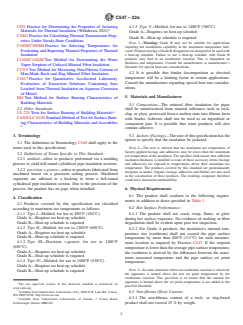
C921Practice for Determining the Properties of Jacketing 4.1.5 Type V—Molded, for use to 1400°F (760°C)
Materials for Thermal Insulation (Withdrawn 2021)
Grade A—Requires no heat-up schedule
C1045Practice for Calculating Thermal Transmission Prop-
Grade B—Heat-up schedule is required
erties Under Steady-State Conditions
NOTE 1—Warning: Grade B may not be suitable for applications
C1058/C1058MPractice for Selecting Temperatures for
requiring hot installation capability at the maximum temperature indi-
Evaluating and Reporting Thermal Properties of Thermal cated.ProductshavingaGradeBdesignationaredesignedtobeusedwith
a heat-up schedule. Failure to use a heat-up schedule with Grade B
Insulation
products may lead to an exothermic reaction. This is dependent on
C1104/C1104MTest Method for Determining the Water
thickness and temperature. Consult the manufacturer or manufacturer’s
Vapor Sorption of Unfaced Mineral Fiber Insulation
literature for special heat rate considerations.
C1335Test Method for Measuring Non-Fibrous Content of
4.2 It is possible that binder decomposition at elevated
Man-Made Rock and Slag Mineral Fiber Insulation
temperature will be a limiting factor in certain applications.
C1617Practice for Quantitative Accelerated Laboratory
Consult the manufacturer regarding special heat rate consider-
Evaluation of Extraction Solutions Containing Ions
ations.
Leached from Thermal Insulation on Aqueous Corrosion
of Metals
5. Materials and Manufacturer
E84Test Method for Surface Burning Characteristics of
Building Materials
5.1 Composition—The mineral fiber insulation for pipes
2.2 Other Standards:
shall be manufactured from mineral substance such as rock,
UL 723Tests for Surface Burning of Building Materials
slag, or glass, processed from a molten state into fibrous form
CAN/ULC-S102StandardMethodofTestforSurfaceBurn-
with binder. Asbestos shall not be used as an ingredient or
ing Characteristics of Building Materials and Assemblies
component part. It is possible that some products will also
contain adhesive.
5.2 Jackets (Facings)—Theuserofthisspecificationhasthe
3. Terminology
option to specify that the insulation be jacketed.
3.1 The definitions in Terminology C168 shall apply to the
terms used in this specification.
NOTE 2—The user is advised that the maximum use temperature of
factory-applied facings and adhesives may be lower than the maximum
3.2 Definitions of Terms Specific to This Standard:
use temperature of the insulation.The specifier shall ensure that sufficient
3.2.1 molded—refers to products preformed via a molding
insulation thickness is installed so none of these accessory items (facings
process to yield full-round cylindrical pipe insulation sections.
and adhesives) are exposed to temperatures above their maximum use
temperature. The products covered by this standard are predominantly
3.2.2 precision v-groove—referstoproductsfabricatedfrom
inorganic in nature. Organic facings, adhesives and binders are also used
machined board via a precision cutting process. Machined
in the construction of these products. The resulting composite therefore
segments are adhered to a backing to form a full-round
could have increased combustibility.
cylindrical pipe insulation section. Due to the precision of the
process, the product has no gaps when installed. 6. Physical Requirements
6.1 The product shall conform to the following require-
4. Classification
ments in addition to those specified in Table 1.
4.1 Products covered by this specification are classified
6.2 Hot Surface Performance:
according to maximum use temperature as follows:
4.1.1 Type I—Molded, for use to 850°F (454°C).
6.2.1 The product shall not crack, warp, flame, or glow
Grade A—Requires no heat-up schedule during hot surface exposure. No evidence of melting or fiber
Grade B—Heat-up schedule is required
degradation shall be evident upon post test inspection.
4.1.2 Type II—Molded, for use to 1200°F (650°C).
6.2.2 For Grade A products, the insulation’s internal tem-
Grade A—Requires no heat-up schedule
perature rise (exotherm) shall not exceed the pipe surface
Grade B—Heat-up schedule is required
temperature by more than 200°F (111°C) for each measure-
4.1.3 Type III—Precision v-groove, for use to 1200°F
ment location as required by Practice C447. If the setpoint
(650°C).
temperatureislowerthantheaveragepipesurfacetemperature,
Grade A—Requires no heat-up schedule
the exotherm is derived by the difference between the maxi-
Grade B—Heat-up schedule is required
mum measured temperature and the pipe surface set point
4.1.4 Type IV—Molded, for use to 1000°F (538°C).
temperature.
Grade A—Requires no heat-up schedule
NOTE 3—In some situations where an exothermic reaction is observed,
Grade B—Heat-up schedule is required
the apparatus is heated above the test set point temperature by the
exothermic reaction. This provision is to ensure that the amount the
apparatus is heated above the set point temperature is not added to the
The last approved version of this historical standard is referenced on
pass/fail threshold.
www.astm.org.
Available from Underwriters Laboratories (UL), 2600 N.W. Lake Rd., Camas,
6.3 Non-fibrous (Shot) Content:
WA 98607-8542, http://www.ul.com.
6.3.1 The non-fibrous content of a rock- or slag-based
Available from Underwriters Laboratories of Canada, 7 Crouse Road,
Scarborough, Ontario MIR3A9. product shall not exceed 25% by weight.
C547−22a
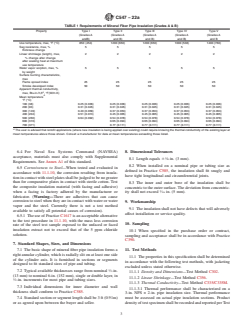
TABLE 1 Requirements of Mineral Fiber Pipe Insulation (Grades A & B)
Property Type I Type II Type III Type IV Type V
(Grades A (Grades A (Grades A (Grades A (Grades A
andB) and B) and B) and B) and B
Use temperature, max, °F (°C) 850 (454) 1200 (650) 1200 (650) 1000 (538) 1400 (760)
Sag resistance, max, % 55555
thickness change
Linear shrinkage (length), max, 22222
% change after change
after soaking heat at maximum
use temperature
Water vapor sorption, max, % 55555
by weight
Surface burning characteristics,
max
Flame spread index 25 25 25 25 25
Smoke developed index 50 50 50 50 50
Apparent thermal conductivity,
max, Btu.in./h,ft , °F(W/m.K)
A
Mean temperature
°F (°C)
100 (38) 0.25 (0.036) 0.25 (0.036) 0.25 (0.036) 0.25 (0.036) 0.25 (0.036)
200 (93) 0.31 (0.045) 0.31 (0.045) 0.31 (0.045) 0.31 (0.045) 0.31 (0.045)
300 (149) 0.40 (0.058) 0.37 (0.053) 0.37 (0.053) 0.37 (0.053) 0.37 (0.053)
400 (204) 0.51 (0.074) 0.45 (0.065) 0.45 (0.065) 0.45 (0.065) 0.45 (0.065)
500 (260) 0.64 (0.092) 0.54 (0.078) 0.54 (0.078) 0.54 (0.078) 0.54 (0.078)
600 (316) 0.65 (0.094) 0.65 (0.094) 0.65 (0.094) 0.65 (0.094)
700 (371) 0.77 (0.111) 0.77 (0.111) 0.77 (0.111) 0.77 (0.111)
A
The user is advised that retrofit applications (where new insulation is being applied over existing) could require knowing the thermal conductivity of the existing layer at
mean temperatures above those shown. Consult a manufacturer for data at mean temperatures exceeding those listed.
6.4 For Naval Sea Systems Command (NAVSEA) 8. Dimensional Tolerances
acceptance, materials must also comply with Supplemental
8.1 Length equals 6 ⁄8-in. (3 mm).
Requirements. See Annex A1 of this standard.
8.2 When installed on a nominal pipe or tubing size as
6.5 Corrosiveness to Steel—When tested and evaluated in
defined in Practice C585, the insulation shall fit snugly and
accordance with 11.1.10, the corrosion resulting from insula-
have tight longitudinal and circumferential joints.
tionincontactwithsteelplatesshallbejudgedtobenogreater
than for comparative plates in contact with sterile cotton. Test
8.3 The inner and outer bore of the insulation shall be
the composite insulation material (with facing and adhesive)
concentric to the outer surface.The deviation from concentric-
when a facing is factory adhered by the manufacturer or
ity shall not exceed ⁄16 in. (5 mm).
fabricator. (Warning—There are adhesives that can cause
corrosion to steel when they are in contact with water or water
9. Workmanship
vapor and the steel. Currently there is not a test method
9.1 The insulation shall not have defects that will adversely
available to satisfy all potential causes of corrosion).
affect installation or service quality.
6.5.1 The use of Practice C1617 is an acceptable alternative
to the test procedure in 11.1.10, with
...
This document is not an ASTM standard and is intended only to provide the user of an ASTM standard an indication of what changes have been made to the previous version. Because
it may not be technically possible to adequately depict all changes accurately, ASTM recommends that users consult prior editions as appropriate. In all cases only the current version
of the standard as published by ASTM is to be considered the official document.
Designation: C547 − 22 C547 − 22a
Standard Specification for
Mineral Fiber Pipe Insulation
This standard is issued under the fixed designation C547; the number immediately following the designation indicates the year of
original adoption or, in the case of revision, the year of last revision. A number in parentheses indicates the year of last reapproval. A
superscript epsilon (´) indicates an editorial change since the last revision or reapproval.
This standard has been approved for use by agencies of the U.S. Department of Defense.
1. Scope
1.1 This specification covers mineral fiber insulation produced to form hollow cylinders for standard pipe and tubing sizes. Use
mineral fiber pipe insulation that has been either molded or precision v-grooved, with one or more walls split longitudinally for
use on pipe temperatures up to 1400°F (760°C).
1.2 For satisfactory performance, use properly installed protective vapor retarders or barriers on sub-ambient temperature
applications to reduce movement of moisture through or around the insulation to the colder surface. Failure to use a vapor barrier
can lead to insulation and system damage. Refer to Practice C921 to aid material selection.
1.3 Flexible mineral fiber wrap products such as perpendicular-oriented fiber insulation rolls, non-precision or manually scored
block or board, or flexible boards or blankets used as pipe insulation, are not covered by this specification.
1.4 The values stated in inch-pound units are to be regarded as standard. The values given in parentheses are mathematical
conversions to SI units that are provided for information only and are not considered standard.
1.5 For Naval Sea Systems Command (NAVSEA) acceptance, materials must also comply with Supplemental Requirements. See
Annex A1 of this standard.
1.6 The following safety hazards caveat applies to the test methods portion, Section 11, only: This standard does not purport
to address all of the safety concerns, if any, associated with its use. It is the responsibility of the user of this standard to establish
appropriate safety, health, and environmental practices and determine the applicability of regulatory limitations prior to use.
1.7 This international standard was developed in accordance with internationally recognized principles on standardization
established in the Decision on Principles for the Development of International Standards, Guides and Recommendations issued
by the World Trade Organization Technical Barriers to Trade (TBT) Committee.
2. Referenced Documents
2.1 ASTM Standards:
C167 Test Methods for Thickness and Density of Blanket or Batt Thermal Insulations
C168 Terminology Relating to Thermal Insulation
This specification is under the jurisdiction of ASTM Committee C16 on Thermal Insulation and is the direct responsibility of Subcommittee C16.20 on Homogeneous
Inorganic Thermal Insulations.
Current edition approved June 1, 2022Sept. 1, 2022. Published June 2022October 2022. Originally approved in 1964. Last previous edition approved in 20192022 as
C547 – 19.C547 – 22. DOI: 10.1520/C0547-22.10.1520/C0547-22A.
For referenced ASTM standards, visit the ASTM website, www.astm.org, or contact ASTM Customer Service at service@astm.org. For Annual Book of ASTM Standards
volume information, refer to the standard’s Document Summary page on the ASTM website.
Copyright © ASTM International, 100 Barr Harbor Drive, PO Box C700, West Conshohocken, PA 19428-2959. United States
C547 − 22a
C177 Test Method for Steady-State Heat Flux Measurements and Thermal Transmission Properties by Means of the
Guarded-Hot-Plate Apparatus
C302 Test Method for Density and Dimensions of Preformed Pipe-Covering-Type Thermal Insulation
C335/C335M Test Method for Steady-State Heat Transfer Properties of Pipe Insulation
C356 Test Method for Linear Shrinkage of Preformed High-Temperature Thermal Insulation Subjected to Soaking Heat
C390 Practice for Sampling and Acceptance of Thermal Insulation Lots
C411 Test Method for Hot-Surface Performance of High-Temperature Thermal Insulation
C447 Practice for Estimating the Maximum Use Temperature of Thermal Insulations
C585 Practice for Inner and Outer Diameters of Thermal Insulation for Nominal Sizes of Pipe and Tubing
C665 Specification for Mineral-Fiber Blanket Thermal Insulation for Light Frame Construction and Manufactured Housing
C680 Practice for Estimate of the Heat Gain or Loss and the Surface Temperatures of Insulated Flat, Cylindrical, and Spherical
Systems by Use of Computer Programs
C795 Specification for Thermal Insulation for Use in Contact with Austenitic Stainless Steel
C921 Practice for Determining the Properties of Jacketing Materials for Thermal Insulation (Withdrawn 2021)
C1045 Practice for Calculating Thermal Transmission Properties Under Steady-State Conditions
C1058/C1058M Practice for Selecting Temperatures for Evaluating and Reporting Thermal Properties of Thermal Insulation
C1104/C1104M Test Method for Determining the Water Vapor Sorption of Unfaced Mineral Fiber Insulation
C1335 Test Method for Measuring Non-Fibrous Content of Man-Made Rock and Slag Mineral Fiber Insulation
C1617 Practice for Quantitative Accelerated Laboratory Evaluation of Extraction Solutions Containing Ions Leached from
Thermal Insulation on Aqueous Corrosion of Metals
E84 Test Method for Surface Burning Characteristics of Building Materials
2.2 Other Standards:
UL 723 Tests for Surface Burning of Building Materials
CAN/ULC-S102 Standard Method of Test for Surface Burning Characteristics of Building Materials and Assemblies
3. Terminology
3.1 The definitions in Terminology C168 shall apply to the terms used in this specification.
3.2 Definitions of Terms Specific to This Standard:
3.2.1 molded—refers to products preformed via a molding process to yield full-round cylindrical pipe insulation sections.
3.2.2 precision v-groove—refers to products fabricated from machined board via a precision cutting process. Machined segments
are adhered to a backing to form a full-round cylindrical pipe insulation section. Due to the precision of the process, the product
has no gaps when installed.
4. Classification
4.1 Products covered by this specification are classified according to maximum use temperature as follows:
4.1.1 Type I—Molded, for use to 850°F (454°C).
Grade A—Requires no heat-up schedule
Grade B—Heat-up schedule is required
4.1.2 Type II—Molded, for use to 1200°F (650°C).
Grade A—Requires no heat-up schedule
Grade B—Heat-up schedule is required
4.1.3 Type III—Precision v-groove, for use to 1200°F (650°C).
Grade A—Requires no heat-up schedule
Grade B—Heat-up schedule is required
4.1.4 Type IV—Molded, for use to 1000°F (538°C).
Grade A—Requires no heat-up schedule
The last approved version of this historical standard is referenced on www.astm.org.
Available from Underwriters Laboratories (UL), 2600 N.W. Lake Rd., Camas, WA 98607-8542, http://www.ul.com.
Available from Underwriters Laboratories of Canada, 7 Crouse Road, Scarborough, Ontario MIR3A9.
C547 − 22a
Grade B—Heat-up schedule is required
4.1.5 Type V—Molded, for use to 1400°F (760°C)
Grade A—Requires no heat-up schedule
Grade B—Heat-up schedule is required
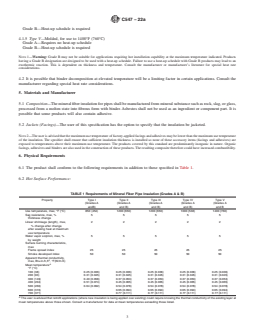
NOTE 1—Warning: Grade B may not be suitable for applications requiring hot installation capability at the maximum temperature indicated. Products
having a Grade B designation are designed to be used with a heat-up schedule. Failure to use a heat-up schedule with Grade B products may lead to an
exothermic reaction. This is dependent on thickness and temperature. Consult the manufacturer or manufacturer’s literature for special heat rate
considerations.
4.2 It is possible that binder decomposition at elevated temperature will be a limiting factor in certain applications. Consult the
manufacturer regarding special heat rate considerations.
5. Materials and Manufacturer
5.1 Composition—The mineral fiber insulation for pipes shall be manufactured from mineral substance such as rock, slag, or glass,
processed from a molten state into fibrous form with binder. Asbestos shall not be used as an ingredient or component part. It is
possible that some products will also contain adhesive.
5.2 Jackets (Facings)—The user of this specification has the option to specify that the insulation be jacketed.
NOTE 2—The user is advised that the maximum use temperature of factory-applied facings and adhesives may be lower than the maximum use temperature
of the insulation. The specifier shall ensure that sufficient insulation thickness is installed so none of these accessory items (facings and adhesives) are
exposed to temperatures above their maximum use temperature. The products covered by this standard are predominantly inorganic in nature. Organic
facings, adhesives and binders are also used in the construction of these products. The resulting composite therefore could have increased combustibility.
6. Physical Requirements
6.1 The product shall conform to the following requirements in addition to those specified in Table 1.
6.2 Hot Surface Performance:
TABLE 1 Requirements of Mineral Fiber Pipe Insulation (Grades A & B)
Property Type I Type II Type III Type IV Type V
(Grades A (Grades A (Grades A (Grades A (Grades A
andB) and B) and B) and B) and B
Use temperature, max, °F (°C) 850 (454) 1200 (650) 1200 (650) 1000 (538) 1400 (760)
Sag resistance, max, % 5 5 5 5 5
thickness change
Linear shrinkage (length), max, 2 2 2 2 2
% change after change
after soaking heat at maximum
use temperature
Water vapor sorption, max, % 5 5 5 5 5
by weight
Surface burning characteristics,
max
Flame spread index 25 25 25 25 25
Smoke developed index 50 50 50 50 50
Apparent thermal conductivity,
max, Btu.in./h,ft , °F(W/m.K)
A
Mean temperature
°F (°C)
100 (38) 0.25 (0.036) 0.25 (0.036) 0.25 (0.036) 0.25 (0.036) 0.25 (0.036)
200 (93) 0.31 (0.045) 0.31 (0.045) 0.31 (0.045) 0.31 (0.045) 0.31 (0.045)
300 (149) 0.40 (0.058) 0.37 (0.053) 0.37 (0.053) 0.37 (0.053) 0.37 (0.053)
400 (204) 0.51 (0.074) 0.45 (0.065) 0.45 (0.065) 0.45 (0.065) 0.45 (0.065)
500 (260) 0.64 (0.092) 0.54 (0.078) 0.54 (0.078) 0.54 (0.078) 0.54 (0.078)
600 (316) 0.65 (0.094) 0.65 (0.094) 0.65 (0.094) 0.65 (0.094)
700 (371) 0.77 (0.111) 0.77 (0.111) 0.77 (0.111) 0.77 (0.111)
A
The user is advised that retrofit applications (where new insulation is being applied over existing) could require knowing the thermal conductivity of the existing layer at
mean temperatures above those shown. Consult a manufacturer for data at mean temperatures exceeding those listed.
C547 − 22a
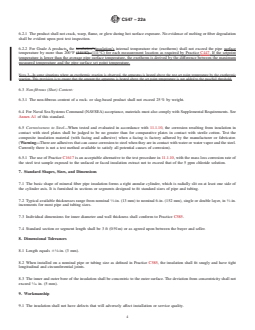
6.2.1 The product shall not crack, warp, flame, or glow during hot surface exposure. No evidence of melting or fiber degradation
shall be evident upon post test inspection.
6.2.2 For Grade A products, the insulation’sinsulation’s internal temperature rise (exotherm) shall not exceed the pipe surface
temperature by more than 200°F (111°C). (111°C) for each measurement location as required by Practice C447. If the setpoint
temperature is lower than the average pipe surface temperature, the exotherm is derived by the difference between the maximum
measured temperature and the pipe surface set point temperature.
NOTE 3—In some situations where an exothermic reaction is observed, the apparatus is heated above the test set point temperature by the exothermic
reaction. This provision is to ensure that the amount the apparatus is heated above the set point temperature is not added to the pass/fail threshold.
6.3 Non-fibrous (Shot) Content:
6.3.1 The non-fibrous content of a rock- or slag-based product shall not exceed 25 % by weight.
6.4 For Naval Sea Systems Command (NAVSEA) acceptance, materials must also comply with Supplemental Requirements. See
Annex A1 of this standard.
6.5 Corrosiveness to Steel—When tested and evaluated in accordance with 11.1.10, the corrosion resulting from insulation in
contact with steel plates shall be judged to be no greater than for comparative plates in contact with sterile cotton. Test the
composite insulation material (with facing and adhesive) when a facing is factory adhered by the manufacturer or fabricator.
(Warning—There are adhesives that can cause corrosion to steel when they are in contact with water or water vapor and the steel.
Currently there is not a test method available to satisfy all potential causes of corrosion).
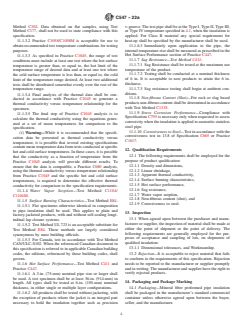
6.5.1 The use of Practice C1617 is an acceptable alternative to the test procedure in 11.1.10, with the mass loss corrosion rate of
the steel test sample exposed to the unfaced or faced insulation extract not to exceed that of the 5 ppm chloride solution.
7. Standard Shapes, Sizes, and Dimensions
7.1 The basic shape of mineral fiber pipe insulation forms a right annular cylinder, which is radially slit on at least one side of
the cylinder axis. It is furnished in sections or segments designed to fit standard sizes of pipe and tubing.
1 1
7.2 Typical available thicknesses range from nominal ⁄2-in. (13 mm) to nominal 6-in. (152 mm), single or dou
...