

ASTM D6412/D6412M-99(2020)
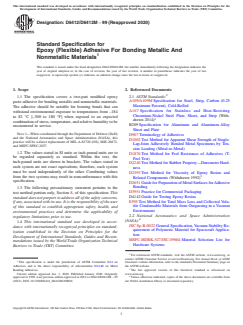
(Specification)Standard Specification for Epoxy (Flexible) Adhesive For Bonding Metallic And Nonmetallic Materials
General Information
- Abstract
ABSTRACT
The specification covers a two-part modified epoxy paste adhesive for bonding metallic and nonmetallic materials. The adhesive should be suitable for forming bonds that can withstand environmental exposure to a certain temperature range when exposed to an expected combination of stress, temperature, and relative humidity to be encountered in service. Two types of adhesive shall be classified according to composition. Type I which consists of two-part kits of liquid base and modified amide liquid accelerator. Type I is further subdivided into two grades: Grade 1 with low viscosity and Grade 2 with high viscosity. The other classification is Type II which consists of premixed, frozen, Type I, Grade 1 or Type I, Grade 2. Different tests shall be conducted in order to determine the following mechanical properties of the adhesives: room-temperature shear, high-temperature shear, low-temperature shear, room-temperature Shore D hardness, room-temperature T-peel, and outgassing characteristics such as total mass loss and vacuum condensable material.
SCOPE
1.1 The specification covers a two-part modified epoxy paste adhesive for bonding metallic and nonmetallic materials. The adhesive should be suitable for forming bonds that can withstand environmental exposure to temperatures from –184 to 82 °C [–300 to 180 °F] when exposed to an expected combination of stress, temperature, and relative humidity to be encountered in service.
Note 1: When coordinated through the Department of Defense (DoD) and the National Aeronautics and Space Administration (NASA), this practice will be a direct replacement of MIL-A-82720 (OS), MIS-26872, and MSFC-SPEC-2037.
1.2 The values stated in SI units or inch-pound units are to be regarded separately as standard. Within the text, the inch-pound units are shown in brackets. The values stated in each system are not exact equivalents; therefore, each system must be used independently of the other. Combining values from the two systems may result in nonconformance with this specification.
1.3 The following precautionary statement pertains to the test method portion only, Section 8, of this specification: This standard does not purport to address all of the safety concerns, if any, associated with its use. It is the responsibility of the user of this standard to establish appropriate safety, health, and environmental practices and determine the applicability of regulatory limitations prior to use.
1.4 This international standard was developed in accordance with internationally recognized principles on standardization established in the Decision on Principles for the Development of International Standards, Guides and Recommendations issued by the World Trade Organization Technical Barriers to Trade (TBT) Committee.
- Status
- Published
- Publication Date
- 31-Dec-2019
- Technical Committee
- D14 - Adhesives
- Drafting Committee
- D14.80 - Metal Bonding Adhesives

Overview
ASTM D6412/D6412M-99(2020): Standard Specification for Epoxy (Flexible) Adhesive for Bonding Metallic and Nonmetallic Materials establishes requirements for a two-part, modified epoxy paste adhesive system used to bond metals and nonmetals. This epoxy adhesive is designed for forming bonds capable of withstanding a broad range of environmental conditions, specifically temperatures from –184°C to 82°C (–300°F to 180°F), while exposed to stress, temperature fluctuations, and humidity during service.
The standard specifies two primary types of adhesive, classified by their composition and form. It covers technical requirements, testing methods, and quality assurance procedures to ensure reliable performance in critical bonding applications, making it widely referenced in numerous industries including aerospace, defense, and industrial manufacturing.
Key Topics
- Types and Grades of Adhesive:
- Type I: Two-part kits (liquid base + modified amide accelerator).
- Grade 1: Low viscosity (liquid).
- Grade 2: High viscosity (paste).
- Type II: Premixed, frozen forms of Type I, Grade 1 or 2.
- Type I: Two-part kits (liquid base + modified amide accelerator).
- Performance Requirements: Bonds must endure thermal cycling, mechanical stress, and humidity for both metallic and nonmetallic substrates.
- Standardized Testing: Includes room, high, and low-temperature shear tests, T-peel strength, Shore D hardness, and NASA-outgassing characteristics, ensuring predictable performance in demanding conditions.
- Procurement and Qualification: Procedures for inspection, qualification, and acceptance based on adhesive performance and reporting.
- Safety and Packaging: Guidelines for documentation of safety practices and packaging in accordance with ASTM and regulatory requirements.
Applications
Epoxy adhesives specified under ASTM D6412/D6412M-99(2020) are extensively used in:
- Aerospace and Defense:
Creating high-strength, temperature- and humidity-resistant bonds in aircraft and spacecraft structures, components, and assemblies. The standard can directly replace legacy military and NASA specifications (e.g., MIL-A-82720, MSFC-SPEC-2037). - Industrial and Automotive Manufacturing:
Providing durable bonds between metals, plastics, and composites in equipment and vehicle assembly where environmental resistance and mechanical reliability are crucial. - Electronics and Electrical Equipment:
Securing metallic and nonmetallic components in assemblies exposed to variable temperatures and potential outgassing requirements for vacuum or cleanroom applications. - Construction and Infrastructure:
Applying in situations requiring flexible, high-strength bonding of diverse materials, particularly when exposed to cyclic loading and temperature extremes.
Related Standards
ASTM D6412/D6412M-99(2020) is often used alongside the following key standards for adhesives and bonded assemblies:
- ASTM D907: Terminology of Adhesives
- ASTM D1002: Apparent Shear Strength of Single-Lap-Joint Adhesively Bonded Metal Specimens by Tension Loading
- ASTM D1876: Peel Resistance of Adhesives (T-Peel Test)
- ASTM D2240: Durometer Hardness (Shore D) for Elastomeric Materials
- ASTM E595: Total Mass Loss and Condensable Volatiles from Outgassing in a Vacuum Environment
Additional references specific to NASA applications include NASA SP-R-0022 (Vacuum Stability Requirements for Polymeric Materials for Spacecraft) and MSFC-HDBK-527 (Material Selection for Hardware Systems).
By following the requirements of ASTM D6412/D6412M-99(2020), users can ensure the selection and application of epoxy adhesives that deliver reliable, high-performance bonds for critical engineering contexts, supported by rigorous test methods and internationally recognized practices.
Relations
- Effective Date
- 01-Jan-2020
- Effective Date
- 01-Mar-2024
- Effective Date
- 01-Oct-2023
- Effective Date
- 01-Apr-2019
- Effective Date
- 01-Nov-2018
- Effective Date
- 01-May-2018
- Effective Date
- 01-Sep-2016
- Effective Date
- 01-May-2016
- Effective Date
- 01-Dec-2015
- Effective Date
- 01-Nov-2015
- Effective Date
- 01-May-2014
- Effective Date
- 01-Oct-2013
- Effective Date
- 01-Jul-2012
- Effective Date
- 01-May-2012
- Effective Date
- 01-Dec-2011
Get Certified
Connect with accredited certification bodies for this standard

BUREAU VERITAS Certification Germany
Bureau Veritas certification in Germany.

Element Materials Technology
Materials testing and product certification.

AQMS Ltd.
AQMS provides ISO certification to SMEs across the UK.
Sponsored listings
Frequently Asked Questions
ASTM D6412/D6412M-99(2020) is a technical specification published by ASTM International. Its full title is "Standard Specification for Epoxy (Flexible) Adhesive For Bonding Metallic And Nonmetallic Materials". This standard covers: ABSTRACT The specification covers a two-part modified epoxy paste adhesive for bonding metallic and nonmetallic materials. The adhesive should be suitable for forming bonds that can withstand environmental exposure to a certain temperature range when exposed to an expected combination of stress, temperature, and relative humidity to be encountered in service. Two types of adhesive shall be classified according to composition. Type I which consists of two-part kits of liquid base and modified amide liquid accelerator. Type I is further subdivided into two grades: Grade 1 with low viscosity and Grade 2 with high viscosity. The other classification is Type II which consists of premixed, frozen, Type I, Grade 1 or Type I, Grade 2. Different tests shall be conducted in order to determine the following mechanical properties of the adhesives: room-temperature shear, high-temperature shear, low-temperature shear, room-temperature Shore D hardness, room-temperature T-peel, and outgassing characteristics such as total mass loss and vacuum condensable material. SCOPE 1.1 The specification covers a two-part modified epoxy paste adhesive for bonding metallic and nonmetallic materials. The adhesive should be suitable for forming bonds that can withstand environmental exposure to temperatures from –184 to 82 °C [–300 to 180 °F] when exposed to an expected combination of stress, temperature, and relative humidity to be encountered in service. Note 1: When coordinated through the Department of Defense (DoD) and the National Aeronautics and Space Administration (NASA), this practice will be a direct replacement of MIL-A-82720 (OS), MIS-26872, and MSFC-SPEC-2037. 1.2 The values stated in SI units or inch-pound units are to be regarded separately as standard. Within the text, the inch-pound units are shown in brackets. The values stated in each system are not exact equivalents; therefore, each system must be used independently of the other. Combining values from the two systems may result in nonconformance with this specification. 1.3 The following precautionary statement pertains to the test method portion only, Section 8, of this specification: This standard does not purport to address all of the safety concerns, if any, associated with its use. It is the responsibility of the user of this standard to establish appropriate safety, health, and environmental practices and determine the applicability of regulatory limitations prior to use. 1.4 This international standard was developed in accordance with internationally recognized principles on standardization established in the Decision on Principles for the Development of International Standards, Guides and Recommendations issued by the World Trade Organization Technical Barriers to Trade (TBT) Committee.
ABSTRACT The specification covers a two-part modified epoxy paste adhesive for bonding metallic and nonmetallic materials. The adhesive should be suitable for forming bonds that can withstand environmental exposure to a certain temperature range when exposed to an expected combination of stress, temperature, and relative humidity to be encountered in service. Two types of adhesive shall be classified according to composition. Type I which consists of two-part kits of liquid base and modified amide liquid accelerator. Type I is further subdivided into two grades: Grade 1 with low viscosity and Grade 2 with high viscosity. The other classification is Type II which consists of premixed, frozen, Type I, Grade 1 or Type I, Grade 2. Different tests shall be conducted in order to determine the following mechanical properties of the adhesives: room-temperature shear, high-temperature shear, low-temperature shear, room-temperature Shore D hardness, room-temperature T-peel, and outgassing characteristics such as total mass loss and vacuum condensable material. SCOPE 1.1 The specification covers a two-part modified epoxy paste adhesive for bonding metallic and nonmetallic materials. The adhesive should be suitable for forming bonds that can withstand environmental exposure to temperatures from –184 to 82 °C [–300 to 180 °F] when exposed to an expected combination of stress, temperature, and relative humidity to be encountered in service. Note 1: When coordinated through the Department of Defense (DoD) and the National Aeronautics and Space Administration (NASA), this practice will be a direct replacement of MIL-A-82720 (OS), MIS-26872, and MSFC-SPEC-2037. 1.2 The values stated in SI units or inch-pound units are to be regarded separately as standard. Within the text, the inch-pound units are shown in brackets. The values stated in each system are not exact equivalents; therefore, each system must be used independently of the other. Combining values from the two systems may result in nonconformance with this specification. 1.3 The following precautionary statement pertains to the test method portion only, Section 8, of this specification: This standard does not purport to address all of the safety concerns, if any, associated with its use. It is the responsibility of the user of this standard to establish appropriate safety, health, and environmental practices and determine the applicability of regulatory limitations prior to use. 1.4 This international standard was developed in accordance with internationally recognized principles on standardization established in the Decision on Principles for the Development of International Standards, Guides and Recommendations issued by the World Trade Organization Technical Barriers to Trade (TBT) Committee.
ASTM D6412/D6412M-99(2020) is classified under the following ICS (International Classification for Standards) categories: 49.025.50 - Adhesives. The ICS classification helps identify the subject area and facilitates finding related standards.
ASTM D6412/D6412M-99(2020) has the following relationships with other standards: It is inter standard links to ASTM D6412/D6412M-99(2012), ASTM A109/A109M-24, ASTM D3951-18(2023), ASTM D1002-10(2019), ASTM A109/A109M-16(2018), ASTM D3951-18, ASTM A109/A109M-16, ASTM D2651-01(2016), ASTM D3951-15, ASTM A109/A109M-15, ASTM A109/A109M-14, ASTM A109/A109M-13, ASTM D907-12a, ASTM D907-12, ASTM D907-11a. Understanding these relationships helps ensure you are using the most current and applicable version of the standard.
ASTM D6412/D6412M-99(2020) is available in PDF format for immediate download after purchase. The document can be added to your cart and obtained through the secure checkout process. Digital delivery ensures instant access to the complete standard document.
Standards Content (Sample)
This international standard was developed in accordance with internationally recognized principles on standardization established in the Decision on Principles for the
Development of International Standards, Guides and Recommendations issued by the World Trade Organization Technical Barriers to Trade (TBT) Committee.
Designation:D6412/D6412M −99(Reapproved 2020)
Standard Specification for
Epoxy (Flexible) Adhesive For Bonding Metallic And
Nonmetallic Materials
This standard is issued under the fixed designation D6412/D6412M; the number immediately following the designation indicates the
year of original adoption or, in the case of revision, the year of last revision. A number in parentheses indicates the year of last
reapproval. A superscript epsilon (´) indicates an editorial change since the last revision or reapproval.
1. Scope 2. Referenced Documents
2.1 ASTM Standards:
1.1 The specification covers a two-part modified epoxy
A109/A109M Specification for Steel, Strip, Carbon (0.25
paste adhesive for bonding metallic and nonmetallic materials.
Maximum Percent), Cold-Rolled
The adhesive should be suitable for forming bonds that can
A167 Specification for Stainless and Heat-Resisting
withstand environmental exposure to temperatures from –184
Chromium-Nickel Steel Plate, Sheet, and Strip (With-
to 82 °C [–300 to 180 °F] when exposed to an expected
drawn 2014)
combination of stress, temperature, and relative humidity to be
B209 Specification for Aluminum and Aluminum-Alloy
encountered in service.
Sheet and Plate
NOTE 1—When coordinated through the Department of Defense (DoD)
D907 Terminology of Adhesives
and the National Aeronautics and Space Administration (NASA), this
D1002 Test Method for Apparent Shear Strength of Single-
practice will be a direct replacement of MIL-A-82720 (OS), MIS-26872,
Lap-Joint Adhesively Bonded Metal Specimens by Ten-
and MSFC-SPEC-2037.
sion Loading (Metal-to-Metal)
1.2 The values stated in SI units or inch-pound units are to
D1876 Test Method for Peel Resistance of Adhesives (T-
be regarded separately as standard. Within the text, the
Peel Test)
inch-pound units are shown in brackets. The values stated in
D2240 Test Method for Rubber Property—Durometer Hard-
each system are not exact equivalents; therefore, each system
ness
must be used independently of the other. Combining values
D2393 Test Method for Viscosity of Epoxy Resins and
from the two systems may result in nonconformance with this
Related Components (Withdrawn 1992)
specification.
D2651 GuideforPreparationofMetalSurfacesforAdhesive
Bonding
1.3 The following precautionary statement pertains to the
D3951 Practice for Commercial Packaging
test method portion only, Section 8, of this specification: This
D4142 Guide for Testing Epoxy Resins
standard does not purport to address all of the safety concerns,
E595 Test Method for Total Mass Loss and Collected Vola-
if any, associated with its use. It is the responsibility of the user
tile Condensable Materials from Outgassing in a Vacuum
of this standard to establish appropriate safety, health, and
Environment
environmental practices and determine the applicability of
2.2 National Aeronautics and Space Administration
regulatory limitations prior to use.
(NASA):
1.4 This international standard was developed in accor-
JSC Sp-R-0022 General Specification,Vacuum Stability Re-
dance with internationally recognized principles on standard-
quirement of Polymeric Material for Spacecraft Applica-
ization established in the Decision on Principles for the
tion
Development of International Standards, Guides and Recom-
MSFC-HDBK-527/JSC-09604 Material Selection List for
mendations issued by the World Trade Organization Technical
Hardware Systems
Barriers to Trade (TBT) Committee.
For referenced ASTM standards, visit the ASTM website, www.astm.org, or
contact ASTM Customer Service at service@astm.org. For Annual Book of ASTM
This specification is under the jurisdiction of ASTM Committee D14 on Standards volume information, refer to the standard’s Document Summary page on
Adhesives and is the direct responsibility of subcommittee D14.80 on Metal the ASTM website.
Bonding Adhesives. The last approved version of this historical standard is referenced on
Current edition approved Jan. 1, 2020. Published January 2020. Originally www.astm.org.
approved in 1999. Last previous edition approved in 2012 as D6412/D6412M – 99 Unless otherwise indicated, copies of the above documents are available from
(2012). DOI: 10.1520/D6412_D6412M-99R20. ant NASA installation library or document repository.
Copyright © ASTM International, 100 Barr Harbor Drive, PO Box C700, West Conshohocken, PA 19428-2959. United States
D6412/D6412M−99(2020)
GSFC RP 1124 Outgassing Data for Selecting Spacecraft shallnothaveadetrimentaleffectonthesurfacesbeingbonded
Materials over the range of temperatures at which the adhesives will be
used.
NOTE 2—Copies of specifications, standards, drawings and publications
required by suppliers in connection with specific purchases should be
7.2 Qualification—The adhesive shall be qualified at the
obtained from the purchaser or as directed by his contracting officer.
time for opening of bids. The qualification shall only apply to
the formulation on which the qualification tests have been
3. Terminology
made (see 6.2). Any changes by the manufacturer in formula-
3.1 Definitions—Many terms in this specification are de-
tion or in the method of manufacturing, shall be cause of
fined in Terminology D907.
designating the adhesive as a new product.
3.2 Definitions of Terms Specific to This Standard:
7.3 Processing—Methods of specimen surface preparation,
3.2.1 epoxy-polyamide high viscosity adhesive, n—anepoxy
that is, cleaning and etching adherends, cure time, temperature
paste base (B) and a modified amide paste accelerator (A)
and pressure shall be in accordance with the manufacturer’s
when mixed in a proper ratio results in a viscous paste.
recommendation.
3.2.2 epoxy-polyamide low viscosity adhesive, n—an epoxy
7.4 The physical, mechanical and outgassing properties of
liquid base (B) and a modified amide liquid accelerator (A)
the adhesive shall meet the requirements specified in Table 1.
when mixed in a proper ratio results in a viscous liquid.
Although,itisnotlistedinTable1,TypeIImaterialsshallmeet
the same requirements as Type I materials.
4. Significance and Use
4.1 General—This specification provides testing procedures
8. Test Methods
and specimen requirements to differentiate between the physi-
8.1 Qualification Tests—Forqualification,theadhesiveshall
cal and adhesive bonding properties of two types of epoxy-
be tested using the tests described in this section. Test methods
polyamide adhesive.
and requirements are included in Table 1.
5. Classification
8.2 Preparation of Test Specimens:
8.2.1 Tensile Shear:
5.1 Theepoxy-polyamideadhesiveshallbefurnishedasone
of the following types: 8.2.1.1 Adherend—The metal bonded shall be 6061-T6 or
5.1.1 Type I—Consists of two-part kits of Part B, base and 2024-T3 aluminum alloy.
Part A, accelerator.
NOTE 3—The use of steel substrates for the evaluation and lot
5.1.1.1 Grade 1—The high viscosity adhesive system is
acceptance of the material is optional at the discretion of the procuring
composed of an epoxy base (B) and a modified polyamide
agency. Use Specification A109/A109M Grade 2 Steel or Specification
A167, Type 302 corrosion resistant steel.
accelerator (A).
5.1.1.2 Grade 2—The low viscosity adhesive system is
8.2.1.2 Surface Treatment—Adherend surfaces shall be
composed of an epoxy liquid base (B) and a modified poly-
cleaned and etched in accordance with Guide D2651.
amide liquid accelerator (A).
8.2.1.3 Cure—Cure time, temperature and pressure shall be
5.1.2 Type II—Consists of premixed, frozen, Type I, Grade
in accordance with the adhesive manufacturer’s recommenda-
1 or Type I, Grade 2.
tion.
6. Ordering Information NOTE 4—Test panels or specimens, or both, other than the breakaway
type shall be cut in such a manner that minimum vibration or heat is
6.1 Procurement Documents—Purchasers may select any of
generated during the cutting operation.
the desired options offered herein and the procurement docu-
NOTE 5—Adhesive bondline thickness for tensile shear specimens shall
ments should specify the following: be 0.05 to 0.13 mm [0.002 in. to 0.005 in.] and 0.25 to 0.43 mm [0.010 to
0.017 in.] for T-Peel specimens. Control of bondline thickness shall be
6.1.1 Title, number and dated revision letter of this
accomplished by placing two lengths of appropriate diameter stainless
specification,
wire [0.13 mm for tensile shear and 0.43 mm forT-Peel] in the lengthwise
6.1.2 Adhesive type and grade numbers,
direction on the specimen bond area during the adhesive bonding
6.1.3 Amounts and unit quantities of adhesive required,
operation; the use of the same diameter glass beads approximately 0.5 %
by weight, thoroughly mixed in the adhesive may also be used to maintain
6.1.4 Curing conditions,
uniform bondine thickness.
6.1.5 Level of Packaging and packing required, and
6.1.6 Whether or not qualification (see 6.2) is necessary.
8.2.2 Hardness specimens shall be prepared using a mixture
of resin and catalyst for Type I Grad
...