

ASTM D6318-24
(Practice)Standard Practice for Calibrating a Fathometer Using a Bar Check Method
General Information
- Abstract
SIGNIFICANCE AND USE
4.1 The accuracy of depth measurements made by a fathometer or echo sounder requires a number of corrections because of the variability of sound or acoustic velocity in water with changes in temperature, salinity, and depth of water. In addition instability of the equipment can also result in significant errors. For additional information see Practice D5073.
4.2 Calibration of echo sounding instruments is absolutely critical in assuring the adequacy of depth measurements. When an echo sounder has been accurately calibrated, any observed (recorded) depth can be related to the true depth of water. Since the intended purpose of echo sounding is to measure the “true” depth, an independent “true” reference must be used.
4.3 A bar-check is the most wide-spread, easiest to construct, and most economical mechanical method to determine corrections for instrument and velocity errors.
4.4 This procedure explains the calibration of a fathometer or electronic depth sounder using a bar-check.
4.5 Bar-checking techniques and equipment are general in nature and may need to be modified for use in specific field conditions.
SCOPE
1.1 This practice provides the user with procedures used in manually calibrating the fathometer or electronic depth sounder. This narrative describes calibration terminology, describes acceptable environmental conditions for calibration, and describes the calibration procedures.
1.2 The references cited contain useful information in the construction and the correct operation of the calibration equipment.
1.3 Any references cited in this narrative to specific products or brand names are made for information only, and is intended to be descriptive, but not restrictive, of products that will perform satisfactorily.
1.4 The values stated in inch-pound units are to be regarded as standard. The values given in parentheses are mathematical conversions to SI units that are provided for information only and are not considered standard.
1.5 This standard does not purport to address all of the safety concerns, if any, associated with its use. It is the responsibility of the user of this standard to establish appropriate safety, health, and environmental practices and determine the applicability of regulatory limitations prior to use.
1.6 This international standard was developed in accordance with internationally recognized principles on standardization established in the Decision on Principles for the Development of International Standards, Guides and Recommendations issued by the World Trade Organization Technical Barriers to Trade (TBT) Committee.
- Status
- Published
- Publication Date
- 31-Mar-2024
- Technical Committee
- D19 - Water
- Drafting Committee
- D19.07 - Sediments, Geomorphology, and Open-Channel Flow

Overview
ASTM D6318-24: Standard Practice for Calibrating a Fathometer Using a Bar Check Method provides standardized procedures for the manual calibration of fathometers and electronic depth sounders. Accurate depth measurement is essential in hydrographic and bathymetric surveys, and this practice specifies the use of a bar check method-a widely recognized technique-for verifying and correcting instrument readings. The standard addresses calibration terminology, environmental conditions, equipment requirements, and procedural steps, ensuring reliable and consistent depth measurement results under various field conditions.
Key Topics
- Importance of Calibration: Accurate echo sounding depends on compensating for variations in sound velocity caused by water temperature, salinity, and depth. Equipment performance and stability can also impact depth readings.
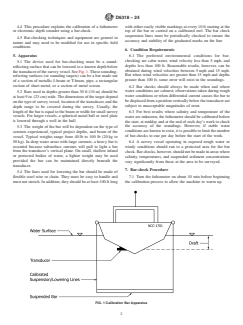
- Bar Check Method: This method involves placing a known sound-reflecting object (the "bar") at specific depths below the transducer to identify and correct errors in instrument readings.
- Environmental Considerations: Calibration should be performed during calm water conditions (wind velocity less than 5 mph) and at depths typically less than 100 feet for optimum accuracy. Bar checks in rough or unstable conditions may introduce errors.
- Apparatus Specifications: The bar should be made of sound-reflecting materials such as steel I-beams, T-beams, or plates, with suspension lines of flexible steel wire or chain. Weight and dimensions must suit local water depths and vessel type.
- Calibration Procedure:
- Power up and warm the equipment.
- Set draft and velocity parameters according to manufacturer instructions.
- Lower the calibration bar incrementally, matching observed readings to known depths.
- Adjust settings as necessary for both shallow and deep checks.
- Make intermediate depth readings for verification.
- Alternatives: Velocity profilers can be used for rapid calibration and are particularly useful in rough water, but still require periodic confirmation via bar check.
Applications
- Hydrographic Surveys: Utilized by government agencies, maritime authorities, and private surveyors for nautical charting, navigation channel assessments, and harbor maintenance.
- Reservoir and Sediment Surveys: Supports environmental monitoring and water resource management by providing accurate underwater profiles.
- Dredging Operations: Precise depth measurement guides dredging activities, ensuring projects meet regulatory and safety standards.
- Infrastructure Projects: Applied for underwater inspections related to bridges, pipelines, and dams.
- Research: Facilitates scientific studies requiring accurate bathymetric data.
Using ASTM D6318-24 ensures that depth sounders and fathometers provide reliable, repeatable data by conforming to internationally recognized calibration methods. This minimizes measurement errors, enhances operational safety, and improves the quality of survey results.
Related Standards
- ASTM D5073: Practice for Depth Measurement of Surface Water-provides complementary methods and background for accurate depth determination.
- ASTM D1129: Terminology Relating to Water-offers definitions relevant to water analysis and measurement.
- International Hydrographic Organization (IHO) Standards: Offers global guidelines for hydrographic survey procedures and equipment calibration.
Keywords
Bathymetric surveys, depth sounding, echo sounders, fathometer calibration, hydrography, bar check method, sediment surveys, water measurement standards, ASTM D6318-24, velocity profiler, electronic depth sounder.
Relations
- Effective Date
- 01-Apr-2024
Frequently Asked Questions
ASTM D6318-24 is a standard published by ASTM International. Its full title is "Standard Practice for Calibrating a Fathometer Using a Bar Check Method". This standard covers: SIGNIFICANCE AND USE 4.1 The accuracy of depth measurements made by a fathometer or echo sounder requires a number of corrections because of the variability of sound or acoustic velocity in water with changes in temperature, salinity, and depth of water. In addition instability of the equipment can also result in significant errors. For additional information see Practice D5073. 4.2 Calibration of echo sounding instruments is absolutely critical in assuring the adequacy of depth measurements. When an echo sounder has been accurately calibrated, any observed (recorded) depth can be related to the true depth of water. Since the intended purpose of echo sounding is to measure the “true” depth, an independent “true” reference must be used. 4.3 A bar-check is the most wide-spread, easiest to construct, and most economical mechanical method to determine corrections for instrument and velocity errors. 4.4 This procedure explains the calibration of a fathometer or electronic depth sounder using a bar-check. 4.5 Bar-checking techniques and equipment are general in nature and may need to be modified for use in specific field conditions. SCOPE 1.1 This practice provides the user with procedures used in manually calibrating the fathometer or electronic depth sounder. This narrative describes calibration terminology, describes acceptable environmental conditions for calibration, and describes the calibration procedures. 1.2 The references cited contain useful information in the construction and the correct operation of the calibration equipment. 1.3 Any references cited in this narrative to specific products or brand names are made for information only, and is intended to be descriptive, but not restrictive, of products that will perform satisfactorily. 1.4 The values stated in inch-pound units are to be regarded as standard. The values given in parentheses are mathematical conversions to SI units that are provided for information only and are not considered standard. 1.5 This standard does not purport to address all of the safety concerns, if any, associated with its use. It is the responsibility of the user of this standard to establish appropriate safety, health, and environmental practices and determine the applicability of regulatory limitations prior to use. 1.6 This international standard was developed in accordance with internationally recognized principles on standardization established in the Decision on Principles for the Development of International Standards, Guides and Recommendations issued by the World Trade Organization Technical Barriers to Trade (TBT) Committee.
SIGNIFICANCE AND USE 4.1 The accuracy of depth measurements made by a fathometer or echo sounder requires a number of corrections because of the variability of sound or acoustic velocity in water with changes in temperature, salinity, and depth of water. In addition instability of the equipment can also result in significant errors. For additional information see Practice D5073. 4.2 Calibration of echo sounding instruments is absolutely critical in assuring the adequacy of depth measurements. When an echo sounder has been accurately calibrated, any observed (recorded) depth can be related to the true depth of water. Since the intended purpose of echo sounding is to measure the “true” depth, an independent “true” reference must be used. 4.3 A bar-check is the most wide-spread, easiest to construct, and most economical mechanical method to determine corrections for instrument and velocity errors. 4.4 This procedure explains the calibration of a fathometer or electronic depth sounder using a bar-check. 4.5 Bar-checking techniques and equipment are general in nature and may need to be modified for use in specific field conditions. SCOPE 1.1 This practice provides the user with procedures used in manually calibrating the fathometer or electronic depth sounder. This narrative describes calibration terminology, describes acceptable environmental conditions for calibration, and describes the calibration procedures. 1.2 The references cited contain useful information in the construction and the correct operation of the calibration equipment. 1.3 Any references cited in this narrative to specific products or brand names are made for information only, and is intended to be descriptive, but not restrictive, of products that will perform satisfactorily. 1.4 The values stated in inch-pound units are to be regarded as standard. The values given in parentheses are mathematical conversions to SI units that are provided for information only and are not considered standard. 1.5 This standard does not purport to address all of the safety concerns, if any, associated with its use. It is the responsibility of the user of this standard to establish appropriate safety, health, and environmental practices and determine the applicability of regulatory limitations prior to use. 1.6 This international standard was developed in accordance with internationally recognized principles on standardization established in the Decision on Principles for the Development of International Standards, Guides and Recommendations issued by the World Trade Organization Technical Barriers to Trade (TBT) Committee.
ASTM D6318-24 has the following relationships with other standards: It is inter standard links to ASTM D6318-03(2014). Understanding these relationships helps ensure you are using the most current and applicable version of the standard.
ASTM D6318-24 is available in PDF format for immediate download after purchase. The document can be added to your cart and obtained through the secure checkout process. Digital delivery ensures instant access to the complete standard document.
Standards Content (Sample)
This international standard was developed in accordance with internationally recognized principles on standardization established in the Decision on Principles for the
Development of International Standards, Guides and Recommendations issued by the World Trade Organization Technical Barriers to Trade (TBT) Committee.
Designation: D6318 − 24
Standard Practice for
Calibrating a Fathometer Using a Bar Check Method
This standard is issued under the fixed designation D6318; the number immediately following the designation indicates the year of
original adoption or, in the case of revision, the year of last revision. A number in parentheses indicates the year of last reapproval. A
superscript epsilon (´) indicates an editorial change since the last revision or reapproval.
1. Scope D5073 Practice for Depth Measurement of Surface Water
1.1 This practice provides the user with procedures used in
3. Terminology
manually calibrating the fathometer or electronic depth
sounder. This narrative describes calibration terminology, de-
3.1 Definitions—Refer to Terminology D1129 for terms
scribes acceptable environmental conditions for calibration, used in this guide.
and describes the calibration procedures.
3.2 Definitions of Terms Specific to This Standard:
1.2 The references cited contain useful information in the 3.2.1 bar, n—a section of metallic channel, I-beam, T-beam,
construction and the correct operation of the calibration equip- pipe, plate, or ball that will reflect sound waves produced by a
ment. fathometer.
3.2.2 bar-check, n—a method for calibrating a fathometer
1.3 Any references cited in this narrative to specific prod-
by setting a sound or accoustic reflector (bar) below a survey
ucts or brand names are made for information only, and is
vessel to a known depth below a sounding transducer.
intended to be descriptive, but not restrictive, of products that
will perform satisfactorily.
3.2.3 draft (transducer draft), n—the vertical distance from
the bottom of the transducer to the surface of the water.
1.4 The values stated in inch-pound units are to be regarded
as standard. The values given in parentheses are mathematical
3.2.4 fathometer, n—An electronic device for registering
conversions to SI units that are provided for information only
depths of water by measuring the time required for the
and are not considered standard.
transmission and reflection of sound waves between a sonic
transducer and the lake or river bottom.
1.5 This standard does not purport to address all of the
safety concerns, if any, associated with its use. It is the
3.2.5 sound, n—to determine the depth of water.
responsibility of the user of this standard to establish appro-
3.2.6 sounding scroll, n—the chart record of an underwater
priate safety, health, and environmental practices and deter-
cross section or profile of the bottom.
mine the applicability of regulatory limitations prior to use.
3.2.7 transducer, n—a device for translating electrical en-
1.6 This international standard was developed in accor-
ergy to acoustical energy and acoustical energy back to
dance with internationally recognized principles on standard-
electrical energy.
ization established in the Decision on Principles for the
Development of International Standards, Guides and Recom-
4. Significance and Use
mendations issued by the World Trade Organization Technical
4.1 The accuracy of depth measurements made by a fath-
Barriers to Trade (TBT) Committee.
ometer or echo sounder requires a number of corrections
2. Referenced Documents
because of the variability of sound or acoustic velocity in water
with changes in temperature, salinity, and depth of water. In
2.1 ASTM Standards:
addition instability of the equipment can also result in signifi-
D1129 Terminology Relating to Water
cant errors. For additional information see Practice D5073.
4.2 Calibration of echo sounding instruments is absolutely
This practice is under the jurisdiction of ASTM Committee D19 on Water and
critical in assuring the adequacy of depth measurements. When
is the direct responsibility of Subcommittee D19.07 on Sediments, Geomorphology,
an echo sounder has been accurately calibrated, any observed
and Open-Channel Flow.
Current edition approved April 1, 2024. Published April 2024. Originally
(recorded) depth can be related to the true depth of water. Since
approved in 1998. Last previous edition approved in 2014 as D6318 – 03 (2014)
the intended purpose of echo sounding is to measure the “true”
which was withdrawn July 2023 and reinstated in April 2024. DOI: 10.1520/D6318-
depth, an independent “true” reference must be used.
24.
For referenced ASTM standards, visit the ASTM website, www.astm.org, or
4.3 A bar-check is the most wide-spread, easiest to
contact ASTM Customer Service at service@astm.org. For Annual Book of ASTM
construct, and most economical mechanical method to deter-
Standards volume information, refer to the standard’s Document Summary page on
the ASTM website. mine corrections for instrument and velocity errors.
Copyright © ASTM International, 100 Barr Harbor Drive, PO Box C700, West Conshohocken, PA 19428-2959. United States
D6318 − 24
4.4 This procedure explains the calibration of a fathometer with either easily visible markings at every 10 ft starting at the
or electronic depth sounder using a bar-check. top of the bar or carried on a calibrated reel. The bar check
suspension lines must be periodically checked to ensure the
4.5 Bar-checking techniques and equipment are general in
accuracy and stability of the graduated marks on the line
nature and may need to be modified for use in specific field
conditions.
6. Condition Requirements
5. Apparatus
6.1 The preferred environmental conditions for bar-
checking are calm water, wind velocity less than 5 mph, and
5.1 The device used for bar-checking must be a sound-
depths less than 100 ft. Reasonable results, however, can be
reflecting surface that can be lowered to a known depth below
obtained during wind velocities between 5 mph and 15 mph.
the transducer of the survey vessel. See Fig. 1. These sounding-
But when wind velocities are greater than 15 mph and depths
refecting surfaces (or sounding targets) can be a bar made out
greater than 100 ft, some error will exist in the soundings.
of a section of metallic I-beam or T-beam, pipe, a rectangular
section of sheet metal, or a section of metal screen.
6.2 Bar checks should always be made when and where
water conditions are calmest; observations taken during rough
5.2 Bars used in depths greater than 30 ft (10 m) should be
water conditions or when differential current causes the bar to
at least 9 in. (23 cm) wide. The dimensions of the target depend
be displaced from a position vertically below the transducer are
on the type of survey vessel, location of the transducer, and the
subject to unacceptable magnitudes of error.
depth range to be covered during the survey. Usually, the
length of the bar is equal to the beam or width for small survey
6.3 For best results where salinity and temperature of the
vessels. For larger vessels, a spherical metal ball or steel plate
water are unknown, the fathometer should be calibrated before
is lowered through a well in the hull.
the start, at midday and at the end of each day’s work to check
the accuracy of the soundings. However, if stable water
5.3 The weight of the bar will be dependent on the type of
conditions are known to exist, it is p
...