

ASTM D2014/D2014M-20
(Test Method)Standard Test Method for Expansion or Contraction of Coal by the Sole-Heated Oven
General Information
- Abstract
SIGNIFICANCE AND USE
4.1 The values determined in this test method indicate to what extent a given coal or coal blend will expand or contract during the carbonization process when evaluated in terms of pertinent experience with other coals and coal blends and processing conditions used in commercial-type coke ovens.
SCOPE
1.1 This test method covers a large-scale laboratory test for obtaining information on the expansion or contraction of coal or coal blends during carbonization under specified conditions. This test method is applicable in the examination of coals or coal blends intended for use in the manufacture of coke.
1.2 Units—The values stated in either SI units or inch-pound units are to be regarded separately as standard. The values stated in each system are not necessarily exact equivalents; therefore, to ensure conformance with the standard, each system shall be used independently of the other, and values from the two systems shall not be combined.
1.3 This standard does not purport to address all of the safety concerns, if any, associated with its use. It is the responsibility of the user of this standard to establish appropriate safety, health, and environmental practices and determine the applicability of regulatory limitations prior to use.
1.4 This international standard was developed in accordance with internationally recognized principles on standardization established in the Decision on Principles for the Development of International Standards, Guides and Recommendations issued by the World Trade Organization Technical Barriers to Trade (TBT) Committee.
- Status
- Published
- Publication Date
- 31-Jan-2020
- Technical Committee
- D05 - Coal and Coke
- Drafting Committee
- D05.15 - Metallurgical Properties of Coal and Coke
Buy Documents
ASTM D2014/D2014M-20 - Standard Test Method for Expansion or Contraction of Coal by the Sole-Heated Oven
REDLINE ASTM D2014/D2014M-20 - Standard Test Method for Expansion or Contraction of Coal by the Sole-Heated Oven
Overview
ASTM D2014/D2014M-20 is the internationally recognized standard test method for determining the expansion or contraction of coal or coal blends during carbonization using a sole-heated oven. Developed by ASTM International, this method provides valuable data on how coal reacts under coking conditions, which is critical for industries involved in the manufacture of metallurgical coke. The standard applies a specified load to a coal sample as it is heated in a controlled environment, producing results relevant for both research and practical coke production.
The values obtained using this method help assess how a particular coal or blend will behave in commercial-type coke ovens, allowing users to compare potential expansion or contraction against reference standards and historical experience.
Key Topics
- Purpose: Evaluate the expansion or contraction characteristics of coal during the coking process in controlled laboratory conditions.
- Applicability: Suitable for both single coal types and coal blends intended for use in commercial coke ovens.
- Test Setup: Involves a large-scale laboratory oven where coal is heated from the sole (bottom surface) under a constant, controlled load.
- Measurement: Monitors thickness change by tracking the vertical movement of a piston on top of the sample.
- Units of Measure: Permits results in either SI or inch-pound units, but systems must be used independently.
- Safety and Compliance: Users are responsible for following appropriate safety, health, and environmental protocols and for determining regulatory compliance.
Applications
This standard is essential for:
- Coke Manufacturing: Assists manufacturers in predicting coal performance and selecting blends that will yield optimal coke with minimal expansion or contraction, avoiding operational issues like oven wall pressure or blockage.
- Coal Quality Assessment: Provides a comparative basis for evaluating different coals’ metallurgical properties, supporting procurement and quality control.
- Process Optimization: Enables adjustments in coal blending and processing conditions to ensure commercial oven compatibility and product consistency.
- Research and Development: Serves laboratories and researchers investigating coking characteristics, coal rheology, and the plastic properties of coals at elevated temperatures.
Benefits of applying ASTM D2014/D2014M-20 include:
- Improved production efficiency by minimizing operational problems in coke ovens.
- Enhanced product quality through predictive testing of expansion/contraction.
- Risk mitigation by foreseeing unwanted coking behaviors.
- Internationally accepted methodology for consistent results and reporting.
Related Standards
For a comprehensive approach to coal and coke testing, consider the following related ASTM standards:
- ASTM D2234/D2234M - Practice for Collection of a Gross Sample of Coal
- ASTM D3302 - Test Method for Total Moisture in Coal
Additionally, this standard aligns with the globally recognized principles for developing international standards as established by the World Trade Organization (WTO) Technical Barriers to Trade (TBT) Committee.
Keywords: ASTM D2014/D2014M-20, coal expansion, coal contraction, sole-heated oven, coke manufacturing, coal blends, carbonization, metallurgical properties, coal testing, ASTM standards.
Relations
- Effective Date
- 01-Feb-2020
- Effective Date
- 01-Dec-2019
- Effective Date
- 15-Oct-2017
- Effective Date
- 01-Mar-2016
- Effective Date
- 01-Jan-2010
- Effective Date
- 01-Oct-2009
- Effective Date
- 01-Oct-2007
- Effective Date
- 01-Oct-2007
- Effective Date
- 01-Jun-2007
- Effective Date
- 01-Jun-2007
- Effective Date
- 01-May-2007
- Effective Date
- 15-Sep-2005
- Effective Date
- 15-Sep-2005
- Effective Date
- 01-Jan-2004
- Effective Date
- 10-Jun-2003
Buy Documents
ASTM D2014/D2014M-20 - Standard Test Method for Expansion or Contraction of Coal by the Sole-Heated Oven
REDLINE ASTM D2014/D2014M-20 - Standard Test Method for Expansion or Contraction of Coal by the Sole-Heated Oven
Get Certified
Connect with accredited certification bodies for this standard

Bureau Veritas Chile
Bureau Veritas certification services in Chile.
Bureau Veritas Peru
Bureau Veritas certification services in Peru.
BVQI Peru
Bureau Veritas certification in Peru.
Sponsored listings
Frequently Asked Questions
ASTM D2014/D2014M-20 is a standard published by ASTM International. Its full title is "Standard Test Method for Expansion or Contraction of Coal by the Sole-Heated Oven". This standard covers: SIGNIFICANCE AND USE 4.1 The values determined in this test method indicate to what extent a given coal or coal blend will expand or contract during the carbonization process when evaluated in terms of pertinent experience with other coals and coal blends and processing conditions used in commercial-type coke ovens. SCOPE 1.1 This test method covers a large-scale laboratory test for obtaining information on the expansion or contraction of coal or coal blends during carbonization under specified conditions. This test method is applicable in the examination of coals or coal blends intended for use in the manufacture of coke. 1.2 Units—The values stated in either SI units or inch-pound units are to be regarded separately as standard. The values stated in each system are not necessarily exact equivalents; therefore, to ensure conformance with the standard, each system shall be used independently of the other, and values from the two systems shall not be combined. 1.3 This standard does not purport to address all of the safety concerns, if any, associated with its use. It is the responsibility of the user of this standard to establish appropriate safety, health, and environmental practices and determine the applicability of regulatory limitations prior to use. 1.4 This international standard was developed in accordance with internationally recognized principles on standardization established in the Decision on Principles for the Development of International Standards, Guides and Recommendations issued by the World Trade Organization Technical Barriers to Trade (TBT) Committee.
SIGNIFICANCE AND USE 4.1 The values determined in this test method indicate to what extent a given coal or coal blend will expand or contract during the carbonization process when evaluated in terms of pertinent experience with other coals and coal blends and processing conditions used in commercial-type coke ovens. SCOPE 1.1 This test method covers a large-scale laboratory test for obtaining information on the expansion or contraction of coal or coal blends during carbonization under specified conditions. This test method is applicable in the examination of coals or coal blends intended for use in the manufacture of coke. 1.2 Units—The values stated in either SI units or inch-pound units are to be regarded separately as standard. The values stated in each system are not necessarily exact equivalents; therefore, to ensure conformance with the standard, each system shall be used independently of the other, and values from the two systems shall not be combined. 1.3 This standard does not purport to address all of the safety concerns, if any, associated with its use. It is the responsibility of the user of this standard to establish appropriate safety, health, and environmental practices and determine the applicability of regulatory limitations prior to use. 1.4 This international standard was developed in accordance with internationally recognized principles on standardization established in the Decision on Principles for the Development of International Standards, Guides and Recommendations issued by the World Trade Organization Technical Barriers to Trade (TBT) Committee.
ASTM D2014/D2014M-20 is classified under the following ICS (International Classification for Standards) categories: 73.040 - Coals. The ICS classification helps identify the subject area and facilitates finding related standards.
ASTM D2014/D2014M-20 has the following relationships with other standards: It is inter standard links to ASTM D2014/D2014M-19, ASTM D2234/D2234M-19, ASTM D2234/D2234M-17, ASTM D2234/D2234M-16, ASTM D2234/D2234M-10, ASTM D2234/D2234M-09a, ASTM D3302-07ae1, ASTM D3302-07a, ASTM D3302-07, ASTM D3302-07e1, ASTM D2234/D2234M-07, ASTM D3302-05e1, ASTM D3302-05, ASTM D2234/D2234M-03e1, ASTM D2234/D2234M-03. Understanding these relationships helps ensure you are using the most current and applicable version of the standard.
ASTM D2014/D2014M-20 is available in PDF format for immediate download after purchase. The document can be added to your cart and obtained through the secure checkout process. Digital delivery ensures instant access to the complete standard document.
Standards Content (Sample)
This international standard was developed in accordance with internationally recognized principles on standardization established in the Decision on Principles for the
Development of International Standards, Guides and Recommendations issued by the World Trade Organization Technical Barriers to Trade (TBT) Committee.
Designation: D2014/D2014M − 20
Standard Test Method for
Expansion or Contraction of Coal by the Sole-Heated Oven
This standard is issued under the fixed designation D2014/D2014M; the number immediately following the designation indicates the
year of original adoption or, in the case of revision, the year of last revision. A number in parentheses indicates the year of last
reapproval. A superscript epsilon (´) indicates an editorial change since the last revision or reapproval.
1. Scope 3. Summary of Test Method
1.1 This test method covers a large-scale laboratory test for 3.1 During the test, a measured thickness of coal about
obtaining information on the expansion or contraction of coal 102 mm [4 in.] is heated from the bottom surface while a force
or coal blends during carbonization under specified conditions. corresponding to 15.17 kPa [2.20 psi] is applied to the top
This test method is applicable in the examination of coals or surface through a piston.At the end of the test, the thickness of
coal blends intended for use in the manufacture of coke. the coke is measured by observing the final position of the
piston.
1.2 Units—The values stated in either SI units or inch-
pound units are to be regarded separately as standard. The
4. Significance and Use
values stated in each system are not necessarily exact equiva-
4.1 The values determined in this test method indicate to
lents; therefore, to ensure conformance with the standard, each
what extent a given coal or coal blend will expand or contract
system shall be used independently of the other, and values
during the carbonization process when evaluated in terms of
from the two systems shall not be combined.
pertinent experience with other coals and coal blends and
1.3 This standard does not purport to address all of the
processing conditions used in commercial-type coke ovens.
safety concerns, if any, associated with its use. It is the
responsibility of the user of this standard to establish appro-
5. Apparatus
priate safety, health, and environmental practices and deter-
5.1 Test Oven Assembly, consisting of the following: either
mine the applicability of regulatory limitations prior to use.
a single-chamber oven having approximately 280 mm [11 in.]
1.4 This international standard was developed in accor-
width, 610 mm [24 in.] length, and 280 mm [11 in.] depth, or a
dance with internationally recognized principles on standard-
double-chambered oven with two chambers each having ap-
ization established in the Decision on Principles for the
proximately 280 mm [11 in.] width, length, and depth; a
Development of International Standards, Guides and Recom-
heating system to heat the charge(s) unidirectionally through
mendations issued by the World Trade Organization Technical
the sole according to a controlled program; piston(s) arranged
Barriers to Trade (TBT) Committee.
so that a constant load may be applied to the top surface of the
charge; and suitable instrumentation so that appropriate tem-
2. Referenced Documents
peratures and the position of the piston(s) may be measured.
2.1 ASTM Standards:
The auxiliary equipment includes apparatus facilitating the
D2234/D2234M Practice for Collection of a Gross Sample
charging of the oven in a standard manner. The vertical
of Coal
partition of the double-chambered oven may be of 51 mm
D3302 Test Method for Total Moisture in Coal
[2 in.] firebrick tile or equivalent.
5.1.1 Carbonization Chamber:
5.1.1.1 Thesoleshallbeofsiliconcarbidetile,about40 mm
This test method is under the jurisdiction of ASTM Committee D05 on Coal [1.5 in.] thick, 305 mm [12 in.] wide, and extending approxi-
and Coke and is the direct responsibility of Subcommittee D05.15 on Metallurgical
mately 75 mm [3 in.] beyond the carbonization chamber at the
Properties of Coal and Coke.
front and back. Side, front, and back walls should be 40 mm
Current edition approved Feb. 1, 2020. Published February 2020. Originally
[1.5 in.] firebrick tile or equivalent. It is appropriate to key the
approved in 1962. Last previous edition approved in 2019 as D2014/D2014M – 19.
DOI: 10.1520/D2014_D2014M-20.
sole to the side and back tiles. The top edges of sidewalls shall
For referenced ASTM standards, visit the ASTM website, www.astm.org, or
be held in an adjustable steel framework so that the walls may
contact ASTM Customer Service at service@astm.org. For Annual Book of ASTM
be made and maintained precisely perpendicular to the sole.
Standards volume information, refer to the standard’s Document Summary page on
the ASTM website. Hole(s) 6.35 mm [0.25 in.] in diameter shall be provided
Copyright © ASTM International, 100 Barr Harbor Drive, PO Box C700, West Conshohocken, PA 19428-2959. United States
D2014/D2014M − 20
through the side of the oven to enable the placement of piercing the piston assembly, including lower plate shall be
thermocouple(s) on the top surface of the sole in the center of provided on the longitudinal center line for a thermocouple,
the oven chamber(s). about 200 mm [8 in.] from either the front or rear edge of the
5.1.1.2 In constructing the oven, the sides and ends of the piston.
carbonization chamber shall be surrounded with at least 5.1.4 Apparatus for Loading Piston—Apparatus shall be
200 mm [8 in.] of insulating refractories and the whole assem- provided so that a constant load of 15.17 kPa 6 0.35 kPa
bly encased in a suitable restraining structure of steel shapes [2.20 psi 6 0.05 psi] calculated over the measured area of the
and plates designed to provide dimensional stability. piston plate, may be applied to the piston during the test. The
5.1.2 Sole-Heating System: manner of applying this load is not critical. Examples of
5.1.2.1 The heating system shall consist of a group of suitable procedures are (1) use of a hydraulic piston as shown
electrical heating elements mounted under the silicon carbide in Fig. 1,(2) use of a hinged lever-arm system bearing on a
sole and suitable equipment to provide automatic control. fulcrum mounted on the upper steelwork of the piston
Heating elements may be either silicon carbide-type resistance structure, and (3) placement of sufficient additional dead
elements or coils of heating wire enclosed in silica tubes. weights on the piston itself. Whatever system is chosen should
Elements shall be arranged to obtain minimum variation of be characterized by rapid assembly for the prompt application
temperature over the area of the sole. It is desirable to of force after charging.
incorporate a maximum number of supports for the silicon
6. Instrumentation
carbide sole tile. The brickwork and steelwork beneath the
heating flues shall be of appropriate design to maintain rigidity 6.1 Piston Movement—The excursion of the piston from an
of the oven under the temperature and load stresses of
initial reference position may be measured either manually, by
operation. observing the movement of an indicator, or automatically by
5.1.2.2 The thermocouple used for temperature control is
means of an appropriate transducer and recording system. A
located in a position which enables the sole to be heated in preferred form of indicator is a witness point on a silica rod
accordance with the sole temperature program shown in Table mounted on the upper surface of the lower piston plate and not
1.Theheatingsystemshallbecapableofreachievingtheinitial connected in any way to the remaining piston structure. When
set point temperature of 554 °C within 10 min of charging the using this design of indicator, no corrections need be made for
oven and of heating the sole in accordance with the sole expansion of the piston structure itself.Alternatively, the basic
temperature program shown in Table 1. indicator may be mounted on the upper steel structure of the
5.1.2.3 The temperature control thermocouple may be in- piston.Inthisevent,anycorrectionforpistonexpansionduring
stalled in the heating flue or in contact with the sole plate. a test, if necessary, shall be determined by appropriate prelimi-
5.1.3 Piston—The piston assembly shall include a massive nary calibration. Measurements of the position of the indicator
bottom plate of metal to which an upper steel assembly is may be made by directly observing the witness point with a
rigidly attached. The bottom plate shall be 19 mm or 25 mm cathetometer or by using a suitable mechanical or electrical
[0.75 in.or1 in.]caststeelorcastironinonepiecewithsquare system of magnifying movement. Apparatus of the latter type
edges. Dimensions are to be so chosen that the clearances
should be calibrated with an accurate cathetometer. Whatever
between piston edges and chamber walls, ends, and sides, at type of indicator is used it shall be placed as close to the
the conclusion of a test (upper surface of coal at 500 °C) are at
geometric center of the piston as possible.
least 3.2 mm [0.125 in.] but not as much as 9.5 mm [0.375 in.]. 6.1.1 Thermocouples shall be provided for measuring both
A 10 mm to 130 mm [4.5 in. to 5 in.] layer of insulating
the temperature of the top surface of the sole (maximum of
refractory shall be formed upon the steel plate, the sides being about950 °C)andthetemperatureofthetopsurfaceofthecoal
recessed somewhat within the piston edges. The upper steel
(maximum about 500 °C) (Note 2).The thermowell containing
assembly shall be rigidly fastened to the corners of the lower the sole couple shall be placed horizontally through the hole in
plate with steel supports. The upper steel assembly and corner the sidewall or endwall tile so that the thermowell lies flat with
supports shall be of adequate strength to permit application of its tip near the geometric center of the sole. The thermowell
the desired load and shall be fitted with appropriate hardware containing the top surface thermocouple shall be placed in the
to permit ready placement into or removal from the carboniza- vertical hole in the piston and adjusted so that its lowest point
tion chamber. A vertical hole, 13 mm [0.5 in.] in diameter, is flush with the lower surface of the piston plate.
NOTE 1—Type K Chromel-Alumel thermocouples have proven satis-
TABLE 1 Sole Temperatures Program factory in these applications. Quartz or porcelain is a satisfactory material
forthermocoupleprotectiontubing.Mildsteelorstainlesstubingmayalso
Time, (h) After Initial Temperature,
be used but will req
...
This document is not an ASTM standard and is intended only to provide the user of an ASTM standard an indication of what changes have been made to the previous version. Because
it may not be technically possible to adequately depict all changes accurately, ASTM recommends that users consult prior editions as appropriate. In all cases only the current version
of the standard as published by ASTM is to be considered the official document.
Designation: D2014/D2014M − 19 D2014/D2014M − 20
Standard Test Method for
Expansion or Contraction of Coal by the Sole-Heated Oven
This standard is issued under the fixed designation D2014/D2014M; the number immediately following the designation indicates the
year of original adoption or, in the case of revision, the year of last revision. A number in parentheses indicates the year of last
reapproval. A superscript epsilon (´) indicates an editorial change since the last revision or reapproval.
1. Scope
1.1 This test method covers a large-scale laboratory test for obtaining information on the expansion or contraction of coal or
coal blends during carbonization under specified conditions. This test method is applicable in the examination of coals or coal
blends intended for use in the manufacture of coke.
1.2 Units—The values stated in either SI units or inch-pound units are to be regarded separately as standard. The values stated
in each system are not necessarily exact equivalents; therefore, to ensure conformance with the standard, each system shall be used
independently of the other, and values from the two systems shall not be combined.
1.3 This standard does not purport to address all of the safety concerns, if any, associated with its use. It is the responsibility
of the user of this standard to establish appropriate safety, health, and environmental practices and determine the applicability of
regulatory limitations prior to use.
1.4 This international standard was developed in accordance with internationally recognized principles on standardization
established in the Decision on Principles for the Development of International Standards, Guides and Recommendations issued
by the World Trade Organization Technical Barriers to Trade (TBT) Committee.
2. Referenced Documents
2.1 ASTM Standards:
D2234/D2234M Practice for Collection of a Gross Sample of Coal
D3302 Test Method for Total Moisture in Coal
3. Summary of Test Method
3.1 During the test, a measured thickness of coal about 102 mm [4 in.] is heated from the bottom surface while a force
corresponding to 15.17 kPa [2.20 psi] is applied to the top surface through a piston. At the end of the test, the thickness of the coke
is measured by observing the final position of the piston.
4. Significance and Use
4.1 The values determined in this test method indicate to what extent a given coal or coal blend will expand or contract during
the carbonization process when evaluated in terms of pertinent experience with other coals and coal blends and processing
conditions used in commercial-type coke ovens.
5. Apparatus
5.1 Test Oven Assembly, consisting of the following: either a single-chamber oven having approximately 280 mm [11 in.] width,
610 mm [24 in.] length, and 280 mm [11 in.] depth, or a double-chambered oven with two chambers each having approximately
280 mm [11 in.] width, length, and depth; a heating system to heat the charge(s) unidirectionally through the sole according to a
controlled program; piston(s) arranged so that a constant load may be applied to the top surface of the charge; and suitable
instrumentation so that appropriate temperatures and the position of the piston(s) may be measured. The auxiliary equipment
includes apparatus facilitating the charging of the oven in a standard manner. The vertical partition of the double-chambered oven
may be of 51 mm [2 in.] firebrick tile or equivalent.
This test method is under the jurisdiction of ASTM Committee D05 on Coal and Coke and is the direct responsibility of Subcommittee D05.15 on Metallurgical Properties
of Coal and Coke.
Current edition approved Jan. 1, 2019Feb. 1, 2020. Published February 2019February 2020. Originally approved in 1962. Last previous edition approved in 20102019
as D2014 – 97D2014/D2014M – 19.(2010). DOI: 10.1520/D2014_D2014M-19.10.1520/D2014_D2014M-20.
For referenced ASTM standards, visit the ASTM website, www.astm.org, or contact ASTM Customer Service at service@astm.org. For Annual Book of ASTM Standards
volume information, refer to the standard’s Document Summary page on the ASTM website.
Copyright © ASTM International, 100 Barr Harbor Drive, PO Box C700, West Conshohocken, PA 19428-2959. United States
D2014/D2014M − 20
5.1.1 Carbonization Chamber:
5.1.1.1 The sole shall be of silicon carbide tile, about 40 mm [1.5 in.] thick, 305 mm [12 in.] wide, and extending approximately
75 mm [3 in.] beyond the carbonization chamber at the front and back. Side, front, and back walls should be 40 mm [1.5 in.]
firebrick tile or equivalent. It is appropriate to key the sole to the side and back tiles. The top edges of sidewalls shall be held in
an adjustable steel framework so that the walls may be made and maintained precisely perpendicular to the sole. Hole(s) 6.35 mm
[0.25 in.] in diameter shall be provided through the side of the oven to enable the placement of thermocouple(s) on the top surface
of the sole in the center of the oven chamber(s).
5.1.1.2 In constructing the oven, the sides and ends of the carbonization chamber shall be surrounded with at least 200 mm
[8 in.] of insulating refractories and the whole assembly encased in a suitable restraining structure of steel shapes and plates
designed to provide dimensional stability.
5.1.2 Sole-Heating System:
5.1.2.1 The heating system shall consist of a group of electrical heating elements mounted under the silicon carbide sole and
suitable equipment to provide automatic control. Heating elements may be either silicon carbide-type resistance elements or coils
of heating wire enclosed in silica tubes. Elements shall be arranged to obtain minimum variation of temperature over the area of
the sole. It is desirable to incorporate a maximum number of supports for the silicon carbide sole tile. The brickwork and steelwork
beneath the heating flues shall be of appropriate design to maintain rigidity of the oven under the temperature and load stresses
of operation.
5.1.2.2 The thermocouple used for temperature control is located in a position which enables the sole to be heated in accordance
with the sole temperature program shown in Table 1. The heating system shall be capable of reachieving the initial set point
temperature of 554 °C within 10 min of charging the oven and of heating the sole in accordance with the sole temperature program
shown in Table 1.
5.1.2.3 The temperature control thermocouple may be installed in the heating flue or in contact with the sole plate.
5.1.3 Piston—The piston assembly shall include a massive bottom plate of metal to which an upper steel assembly is rigidly
attached. The bottom plate shall be 19 mm or 25 mm [0.75 in. or 1 in.] cast steel or cast iron in one piece with square edges.
Dimensions are to be so chosen that the clearances between piston edges and chamber walls, ends, and sides, at the conclusion
of a test (upper surface of coal at 500 °C) are at least 3.2 mm [0.125 in.] but not as much as 9.5 mm [0.375 in.]. A 10 mm to
130 mm [4.5 in. to 5 in.] layer of insulating refractory shall be formed upon the steel plate, the sides being recessed somewhat
within the piston edges. The upper steel assembly shall be rigidly fastened to the corners of the lower plate with steel supports.
The upper steel assembly and corner supports shall be of adequate strength to permit application of the desired load and shall be
fitted with appropriate hardware to permit ready placement into or removal from the carbonization chamber. A vertical hole, 13 mm
[0.5 in.] in diameter, piercing the piston assembly, including lower plate shall be provided on the longitudinal center line for a
thermocouple, about 200 mm [8 in.] from either the front or rear edge of the piston.
5.1.4 Apparatus for Loading Piston—Apparatus shall be provided so that a constant load of 15.17 kPa 6 0.35 kPa [2.20 psi 6
0.05 psi] calculated over the measured area of the piston plate, may be applied to the piston during the test. The manner of applying
this load is not critical. Examples of suitable procedures are (1) use of a hydraulic piston as shown in Fig. 1, (2) use of a hinged
lever-arm system bearing on a fulcrum mounted on the upper steelwork of the piston structure, and (3) placement of sufficient
additional dead weights on the piston itself. Whatever system is chosen should be characterized by rapid assembly for the prompt
application of force after charging.
6. Instrumentation
6.1 Piston Movement—The excursion of the piston from an initial reference position may be measured either manually, by
observing the movement of an indicator, or automatically by means of an appropriate transducer and recording system. A preferred
form of indicator is a witness point on a silica rod mounted on the upper surface of the lower piston plate and not connected in
any way to the remaining piston structure. When using this design of indicator, no corrections need be made for expansion of the
piston structure itself. Alternatively, the basic indicator may be mounted on the upper steel structure of the piston. In this event,
any correction for piston expansion during a test, if necessary, shall be determined by appropriate preliminary calibration.
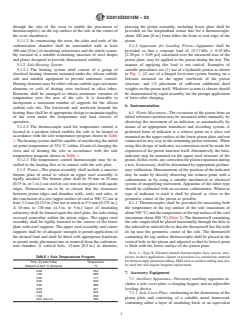
Measurements of the position of the indicator may be made by directly observing the witness point with a cathetometer or by using
TABLE 1 Sole Temperatures Program
Time, (h) After Initial Temperature,
Setpoint of 554 °C Achieved °C
0.00 554
1.00 685
2.00 777
3.00 840
4.00 889
5.00 921
6.00 943
7.00 950
from then on 950
D2014/D2014M − 20
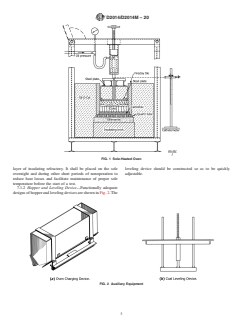
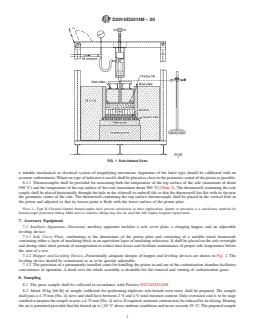
FIG. 1 Sole-Heated Oven
a suitable mechanical or electrical system of magnifying movement. Apparatus of the latter type should be calibrated with an
accurate cathetometer. Whatever type of indicator is used it shall be placed as close to the geometric center of the piston as possible.
6.1.1 Thermocouples shall be provided for measuring both the temperature of the top surface of the sole (maximum of about
950 °C) and the temperature of the top surface of the coal (maximum about 500 °C) (Note 2). The thermowell containing the sole
couple shall be placed horizontally through the hole in the sidewall or endwall tile so that the thermowell lies flat with its tip near
the geometric center of the sole. The thermowell containing the top surface thermocouple shall be placed in the vertical hole in
the piston and adjusted so that its lowest point is flush with the lower surface of the piston plate.
NOTE 1—Type K Chromel-Alumel thermocouples have proven satisfactory in these applications. Quartz or porcelain is a satisfactory material for
thermocouple protection tubing. Mild steel or stainless tubing may also be used but will require frequent r
...