

ASTM D4716/D4716M-22
(Test Method)Standard Test Method for Determining the (In-plane) Flow Rate per Unit Width and Hydraulic Transmissivity of a Geosynthetic Using a Constant Head
General Information
- Abstract
SIGNIFICANCE AND USE
5.1 This test method is intended either as an index test or as a performance test used to determine and compare the flow rate per unit width of one or several candidate geosynthetics under specific conditions.
5.2 This test method may be used as an index test for acceptance testing of commercial shipments of geosynthetics, but caution is advised since information on between-laboratory precision of this test method is incomplete. Comparative tests as directed in 5.2.1 may be advisable.
5.2.1 In case of a dispute arising from differences in reported test results when using this test method for acceptance testing of commercial shipments, the purchaser and the supplier should first confirm that the tests were conducted using comparable test parameters including specimen conditioning, normal stress, seating period, hydraulic gradient, test water temperature, etc., then conduct comparative tests to determine if there is a statistical bias between their laboratories. Competent statistical assistance is recommended for the investigation of bias. As a minimum, the two parties should take a group of test specimens that are as homogenous as possible and that are formed from a lot of the material of the type in question. The test specimens should then be randomly assigned in equal numbers to each laboratory for testing. The average results from the two laboratories should be compared using the Student's t-test for unpaired data and an acceptable probability level chosen by the two parties before the testing is begun. If bias is found, either its cause must be found and corrected or the purchaser and supplier must agree to interpret future test results in light of the known bias.
SCOPE
1.1 This test method covers the procedure for determining the flow rate per unit width within the manufactured plane of geosynthetics under varying normal compressive stresses and a constant head. The test is intended primarily as an index test but can be used also as a performance test when the hydraulic gradients and specimen contact surfaces are selected by the user to model anticipated field conditions.
1.2 This test method is limited to geosynthetics that allow continuous in-plane flow paths to occur parallel to the intended direction of flow.
1.3 The values stated in either SI units or inch-pound units are to be regarded separately as standard. The values stated in each system are not necessarily exact equivalents; therefore, to ensure conformance with the standard, each system shall be used independently of the other, and values from the two systems shall not be combined.
1.4 This standard does not purport to address all of the safety concerns, if any, associated with its use. It is the responsibility of the user of this standard to establish appropriate safety, health, and environmental practices and determine the applicability of regulatory limitations prior to use.
1.5 This international standard was developed in accordance with internationally recognized principles on standardization established in the Decision on Principles for the Development of International Standards, Guides and Recommendations issued by the World Trade Organization Technical Barriers to Trade (TBT) Committee.
- Status
- Published
- Publication Date
- 30-Apr-2022
- Technical Committee
- D35 - Geosynthetics
- Drafting Committee
- D35.03 - Permeability and Filtration
Buy Documents
ASTM D4716/D4716M-22 - Standard Test Method for Determining the (In-plane) Flow Rate per Unit Width and Hydraulic Transmissivity of a Geosynthetic Using a Constant Head
REDLINE ASTM D4716/D4716M-22 - Standard Test Method for Determining the (In-plane) Flow Rate per Unit Width and Hydraulic Transmissivity of a Geosynthetic Using a Constant Head
Overview
ASTM D4716/D4716M-22 is the internationally recognized standard test method for determining the in-plane flow rate per unit width and hydraulic transmissivity of geosynthetic materials using a constant head. Developed by ASTM International's Committee D35 on Geosynthetics, this standard provides consistent procedures essential for quality assurance, acceptance testing, and performance evaluation of geosynthetics used in civil engineering and environmental projects.
This method is mainly used as an index test for routine acceptance of geosynthetic shipments, but it can also be adapted as a performance test to simulate anticipated field conditions. The procedure is applicable to a wide range of geosynthetics, including geonets, geocomposites, and geotextiles, that enable continuous in-plane flow paths.
Key Topics
- In-Plane Flow Rate Measurement: The standard outlines precise steps for measuring the volume of water passing through a geosynthetic specimen under controlled normal compressive stresses and a specified hydraulic gradient.
- Hydraulic Transmissivity: It details the calculation of hydraulic transmissivity, defined as the volumetric flow rate per unit width of specimen per unit hydraulic gradient in the plane of the material.
- Test Configurations: The method allows for both index testing (quality control and shipment acceptance) and performance testing (modeling specific project or field conditions).
- Specimen Conditioning and Test Parameters: Parameters such as specimen conditioning, applied normal stress, hydraulic gradient selection, and seating periods are emphasized for ensuring consistency and relevance to actual conditions.
- Data Reporting and Evaluation: The standard specifies comprehensive reporting requirements including calibration procedures, test plots, material descriptions, and conditions or departures from the recommended procedures.
- Interlaboratory Precision: Guidance is given on resolving disputes and assessing laboratory bias using comparative testing and statistical analysis.
Applications
The ASTM D4716/D4716M-22 standard is widely used in the following applications:
- Quality Control and Product Acceptance: As an index test, manufacturers, suppliers, and purchasers use this standard to evaluate and accept commercial geosynthetic shipments, ensuring products meet project specifications.
- Engineering Design: Engineers use the results for selecting materials with appropriate flow characteristics for drainage or filtration in environmental and geotechnical applications, such as landfill liners, roadbeds, retaining walls, and erosion control systems.
- Performance Verification: Project-specific tests simulate real field stresses and hydraulic gradients to predict long-term behavior and ensure that the chosen geosynthetic will perform as required in situ.
- Research and Development: Laboratories and product developers rely on this standardized procedure for benchmarking new products and innovations within the geosynthetics industry.
By utilizing ASTM D4716/D4716M-22, stakeholders benefit from consistent, repeatable, and comparable measurements critical for material selection, regulatory compliance, and the successful implementation of geosynthetic solutions.
Related Standards
Several ASTM standards complement or reference ASTM D4716/D4716M-22, including:
- ASTM D4354: Practice for Sampling of Geosynthetics and Rolled Erosion Control Products for Testing
- ASTM D4439: Terminology for Geosynthetics
- ASTM D4491/D4491M: Test Methods for Water Permeability of Geotextiles by Permittivity
- ASTM D5092/D5092M: Practice for Design and Installation of Groundwater Monitoring Wells
- ASTM D5199: Test Method for Measuring the Nominal Thickness of Geosynthetics
- ASTM D6574/D6574M: Test Method for Determining Hydraulic Transmissivity by Radial Flow
- ASTM D7361: Test Method for Accelerated Compressive Creep of Geosynthetic Materials
- ASTM E691: Practice for Conducting an Interlaboratory Study to Determine Precision of a Test Method
Adhering to these related ASTM standards ensures comprehensive geosynthetic testing, reinforcing project reliability, regulatory acceptance, and optimal system performance in critical environmental and infrastructure projects.
Relations
- Effective Date
- 01-Feb-2024
- Effective Date
- 01-May-2020
- Refers
ASTM D5199-12(2019) - Standard Test Method for Measuring the Nominal Thickness of Geosynthetics - Effective Date
- 15-Jun-2019
- Effective Date
- 15-Apr-2018
- Effective Date
- 01-Aug-2017
- Refers
ASTM D4491/D4491M-17 - Standard Test Methods for Water Permeability of Geotextiles by Permittivity - Effective Date
- 01-Jan-2017
- Refers
ASTM D5092/D5092M-16 - Standard Practice for Design and Installation of Groundwater Monitoring Wells - Effective Date
- 15-Nov-2016
- Refers
ASTM D4491/D4491M-16 - Standard Test Methods for Water Permeability of Geotextiles by Permittivity - Effective Date
- 01-Jul-2016
- Effective Date
- 01-Sep-2015
- Refers
ASTM D4491/D4491M-15 - Standard Test Methods for Water Permeability of Geotextiles by Permittivity - Effective Date
- 01-Jul-2015
- Effective Date
- 01-Jul-2015
- Effective Date
- 01-Mar-2014
- Effective Date
- 01-Jul-2013
- Effective Date
- 01-May-2013
- Effective Date
- 01-Jul-2012
Buy Documents
ASTM D4716/D4716M-22 - Standard Test Method for Determining the (In-plane) Flow Rate per Unit Width and Hydraulic Transmissivity of a Geosynthetic Using a Constant Head
REDLINE ASTM D4716/D4716M-22 - Standard Test Method for Determining the (In-plane) Flow Rate per Unit Width and Hydraulic Transmissivity of a Geosynthetic Using a Constant Head
Get Certified
Connect with accredited certification bodies for this standard

Control Union Certifications
Global certification for agriculture and sustainability.

Hohenstein Institut
Textile testing and certification.

Bureau Veritas Bangladesh
Bureau Veritas certification services in Bangladesh.
Sponsored listings
Frequently Asked Questions
ASTM D4716/D4716M-22 is a standard published by ASTM International. Its full title is "Standard Test Method for Determining the (In-plane) Flow Rate per Unit Width and Hydraulic Transmissivity of a Geosynthetic Using a Constant Head". This standard covers: SIGNIFICANCE AND USE 5.1 This test method is intended either as an index test or as a performance test used to determine and compare the flow rate per unit width of one or several candidate geosynthetics under specific conditions. 5.2 This test method may be used as an index test for acceptance testing of commercial shipments of geosynthetics, but caution is advised since information on between-laboratory precision of this test method is incomplete. Comparative tests as directed in 5.2.1 may be advisable. 5.2.1 In case of a dispute arising from differences in reported test results when using this test method for acceptance testing of commercial shipments, the purchaser and the supplier should first confirm that the tests were conducted using comparable test parameters including specimen conditioning, normal stress, seating period, hydraulic gradient, test water temperature, etc., then conduct comparative tests to determine if there is a statistical bias between their laboratories. Competent statistical assistance is recommended for the investigation of bias. As a minimum, the two parties should take a group of test specimens that are as homogenous as possible and that are formed from a lot of the material of the type in question. The test specimens should then be randomly assigned in equal numbers to each laboratory for testing. The average results from the two laboratories should be compared using the Student's t-test for unpaired data and an acceptable probability level chosen by the two parties before the testing is begun. If bias is found, either its cause must be found and corrected or the purchaser and supplier must agree to interpret future test results in light of the known bias. SCOPE 1.1 This test method covers the procedure for determining the flow rate per unit width within the manufactured plane of geosynthetics under varying normal compressive stresses and a constant head. The test is intended primarily as an index test but can be used also as a performance test when the hydraulic gradients and specimen contact surfaces are selected by the user to model anticipated field conditions. 1.2 This test method is limited to geosynthetics that allow continuous in-plane flow paths to occur parallel to the intended direction of flow. 1.3 The values stated in either SI units or inch-pound units are to be regarded separately as standard. The values stated in each system are not necessarily exact equivalents; therefore, to ensure conformance with the standard, each system shall be used independently of the other, and values from the two systems shall not be combined. 1.4 This standard does not purport to address all of the safety concerns, if any, associated with its use. It is the responsibility of the user of this standard to establish appropriate safety, health, and environmental practices and determine the applicability of regulatory limitations prior to use. 1.5 This international standard was developed in accordance with internationally recognized principles on standardization established in the Decision on Principles for the Development of International Standards, Guides and Recommendations issued by the World Trade Organization Technical Barriers to Trade (TBT) Committee.
SIGNIFICANCE AND USE 5.1 This test method is intended either as an index test or as a performance test used to determine and compare the flow rate per unit width of one or several candidate geosynthetics under specific conditions. 5.2 This test method may be used as an index test for acceptance testing of commercial shipments of geosynthetics, but caution is advised since information on between-laboratory precision of this test method is incomplete. Comparative tests as directed in 5.2.1 may be advisable. 5.2.1 In case of a dispute arising from differences in reported test results when using this test method for acceptance testing of commercial shipments, the purchaser and the supplier should first confirm that the tests were conducted using comparable test parameters including specimen conditioning, normal stress, seating period, hydraulic gradient, test water temperature, etc., then conduct comparative tests to determine if there is a statistical bias between their laboratories. Competent statistical assistance is recommended for the investigation of bias. As a minimum, the two parties should take a group of test specimens that are as homogenous as possible and that are formed from a lot of the material of the type in question. The test specimens should then be randomly assigned in equal numbers to each laboratory for testing. The average results from the two laboratories should be compared using the Student's t-test for unpaired data and an acceptable probability level chosen by the two parties before the testing is begun. If bias is found, either its cause must be found and corrected or the purchaser and supplier must agree to interpret future test results in light of the known bias. SCOPE 1.1 This test method covers the procedure for determining the flow rate per unit width within the manufactured plane of geosynthetics under varying normal compressive stresses and a constant head. The test is intended primarily as an index test but can be used also as a performance test when the hydraulic gradients and specimen contact surfaces are selected by the user to model anticipated field conditions. 1.2 This test method is limited to geosynthetics that allow continuous in-plane flow paths to occur parallel to the intended direction of flow. 1.3 The values stated in either SI units or inch-pound units are to be regarded separately as standard. The values stated in each system are not necessarily exact equivalents; therefore, to ensure conformance with the standard, each system shall be used independently of the other, and values from the two systems shall not be combined. 1.4 This standard does not purport to address all of the safety concerns, if any, associated with its use. It is the responsibility of the user of this standard to establish appropriate safety, health, and environmental practices and determine the applicability of regulatory limitations prior to use. 1.5 This international standard was developed in accordance with internationally recognized principles on standardization established in the Decision on Principles for the Development of International Standards, Guides and Recommendations issued by the World Trade Organization Technical Barriers to Trade (TBT) Committee.
ASTM D4716/D4716M-22 is classified under the following ICS (International Classification for Standards) categories: 59.080.70 - Geotextiles. The ICS classification helps identify the subject area and facilitates finding related standards.
ASTM D4716/D4716M-22 has the following relationships with other standards: It is inter standard links to ASTM D4439-24, ASTM D4354-12(2020), ASTM D5199-12(2019), ASTM D4439-18, ASTM D4439-17, ASTM D4491/D4491M-17, ASTM D5092/D5092M-16, ASTM D4491/D4491M-16, ASTM D4439-15a, ASTM D4491/D4491M-15, ASTM D4439-15, ASTM D4439-14, ASTM D6574/D6574M-13, ASTM E691-13, ASTM D7361-07(2012). Understanding these relationships helps ensure you are using the most current and applicable version of the standard.
ASTM D4716/D4716M-22 is available in PDF format for immediate download after purchase. The document can be added to your cart and obtained through the secure checkout process. Digital delivery ensures instant access to the complete standard document.
Standards Content (Sample)
This international standard was developed in accordance with internationally recognized principles on standardization established in the Decision on Principles for the
Development of International Standards, Guides and Recommendations issued by the World Trade Organization Technical Barriers to Trade (TBT) Committee.
Designation: D4716/D4716M − 22
Standard Test Method for
Determining the (In-plane) Flow Rate per Unit Width and
Hydraulic Transmissivity of a Geosynthetic Using a
Constant Head
This standard is issued under the fixed designation D4716/D4716M; the number immediately following the designation indicates the
year of original adoption or, in the case of revision, the year of last revision. A number in parentheses indicates the year of last
reapproval. A superscript epsilon (´) indicates an editorial change since the last revision or reapproval.
1. Scope 2. Referenced Documents
2.1 ASTM Standards:
1.1 This test method covers the procedure for determining
D4354Practice for Sampling of Geosynthetics and Rolled
the flow rate per unit width within the manufactured plane of
Erosion Control Products (RECPs) for Testing
geosyntheticsundervaryingnormalcompressivestressesanda
D4439Terminology for Geosynthetics
constant head. The test is intended primarily as an index test
D4491/D4491MTest Methods for Water Permeability of
but can be used also as a performance test when the hydraulic
Geotextiles by Permittivity
gradients and specimen contact surfaces are selected by the
D5092/D5092MPractice for Design and Installation of
user to model anticipated field conditions.
Groundwater Monitoring Wells
1.2 This test method is limited to geosynthetics that allow D5199Test Method for Measuring the Nominal Thickness
continuousin-planeflowpathstooccurparalleltotheintended of Geosynthetics
D6574/D6574MTestMethodforDeterminingthe(In-Plane)
direction of flow.
Hydraulic Transmissivity of a Geosynthetic by Radial
1.3 The values stated in either SI units or inch-pound units
Flow
are to be regarded separately as standard. The values stated in
D7361Test Method for Accelerated Compressive Creep of
each system are not necessarily exact equivalents; therefore, to
Geosynthetic Materials Based on Time-Temperature Su-
ensure conformance with the standard, each system shall be
perposition Using the Stepped Isothermal Method
used independently of the other, and values from the two
E691Practice for Conducting an Interlaboratory Study to
systems shall not be combined.
Determine the Precision of a Test Method
1.4 This standard does not purport to address all of the
3. Terminology
safety concerns, if any, associated with its use. It is the
3.1 Definitions:
responsibility of the user of this standard to establish appro-
3.1.1 geocomposite, n—a product fabricated from any com-
priate safety, health, and environmental practices and deter-
bination of geosynthetics with geotechnical materials or other
mine the applicability of regulatory limitations prior to use.
syntheticswhichisusedinageotechnicalapplication. (D4439)
1.5 This international standard was developed in accor-
3.1.2 geonet, n—a geosynthetic consisting of integrally
dance with internationally recognized principles on standard-
connected parallel sets of ribs overlying similar sets at various
ization established in the Decision on Principles for the
angles for planar drainage of liquids or gases. (D4439)
Development of International Standards, Guides and Recom-
3.1.3 geosynthetic, n—a planar product manufactured from
mendations issued by the World Trade Organization Technical
polymeric material used with soil, rock, earth, or other geo-
Barriers to Trade (TBT) Committee.
technical engineering related material as an integral part of a
man-made project, structure, or system. (D4439)
3.1.4 geotechnics, n—the application of scientific methods
and engineering principles to the acquisition, interpretation,
and use of knowledge of material of the earth’s crust to the
solution of engineering problems.
This test method is under the jurisdiction of ASTM Committee D35 on
Geosynthetics and is the direct responsibility of Subcommittee D35.03 on Perme-
ability and Filtration. For referenced ASTM standards, visit the ASTM website, www.astm.org, or
Current edition approved May 1, 2022. Published June 2022. Originally contact ASTM Customer Service at service@astm.org. For Annual Book of ASTM
approved in 1995. Last previous edition approved in 2020 as D4716/D4716M–20. Standards volume information, refer to the standard’s Document Summary page on
DOI: 10.1520/D4716_D4716M-22. the ASTM website.
Copyright © ASTM International, 100 Barr Harbor Drive, PO Box C700, West Conshohocken, PA 19428-2959. United States
D4716/D4716M − 22
3.1.4.1 Discussion—Geotechnics embraces the fields of soil 4. Summary of Test Method
mechanics, rock mechanics, and many of the engineering
4.1 Theflowrateperunitwidthisdeterminedbymeasuring
aspects of geology, geophysics, hydrology, and related
the quantity of water that passes through a test specimen in a
sciences. (D4439)
specific time interval under a specific normal stress and a
3.1.5 geotextile, n—a permeable geosynthetic comprised specific hydraulic gradient. The hydraulic gradient(s) and
solely of textiles. (D4439) specimen contact surfaces are selected by the user either as an
index test or as a performance test to model a given set of field
3.1.6 gravity flow, n—flow in a direction parallel to the
parameters as closely as possible. Measurements may be
planeofageosyntheticdrivenpredominantlybyadifferencein
repeated under increasing normal stresses selected by the user.
elevation between the inlet and outflow points of a specimen.
4.1.1 The hydraulic transmissivity is the flow rate per unit
3.1.6.1 Discussion—The pressure at the outflow is consid-
width divided by the associated hydraulic gradient.
ered to be atmospheric. (D4439)
3.1.7 head (static), n—the height above a standard datum of
5. Significance and Use
the surface of a column of water (or other liquid) that can be
5.1 This test method is intended either as an index test or as
supported by a static pressure at a given point. The static head
aperformancetestusedtodetermineandcomparetheflowrate
is the sum of the elevation head and the pressure head.
per unit width of one or several candidate geosynthetics under
(D5092/D5092M)
specific conditions.
3.1.8 hydraulicgradient,i,n—thelossofhydraulicheadper
5.2 This test method may be used as an index test for
unit distance of flow, dh/dL. (D4439)
acceptance testing of commercial shipments of geosynthetics,
2 −1
3.1.9 hydraulic transmissivity, θ (L T ),n—for a
butcautionisadvisedsinceinformationonbetween-laboratory
geosynthetic, the volumetric flow rate per unit width of
precision of this test method is incomplete. Comparative tests
specimenperunitgradientinadirectionparalleltotheplaneof
as directed in 5.2.1 may be advisable.
the specimen.
5.2.1 In case of a dispute arising from differences in
3.1.9.1 Discussion—“Transmissivity” is technically appli-
reportedtestresultswhenusingthistestmethodforacceptance
cable only to saturated, laminar hydraulic flow conditions.
testing of commercial shipments, the purchaser and the sup-
(D4439)
plier should first confirm that the tests were conducted using
comparable test parameters including specimen conditioning,
3.1.10 index test, n—a test procedure that may contain
normal stress, seating period, hydraulic gradient, test water
known bias but which may be used to establish an order for a
temperature, etc., then conduct comparative tests to determine
set of specimens with respect to the property of interest.
if there is a statistical bias between their laboratories. Compe-
(D4439)
tent statistical assistance is recommended for the investigation
3.1.11 in-plane flow, n—fluid flow confined to a direction
of bias.As a minimum, the two parties should take a group of
parallel to the plane of a geosynthetic. (D4439)
test specimens that are as homogenous as possible and that are
3.1.12 laminar flow, n—flow in which the head loss is formed from a lot of the material of the type in question. The
proportional to the first power of the velocity. (D4439) test specimens should then be randomly assigned in equal
−2 numbers to each laboratory for testing. The average results
3.1.13 normal stress (FL ), n—the component of applied
from the two laboratories should be compared using the
stress that is perpendicular to the surface on which the force
Student’s t-test for unpaired data and an acceptable probability
acts. (D4439)
level chosen by the two parties before the testing is begun. If
3.1.14 performance test, n—a test that simulates in the
bias is found, either its cause must be found and corrected or
laboratory as closely as practical selected conditions experi-
the purchaser and supplier must agree to interpret future test
enced in the field and which can be used in design. (D4439)
results in light of the known bias.
3.1.15 pressure flow, n—flow in a direction parallel to the
6. Apparatus
plane of a geosynthetic driven predominantly by a differential
fluid pressure. (D4439)
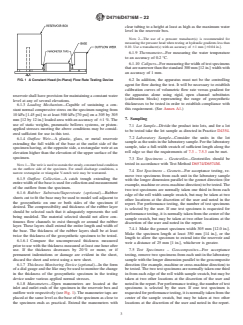
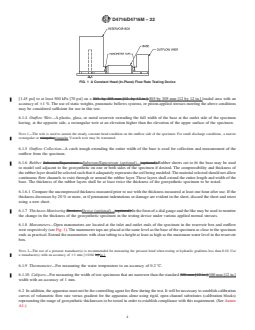
6.1 Aschematic drawing of an assembly is shown in Fig. 1.
The individual components and accessories are as follows:
3.1.16 turbulent flow, n—that type of flow in which any
water particle may move in any direction with respect to any 6.1.1 Base—A sturdy metal base with smooth, flat bottom
and sides capable of holding a test specimen of sufficient area
other particle, and in which the head loss is approximately
proportional to the second power of the velocity. (D4439) and thickness.All seams between the bottom surface and sides
of the base must be watertight and not inhibit in-plane flow of
3.1.17 For definitions of terms relating to geosynthetics,
water through the specimen. For geotextile testing, all surfaces
refer to Terminology D4439.
of the base in contact with the specimen shall be covered by a
3.2 Definitions of Terms Specific to This Standard:
thin layer of rubber material of low compressibility in order to
3.2.1 steady flow, n—flow conditions that do not vary with
ensure a tight seal.
time.
6.1.2 Reservoir—A plastic, glass, or metal water reservoir
3.2.2 uniform flow, n—conditions where the flow area and extendingthefullwidthofthebase.Theheightofthereservoir
the mean velocity in the direction of flow are constant. shall be at least equal to the total length of the specimen. The
D4716/D4716M − 22
clear tubing to a height at least as high as the maximum water
level in the reservoir box.
NOTE 2—The use of a pressure transducer(s) is recommended for
measuring the pressure head when testing at hydraulic gradients less than
0.10. Use a transducer(s) with an accuracy of 61mm[60.04 in.].
6.1.9 Thermometer—For measuring the water temperature
to an accuracy of 0.2°C.
6.1.10 Calipers—Formeasuringthewidthoftestspecimens
thatarenarrowerthanthestandard300mm[12in.]widthwith
an accuracy of 1 mm.
FIG. 1 A Constant Head (In-Plane) Flow Rate Testing Device
6.2 In addition, the apparatus must not be the controlling
agent for flow during the test. It will be necessary to establish
calibration curves of volumetric flow rate versus gradient for
the apparatus alone using rigid, open channel substitutes
reservoir shall have provision for maintaining a constant water
(calibration blocks) representing the range of geosynthetic
level at any of several elevations.
thicknesses to be tested in order to establish compliance with
6.1.3 Loading Mechanism—Capable of sustaining a con-
this requirement. (See Annex A1.)
stant normal compressive stress on the specimen ranging from
10 kPa [1.45 psi] to at least 500 kPa [70 psi] on a 305 by 305
7. Sampling
mm [12 by 12 in.] loaded area with an accuracy of 61%. The
use of static weights, pneumatic bellows systems, or piston-
7.1 Lot Sample—Divide the product into lots, and for a lot
applied stresses meeting the above conditions may be consid-
to be tested take the lot sample as directed in Practice D4354.
ered sufficient for use in this test.
7.2 Laboratory Sample—Consider the units in the lot
6.1.4 Outflow Weir—A plastic, glass, or metal reservoir
sampleastheunitsinthelaboratorysample.Forthelaboratory
extending the full width of the base at the outlet side of the
sample, take a full-width swatch of sufficient length along the
specimen having, at the opposite side, a rectangular weir at an
roll edge so that the requirements of 7.3 – 7.5.3 can be met.
elevation higher than the elevation of the upper surface of the
specimen.
7.3 Test Specimens – Geotextiles—Geotextiles should be
tested in accordance with Test Method D6574/D6574M.
NOTE1—Theweirisusedtosustainthesteady,constantheadcondition
on the outflow side of the specimen. For small discharge conditions, a
7.4 Test Specimens – Geonets—For acceptance testing, re-
narrow rectangular or triangular V-notch weir may be warranted.
move two specimens from each unit in the laboratory sample
6.1.5 Outflow Collection—A catch trough extending the
with the longer dimension parallel to the geonet direction (for
entirewidthofthebaseisusedforcollectionandmeasurement
example,machineorcross-machinedirection)tobetested.The
of the outflow from the specimen.
two test specimens are normally taken one third in from each
6.1.6 Rubber Substrate/Superstrate (optional)—Rubber
edge of the roll width sample swatch, but may be taken at two
sheets cut to fit the base may be used to model soil adjacent to
other locations at the discretion of the user and noted in the
the geosynthetic on one or both sides of the specimen if
report. For performance testing, the number of test specimens
desired. The compressibility and thickness of the rubber layer
is selected by the user. If one test specimen is requested for
should be selected such that it adequately represents the soil
performance testing, it is normally taken from the center of the
being modeled. The material selected should not allow con-
sample swatch, but may be taken at two other locations at the
tinuous flow channels to exist through or around the rubber
discretion of the user and noted in the report.
layer. These layers shall extend the entire length and width of
7.4.1 Make the geonet specimen width 305 mm [12.0 in.].
the base. The thickness of the rubber layers shall be at least
Make the specimen length at least 350 mm [14 in.], or the
twice the thickness of the geosynthetic specimen to be tested.
length to allow the specimen to extend into the reservoir and
6.1.6.1 Compare the uncompressed thickness measured
weir a distance of 25 mm [1 in.], whichever is greater.
prior to use with the thickness measured at least one hour after
use. If the thickness decreases by 20% or more, or if 7.5 Test Specimens – Geocomposites—For acceptance
permanent indentations or damage are evident in the sheet, testing,removetwospecimensfromeachunitinthelaboratory
discard the sheet and retest using a new sheet. sample with the longer dimension parallel to the geocomposite
6.1.7 Thickness Monitoring Device (optional)—In the form direction (for example, machine or cross-machine direction) to
of a dial gauge and the like may be used to monitor the change be tested. The two test specimens are normally taken one third
in the thickness of the geosynthetic specimen in the testing in from each edge of the roll width sample swatch, but may be
device under various applied normal stresses. taken at two other locations at the discretion of the user and
6.1.8 Manometers—Open manometers are located at the notedinthereport.Forperformancetesting,thenumberoftest
inlet and outlet ends of the specimen in the reservoir box and specimens is selected by the user. If one test specimen is
outflow weir respectively (see Fig. 1).The manometer taps are requestedforperformancetesting,itisnormallytakenfromthe
placed at the same level as the base of the specimen as close to center of the sample swatch, but may be taken at two other
the specimen ends as practical. Extend the manometers with locations at the discretion of the user and noted in the report.
D4716/D4716M − 22
7.5.1 Forgeocompositesmanufacturedwiththefullproduct 8.3.1 Index Testing—For acceptance testing, the applied
width less than 305 mm [12.0 in.], the specimen width is equal normal compressive stress(es) should be prescribed by the
to the manufactured product width. The specimen length is at material specification. In the absence of a user or supplier
least 350 mm [14 in.], or the length to allow the specimen to specification, perform flow rate testing using a minimum of
extend into the reservoir and weir a distance of 25 mm [1 in.], three applied normal stresses selected from the following
whichever is greater. values: 10, 25, 50, 100, 250, and 500 kPa [1.45, 3.63, 7.26,
14.51, 36.28, and 72.55 psi].
NOTE 3—The actual length of the geocomposite specimen may have an
8.3.2 For performance testing, select the minimum and
influence on the measured head losses and associated gradients; therefore,
the specimen length of 350 mm [14 in.] will be considered standard. In
maximum normal stress to be applied as to model the specific
any case, always report the actual specimen length used.
field conditions. Perform the tests using a minimum of three
7.5.2 For geocomposites manufactured with a full product appliednormalstresses,selectingatleastonevaluegreaterand
one value less than the known design stress value.
width 305 mm [12.0 in.] or greater, the specimen width is
300mm [12 in.] unless the product cannot be cut to width
8.3.2.1 Where the design or maximum normal compressive
without altering the product structure.
stress for a particular application is known, it may be sufficient
7.5.3 Forgeocompositesconsistingoftwoormoredifferent
to test the specimen under a single stress. This option should
geosynthetic components, determine the specimen dimensions
only be used when selected by the user or product specifier.
for each individual material in accordance with the applicable
subsection, 7.3, 7.4,or 7.5.2. The minimum dimension of the
9. Procedure
specimens shall then be dictated by the component requiring
9.1 Placethespecimensubstratum,ifany,onthetestdevice
the largest minimum size. This requirement does not apply for
base.Fortestsectionswherethesubstratumconsistsofanother
components sized per 7.5.1, which have manufactured widths
geosynthetic,theinterfacebetweenthesubstratumandthebase
less than 305 mm [12.0 in.].
should be sealed to prevent water from flowing under the
substratum when this potential exists.
8. Test Parameter Selection
8.1 Selection of Substrate and Superstrate:
9.2 Trim the test specimen to the dimensions prescribed in
8.1.1 Index Testing—For acceptance testing, the contact
7.3 – 7.5 and then place the test specimen over the substratum,
surfaces should be prescribed by the material specification. In
ensuring that all wrinkles, folds, etc., are removed.
the absence of a specification, use rigid sub and superstrates to
9.2.1 Seal the sides of the specimen parallel to the direction
minimize the variables impacting the test results.
of flow by wrapping the test specimen in a thin sheet of low
8.1.2 For performance testing, the nature of the material in
compressibility plastic or rubber membrane, using a cast-in-
contactwiththegeosyntheticinthefieldshouldbemodeled.A
place rubber or wax edge seal, or other measure (to prevent
rigid platen on one or both sides of the specimen simulates
side leakage). This precaution may not be warranted for test
similarly rigid surfaces (such as concrete walls or stiff
specimens that are rectangular in profile, placed between rigid
geomembranes)whereintrusionintothegeosyntheticopenings
surfaces, and cut to fit snugly against the sides of the base.
or pore spaces is not anticipated. Where intrusion is expected
NOTE 5—The elimination of leakage paths along the sides of the test
(as is the case for a geotextile in contact with soil or a
specimen and along the loading tray adjacent to the upper surface of the
geonet/geotextile/soil section) a layer of rubber membrane or
specimen merits close attention when testing geotextile materials. The
representative soil may be placed between the platen and the
user is cautioned of the relatively high variability (see 12.1) in the test
geosynthetic specimen.
results that may be directly related to the laboratory’s ability to address
these fugative flows.
NOTE 4—Tests performed using site-specific soils are recommended
when the end use of the material is known. The long-term effect of soil
9.3 Place the desired superstratum, if any, over the test
cloggingshouldbeconsideredwhenperformingtestsdescribedinthistest
specimen in a similar manner. For test sections where the
method.
superstratum consists of another geosynthetic, the interface
8.2 Gradient Selection:
between the superstratum and the top plate should be sealed to
8.2.1 Index Testing—For acceptance testing, the test gradi-
prevent water from flowing over the superstratum when this
ents should be prescribed by the material specification. In the
potential exists.
absenceofaspecification,usethreegradientsselectedfromthe
9.4 Seat the top plate (platen) on the test assembly applying
following values: 0.05, 0.10, 0.25, 0.50, and 1.0.
a small seating stress of 5 to 10 kPa [0.73 to 1.45 psi], and
8.2.2 Performance Testing—Select a test hydraulic gradient
slowly fill the reservoir with water allowing water to flow
that is appropriate for the end use of the material and for
through the test specimen. From this point forward, the
specific field conditions.When specific field conditions are not
specimen must be kept saturated at all times.
known, use one of the following recommended gradients as
well as at least two lesser gradients.
NOTE 6—For test devices or test sections, or both, where the test
8.2.2.1 A maximum hydraulic gradient of 1.0 is suggested
specimens are not placed into a loading tray that already contains water
for tests intended to model gravity flow conditions. (which allows for expulsion of trapped air from the test specimen), a
pre-flush is recommended to expel air from the test specimen. This step
8.2.2.2 A maximum hydraulic gradient of 0.1 is suggested
entails raising the water level in the reservoir to a gradient of approxi-
for tests intended to model pressure flow conditions.
mately 0.5 and allowing the flow to continue until air bubbles no longer
8.3 Selection of the Applied Normal Compressive Stresses: are visibly exiting the weir end of the test specimen.
D4716/D4716M − 22
9.4.1 The test water should be maintained at 21 6 2°C [70 9.10 Compare flow rate data for each test to the flow rate
6 4°F] throughout the test duration. data plotted on the appropriate calibration block curve for the
9.4.2 Visually check for preferential flow paths along the device.Foragivenflowrate,ifthehydraulicgradientvaluefor
boundaries of the test specimen. If such flows are observed, the calibration block is more than 5% of the corresponding
re-seat or replace the test specimen as required. gradient for the geosynthetic, then the test data is invalid and
the device cannot be used to evaluate the test condition
NOTE 7—The use of deaired water is recommended for testing
modeled.
geotextiles and may be a consideration for test sections that include
geotextileswheredissolvedoxygenmayinfluencethetestresults.Referto
9.11 Repeat the procedure 9.1 – 9.9 on the remaining test
Test Methods D4491/D4491M for details regarding deaired water.
specimens.
9.5 Seat the specimen under the minimum normal
...
This document is not an ASTM standard and is intended only to provide the user of an ASTM standard an indication of what changes have been made to the previous version. Because
it may not be technically possible to adequately depict all changes accurately, ASTM recommends that users consult prior editions as appropriate. In all cases only the current version
of the standard as published by ASTM is to be considered the official document.
Designation: D4716/D4716M − 20 D4716/D4716M − 22
Standard Test Method for
Determining the (In-plane) Flow Rate per Unit Width and
Hydraulic Transmissivity of a Geosynthetic Using a
Constant Head
This standard is issued under the fixed designation D4716/D4716M; the number immediately following the designation indicates the
year of original adoption or, in the case of revision, the year of last revision. A number in parentheses indicates the year of last
reapproval. A superscript epsilon (´) indicates an editorial change since the last revision or reapproval.
1. Scope
1.1 This test method covers the procedure for determining the flow rate per unit width within the manufactured plane of
geosynthetics under varying normal compressive stresses and a constant head. The test is intended primarily as an index test but
can be used also as a performance test when the hydraulic gradients and specimen contact surfaces are selected by the user to model
anticipated field conditions.
1.2 This test method is limited to geosynthetics that allow continuous in-plane flow paths to occur parallel to the intended direction
of flow.
1.3 The values stated in either SI units or inch-pound units are to be regarded separately as standard. The values stated in each
system are not necessarily exact equivalents; therefore, to ensure conformance with the standard, each system shall be used
independently of the other, and values from the two systems shall not be combined.
1.4 This standard does not purport to address all of the safety concerns, if any, associated with its use. It is the responsibility
of the user of this standard to establish appropriate safety, health, and environmental practices and determine the applicability of
regulatory limitations prior to use.
1.5 This international standard was developed in accordance with internationally recognized principles on standardization
established in the Decision on Principles for the Development of International Standards, Guides and Recommendations issued
by the World Trade Organization Technical Barriers to Trade (TBT) Committee.
2. Referenced Documents
2.1 ASTM Standards:
D4354 Practice for Sampling of Geosynthetics and Rolled Erosion Control Products (RECPs) for Testing
D4439 Terminology for Geosynthetics
D4491/D4491M Test Methods for Water Permeability of Geotextiles by Permittivity
D5092/D5092M Practice for Design and Installation of Groundwater Monitoring Wells
D5199 Test Method for Measuring the Nominal Thickness of Geosynthetics
D6574/D6574M Test Method for Determining the (In-Plane) Hydraulic Transmissivity of a Geosynthetic by Radial Flow
This test method is under the jurisdiction of ASTM Committee D35 on Geosynthetics and is the direct responsibility of Subcommittee D35.03 on Permeability and
Filtration.
Current edition approved June 1, 2020May 1, 2022. Published June 2020June 2022. Originally approved in 1995. Last previous edition approved in 20142020 as
D4716/D4716M – 14.D4716/D4716M – 20. DOI: 10.1520/D4716_D4716M-20.10.1520/D4716_D4716M-22.
For referenced ASTM standards, visit the ASTM website, www.astm.org, or contact ASTM Customer Service at service@astm.org. For Annual Book of ASTM Standards
volume information, refer to the standard’s Document Summary page on the ASTM website.
Copyright © ASTM International, 100 Barr Harbor Drive, PO Box C700, West Conshohocken, PA 19428-2959. United States
D4716/D4716M − 22
D7361 Test Method for Accelerated Compressive Creep of Geosynthetic Materials Based on Time-Temperature Superposition
Using the Stepped Isothermal Method
E691 Practice for Conducting an Interlaboratory Study to Determine the Precision of a Test Method
3. Terminology
3.1 Definitions:
3.1.1 geocomposite, n—a product fabricated from any combination of geosynthetics with geotechnical materials or other
synthetics which is used in a geotechnical application. (D4439)
3.1.2 geonet, n—a geosynthetic consisting of integrally connected parallel sets of ribs overlying similar sets at various angles for
planar drainage of liquids or gases. (D4439)
3.1.3 geosynthetic, n—a planar product manufactured from polymeric material used with soil, rock, earth, or other geotechnical
engineering related material as an integral part of a man-made project, structure, or system. (D4439)
3.1.4 geotechnics, n—the application of scientific methods and engineering principalsprinciples to the acquisition, interpretation,
and use of knowledge of material of the earth’s crust to the solution of engineering problems.
3.1.4.1 Discussion—
Geotechnics embraces the fields of soil mechanics, rock mechanics, and many of the engineering aspects of geology, geophysics,
hydrology, and related sciences. (D4439)
3.1.5 geotextile, n—a permeable geosynthetic comprised solely of textiles. (D4439)
3.1.6 gravity flow, n—flow in a direction parallel to the plane of a geosynthetic driven predominantly by a difference in elevation
between the inlet and outflow points of a specimen.
3.1.6.1 Discussion—
The pressure at the outflow is considered to be atmospheric. (D4439)
3.1.7 head (static), n—the height above a standard datum of the surface of a column of water (or other liquid) that can be supported
by a static pressure at a given point. The static head is the sum of the elevation head and the pressure head. (D5092/D5092M)
3.1.8 hydraulic gradient, i, n—the loss of hydraulic head per unit distance of flow, dh/dL. (D4439)
2 −1
3.1.9 hydraulic transmissivity, θ (L T ),n—for a geosynthetic, the volumetric flow rate per unit width of specimen per unit
gradient in a direction parallel to the plane of the specimen.
3.1.9.1 Discussion—
“Transmissivity” is technically applicable only to saturated, laminar hydraulic flow conditions. (D4439)
3.1.10 in-plane flow, n—fluid flow confined to a direction parallel to the plane of a geosynthetic. (D4439)
3.1.10 index test, n—a test procedure that may contain known bias but which may be used to establish an order for a set of
specimens with respect to the property of interest. (D4439)
3.1.11 in-plane flow, n—fluid flow confined to a direction parallel to the plane of a geosynthetic. (D4439)
3.1.12 laminar flow, n—flow in which the head loss is proportional to the first power of the velocity. (D4439)
−2
3.1.13 normal stress (FL ), n—the component of applied stress that is perpendicular to the surface on which the force acts.
(D4439)
3.1.14 performance test, n—a test that simulates in the laboratory as closely as practical selected conditions experienced in the
field and which can be used in design. (D4439)
D4716/D4716M − 22
3.1.15 pressure flow, n—flow in a direction parallel to the plane of a geosynthetic driven predominantly by a differential fluid
pressure. (D4439)
3.1.16 turbulent flow, n—that type of flow in which any water particle may move in any direction with respect to any other particle,
and in which the head loss is approximately proportional to the second power of the velocity. (D4439)
3.1.17 For definitions of terms relating to geosynthetics, refer to Terminology D4439.
3.2 Definitions of Terms Specific to This Standard:
3.2.1 steady flow, n—flow conditions that do not vary with time.
3.2.2 uniform flow, n—conditions where the flow area and the mean velocity in the direction of flow are constant.
4. Summary of Test Method
4.1 The flow rate per unit width is determined by measuring the quantity of water that passes through a test specimen in a specific
time interval under a specific normal stress and a specific hydraulic gradient. The hydraulic gradient(s) and specimen contact
surfaces are selected by the user either as an index test or as a performance test to model a given set of field parameters as closely
as possible. Measurements may be repeated under increasing normal stresses selected by the user.
4.1.1 The hydraulic transmissivity is the flow rate per unit width divided by the associated hydraulic gradient.
5. Significance and Use
5.1 This test method is intended either as an index test or as a performance test used to determine and compare the flow rate per
unit width of one or several candidate geosynthetics under specific conditions.
5.2 This test method may be used as an index test for acceptance testing of commercial shipments of geosynthetics, but caution
is advised since information on between-laboratory precision of this test method is incomplete. Comparative tests as directed in
5.2.1 may be advisable.
5.2.1 In case of a dispute arising from differences in reported test results when using this test method for acceptance testing of
commercial shipments, the purchaser and the supplier should first confirm that the tests were conducted using comparable test
parameters including specimen conditioning, normal stress, seating period, hydraulic gradient, test water temperature, etc., then
conduct comparative tests to determine if there is a statistical bias between their laboratories. Competent statistical assistance is
recommended for the investigation of bias. As a minimum, the two parties should take a group of test specimens that are as
homogenous as possible and that are formed from a lot of the material of the type in question. The test specimens should then be
randomly assigned in equal numbers to each laboratory for testing. The average results from the two laboratories should be
compared using the Student’s t-test for unpaired data and an acceptable probability level chosen by the two parties before the
testing is begun. If bias is found, either its cause must be found and corrected or the purchaser and supplier must agree to interpret
future test results in light of the known bias.
6. Apparatus
6.1 A schematic drawing of an assembly is shown in Fig. 1. The individual components and accessories are as follows:
6.1.1 Base—A sturdy metal base with smooth, flat bottom and sides capable of holding a test specimen of sufficient area and
thickness. All seams between the bottom surface and sides of the base must be watertight and not inhibit in-plane flow of water
through the specimen. For geotextile testing, all surfaces of the base in contact with the specimen shall be covered by a thin layer
of rubber material of low compressibility in order to ensure a tight seal.
6.1.2 Reservoir—A plastic, glass, or metal water reservoir extending the full width of the base. The height of the reservoir shall
be at least equal to the total length of the specimen. The reservoir shall have provision for maintaining a constant water level at
any of several elevations.
6.1.3 Loading Mechanism—Capable of sustaining a constant normal compressive stress on the specimen ranging from 10 kPa
D4716/D4716M − 22
FIG. 1 A Constant Head (In-Plane) Flow Rate Testing Device
[1.45 psi] to at least 500 kPa [70 psi] on a 305- by 305-mm [12- by 12-in.] 305 by 305 mm [12 by 12 in.] loaded area with an
accuracy of 61 %. The use of static weights, pneumatic bellows systems, or piston-applied stresses meeting the above conditions
may be considered sufficient for use in this test.
6.1.4 Outflow Weir—A plastic, glass, or metal reservoir extending the full width of the base at the outlet side of the specimen
having, at the opposite side, a rectangular weir at an elevation higher than the elevation of the upper surface of the specimen.
NOTE 1—The weir is used to sustain the steady, constant head condition on the outflow side of the specimen. For small discharge conditions, a narrow
rectangular or triangular,triangular V-notch weir may be warranted.
6.1.5 Outflow Collection—A catch trough extending the entire width of the base is used for collection and measurement of the
outflow from the specimen.
6.1.6 Rubber Substrate/Superstrate—Substrate/Superstrate (optional)—(optional) Rubber sheets cut to fit the base may be used
to model soil adjacent to the geosynthetic on one or both sides of the specimen if desired. The compressibility and thickness of
the rubber layer should be selected such that it adequately represents the soil being modeled. The material selected should not allow
continuous flow channels to exist through or around the rubber layer. These layers shall extend the entire length and width of the
base. The thickness of the rubber layers shall be at least twice the thickness of the geosynthetic specimen to be tested.
6.1.6.1 Compare the uncompressed thickness measured prior to use with the thickness measured at least one hour after use. If the
thickness decreases by 20 % or more, or if permanent indentations or damage are evident in the sheet, discard the sheet and retest
using a new sheet.
6.1.7 Thickness Monitoring Device—Device (optional)—(optional) In the form of a dial gauge and the like may be used to monitor
the change in the thickness of the geosynthetic specimen in the testing device under various applied normal stresses.
6.1.8 Manometers—Open manometers are located at the inlet and outlet ends of the specimen in the reservoir box and outflow
weir respectively (see Fig. 1). The manometer taps are placed at the same level as the base of the specimen as close to the specimen
ends as practical. Extend the manometers with clear tubing to a height at least as high as the maximum water level in the reservoir
box.
NOTE 2—The use of a pressure transducer(s) is recommended for measuring the pressure head when testing at hydraulic gradients less than 0.10. Use
a transducer(s) with an accuracy of 61 mm [60.04 in].in.].
6.1.9 Thermometer—For measuring the water temperature to an accuracy of 0.2 °C.
6.1.10 Calipers—For measuring the width of test specimens that are narrower than the standard 300-mm [12-in.] 300 mm [12 in.]
width with an accuracy of 1 mm.
6.2 In addition, the apparatus must not be the controlling agent for flow during the test. It will be necessary to establish calibration
curves of volumetric flow rate versus gradient for the apparatus alone using rigid, open channel substitutes (calibration blocks)
representing the range of geosynthetic thicknesses to be tested in order to establish compliance with this requirement. (See Annex
A1.)
D4716/D4716M − 22
7. Sampling
7.1 Lot Sample—Divide the product into lots, and for a lot to be tested take the lot sample as directed in Practice D4354.
7.2 Laboratory Sample—Consider the units in the lot sample as the units in the laboratory sample. For the laboratory sample, take
a full-width swatch of sufficient length along the roll edge so that the requirements of 7.3 – 7.5.3 can be met.
7.3 Test Specimens – Geotextiles—Geotextiles should be tested in accordance with Test Method D6574/D6574M.
7.4 Test Specimens – Geonets—For acceptance testing, remove two specimens from each unit in the laboratory sample with the
longer dimension parallel to the geonet direction (for example, machine or cross-machine direction) to be tested. The two test
specimens are normally taken one third in from each edge of the roll width sample swatch, but may be taken at two other locations
at the discretion of the user and noted in the report. For performance testing, the number of test specimens is selected by the user.
If one test specimen is requested for performance testing, it is normally taken from the center of the sample swatch, but may be
taken at two other locations at the discretion of the user and noted in the report.
7.4.1 Make the geonet specimen width 305 mm [12.0 in.]. Make the specimen length at least 350 mm [14 in.], or the length to
allow the specimen to extend into the reservoir and weir a distance of 25 mm [1 in.], whichever is greater.
7.5 Test Specimens – Geocomposites—For acceptance testing, remove two specimens from each unit in the laboratory sample with
the longer dimension parallel to the geocomposite direction (for example, machine or cross-machine direction) to be tested. The
two test specimens are normally taken one third in from each edge of the roll width sample swatch, but may be taken at two other
locations at the discretion of the user and noted in the report. For performance testing, the number of test specimens is selected
by the user. If one test specimen is requested for performance testing, it is normally taken from the center of the sample swatch,
but may be taken at two other locations at the discretion of the user and noted in the report.
7.5.1 For geocomposites manufactured with the full product width less than 305 mm [12.0 in.], the specimen width is equal to
the manufactured product width. The specimen length is at least 350 mm [14 in.], or the length to allow the specimen to extend
into the reservoir and weir a distance of 25 mm [1 in.], whichever is greater.
NOTE 3—The actual length of the geocomposite specimen may have an influence on the measured head losses and associated gradients; therefore, the
specimen length of 350 mm [14 in.] will be considered standard. In any case, always report the actual specimen length used.
7.5.2 For geocomposites manufactured with a full product width 305 mm [12.0 in.] or greater, the specimen width is 300 mm [12
in.] unless the product cannot be cut to width without altering the product structure.
7.5.3 For geocomposites consisting of two or more different geosynthetic components, determine the specimen dimensions for
each individual material in accordance with the applicable section,subsection, 7.3, 7.4, or 7.5.2. The minimum dimension of the
specimens shall then be dictated by the component requiring the largest minimum size. This requirement does not apply for
components sized per 7.5.1, which have manufactured widths less than 305 mm [12.0 in.].
8. Test Parameter Selection
8.1 Selection of Substrate and Superstrate:
8.1.1 Index Testing—For acceptance testing, the contact surfaces should be prescribed by the material specification. In the absence
of a specification, use rigid sub and superstrates to minimize the variables impacting the test results.
8.1.2 For performance testing, the nature of the material in contact with the geosynthetic in the field should be modeled. A rigid
platen on one or both sides of the specimen simulates similarly rigid surfaces (such as concrete walls or stiff geomembranes) where
intrusion into the geosynthetic openings or pore spaces is not anticipated. Where intrusion is expected (as is the case for a geotextile
in contact with soil or a geonet/geotextile/soil section) a layer of rubber membrane or representative soil may be placed between
the platen and the geosynthetic specimen.
NOTE 4—Tests performed using site-specific soils are recommended when the end use of the material is known. The long-term effect of soil clogging
should be considered when performing tests described in this test method.
D4716/D4716M − 22
8.2 Gradient Selection:
8.2.1 Index Testing—For acceptance testing, the test gradients should be prescribed by the material specification. In the absence
of a specification, use three gradients selected from the following values;values: 0.05, 0.10, 0.25, 0.50, and 1.0.
8.2.2 Performance Testing—Select a test hydraulic gradient that is appropriate for the end use of the material and for specific field
conditions. When specific field conditions are not known, use one of the following recommended gradients as well as at least two
lesser gradients.
8.2.2.1 A maximum hydraulic gradient of 1.0 is suggested for tests intended to model gravity flow conditions.
8.2.2.2 A maximum hydraulic gradient of 0.1 is suggested for tests intended to model pressure flow conditions.
8.3 Selection of the Applied Normal Compressive Stresses:
8.3.1 Index Testing—For acceptance testing, the applied normal compressive stress(es) should be prescribed by the material
specification. In the absence of a user or supplier specification, perform flow rate testing using a minimum of three applied normal
stresses selected from the following values;values: 10, 25, 50, 100, 250, and 500 kPa [1.45, 3.63, 7.26, 14.51, 36.28, and 72.55
psi].
8.3.2 For performance testing, select the minimum and maximum normal stress to be applied as to model the specific field
conditions. Perform the tests using a minimum of three applied normal stresses, selecting at least one value greater and one value
less than the known design stress value.
8.3.2.1 Where the design or maximum normal compressive stress for a particular application is known, it may be sufficient to test
the specimen under a single stress. This option should only be used when selected by the user or product specifier.
9. Procedure
9.1 Place the specimen substratum, if any, on the test device base. For test sections where the substratum consists of another
geosynthetic, the interface between the substratum and the base should be sealed to prevent water from flowing under the
substratum when this potential exists.
9.2 Trim the test specimen to the dimensions prescribed in 7.3 – 7.5 and then place the test specimen over the substratum, ensuring
that all wrinkles, folds, etc., are removed.
9.2.1 Seal the sides of the specimen parallel to the direction of flow by wrapping the test specimen in a thin sheet of low
compressibility plastic or rubber membrane, using a cast-in-place rubber or wax edge seal, or other measure (to prevent side
leakage). This precaution may not be warranted for test specimens that are rectangular in profile, placed between rigid surfaces,
and cut to fit snugly against the sides of the base.
NOTE 5—The elimination of leakage paths along the sides of the test specimen and along the loading tray adjacent to the upper surface of the specimen
merits close attention when testing geotextile materials. The user is cautioned of the relatively high variability (see 12.1) in the test results,results that
may be directly related to the laboratory’s ability to address these fugative flows.
9.3 Place the desired superstratum, if any, over the test specimen in a similar manner. For test sections where the superstratum
consists of another geosynthetic, the interface between the superstratum and the top plate should be sealed to prevent water from
flowing over the superstratum when this potential exists.
9.4 Seat the top plate (platen) on the test assembly applying a small seating stress of 5 to 10 kPa [0.73 to 1.45 psi]psi], and slowly
fill the reservoir with water allowing water to flow through the test specimen. From this point forward, the specimen must be kept
saturated at all times.
NOTE 6—For test devices or test sections, or both, where the test specimens are not placed into a loading tray that already contains water (which
allowallows for expulsion of trapped air from the test specimen), a pre-flush is recommended to expel air from the test specimen. This step entails raising
D4716/D4716M − 22
the water level in the reservoir to a gradient of approximately 0.5 and allowing the flow to continue until air bubbles no longer are visibly exiting the
weir end of the test specimen.
9.4.1 The test water should be maintained at 21 6 2 °C [70 6 4 °F] throughout the test duration.
9.4.2 Visually check for preferential flow paths along the boundaries of the test specimen. If such flows are observed, re-seat or
replace the test specimen as required.
NOTE 7—The use of deaired water is recommended for testing geotextiles and may be a consideration for test sections that include geotextiles where
dissolved oxygen may influence the test results. Refer to Test Methods D4491/D4491M for details regarding deaired water.
9.5 Seat the specimen under the minimum normal compressive stress for a minimum period of 15 min.
9.5.1 The minimum seating period suggested may not be sufficient for acceptance testing of geosynthetics that exhibit
time-dependent structural instability or other compressive response that significantly impacts the flow rate for stresses sustained
longer than 15 m
...