

ASTM B582-07(2018)
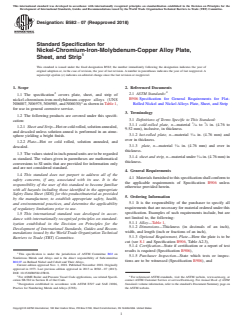
(Specification)Standard Specification for Nickel-Chromium-Iron-Molybdenum-Copper Alloy Plate, Sheet, and Strip
General Information
- Abstract
ABSTRACT
This specification deals with the standard requirements for nickel-chromium-iron-molybdenum-copper alloys (UNS N06007, N06975, N06985, and N06030) in the form of plate, sheet, and strip for use in general corrosive services. These materials shall undergo hot or cold rolling, solution annealing, and descaling. The plates shall have sheared or cut machined, abrasive cut, powder cut, or inert arc cut edges while the sheet and strip shall have sheared or slit edges. Heat and product analysis shall be performed to determine the chemical composition of the specimens which shall conform to the specified nickel, chromium, iron, molybdenum, copper, manganese, cobalt, carbon, tungsten, silicon, phosphorus, sulfur, columbium, tantalum, and titanium limits. The materials shall also conform to the mechanical property requirements for tensile strength, yield strength, elongation, and Rockwell hardness.
SCOPE
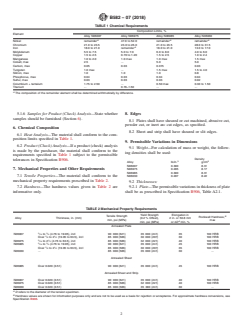
1.1 The specification2 covers plate, sheet, and strip of nickel-chromium-iron-molybdenum-copper alloys (UNS N06007, N06975, N06985, and N06030)3 as shown in Table 1, for use in general corrosive service.
1.2 The following products are covered under this specification:
1.2.1 Sheet and Strip—Hot or cold rolled, solution annealed, and descaled unless solution anneal is performed in an atmosphere yielding a bright finish.
1.2.2 Plate—Hot or cold rolled, solution annealed, and descaled.
1.3 The values stated in inch-pound units are to be regarded as standard. The values given in parentheses are mathematical conversions to SI units that are provided for information only and are not considered standard.
1.4 This standard does not purport to address all of the safety concerns, if any, associated with its use. It is the responsibility of the user of this standard to become familiar with all hazards including those identified in the appropriate Safety Data Sheet (SDS) for this product/material as provided by the manufacturer, to establish appropriate safety, health, and environmental practices, and determine the applicability of regulatory limitations prior to use.
1.5 This international standard was developed in accordance with internationally recognized principles on standardization established in the Decision on Principles for the Development of International Standards, Guides and Recommendations issued by the World Trade Organization Technical Barriers to Trade (TBT) Committee.
- Status
- Published
- Publication Date
- 31-Oct-2018
- Technical Committee
- B02 - Nonferrous Metals and Alloys
- Drafting Committee
- B02.07 - Refined Nickel and Cobalt and Their Alloys


Overview
ASTM B582-07(2018) is the standard specification developed by ASTM International covering Nickel-Chromium-Iron-Molybdenum-Copper alloys (UNS N06007, N06975, N06985, and N06030) in the form of plate, sheet, and strip. These materials are designed for general corrosive service and manufactured through hot or cold rolling, followed by solution annealing and descaling. The standard establishes mandatory chemical composition and mechanical property requirements to ensure consistency and performance, making it essential for a variety of industrial applications where corrosion resistance and material reliability are priorities.
Key Topics
Material Forms Covered:
- Plate
- Sheet
- Strip
Alloy Grades:
- UNS N06007
- UNS N06975
- UNS N06985
- UNS N06030
Manufacturing Processes:
- Hot or cold rolling
- Solution annealing
- Descaling
Edge and Surface Finish:
- Plates: Sheared or various cut edge options
- Sheet/Strip: Sheared or slit edges
Chemical Composition:
Alloys must conform to limits for nickel, chromium, iron, molybdenum, copper, manganese, cobalt, carbon, tungsten, silicon, phosphorus, sulfur, columbium, tantalum, and titanium.Mechanical Property Requirements:
- Tensile strength
- Yield strength
- Elongation
- Hardness (Rockwell, informative only)
Dimensional Tolerances:
Thickness, width, length, squareness, and flatness as specified and referenced in ASTM B906.Marking and Certification:
Plates, sheets, and strips require clear marking for identification and traceability.
Applications
The materials specified in ASTM B582 are widely used in sectors that demand high corrosion resistance and robust mechanical properties. Typical applications include:
- Chemical processing equipment: Storage tanks, heat exchangers, and piping systems where resistance to aggressive chemicals is critical.
- Energy and power generation: Components in boiler and pressure vessel construction, especially when subject to corrosive environments.
- Petrochemical and refining industries: For equipment subjected to harsh chemical exposure and varying pressures.
- Marine engineering: Structural parts, assemblies, and fixtures exposed to seawater and saline atmospheres.
- Pollution control and environmental equipment: Scrubber systems, flue-gas desulfurization, and wastewater processing infrastructure.
- Pharmaceutical and food processing: Where non-reactive surfaces and contamination resistance are vital.
The standard is particularly beneficial when specifying materials that must maintain performance in environments where typical steel alloys would corrode or fail.
Related Standards
- ASTM B906: General requirements for flat-rolled nickel and nickel alloys plate, sheet, and strip. Referenced for additional dimensional and testing requirements.
- ASME SB-582: The ASME Boiler and Pressure Vessel Code equivalent for pressure-related applications.
- UNS Designations (ASTM E527, SAE J1086): Numbering system for metals and alloys, ensuring consistent identification.
- Safety Data Sheets (SDS): Compliance with safety, health, and environmental practices is mandatory when using these materials.
By following ASTM B582, organizations ensure they are selecting, testing, and purchasing nickel-chromium-iron-molybdenum-copper alloy plate, sheet, and strip that meet proven standards for quality and performance in challenging, corrosive conditions.
Keywords: ASTM B582, nickel alloy plate, corrosion-resistant alloys, UNS N06007, N06975, N06985, N06030, sheet, strip, chemical composition, mechanical properties, industrial materials, corrosive service.
Relations
- Effective Date
- 01-Nov-2018
- Effective Date
- 01-Nov-2017
- Effective Date
- 01-May-2012
- Effective Date
- 01-Dec-2006
- Effective Date
- 10-Oct-2002
- Effective Date
- 10-Jun-2000
- Effective Date
- 01-Nov-2018
- Referred By
ASTM B474/B474M-19 - Standard Specification for Electric Fusion Welded Nickel and Nickel Alloy Pipe - Effective Date
- 01-Nov-2018
- Referred By
ASTM A265-12(2019) - Standard Specification for Nickel and Nickel-Base Alloy-Clad Steel Plate - Effective Date
- 01-Nov-2018
- Effective Date
- 01-Nov-2018
Get Certified
Connect with accredited certification bodies for this standard

Element Materials Technology
Materials testing and product certification.

Inštitut za kovinske materiale in tehnologije
Institute of Metals and Technology. Materials testing, metallurgical analysis, NDT.
Sponsored listings
Frequently Asked Questions
ASTM B582-07(2018) is a technical specification published by ASTM International. Its full title is "Standard Specification for Nickel-Chromium-Iron-Molybdenum-Copper Alloy Plate, Sheet, and Strip". This standard covers: ABSTRACT This specification deals with the standard requirements for nickel-chromium-iron-molybdenum-copper alloys (UNS N06007, N06975, N06985, and N06030) in the form of plate, sheet, and strip for use in general corrosive services. These materials shall undergo hot or cold rolling, solution annealing, and descaling. The plates shall have sheared or cut machined, abrasive cut, powder cut, or inert arc cut edges while the sheet and strip shall have sheared or slit edges. Heat and product analysis shall be performed to determine the chemical composition of the specimens which shall conform to the specified nickel, chromium, iron, molybdenum, copper, manganese, cobalt, carbon, tungsten, silicon, phosphorus, sulfur, columbium, tantalum, and titanium limits. The materials shall also conform to the mechanical property requirements for tensile strength, yield strength, elongation, and Rockwell hardness. SCOPE 1.1 The specification2 covers plate, sheet, and strip of nickel-chromium-iron-molybdenum-copper alloys (UNS N06007, N06975, N06985, and N06030)3 as shown in Table 1, for use in general corrosive service. 1.2 The following products are covered under this specification: 1.2.1 Sheet and Strip—Hot or cold rolled, solution annealed, and descaled unless solution anneal is performed in an atmosphere yielding a bright finish. 1.2.2 Plate—Hot or cold rolled, solution annealed, and descaled. 1.3 The values stated in inch-pound units are to be regarded as standard. The values given in parentheses are mathematical conversions to SI units that are provided for information only and are not considered standard. 1.4 This standard does not purport to address all of the safety concerns, if any, associated with its use. It is the responsibility of the user of this standard to become familiar with all hazards including those identified in the appropriate Safety Data Sheet (SDS) for this product/material as provided by the manufacturer, to establish appropriate safety, health, and environmental practices, and determine the applicability of regulatory limitations prior to use. 1.5 This international standard was developed in accordance with internationally recognized principles on standardization established in the Decision on Principles for the Development of International Standards, Guides and Recommendations issued by the World Trade Organization Technical Barriers to Trade (TBT) Committee.
ABSTRACT This specification deals with the standard requirements for nickel-chromium-iron-molybdenum-copper alloys (UNS N06007, N06975, N06985, and N06030) in the form of plate, sheet, and strip for use in general corrosive services. These materials shall undergo hot or cold rolling, solution annealing, and descaling. The plates shall have sheared or cut machined, abrasive cut, powder cut, or inert arc cut edges while the sheet and strip shall have sheared or slit edges. Heat and product analysis shall be performed to determine the chemical composition of the specimens which shall conform to the specified nickel, chromium, iron, molybdenum, copper, manganese, cobalt, carbon, tungsten, silicon, phosphorus, sulfur, columbium, tantalum, and titanium limits. The materials shall also conform to the mechanical property requirements for tensile strength, yield strength, elongation, and Rockwell hardness. SCOPE 1.1 The specification2 covers plate, sheet, and strip of nickel-chromium-iron-molybdenum-copper alloys (UNS N06007, N06975, N06985, and N06030)3 as shown in Table 1, for use in general corrosive service. 1.2 The following products are covered under this specification: 1.2.1 Sheet and Strip—Hot or cold rolled, solution annealed, and descaled unless solution anneal is performed in an atmosphere yielding a bright finish. 1.2.2 Plate—Hot or cold rolled, solution annealed, and descaled. 1.3 The values stated in inch-pound units are to be regarded as standard. The values given in parentheses are mathematical conversions to SI units that are provided for information only and are not considered standard. 1.4 This standard does not purport to address all of the safety concerns, if any, associated with its use. It is the responsibility of the user of this standard to become familiar with all hazards including those identified in the appropriate Safety Data Sheet (SDS) for this product/material as provided by the manufacturer, to establish appropriate safety, health, and environmental practices, and determine the applicability of regulatory limitations prior to use. 1.5 This international standard was developed in accordance with internationally recognized principles on standardization established in the Decision on Principles for the Development of International Standards, Guides and Recommendations issued by the World Trade Organization Technical Barriers to Trade (TBT) Committee.
ASTM B582-07(2018) is classified under the following ICS (International Classification for Standards) categories: 77.150.40 - Nickel and chromium products. The ICS classification helps identify the subject area and facilitates finding related standards.
ASTM B582-07(2018) has the following relationships with other standards: It is inter standard links to ASTM B582-07(2013), ASTM B906-02(2017), ASTM B906-02(2012), ASTM B906-02(2006), ASTM B906-02, ASTM B906-00, ASTM B366/B366M-23, ASTM B474/B474M-19, ASTM A265-12(2019), ASTM B906-22. Understanding these relationships helps ensure you are using the most current and applicable version of the standard.
ASTM B582-07(2018) is available in PDF format for immediate download after purchase. The document can be added to your cart and obtained through the secure checkout process. Digital delivery ensures instant access to the complete standard document.
Standards Content (Sample)
This international standard was developed in accordance with internationally recognized principles on standardization established in the Decision on Principles for the
Development of International Standards, Guides and Recommendations issued by the World Trade Organization Technical Barriers to Trade (TBT) Committee.
Designation: B582 −07 (Reapproved 2018)
Standard Specification for
Nickel-Chromium-Iron-Molybdenum-Copper Alloy Plate,
Sheet, and Strip
This standard is issued under the fixed designation B582; the number immediately following the designation indicates the year of
original adoption or, in the case of revision, the year of last revision. A number in parentheses indicates the year of last reapproval. A
superscript epsilon (´) indicates an editorial change since the last revision or reapproval.
1. Scope 2. Referenced Documents
2.1 ASTM Standards:
1.1 The specification covers plate, sheet, and strip of
B906 Specification for General Requirements for Flat-
nickel-chromium-iron-molybdenum-copper alloys (UNS
Rolled Nickel and Nickel Alloys Plate, Sheet, and Strip
N06007, N06975, N06985, and N06030) as shown in Table 1,
for use in general corrosive service.
3. Terminology
1.2 The following products are covered under this specifi-
3.1 Definitions of Terms Specific to This Standard:
cation:
3 3
3.1.1 cold-rolled plate, n—material ⁄16 to ⁄8 in. (4.76 to
1.2.1 Sheet and Strip—Hotorcoldrolled,solutionannealed,
9.52 mm), inclusive, in thickness.
and descaled unless solution anneal is performed in an atmo-
3.1.2 hot-rolled plate, n—material ⁄16 in. (4.76 mm) and
sphere yielding a bright finish.
over in thickness.
1.2.2 Plate—Hot or cold rolled, solution annealed, and
3.1.3 plate, n—material ⁄16 in. (4.76 mm) and over in
descaled.
thickness.
1.3 The values stated in inch-pound units are to be regarded
3.1.4 sheet and strip, n—material under ⁄16 in. (4.76 mm) in
as standard. The values given in parentheses are mathematical
thickness.
conversions to SI units that are provided for information only
and are not considered standard.
4. General Requirements
1.4 This standard does not purport to address all of the
4.1 Materials furnished to this specification shall conform to
safety concerns, if any, associated with its use. It is the
the applicable requirements of Specification B906 unless
responsibility of the user of this standard to become familiar
otherwise provided herein.
with all hazards including those identified in the appropriate
Safety Data Sheet (SDS) for this product/material as provided
5. Ordering Information
by the manufacturer, to establish appropriate safety, health,
5.1 It is the responsibility of the purchaser to specify all
and environmental practices, and determine the applicability
requirements that are necessary for material ordered under this
of regulatory limitations prior to use.
specification. Examples of such requirements include, but are
1.5 This international standard was developed in accor-
not limited to, the following:
dance with internationally recognized principles on standard-
5.1.1 Alloy—Table 1,
ization established in the Decision on Principles for the
5.1.2 Dimensions—Thickness (in decimals of an inch),
Development of International Standards, Guides and Recom-
width, and length (inch or fractions of an inch),
mendations issued by the World Trade Organization Technical
5.1.3 Optional Requirement, Plate—How the plate is to be
Barriers to Trade (TBT) Committee.
cut (see 8.1 and Specification B906, Table A2.3),
5.1.4 Certification—State if certification or a report of test
results is required (Specification B906),
This specification is under the jurisdiction of ASTM Committee B02 on
5.1.5 Purchaser Inspection—State which tests or inspec-
Nonferrous Metals and Alloys and is the direct responsibility of Subcommittee
tions are to be witnessed (Specification B906), and
B02.07 on Refined Nickel and Cobalt and Their Alloys.
Current edition approved Nov. 1, 2018. Published November 2018. Originally
approved in 1973. Last previous edition approved in 2013 as B582 – 07 (2013).
DOI: 10.1520/B0582-07R18.
2 4
For ASME Boiler and Pressure Vessel Code applications, see related Specifi- For referenced ASTM standards, visit the ASTM website, www.astm.org, or
cation SB-582 in Section II of that Code. contact ASTM Customer Service at service@astm.org. For Annual Book of ASTM
Designation established in accordance with ASTM E527 and SAE J1086, Standards volume information, refer to the standard’s Document Summary page on
Practice for Numbering Metals and Alloys (UNS). the ASTM website.
Copyright © ASTM International, 100 Barr Harbor Drive, PO Box C700, West Conshohocken, PA 19428-2959. United States
B582 − 07 (2018)
TABLE 1 Chemical Requirements
Composition Limits, %
Element
Alloy N06007 Alloy N06975 Alloy N06985 Alloy N06030
A A A
Nickel remainder 47.0 to 52.0 remainder remainder
Chromium 21.0 to 23.5 23.0 to 26.0 21.0 to 23.5 28.0 to 31.5
A
Iron 18.0 to 21.0 remainder 18.0 to 21.0 13.0 to 17.0
Molybdenum 5.5 to 7.5 5.0 to 7.0 6.0 to 8.0 4.0 to 6.0
Copper 1.5 to 2.5 0.70 to 1.20 1.5 to 2.5 1.0 to 2.4
Manganese 1.0 to 2.0 1.0 max 1.0 max 1.5 max
Cobalt, max 2.5 . 5.0 5.0
Carbon, max 0.05 0.03 0.015 0.03
Tungsten 1.0 max . 1.5 max 1.5 to 4.0
Silicon, max 1.0 1.0 1.0 0.8
Phosphorus, max 0.04 0.03 0.04 0.04
Sulfur, max 0.03 0.03 0.03 0.02
Columbium + tantalum 1.75 to 2.50 . 0.50 max 0.30 to 1.50
Titanium . 0.70–1.50 . .
A
The composition of the remainder element shall be determined arithmetically by difference.
5.1.6 Samples for Product (Check) Analysis—State whether 8. Edges
samples should be furnished (Section 6).
8.1 Plates shall have sheared or cut machined, abrasive cut,
powder cut, or inert arc cut edges, as specified.
6. Chemical Composition
8.2 Sheet and strip shall have sheared or slit edges.
6.1 Heat Analysis—
...