

ASTM D6170-17
(Guide)Standard Guide for Selecting a Groundwater Modeling Code
General Information
- Abstract
SIGNIFICANCE AND USE
4.1 Groundwater modeling has become an important methodology in support of the planning and decision-making processes involved in groundwater management. Groundwater models provide an analytical framework for obtaining an understanding of the mechanisms and controls of groundwater systems and the processes that influence their quality, especially those caused by human intervention in such systems. Increasingly, models are an integral part of water resources assessment, protection, and restoration studies, and provide needed and cost-effective support for planning and screening of alternative policies, regulations, and engineering designs affecting groundwater.4
4.2 Many different groundwater modeling codes are available, each with their own capabilities, operational characteristics and limitations. Furthermore, each groundwater project has its own requirements with respect to modeling. Therefore, it is important that the most appropriate code is selected for a particular project. This is even more important for projects that require extensive modeling, or where costly decisions are based, in part, on the outcome of modeling-based analysis.
4.3 Systematic and comprehensive description of project requirements and code features provides the necessary basis for efficient selection of a groundwater modeling code. This standard guide is intended to encourage comprehensive and consistent description of code capabilities and code requirements in the code selection process, as well as thorough documentation of the code selection process.
SCOPE
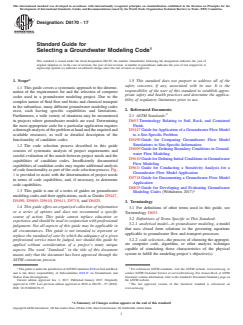
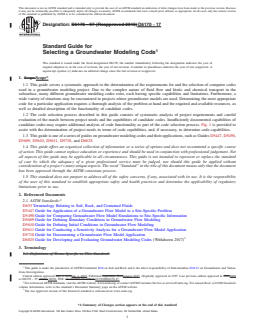
1.1 This guide covers a systematic approach to the determination of the requirements for and the selection of computer codes used in a groundwater modeling project. Due to the complex nature of fluid flow and biotic and chemical transport in the subsurface, many different groundwater modeling codes exist, each having specific capabilities and limitations. Furthermore, a wide variety of situations may be encountered in projects where groundwater models are used. Determining the most appropriate code for a particular application requires a thorough analysis of the problem at hand and the required and available resources, as well as detailed description of the functionality of candidate codes.
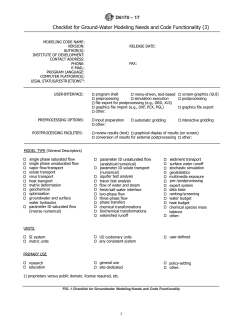
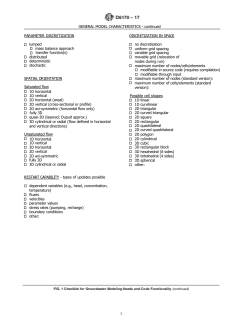
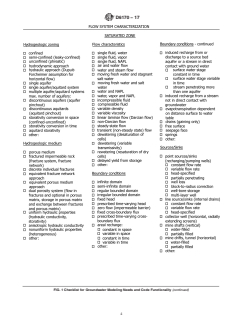
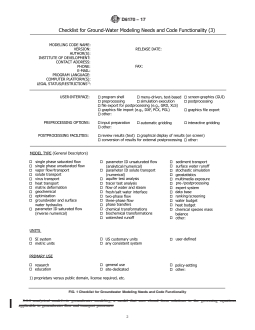
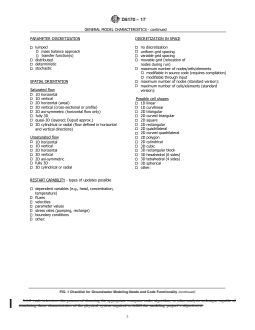
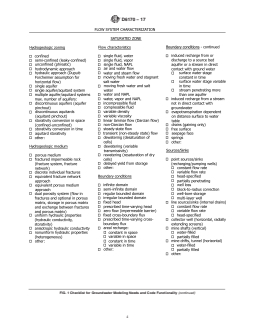
1.2 The code selection process described in this guide consists of systematic analysis of project requirements and careful evaluation of the match between project needs and the capabilities of candidate codes. Insufficiently documented capabilities of candidate codes may require additional analysis of code functionality as part of the code selection process. Fig. 1 is provided to assist with the determination of project needs in terms of code capabilities, and, if necessary, to determine code capabilities.
1.3 This guide is one of a series of guides on groundwater modeling codes and their applications, such as Guides D5447, D5490, D5609, D5610, D5611, D5718, and D6025.
1.4 This guide offers an organized collection of information or a series of options and does not recommend a specific course of action. This guide cannot replace education or experience and should be used in conjunction with professional judgement. Not all aspects of this guide may be applicable in all circumstances. This guide is not intended to represent or replace the standard of care by which the adequacy of a given professional service must be judged, nor should this guide be applied without consideration of a project's many unique aspects. The word “Standard” in the title of this document means only that the document has been approved through the ASTM consensus process.
1.5 This standard does not purport to address all of the safety concerns, if any, associated with its use. It is the responsibility of the user of this standard to establish appropriate safety and health practices and determine the applicability of regulatory limitations prior to use.
- Status
- Published
- Publication Date
- 31-Dec-2016
- Technical Committee
- D18 - Soil and Rock
- Drafting Committee
- D18.21 - Groundwater and Vadose Zone Investigations
Overview
ASTM D6170-17: Standard Guide for Selecting a Groundwater Modeling Code provides a systematic approach for determining requirements and selecting appropriate computer codes in groundwater modeling projects. Developed by ASTM International, this standard emphasizes the importance of careful analysis and documentation throughout the code selection process. Groundwater models serve a vital role in supporting groundwater management decisions, resource assessment, environmental protection, and restoration projects.
The standard does not prescribe a specific modeling code, but instead guides users through evaluating project needs and available code functionalities. This helps ensure reliable modeling outcomes, optimal allocation of resources, and defensible decision-making in groundwater applications.
Key Topics
Systematic Code Selection:
- Emphasizes matching project-specific modeling needs with the functionalities of existing groundwater modeling codes.
- Recommends a thorough analysis and detailed description of both project requirements and candidate code capabilities.
Essential vs. Non-Essential Functions:
- Encourages users to distinguish between essential and non-essential code capabilities, focusing on core requirements for the intended application.
- Provides guidelines for weighting non-essential features to aid in the selection process.
Code Documentation and Credibility:
- Stresses the need for reviewing code documentation, theoretical foundations, history of use, and verification data.
- Discusses user support, code availability (public domain and proprietary), operational characteristics, and the importance of up-to-date, well-structured documentation.
Project and Modeling Objectives:
- Promotes formulating clear project objectives, modeling goals, acceptable levels of uncertainty, and defining the conceptual model of the groundwater system.
- Recommends documentation of the code selection process within project reports for transparency and future reference.
Iterative and Judgement-Based Process:
- Recognizes that code selection is often iterative and relies heavily on professional judgment, especially when project needs evolve or information is incomplete.
Applications
ASTM D6170-17 is essential for professionals and organizations undertaking groundwater modeling projects, including:
Water Resource Assessment:
Used for evaluating aquifer systems, groundwater availability, and sustainable usage scenarios.Environmental Impact and Remediation:
Supports assessment and management of contaminant transport, site remediation planning, and risk evaluation at facilities.Infrastructure and Land Use Planning:
Guides policy development, facility siting, and impact screening where groundwater interactions are significant.Regulatory and Compliance Projects:
Assists in preparing defensible technical documentation for regulatory submissions related to groundwater management.
By applying this standard, users can select modeling codes that are well-matched to their project’s scale, data availability, complexity, technical requirements, and stakeholder concerns. This minimizes unnecessary work, maximizes predictive reliability, and supports transparent decision-making in groundwater studies.
Related Standards
ASTM D6170-17 is part of a broader suite of ASTM guides addressing groundwater modeling. Related standards include:
- ASTM D5447: Application of a Groundwater Flow Model to a Site-Specific Problem
- ASTM D5490: Comparing Groundwater Flow Model Simulations to Site-Specific Information
- ASTM D5609: Defining Boundary Conditions in Groundwater Flow Modeling
- ASTM D5610: Defining Initial Conditions in Groundwater Flow Modeling
- ASTM D5611: Conducting a Sensitivity Analysis for a Groundwater Flow Model Application
- ASTM D5718: Documenting a Groundwater Flow Model Application
Consulting these related standards alongside ASTM D6170-17 supports comprehensive and robust groundwater modeling practice.
Keywords: ASTM D6170-17, groundwater modeling code selection, groundwater model, code evaluation, simulation, water resource assessment, environmental impact, code documentation, public domain software, proprietary software, code selection standard.
Relations
- Effective Date
- 01-Jan-2017
- Effective Date
- 15-Dec-2017
- Effective Date
- 01-Mar-2016
- Effective Date
- 01-Jan-2016
- Effective Date
- 01-Aug-2014
- Effective Date
- 01-May-2012
- Effective Date
- 01-Sep-2011
- Effective Date
- 01-Aug-2010
- Effective Date
- 01-Jan-2009
- Effective Date
- 01-Dec-2008
- Effective Date
- 01-Nov-2008
- Refers
ASTM D5609-94(2008) - Standard Guide for Defining Boundary Conditions in Groundwater Flow Modeling - Effective Date
- 15-Sep-2008
- Refers
ASTM D5609-94(2015)e1 - Standard Guide for Defining Boundary Conditions in Groundwater Flow Modeling - Effective Date
- 15-Sep-2008
- Effective Date
- 15-Sep-2008
- Effective Date
- 15-Sep-2008
Get Certified
Connect with accredited certification bodies for this standard

CIS Institut d.o.o.
Personal Protective Equipment (PPE) certification body. Notified Body NB-2890 for EU Regulation 2016/425 PPE.

Kiwa BDA Testing
Building and construction product certification.
Kmetijski inštitut Slovenije
Agricultural Institute of Slovenia. Soil testing, plant health, agricultural product analysis.
Sponsored listings
Frequently Asked Questions
ASTM D6170-17 is a guide published by ASTM International. Its full title is "Standard Guide for Selecting a Groundwater Modeling Code". This standard covers: SIGNIFICANCE AND USE 4.1 Groundwater modeling has become an important methodology in support of the planning and decision-making processes involved in groundwater management. Groundwater models provide an analytical framework for obtaining an understanding of the mechanisms and controls of groundwater systems and the processes that influence their quality, especially those caused by human intervention in such systems. Increasingly, models are an integral part of water resources assessment, protection, and restoration studies, and provide needed and cost-effective support for planning and screening of alternative policies, regulations, and engineering designs affecting groundwater.4 4.2 Many different groundwater modeling codes are available, each with their own capabilities, operational characteristics and limitations. Furthermore, each groundwater project has its own requirements with respect to modeling. Therefore, it is important that the most appropriate code is selected for a particular project. This is even more important for projects that require extensive modeling, or where costly decisions are based, in part, on the outcome of modeling-based analysis. 4.3 Systematic and comprehensive description of project requirements and code features provides the necessary basis for efficient selection of a groundwater modeling code. This standard guide is intended to encourage comprehensive and consistent description of code capabilities and code requirements in the code selection process, as well as thorough documentation of the code selection process. SCOPE 1.1 This guide covers a systematic approach to the determination of the requirements for and the selection of computer codes used in a groundwater modeling project. Due to the complex nature of fluid flow and biotic and chemical transport in the subsurface, many different groundwater modeling codes exist, each having specific capabilities and limitations. Furthermore, a wide variety of situations may be encountered in projects where groundwater models are used. Determining the most appropriate code for a particular application requires a thorough analysis of the problem at hand and the required and available resources, as well as detailed description of the functionality of candidate codes. 1.2 The code selection process described in this guide consists of systematic analysis of project requirements and careful evaluation of the match between project needs and the capabilities of candidate codes. Insufficiently documented capabilities of candidate codes may require additional analysis of code functionality as part of the code selection process. Fig. 1 is provided to assist with the determination of project needs in terms of code capabilities, and, if necessary, to determine code capabilities. 1.3 This guide is one of a series of guides on groundwater modeling codes and their applications, such as Guides D5447, D5490, D5609, D5610, D5611, D5718, and D6025. 1.4 This guide offers an organized collection of information or a series of options and does not recommend a specific course of action. This guide cannot replace education or experience and should be used in conjunction with professional judgement. Not all aspects of this guide may be applicable in all circumstances. This guide is not intended to represent or replace the standard of care by which the adequacy of a given professional service must be judged, nor should this guide be applied without consideration of a project's many unique aspects. The word “Standard” in the title of this document means only that the document has been approved through the ASTM consensus process. 1.5 This standard does not purport to address all of the safety concerns, if any, associated with its use. It is the responsibility of the user of this standard to establish appropriate safety and health practices and determine the applicability of regulatory limitations prior to use.
SIGNIFICANCE AND USE 4.1 Groundwater modeling has become an important methodology in support of the planning and decision-making processes involved in groundwater management. Groundwater models provide an analytical framework for obtaining an understanding of the mechanisms and controls of groundwater systems and the processes that influence their quality, especially those caused by human intervention in such systems. Increasingly, models are an integral part of water resources assessment, protection, and restoration studies, and provide needed and cost-effective support for planning and screening of alternative policies, regulations, and engineering designs affecting groundwater.4 4.2 Many different groundwater modeling codes are available, each with their own capabilities, operational characteristics and limitations. Furthermore, each groundwater project has its own requirements with respect to modeling. Therefore, it is important that the most appropriate code is selected for a particular project. This is even more important for projects that require extensive modeling, or where costly decisions are based, in part, on the outcome of modeling-based analysis. 4.3 Systematic and comprehensive description of project requirements and code features provides the necessary basis for efficient selection of a groundwater modeling code. This standard guide is intended to encourage comprehensive and consistent description of code capabilities and code requirements in the code selection process, as well as thorough documentation of the code selection process. SCOPE 1.1 This guide covers a systematic approach to the determination of the requirements for and the selection of computer codes used in a groundwater modeling project. Due to the complex nature of fluid flow and biotic and chemical transport in the subsurface, many different groundwater modeling codes exist, each having specific capabilities and limitations. Furthermore, a wide variety of situations may be encountered in projects where groundwater models are used. Determining the most appropriate code for a particular application requires a thorough analysis of the problem at hand and the required and available resources, as well as detailed description of the functionality of candidate codes. 1.2 The code selection process described in this guide consists of systematic analysis of project requirements and careful evaluation of the match between project needs and the capabilities of candidate codes. Insufficiently documented capabilities of candidate codes may require additional analysis of code functionality as part of the code selection process. Fig. 1 is provided to assist with the determination of project needs in terms of code capabilities, and, if necessary, to determine code capabilities. 1.3 This guide is one of a series of guides on groundwater modeling codes and their applications, such as Guides D5447, D5490, D5609, D5610, D5611, D5718, and D6025. 1.4 This guide offers an organized collection of information or a series of options and does not recommend a specific course of action. This guide cannot replace education or experience and should be used in conjunction with professional judgement. Not all aspects of this guide may be applicable in all circumstances. This guide is not intended to represent or replace the standard of care by which the adequacy of a given professional service must be judged, nor should this guide be applied without consideration of a project's many unique aspects. The word “Standard” in the title of this document means only that the document has been approved through the ASTM consensus process. 1.5 This standard does not purport to address all of the safety concerns, if any, associated with its use. It is the responsibility of the user of this standard to establish appropriate safety and health practices and determine the applicability of regulatory limitations prior to use.
ASTM D6170-17 is classified under the following ICS (International Classification for Standards) categories: 13.060.10 - Water of natural resources. The ICS classification helps identify the subject area and facilitates finding related standards.
ASTM D6170-17 has the following relationships with other standards: It is inter standard links to ASTM D6170-97(2010), ASTM D5447-17, ASTM D5609-16, ASTM D5611-94(2016), ASTM D653-14, ASTM D5718-95(2012), ASTM D653-11, ASTM D5447-04(2010), ASTM D653-09, ASTM D653-08a, ASTM D653-08, ASTM D5609-94(2008), ASTM D5609-94(2015)e1, ASTM D6025-96(2008), ASTM D5490-93(2008). Understanding these relationships helps ensure you are using the most current and applicable version of the standard.
ASTM D6170-17 is available in PDF format for immediate download after purchase. The document can be added to your cart and obtained through the secure checkout process. Digital delivery ensures instant access to the complete standard document.
Standards Content (Sample)
This international standard was developed in accordance with internationally recognized principles on standardization established in the Decision on Principles for the
Development of International Standards, Guides and Recommendations issued by the World Trade Organization Technical Barriers to Trade (TBT) Committee.
Designation: D6170 − 17
Standard Guide for
Selecting a Groundwater Modeling Code
This standard is issued under the fixed designation D6170; the number immediately following the designation indicates the year of
original adoption or, in the case of revision, the year of last revision. A number in parentheses indicates the year of last reapproval. A
superscript epsilon (´) indicates an editorial change since the last revision or reapproval.
1. Scope* 1.5 This standard does not purport to address all of the
safety concerns, if any, associated with its use. It is the
1.1 This guide covers a systematic approach to the determi-
responsibility of the user of this standard to establish appro-
nation of the requirements for and the selection of computer
priate safety and health practices and determine the applica-
codes used in a groundwater modeling project. Due to the
bility of regulatory limitations prior to use.
complex nature of fluid flow and biotic and chemical transport
in the subsurface, many different groundwater modeling codes
2. Referenced Documents
exist, each having specific capabilities and limitations.
Furthermore, a wide variety of situations may be encountered 2.1 ASTM Standards:
D653 Terminology Relating to Soil, Rock, and Contained
in projects where groundwater models are used. Determining
the most appropriate code for a particular application requires Fluids
D5447 Guide forApplication of a Groundwater Flow Model
athoroughanalysisoftheproblemathandandtherequiredand
available resources, as well as detailed description of the to a Site-Specific Problem
D5490 Guide for Comparing Groundwater Flow Model
functionality of candidate codes.
Simulations to Site-Specific Information
1.2 The code selection process described in this guide
D5609 Guide for Defining Boundary Conditions in Ground-
consists of systematic analysis of project requirements and
water Flow Modeling
careful evaluation of the match between project needs and the
D5610 GuideforDefiningInitialConditionsinGroundwater
capabilities of candidate codes. Insufficiently documented
Flow Modeling
capabilities of candidate codes may require additional analysis
D5611 Guide for Conducting a Sensitivity Analysis for a
of code functionality as part of the code selection process. Fig.
Groundwater Flow Model Application
1 is provided to assist with the determination of project needs
D5718 Guide for Documenting a Groundwater Flow Model
in terms of code capabilities, and, if necessary, to determine
Application
code capabilities.
D6025 Guide for Developing and Evaluating Groundwater
1.3 This guide is one of a series of guides on groundwater
Modeling Codes (Withdrawn 2017)
modeling codes and their applications, such as Guides D5447,
D5490, D5609, D5610, D5611, D5718, and D6025.
3. Terminology
1.4 This guide offers an organized collection of information
3.1 For definitions of other terms used in this guide, see
or a series of options and does not recommend a specific
Terminology D653.
course of action. This guide cannot replace education or
3.2 Definitions of Terms Specific to This Standard:
experience and should be used in conjunction with professional
3.2.1 analytical model—in groundwater modeling, a model
judgement. Not all aspects of this guide may be applicable in
that uses closed form solutions to the governing equations
all circumstances. This guide is not intended to represent or
applicable to groundwater flow and transport processes.
replace the standard of care by which the adequacy of a given
3.2.2 code selection—the process of choosing the appropri-
professional service must be judged, nor should this guide be
ate computer code, algorithm, or other analysis technique
applied without consideration of a project’s many unique
capable of simulating those characteristics of the physical
aspects. The word “Standard” in the title of this document
system to fulfill the modeling project’s objective(s).
means only that the document has been approved through the
ASTM consensus process.
1 2
This guide is under the jurisdiction ofASTM Committee D18 on Soil and Rock For referenced ASTM standards, visit the ASTM website, www.astm.org, or
and is the direct responsibility of Subcommittee D18.21 on Groundwater and contact ASTM Customer Service at service@astm.org. For Annual Book of ASTM
Vadose Zone Investigations. Standards volume information, refer to the standard’s Document Summary page on
Current edition approved Jan. 1, 2017. Published January 2017. Originally the ASTM website.
approved in 1997. Last previous edition approved in 2010 as D6170 – 97 (2010). The last approved version of this historical standard is referenced on
DOI: 10.1520/D6170-17. www.astm.org.
*A Summary of Changes section appears at the end of this standard
Copyright © ASTM International, 100 Barr Harbor Drive, PO Box C700, West Conshohocken, PA 19428-2959. United States
D6170 − 17
FIG. 1 Checklist for Groundwater Modeling Needs and Code Functionality
D6170 − 17
FIG. 1 Checklist for Groundwater Modeling Needs and Code Functionality (continued)
D6170 − 17
FIG. 1 Checklist for Groundwater Modeling Needs and Code Functionality (continued)
D6170 − 17
FIG. 1 Checklist for Groundwater Modeling Needs and Code Functionality (continued)
D6170 − 17
FIG. 1 Checklist for Groundwater Modeling Needs and Code Functionality (continued)
D6170 − 17
FIG. 1 Checklist for Groundwater Modeling Needs and Code Functionality (continued)
D6170 − 17
FIG. 1 Checklist for Groundwater Modeling Needs and Code Functionality (continued)
D6170 − 17
FIG. 1 Checklist for Groundwater Modeling Needs and Code Functionality (continued)
D6170 − 17
FIG. 1 Checklist for Groundwater Modeling Needs and Code Functionality (continued)
D6170 − 17
FIG. 1 Checklist for Groundwater Modeling Needs and Code Functionality (continued)
D6170 − 17
FIG. 1 Checklist for Groundwater Modeling Needs and Code Functionality (continued)
D6170 − 17
FIG. 1 Checklist for Groundwater Modeling Needs and Code Functionality (continued)
D6170 − 17
FIG. 1 Checklist for Groundwater Modeling Needs and Code Functionality (continued)
D6170 − 17
FIG. 1 Checklist for Groundwater Modeling Needs and Code Functionality (continued)
3.2.3 conceptual model—an interpretation or working de- 3.2.5 groundwater modeling code—the non-parameterized
scription of the characteristics and dynamics of the physical
computer code used in groundwater modeling to represent a
system.
non-unique, simplified mathematical description of the physi-
cal framework, geometry, active processes, and boundary
3.2.4 functionality—of a groundwater modeling code, the
conditionspresentinareferencesubsurfacehydrologicsystem.
setoffunctionsandfeaturesthecodeofferstheuserintermsof
model framework geometry, simulated processes, boundary
conditions, and analytical and operational capabilities.
D6170 − 17
3.2.6 mathematical model—(a) mathematical equations ex- Each groundwater project in which computer-based modeling
pressing the physical system and including simplifying as- is performed should include a code selection phase.
sumptions; (b) the representation of a physical system by
5.2 Code selection is in essence the process of matching a
mathematical expressions from which the behavior of the
project’s modeling needs with the documented capabilities of
system can be deduced with known accuracy.
existing computer codes.
3.2.7 model construction—the process of transforming the
5.3 Selecting an appropriate code requires analysis and
conceptual model into a parameterized mathematical form; as
systematic description of both the modeling needs and the
parametrization requires assumptions regarding spatial and
characteristics of existing groundwater modeling codes.
temporal discretization, model construction requires a priori
5.4 A perfect match rarely exists between desired code
selection of a computer code.
characteristics or selection criteria and the capabilities or
3.2.8 model schematization—simplification of a conceptual-
functionality of available codes. Therefore, the selection crite-
ized groundwater system for quantitative, model-based analy-
ria are divided into the following two groups: essential code
sis commensurate with project objectives and constraints.
capabilities and non-essential code capabilities. If a candidate
3.2.9 numerical model—in groundwater modeling, a model
code does not include the essential capabilities, it should be
that uses numerical methods to solve the governing equations
removed from consideration.
of the applicable problem.
5.5 The relative importance of the non-essential code capa-
3.2.10 semi-analytical model—a mathematical model in
bilities needs to be assessed. This may be done by assigning
which complex analytical solutions are evaluated using ap-
weighting factors to the considered capabilities (for example,
proximate techniques, resulting in a solution discrete in either
using weights from one to five according to their relative
the space or time domain.
importance). Although such weighing factors are often not
explicitly mentioned in the code selection process, candidate
4. Significance and Use
codes are often ranked implicitly using some kind of weighting
4.1 Groundwater modeling has become an important meth-
of the non-essential capabilities.Assigning weighting factors is
odology in support of the planning and decision-making
a rather subjective procedure; if a match is difficult to obtain,
processes involved in groundwater management. Groundwater
reassessment of these factors may be necessary. Hence, code
models provide an analytical framework for obtaining an
selection may turn out to be a rather iterative process requiring
understanding of the mechanisms and controls of groundwater
a significant level of professional judgment and experience.
systems and the processes that influence their quality, espe-
5.6 Selecting the right code is necessary for an optimal
cially those caused by human intervention in such systems.
trade-off between effort and result in a modeling project. The
Increasingly, models are an integral part of water resources
result can be expressed as the expected effectiveness of the
assessment, protection, and restoration studies, and provide
neededandcost-effectivesupportforplanningandscreeningof modeling tasks in terms of prediction accuracy. The effort is
basicallyrepresentedbythemodelingcosts,suchasincurredin
alternative policies, regulations, and engineering designs af-
becoming familiar with the code, model schematization and
fecting groundwater.
model construction, and model-based scenario analysis. Such
4.2 Many different groundwater modeling codes are
costs should not be considered independently from those of
available, each with their own capabilities, operational charac-
field data acquisition, especially those needed for the modeling
teristics and limitations. Furthermore, each groundwater proj-
effort. For a proper assessment of modeling cost, consideration
ect has its own requirements with respect to modeling.
should be given to the choice of developing a new code (or
Therefore, it is important that the most appropriate code is
modifying an existing one) versus acquisition of an existing
selected for a particular project. This is even more important
code, the implementation and maintenance of the code, com-
for projects that require extensive modeling, or where costly
puter platform requirements, and the development and main-
decisions are based, in part, on the outcome of modeling-based
tenance of databases.
analysis.
NOTE 1—The availability of or familiarity with a particular code, or
4.3 Systematic and comprehensive description of project
both, may lead to modeling overkill by using a pre-chosen code requiring
requirementsandcodefeaturesprovidesthenecessarybasisfor
significantly more preparation in data gathering and model construction
efficient selection of a groundwater modeling code. This
than necessary for the project. Such modeling overkill may also result
standard guide is intended to encourage comprehensive and from the user’s inability to limit the number of “essential” code features,
or to discriminate between non-essential code features.
consistent description of code capabilities and code require-
NOTE 2—The belief that use of the “best” or most mathematically
ments in the code selection process, as well as thorough
advanced codes will automatically provide predictive reliability and
documentation of the code selection process.
scientific credibility is false.The technical capability of the modeler or the
modelingteaminvolvedinthemodelingprojecthasthegreatestimpacton
5. Code Selection Process in Groundwater Modeling
the overall results.
5.1 Codeselectioningroundwatermodelingisacrucialstep
in the application of groundwater models (see Guide D5447).
Simmons, C. R., and Cole, C. R., Guidelines for Selecting Codes for
National Research Council (NRC), Committee on Ground Water Modeling Ground-Water Transport Modeling of Low-Level Waste Burial Sites; Volume 1 –
Assessment,WaterScienceandTechnologyBoard,GroundWaterModels:Scientific GuidelineApproach,PNL-4980Vol1,PacificNorthwestLaboratory,Richland,WA,
and Regulatory Applications, National Academy Press, Washington, DC, 1990. 1985.
D6170 − 17
5.7 If different project questions need to be addressed, more needed, while taking into considerations these scientific and
than one code might be needed or different combinations of technicallimitations,oftenleadstofurthersimplificationofthe
functions of a single code may be utilized. This is often the conceptual model, a process that is sometimes called model
case when models are used in different stages of the project. schematization. Such simplifications may relate to the spatial
For example, in an early stage of a remediation project, a dimensionality of the model, the type of boundary conditions
model is used to assist in problem scoping and system and the geometry of the boundaries employed, the spatial
conceptualization,whileduringthedesignphaseoftheproject, variability or zoning of the system parameters and stresses, the
a model is used to screen between alternative remediation mathematical description of the physical and chemical pro-
techniques and to detail the selected remediation approach. cesses of interest, and the representation of time (that is,
steady-state versus transient). A concise description of the
5.8 If, as a result of the code selection process, a code is
conceptual model used for code selection should include a
selected that requires modification, proper quality assurance
mathematical statement of governing equations and boundary
procedures for code development and testing need to be
and initial conditions (that is, a mathematical model of the
followed (see Guide D6025).
groundwater system).
6. Defining Modeling Needs NOTE 3—Because code selection is a somewhat subjective process, the
danger exists that the availability of or familiarity with a particular code,
6.1 Followingaremajorstepsinevaluatingmodelingneeds:
or both, leads to an attempt to force-fit the conceptual model or even the
formulating the project-related modeling objectives; determin-
study objectives into the mold of a pre-chosen code.
ingtherequiredlevelofanalysis(thatis,modelingcomplexity)
6.5 Modeling, in its widest interpretation, does not always
andreliabilityintermsofpredictionaccuracyandsensitivityof
require the use of c
...
This document is not an ASTM standard and is intended only to provide the user of an ASTM standard an indication of what changes have been made to the previous version. Because
it may not be technically possible to adequately depict all changes accurately, ASTM recommends that users consult prior editions as appropriate. In all cases only the current version
of the standard as published by ASTM is to be considered the official document.
Designation: D6170 − 97 (Reapproved 2010) D6170 − 17
Standard Guide for
Selecting a Groundwater Modeling Code
This standard is issued under the fixed designation D6170; the number immediately following the designation indicates the year of
original adoption or, in the case of revision, the year of last revision. A number in parentheses indicates the year of last reapproval. A
superscript epsilon (´) indicates an editorial change since the last revision or reapproval.
1. Scope Scope*
1.1 This guide covers a systematic approach to the determination of the requirements for and the selection of computer codes
used in a groundwater modeling project. Due to the complex nature of fluid flow and biotic and chemical transport in the
subsurface, many different groundwater modeling codes exist, each having specific capabilities and limitations. Furthermore, a
wide variety of situations may be encountered in projects where groundwater models are used. Determining the most appropriate
code for a particular application requires a thorough analysis of the problem at hand and the required and available resources, as
well as detailed description of the functionality of candidate codes.
1.2 The code selection process described in this guide consists of systematic analysis of project requirements and careful
evaluation of the match between project needs and the capabilities of candidate codes. Insufficiently documented capabilities of
candidate codes may require additional analysis of code functionality as part of the code selection process. Fig. 1 is provided to
assist with the determination of project needs in terms of code capabilities, and, if necessary, to determine code capabilities.
1.3 This guide is one of a series of guides on groundwater modeling codes and their applications, such as Guides D5447, D5490,
D5609, D5610, D5611, D5718, and D6025.
1.4 This guide offers an organized collection of information or a series of options and does not recommend a specific course
of action. This guide cannot replace education or experience and should be used in conjunction with professional judgement. Not
all aspects of this guide may be applicable in all circumstances. This guide is not intended to represent or replace the standard
of care by which the adequacy of a given professional service must be judged, nor should this guide be applied without
consideration of a project’s many unique aspects. The word “Standard” in the title of this document means only that the document
has been approved through the ASTM consensus process.
1.5 This standard does not purport to address all of the safety concerns, if any, associated with its use. It is the responsibility
of the user of this standard to establish appropriate safety and health practices and determine the applicability of regulatory
limitations prior to use.
2. Referenced Documents
2.1 ASTM Standards:
D653 Terminology Relating to Soil, Rock, and Contained Fluids
D5447 Guide for Application of a Groundwater Flow Model to a Site-Specific Problem
D5490 Guide for Comparing Groundwater Flow Model Simulations to Site-Specific Information
D5609 Guide for Defining Boundary Conditions in Groundwater Flow Modeling
D5610 Guide for Defining Initial Conditions in Groundwater Flow Modeling
D5611 Guide for Conducting a Sensitivity Analysis for a Groundwater Flow Model Application
D5718 Guide for Documenting a Groundwater Flow Model Application
D6025 Guide for Developing and Evaluating Groundwater Modeling Codes (Withdrawn 2017)
3. Terminology
3.1 Definitions of Terms Specific to This Standard:
This guide is under the jurisdiction of ASTM Committee D18 on Soil and Rock and is the direct responsibility of Subcommittee D18.21 on Groundwater and Vadose
Zone Investigations.
Current edition approved July 1, 2010Jan. 1, 2017. Published September 2010January 2017. Originally approved in 1997. Last previous edition approved in 20042010
as D6170 – 97 (2004).(2010). DOI: 10.1520/D6170-97R10.10.1520/D6170-17.
For referenced ASTM standards, visit the ASTM website, www.astm.org, or contact ASTM Customer Service at service@astm.org. For Annual Book of ASTM Standards
volume information, refer to the standard’s Document Summary page on the ASTM website.
The last approved version of this historical standard is referenced on www.astm.org.
*A Summary of Changes section appears at the end of this standard
Copyright © ASTM International, 100 Barr Harbor Drive, PO Box C700, West Conshohocken, PA 19428-2959. United States
D6170 − 17
FIG. 1 Checklist for Groundwater Modeling Needs and Code Functionality
3.1.1 analytical model—in groundwater modeling, a model that uses closed form solutions to the governing equations
applicable to groundwater flow and transport processes.
D6170 − 17
FIG. 1 Checklist for Groundwater Modeling Needs and Code Functionality (continued)
3.1.2 code selection—the process of choosing the appropriate computer code, algorithm, or other analysis technique capable of
simulating those characteristics of the physical system required to fulfill the modeling project’s objective(s).
D6170 − 17
FIG. 1 Checklist for Groundwater Modeling Needs and Code Functionality (continued)
D6170 − 17
FIG. 1 Checklist for Groundwater Modeling Needs and Code Functionality (continued)
D6170 − 17
FIG. 1 Checklist for Groundwater Modeling Needs and Code Functionality (continued)
D6170 − 17
FIG. 1 Checklist for Groundwater Modeling Needs and Code Functionality (continued)
D6170 − 17
FIG. 1 Checklist for Groundwater Modeling Needs and Code Functionality (continued)
3.1.3 computer code (computer program)—assembly of numerical techniques, bookkeeping, and control language that
represents the model from acceptance of input data and instructions to delivery of output.
D6170 − 17
FIG. 1 Checklist for Groundwater Modeling Needs and Code Functionality (continued)
3.1.4 conceptual model—an interpretation or working description of the characteristics and dynamics of the physical system.
D6170 − 17
FIG. 1 Checklist for Groundwater Modeling Needs and Code Functionality (continued)
D6170 − 17
FIG. 1 Checklist for Groundwater Modeling Needs and Code Functionality (continued)
D6170 − 17
FIG. 1 Checklist for Groundwater Modeling Needs and Code Functionality (continued)
3.1.5 functionality—of a groundwater modeling code, the set of functions and features the code offers the user in terms of model
framework geometry, simulated processes, boundary conditions, and analytical and operational capabilities.
D6170 − 17
FIG. 1 Checklist for Groundwater Modeling Needs and Code Functionality (continued)
D6170 − 17
FIG. 1 Checklist for Groundwater Modeling Needs and Code Functionality (continued)
D6170 − 17
FIG. 1 Checklist for Groundwater Modeling Needs and Code Functionality (continued)
3.1.6 groundwater modeling code—the non-parameterized computer code used in groundwater modeling to represent a
non-unique, simplified mathematical description of the physical framework, geometry, active processes, and boundary conditions
present in a reference subsurface hydrologic system.
3.1.7 mathematical model—(a) mathematical equations expressing the physical system and including simplifying assumptions;
(b) the representation of a physical system by mathematical expressions from which the behavior of the system can be deduced
with known accuracy.
3.1.8 model construction—the process of transforming the conceptual model into a parameterized mathematical form; as
parametrization requires assumptions regarding spatial and temporal discretization, model construction requires a priori selection
of a computer code.
D6170 − 17
3.1.9 model schematization—simplification of a conceptualized groundwater system for quantitative, model-based analysis
commensurate with project objectives and constraints.
3.1.10 numerical model—in groundwater modeling, a model that uses numerical methods to solve the governing equations of
the applicable problem.
3.1.11 semi-analytical model—a mathematical model in which complex analytical solutions are evaluated using approximate
techniques, resulting in a solution discrete in either the space or time domain.
3.1 For definitions of other terms used in this guide, see Terminology D653.
3.2 Definitions of Terms Specific to This Standard:
3.2.1 analytical model—in groundwater modeling, a model that uses closed form solutions to the governing equations
applicable to groundwater flow and transport processes.
3.2.2 code selection—the process of choosing the appropriate computer code, algorithm, or other analysis technique capable of
simulating those characteristics of the physical system to fulfill the modeling project’s objective(s).
3.2.3 conceptual model—an interpretation or working description of the characteristics and dynamics of the physical system.
3.2.4 functionality—of a groundwater modeling code, the set of functions and features the code offers the user in terms of model
framework geometry, simulated processes, boundary conditions, and analytical and operational capabilities.
3.2.5 groundwater modeling code—the non-parameterized computer code used in groundwater modeling to represent a
non-unique, simplified mathematical description of the physical framework, geometry, active processes, and boundary conditions
present in a reference subsurface hydrologic system.
3.2.6 mathematical model—(a) mathematical equations expressing the physical system and including simplifying assumptions;
(b) the representation of a physical system by mathematical expressions from which the behavior of the system can be deduced
with known accuracy.
3.2.7 model construction—the process of transforming the conceptual model into a parameterized mathematical form; as
parametrization requires assumptions regarding spatial and temporal discretization, model construction requires a priori selection
of a computer code.
3.2.8 model schematization—simplification of a conceptualized groundwater system for quantitative, model-based analysis
commensurate with project objectives and constraints.
3.2.9 numerical model—in groundwater modeling, a model that uses numerical methods to solve the governing equations of the
applicable problem.
3.2.10 semi-analytical model—a mathematical model in which complex analytical solutions are evaluated using approximate
techniques, resulting in a solution discrete in either the space or time domain.
4. Significance and Use
4.1 Groundwater modeling has become an important methodology in support of the planning and decision-making processes
involved in groundwater management. Groundwater models provide an analytical framework for obtaining an understanding of the
mechanisms and controls of groundwater systems and the processes that influence their quality, especially those caused by human
intervention in such systems. Increasingly, models are an integral part of water resources assessment, protection, and restoration
studies, and provide essentialneeded and cost-effective support for planning and screening of alternative policies, regulations, and
engineering designs affecting groundwater.
4.2 Many different groundwater modeling codes are available, each with their own capabilities, operational characteristics and
limitations. Furthermore, each groundwater project has its own requirements with respect to modeling. Therefore, it is important
that the most appropriate code is selected for a particular project. This is even more important for projects that require extensive
modeling, or where costly decisions are based, in part, on the outcome of modeling-based analysis.
4.3 Systematic and comprehensive description of project requirements and code features provides the necessary basis for
efficient selection of a groundwater modeling code. This standard guide is intended to encourage comprehensive and consistent
description of code capabilities and code requirements in the code selection process, as well as thorough documentation of the code
selection process.
5. Code Selection Process in Groundwater Modeling
5.1 Code selection in groundwater modeling is a crucial step in the application of groundwater models (see Guide D5447). Each
groundwater project in which computer-based modeling is performed should include a code selection phase.
National Research Council (NRC), Committee on Ground Water Modeling Assessment, Water Science and Technology Board, Ground Water Models: Scientific and
Regulatory Applications, National Academy Press, Washington, DC, 1990.
D6170 − 17
5.2 Code selection is in essence the process of matching a project’s modeling needs with the documented capabilities of existing
computer codes.
5.3 Selecting an appropriate code requires analysis and systematic description of both the modeling needs and the characteristics
of existing groundwater modeling codes.
5.4 A perfect match rarely exists between desired code characteristics or selection criteria and the capabilities or functionality
of available codes. Therefore, the selection criteria are divided into the following two groups: essential code capabilities and
non-essential code capabilities. If a candidate code does not include the essential capabilities, it should be removed from
consideration.
5.5 The relative importance of the non-essential code capabilities needs to be assessed. This may be done by assigning
weighting factors to the considered capabilities (for example, using weights from one to five according to their relative
importance). Although such weighing factors are often not explicitly mentioned in the code selection process, candidate codes are
often ranked implicitly using some kind of weighting of the non-essential capabilities. Assigning weighting factors is a rather
subjective procedure; if a match is difficult to obtain, reassessment of these factors may be necessary. Hence, code selection may
turn out to be a rather iterative process requiring a significant level of professional judgment and experience.
5.6 Selecting the right code is critical in ensuring necessary for an optimal trade-off between effort and result in a modeling
project. The result can be expressed as the expected effectiveness of the modeling tasks in terms of prediction accuracy. The effort
is basically represented by the modeling costs, such as incurred in becoming familiar with the code, model schematization and
model construction, and model-based scenario analysis. Such costs should not be considered independently from those of field data
acquisition, especially those requiredneeded for the modeling effort. For a proper assessment of modeling cost, consideration
should be given to the choice of developing a new code (or modifying an existing one) versus acquisition of an existing code, the
implementation and maintenance of the code, computer platform requirements, and the development and maintenance of databases.
NOTE 1—The availability of or familiarity with a particular code, or both, may lead to modeling overkill by using a pre-chosen code requiring
significantly more preparation in data gathering and model construction than necessary for the project. Such modeling overkill may also result from the
user’s inability to limit the number of “essential” code features, or to discriminate between non-essential code features.
NOTE 2—The belief that use of the “best” or most mathematically advanced codes will automatically provide predictive reliability and scientific
credibility is false. The technical capability of the modeler or the modeling team involved in the modeling project has the greatest impact on the overall
results.
5.7 If different project questions need to be addressed, more than one code might be needed or different combinations of
functions of a single code may be utilized. This is often the case when models are used in different stages of the project. For
example, in an early stage of a remediation project, a model is used to assist in problem scoping and system conceptualization,
while during the design phase of the project, a model is used to screen between alternative remediation techniques and to detail
the selected remediation approach.
5.8 If, as a result of the code selection process, a code is selected that requires modification, proper quality assurance procedures
for code development and testing need to be followed (see Guide D6025).
6. Defining Modeling Needs
6.1 Following are major steps in evaluating modeling needs: formulating the project-related modeling objectives; determining
the required level of analysis (that is, modeling complexity) and reliability in terms of prediction accuracy and sensitivity of the
project for incorrect or imprecise answers (that is, acceptable level of uncertainty); conceptualizing and characterizing the
groundwater system involved; and analyzing the constraints in human and material resources ava
...