

ASTM F1446-20
(Test Method)Standard Test Methods for Equipment and Procedures Used in Evaluating the Performance Characteristics of Protective Headgear
General Information
- Abstract
SIGNIFICANCE AND USE
5.1 The purpose of these test methods is to provide reliable and repeatable tests for the evaluation of various types of protective headgear. Use of these test methods in conjunction with the specific individual performance standards is intended to reduce the likelihood of serious injury and death resulting from impacts to the head sustained by individuals participating in sports, recreation, and other leisure activities in which protective headgear is worn.
SCOPE
1.1 These test methods cover laboratory equipment, procedures, and basic requirements pertinent to testing protective headgear. Deviations or additions, or both, to these test methods will be specified, as required, in individual ASTM performance standards.
1.2 Requirements—The protective headgear is to be tested under specified environmental conditions for the following:
1.2.1 Impact attenuation (the limiting of head acceleration) of the protective headgear, and
1.2.2 Strength and stability of the retention system and its attachment to the protective headgear.
1.2.3 Special tests for particular protective headgear uses will be specified in the individual performance standards to be used in conjunction with these test methods.
1.3 This standard does not purport to address all of the safety concerns, if any, associated with its use. It is the responsibility of the user of this standard to establish appropriate safety, health, and environmental practices and determine the applicability of regulatory limitations prior to use.
1.4 This international standard was developed in accordance with internationally recognized principles on standardization established in the Decision on Principles for the Development of International Standards, Guides and Recommendations issued by the World Trade Organization Technical Barriers to Trade (TBT) Committee.
- Status
- Published
- Publication Date
- 30-Sep-2020
- Technical Committee
- F08 - Sports Equipment, Playing Surfaces, and Facilities
- Drafting Committee
- F08.53 - Headgear and Helmets
Buy Documents
ASTM F1446-20 - Standard Test Methods for Equipment and Procedures Used in Evaluating the Performance Characteristics of Protective Headgear
REDLINE ASTM F1446-20 - Standard Test Methods for Equipment and Procedures Used in Evaluating the Performance Characteristics of Protective Headgear
Overview
ASTM F1446-20: Standard Test Methods for Equipment and Procedures Used in Evaluating the Performance Characteristics of Protective Headgear establishes comprehensive laboratory methodologies for testing the safety and functional performance of protective headgear. Developed and maintained by ASTM International, this standard is pivotal for supporting individual ASTM helmet performance standards across a wide array of sports, recreational, and leisure activities. By specifying trusted equipment and test protocols, ASTM F1446-20 helps reduce the risks of head injuries due to impacts, ensuring greater user safety through rigorous and repeatable testing procedures.
Key Topics
Scope and Significance
- Covers laboratory equipment, procedures, and basic requirements for evaluating all types of protective headgear.
- Applied in conjunction with individual ASTM helmet standards, tailored for specific activities (e.g., bicycling, skateboarding, skiing).
- Supports the overarching goal of reducing serious injury and fatalities resulting from head impacts.
Testing Methodologies
- Impact attenuation: Assesses a helmet’s ability to limit head acceleration following an impact.
- Retention system strength and stability: Evaluates chin strap reliability and helmet attachment under force.
- Conditioning environments: Helmets are tested under various environmental conditions, including extreme temperatures and water immersion, to simulate real-world scenarios.
- Special tests: Additional requirements may be specified for specialized headgear in individual standards.
Equipment Covered
- Includes requirements and specifications for test headforms, impact anvils (flat, hemispherical, cylindrical, hazard-specific), and impact measurement instrumentation.
- Dictates sample selection, conditioning, calibration, and reporting protocols.
Certification and Reporting
- Allows for self-certification, with strong recommendations for independent laboratory testing.
- Detailed requirements for labeling, user warnings, and reporting test results to ensure transparency and traceability.
Applications
ASTM F1446-20 is critical for manufacturers, test laboratories, industry assessors, and regulatory bodies involved in headgear safety testing and certification. Its applications include:
- Sports and Recreation: Testing helmets for activities such as cycling, skateboarding, equestrian sports, snow sports, rollerblading, and more.
- Product Certification: Used as a foundational reference for compliance with specific ASTM helmet performance standards.
- Product Development: Guides headgear designers and engineers in assessing prototype and production model safety before marketplace release.
- Independent Testing Laboratories: Ensures consistent, repeatable test results for regulatory approval and consumer trust.
- Regulatory Compliance: Provides a harmonized framework recognized by international trade organizations, aiding in cross-border acceptance.
Related Standards
ASTM F1446-20 serves as a general methodology foundation and references several important standards, such as:
- ASTM E177 - Practice for Use of the Terms Precision and Bias in ASTM Test Methods.
- ASTM E691 - Practice for Conducting an Interlaboratory Study to Determine the Precision of a Test Method.
- ASTM F2220 - Specification for Headforms used in helmet testing.
- Federal Motor Vehicle Safety Standard (FMVSS) 218 - Motorcycle helmet requirements.
- SAE J211 - Instrumentation for Impact Tests - Channel Class 1000.
Additionally, individual ASTM performance standards for specific helmet types (e.g., ASTM F1447 for bicycle helmets) are intended to be used with F1446 for complete evaluation.
Keywords: ASTM F1446, helmet test methods, protective headgear evaluation, impact attenuation, helmet safety standard, headform, impact testing, helmet retention, certification, helmet performance testing, laboratory test equipment
Relations
- Effective Date
- 01-Nov-2014
- Effective Date
- 01-May-2014
- Effective Date
- 01-May-2013
- Effective Date
- 01-May-2013
- Effective Date
- 01-Nov-2012
- Effective Date
- 01-Nov-2011
- Effective Date
- 01-Apr-2011
- Effective Date
- 01-Oct-2010
- Effective Date
- 01-Feb-2009
- Effective Date
- 01-Oct-2008
- Effective Date
- 01-Oct-2008
- Refers
ASTM E177-06b - Standard Practice for Use of the Terms Precision and Bias in ASTM Test Methods - Effective Date
- 15-Nov-2006
- Refers
ASTM E177-06a - Standard Practice for Use of the Terms Precision and Bias in ASTM Test Methods - Effective Date
- 01-Nov-2006
- Effective Date
- 01-Nov-2005
- Effective Date
- 01-Nov-2004
Buy Documents
ASTM F1446-20 - Standard Test Methods for Equipment and Procedures Used in Evaluating the Performance Characteristics of Protective Headgear
REDLINE ASTM F1446-20 - Standard Test Methods for Equipment and Procedures Used in Evaluating the Performance Characteristics of Protective Headgear
Get Certified
Connect with accredited certification bodies for this standard

CIS Institut d.o.o.
Personal Protective Equipment (PPE) certification body. Notified Body NB-2890 for EU Regulation 2016/425 PPE.

Kiwa BDA Testing
Building and construction product certification.
Kmetijski inštitut Slovenije
Agricultural Institute of Slovenia. Soil testing, plant health, agricultural product analysis.
Sponsored listings
Frequently Asked Questions
ASTM F1446-20 is a standard published by ASTM International. Its full title is "Standard Test Methods for Equipment and Procedures Used in Evaluating the Performance Characteristics of Protective Headgear". This standard covers: SIGNIFICANCE AND USE 5.1 The purpose of these test methods is to provide reliable and repeatable tests for the evaluation of various types of protective headgear. Use of these test methods in conjunction with the specific individual performance standards is intended to reduce the likelihood of serious injury and death resulting from impacts to the head sustained by individuals participating in sports, recreation, and other leisure activities in which protective headgear is worn. SCOPE 1.1 These test methods cover laboratory equipment, procedures, and basic requirements pertinent to testing protective headgear. Deviations or additions, or both, to these test methods will be specified, as required, in individual ASTM performance standards. 1.2 Requirements—The protective headgear is to be tested under specified environmental conditions for the following: 1.2.1 Impact attenuation (the limiting of head acceleration) of the protective headgear, and 1.2.2 Strength and stability of the retention system and its attachment to the protective headgear. 1.2.3 Special tests for particular protective headgear uses will be specified in the individual performance standards to be used in conjunction with these test methods. 1.3 This standard does not purport to address all of the safety concerns, if any, associated with its use. It is the responsibility of the user of this standard to establish appropriate safety, health, and environmental practices and determine the applicability of regulatory limitations prior to use. 1.4 This international standard was developed in accordance with internationally recognized principles on standardization established in the Decision on Principles for the Development of International Standards, Guides and Recommendations issued by the World Trade Organization Technical Barriers to Trade (TBT) Committee.
SIGNIFICANCE AND USE 5.1 The purpose of these test methods is to provide reliable and repeatable tests for the evaluation of various types of protective headgear. Use of these test methods in conjunction with the specific individual performance standards is intended to reduce the likelihood of serious injury and death resulting from impacts to the head sustained by individuals participating in sports, recreation, and other leisure activities in which protective headgear is worn. SCOPE 1.1 These test methods cover laboratory equipment, procedures, and basic requirements pertinent to testing protective headgear. Deviations or additions, or both, to these test methods will be specified, as required, in individual ASTM performance standards. 1.2 Requirements—The protective headgear is to be tested under specified environmental conditions for the following: 1.2.1 Impact attenuation (the limiting of head acceleration) of the protective headgear, and 1.2.2 Strength and stability of the retention system and its attachment to the protective headgear. 1.2.3 Special tests for particular protective headgear uses will be specified in the individual performance standards to be used in conjunction with these test methods. 1.3 This standard does not purport to address all of the safety concerns, if any, associated with its use. It is the responsibility of the user of this standard to establish appropriate safety, health, and environmental practices and determine the applicability of regulatory limitations prior to use. 1.4 This international standard was developed in accordance with internationally recognized principles on standardization established in the Decision on Principles for the Development of International Standards, Guides and Recommendations issued by the World Trade Organization Technical Barriers to Trade (TBT) Committee.
ASTM F1446-20 is classified under the following ICS (International Classification for Standards) categories: 13.340.20 - Head protective equipment. The ICS classification helps identify the subject area and facilitates finding related standards.
ASTM F1446-20 has the following relationships with other standards: It is inter standard links to ASTM F2220-14, ASTM E177-14, ASTM E691-13, ASTM E177-13, ASTM F2220-12, ASTM E691-11, ASTM F2220-11, ASTM E177-10, ASTM F2220-02(2009), ASTM E691-08, ASTM E177-08, ASTM E177-06b, ASTM E177-06a, ASTM E691-05, ASTM E177-06. Understanding these relationships helps ensure you are using the most current and applicable version of the standard.
ASTM F1446-20 is available in PDF format for immediate download after purchase. The document can be added to your cart and obtained through the secure checkout process. Digital delivery ensures instant access to the complete standard document.
Standards Content (Sample)
This international standard was developed in accordance with internationally recognized principles on standardization established in the Decision on Principles for the
Development of International Standards, Guides and Recommendations issued by the World Trade Organization Technical Barriers to Trade (TBT) Committee.
Designation:F1446 −20 An American National Standard
Standard Test Methods for
Equipment and Procedures Used in Evaluating the
Performance Characteristics of Protective Headgear
This standard is issued under the fixed designation F1446; the number immediately following the designation indicates the year of
original adoption or, in the case of revision, the year of last revision. A number in parentheses indicates the year of last reapproval. A
superscript epsilon (´) indicates an editorial change since the last revision or reapproval.
INTRODUCTION
These test methods specify equipment and procedures used for testing protective headgear.
Individual ASTM performance standards (standard specifications) will use these procedures and
equipment. Test conditions, pass-fail criteria, and other performance requirements will be specified in
the individual performance standards, tailored to the needs of a particular activity (for example,
bicycling, skateboarding, skiing, etc.).
These test methods were developed using resources in medical, scientific, mechanical engineering,
human factors, and biomechanical fields. However, it is recognized that it is not possible to write a
protective headgear performance standard that will result in headgear that can protect against injury
or death in all accidents. It is also recognized that serious injury or death can result from both low-
and high-energy impacts, even when protective headgear is worn.
These test methods incorporate aspects of other recognized headgear performance standards. They
draw from work done by others where appropriate for these test methods. These standards are
referenced within this standard test method. It should be noted that these test methods specify
laboratory tests of completed headgear to measure its ability to reduce head acceleration during use
and other selected parameters.
1. Scope responsibility of the user of this standard to establish appro-
priate safety, health, and environmental practices and deter-
1.1 These test methods cover laboratory equipment,
mine the applicability of regulatory limitations prior to use.
procedures, and basic requirements pertinent to testing protec-
1.4 This international standard was developed in accor-
tive headgear. Deviations or additions, or both, to these test
dance with internationally recognized principles on standard-
methods will be specified, as required, in individual ASTM
ization established in the Decision on Principles for the
performance standards.
Development of International Standards, Guides and Recom-
1.2 Requirements—The protective headgear is to be tested
mendations issued by the World Trade Organization Technical
under specified environmental conditions for the following:
Barriers to Trade (TBT) Committee.
1.2.1 Impact attenuation (the limiting of head acceleration)
2. Referenced Documents
of the protective headgear, and
1.2.2 Strength and stability of the retention system and its
2.1 ASTM Standard:
attachment to the protective headgear.
E177 Practice for Use of the Terms Precision and Bias in
1.2.3 Special tests for particular protective headgear uses
ASTM Test Methods
will be specified in the individual performance standards to be
E691 Practice for Conducting an Interlaboratory Study to
used in conjunction with these test methods.
Determine the Precision of a Test Method
1.3 This standard does not purport to address all of the F2220 Specification for Headforms
safety concerns, if any, associated with its use. It is the 2.2 Federal Motor Vehicle Safety Standard:
218 S7.1.8 Motorcycle Helmets
1 2
These test methods are under the jurisdiction of ASTM Committee F08 on For referenced ASTM standards, visit the ASTM website, www.astm.org, or
Sports Equipment, Playing Surfaces, and Facilities and are the direct responsibility contactASTM Customer Service at service@astm.org. ForAnnual Book ofASTM
of Subcommittee F08.53 on Headgear and Helmets. Standards volume information, refer to the standard’s Document Summary page on
Current edition approved Oct. 1, 2020. Published November 2020. Originally the ASTM website.
approved in 1993. Last previous edition approved in 2015 as F1446 – 15b. DOI: Available from National HighwayTraffic SafetyAdministration (NHTSA), 400
10.1520/F1446-20. 7th St., NW, Washington, DC 20590.
Copyright © ASTM International, 100 Barr Harbor Drive, PO Box C700, West Conshohocken, PA 19428-2959. United States
F1446−20
TABLE 1 Table for Reference
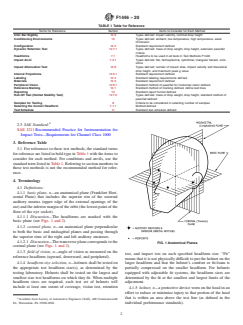
Terms for Reference Section Items to Consider for Each Method
Chin Bar Rigidity 12.9 Types defined: impact velocity, nominal drop height
Conditioning Environments 10 Types defined: ambient, low temperature, high temperature, water
immersion
Configuration 12.2 Standard requirement defined
Dynamic Retention Test 12.7.1 Types defined: mass of drop weight, drop height, extension pass/fail
criteria
Headforms 7.1 Headforms to be used in all tests in Test Methods F1446
Impact Anvil 7.3.1 Types defined: flat, hemispherical, cylindrical, triangular hazard, curb-
stone
Impact Attenuation Test 12.8 Types defined: number of impact sites, impact velocity and theoretical
drop height, and maximum peak g value
Internal Projections 12.5.1 Standard requirement defined
Labeling 12.4 Standard labeling requirements defined
Materials 12.3 Standard requirement defined
Peripheral Vision 12.6.1 Standard method of pass/fail for horizontal vision defined
Reference Marking 12.1 Standard method of marking defined, define test lines
Reporting 13 Standard report format defined
Roll-Off Test (Helmet Stability Test) 12.7.2 Types defined: mass of drop weight, drop height, standard method of
pass/fail defined
Samples for Testing 8 Criteria to be considered in selecting number of samples
Selecting the Correct Headform 7.1.1 Method defined
Test Schedule 11 Standard test schedule defined
2.3 SAE Standard:
SAE J211 Recommended Practice for Instrumentation for
Impact Tests—Requirements for Channel Class 1000
3. Reference Table
3.1 For references to these test methods, the standard terms
for reference are listed in bold type in Table 1 with the items to
consider for each method. For conditions and anvils, use the
standard term listed in Table 1. Referring to section numbers in
these test methods is not the recommended method for refer-
ence.
4. Terminology
4.1 Definitions:
4.1.1 basic plane, n—an anatomical plane (Frankfort Hori-
zontal Plane) that includes the superior rim of the external
auditory meatus (upper edge of the external openings of the
ear) and the inferior margin of the orbit (the lowest point of the
floor of the eye socket).
4.1.1.1 Discussion—The headforms are marked with the
basic plane (see Figs. 1 and 2).
4.1.2 coronal plane, n—an anatomical plane perpendicular
to both the basic and midsagittal planes and passing through
the superior rims of the right and left auditory meatuses.
4.1.2.1 Discussion—Thetransverseplanecorrespondstothe
FIG. 1Anatomical Planes
coronal plane (see Figs. 1 and 2).
4.1.3 field of vision, n—angle of vision as measured on the
test, and impact test on each specified headform size. “Fit”
reference headform (upward, downward, and peripheral).
means that it is not physically difficult to put the helmet on the
4.1.4 headform size selection, n—helmets shall be tested on larger headform and that the helmet’s comfort or fit-foam is
the appropriate test headform size(s), as determined by the
partially compressed on the smaller headform. For helmets
testing laboratory. Helmets shall be tested on the largest and equipped with adjustable fit systems, the headform sizes are
smallest size test headforms on which they fit. When multiple
determined by the fit at the smallest and largest limits of the
headform sizes are required, each test set of helmets will adjustment.
include at least one extent of coverage, vision test, retention
4.1.5 helmet, n—a protective device worn on the head in an
effort to reduce or minimize injury to that portion of the head
that is within an area above the test line (as defined in the
Available from Society of Automotive Engineers (SAE), 400 Commonwealth
Dr., Warrendale, PA 15096-0001. individual performance standards).
F1446−20
4.1.13.1 Discussion—The reference headforms should in-
clude surface markings corresponding to the basic, coronal,
midsagittal, and reference planes (see Figs. 1 and 2).
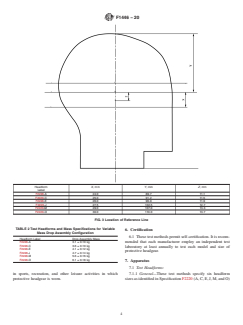
4.1.14 reference plane, n—aplanemarkedontheheadforms
ataspecifieddistanceaboveandparalleltothebasicplane(see
Fig. 3).
4.1.15 retention system, n—the complete assembly that
secures the helmet, in a stable position, on the wearer’s head.
4.1.16 shield, n—optional equipment used in place of
goggles to protect the eyes.
4.1.17 size, n—a combination of structure(s) making up the
primary energy-absorption structure covering part of the wear-
er’s head.
4.1.17.1 Discussion—Each structural size is made up of a
specific size energy-absorbing structure that may include an
outer or inner hard shell, or both.
FIG. 2Test Headform—Basic, Reference, and Midsagittal Planes
4.1.18 spherical impactor, n—a device made of low reso-
nance material (for example, magnesium), aluminum alloy, or
stainless steel that couples mechanically with the ball arm
4.1.5.1 Discussion—A helmet of a given size is further
connector of the drop assembly in place of the impact test
defined as a combination of structure(s) making up the primary
headform. When mounted, the device presents a spherically
energy-absorption structure covering part of the wearer’s head.
machined impact face with a radius of 73 mm on its bottom
Each structural size is made up of a specific size energy-
surface.All radii from the center of the curvature of the impact
absorbing structure that may include an outer or inner hard
face to its outer edge shall from angles of no less than 40° with
shell, or both.
the downward vertical axis. The center of curvature shall be
4.1.6 helmet position index (HPI), n—the vertical distance
within 5 mm of the vertical axis drawn through the center of
from the brow of the helmet to the basic plane, when the
the ball arm. The mass and center of gravity of the drop
helmet is placed on a reference headform. The manufacturer
assembly including the impactor shall meet the same require-
shall specify the size of the headform and the vertical distance.
ments as those specified for the drop assembly incorporated
4.1.7 helmet type, n—a category of helmets which do not
with the test headforms (see 7.3.2), using the 5 6 0.1 kg drop
differ in basic construction components such as shell, energy-
mass.
absorbing layer(s), retention system, or any other component
4.1.19 test area, n—the area of the helmet on or above a
that is tested.
specified test line, subject to impact or penetration testing.
4.1.7.1 Discussion—Difference in size alone does not con-
4.1.20 test headforms, n—test headforms that correspond to
stitute a different helmet type.
thephysicaldimensionsdefinedinSpecificationF2220assizes
4.1.8 midsagittal plane, n—ananatomicalplaneperpendicu-
A, C, E, J, M, and O. The weight of the drop assembly
lar to the basic plane and containing the midpoint of the line
includingtheheadformshallbe5.0 60.10kgunlessavariable
connecting the notches of the right and left inferior orbital
mass drop assembly configuration is specified. If a variable
ridgesandthemidpointofthelineconnectingthesuperiorrims
mass configuration is specified, then the weight of the drop
of the right and left external auditory meatus.
assemblyshallcomplywiththeweightspecificationspresented
4.1.8.1 Discussion—The longitudinal plane corresponds to
in Table 2. The test headforms may include surface markings
the midsagittal plane (see Figs. 1 and 2).
corresponding to the basic, coronal, midsagittal, and reference
4.1.9 modular elastomer programmer (MEP), n—a
planes (see Fig. Fig. 2).
cylindrical-shaped pad used as the impact surface for the
4.1.21 test line, n—a line drawn on the helmet as specified
spherical impactor.
in the individual performance standards.
4.1.10 preload ballast, n—a “bean-bag” filled with shot
4.1.22 visor (peak), n—optional equipment for protection
placed on the helmet to secure its position on the headform.
against sun or glare, and sometimes used as a rock or dirt
The weight of the preload ballast shall be 5.0 6 0.1 kg unless
deflector.
otherwisespecifiedintheindividualperformancespecification.
4.1.11 projection, n—any part of a helmet, internal or
5. Significance and Use
external, that extends beyond the faired surface and is likely to
5.1 The purpose of these test methods is to provide reliable
cause injury.
and repeatable tests for the evaluation of various types of
4.1.12 protective headgear, n—see helmet.
protective headgear. Use of these test methods in conjunction
4.1.13 reference headforms, n—measuring headforms con- with the specific individual performance standards is intended
toured in the same configuration as the test headforms sizesA, to reduce the likelihood of serious injury and death resulting
C, E, J, M, and O, as defined in Specification F2220. from impacts to the head sustained by individuals participating
F1446−20
Headform X,mm Y,mm Z,mm
Label
F2220-A 24.0 89.7 11.1
F2220-C 25.0 91.2 11.5
F2220-E 26.0 96.0 11.9
F2220-J 27.5 102.5 12.7
F2220-M 29.0 107.0 13.3
F2220-O 30.0 110.0 13.7
FIG. 3Location of Reference Line
TABLE 2 Test Headforms and Mass Specifications for Variable
6. Certification
Mass Drop Assembly Configuration
6.1 These test methods permit self-certification. It is recom-
Headform Label Drop Assembly Mass
F2220-A 3.1±0.10kg mended that each manufacturer employ an independent test
F2220-C 3.6±0.10kg
laboratory at least annually to test each model and size of
F2220-E 4.1±0.12kg
protective headgear.
F2220-J 4.7±0.14kg
F2220-M 5.6±0.16kg
F2220-O 6.1±0.18kg
7. Apparatus
7.1 Test Headforms:
in sports, recreation, and other leisure activities in which 7.1.1 General—These test methods specify six headform
protective headgear is worn. sizesasidentifiedinSpecificationF2220(A,C,E,J,M,andO)
F1446−20
for performing reference measurements, impact, roll-off, dy- elongation of no more than 18 mm/m when loaded with 1000
namic retention, penetration, and other tests required by the N. The guide rod and drop weight are similar to those in the
individual performance specification standards.
dynamic retention strength test minus the simulated mandible.
7.1.2 Impact Headforms—These headforms shall be made This equipment shall allow a drop weight to slide in a guided
of K1A magnesium material and shall conform to the external
free fall to impact a rigid stop. No pad shall be used between
dimension requirements of each particular headform size, as
the drop weight and the rigid stop. The mass of the roll-off test
specified in Specification F2220.
apparatus, excluding the drop weight, shall be 1.0 -0.0 +0.2 kg.
7.1.3 Other Headforms—These headforms should be made
7.2.2 Dynamic Retention Test Apparatus—The retention
of material of sufficient strength and stiffness to maintain their
system test equipment shall allow a drop weight to slide in a
geometry during testing. They shall conform to the external
guided free fall to impact a rigid stop (see Fig. 5). No pad shall
dimension requirements of each particular headform size, as
be used between the drop weight and the rigid stop. The guide
specified in Specification F2220. Full-chin headforms will be
rod and drop weight shall consist of a simulated mandible,
used as necessary.
guide rod with rigid stop, drop weight and electronic position
7.2 Retention System—Thetestapparatusfortheroll-offand measuring system(s). The entire dynamic test apparatus, in-
dynamic retention testing are shown in Fig. 4 and Fig. 5, cluding the drop weight shall hang loosely restrained from
respectively. The mass of the drop weight and drop height are
non-vertical movement on the retention system. The mass of
specified in the individual performance specification standards. the dynamic test apparatus, excluding the drop weight, shall be
7.2.1 Roll-Off Test Apparatus—The test apparatus shall be
7 6 0.1 kg.
used to apply a shock load to a helmet secured to the headform
7.2.2.1 Electronic Position Measuring System—A device to
byitsownretentionsystem.Thegeometryofthetestheadform
measure the dynamic and residual displacement of the moving
shall comply with the dimension of the full chin reference
parts of the test fixture. Such devices shall have a minimum
headforms.The headform shall be secured in a test fixture with
sampling rate of 1000 Hz.
its vertical axis pointing downward at 45° to the direction of
7.2.2.2 Simulated Mandible Fixture—This fixture shall con-
gravity (see Fig. 4). The test fixture shall permit rotation of the
sist of two metal bars that spin freely, each with a diameter of
headformaboutitsverticalaxisandincludeameanstolockthe
12.5 6 0.5 mm, that have a center distance of 76.0 6 1 mm.
headform in the face-up and face-down positions. The cable
and hook shall be a flexible strap or cable and attaching hook 7.3 Impact Attenuation—The impact attenuation test appa-
which connect the guide rod to the upper edge of the helmet. ratus shall allow determination of the impact attenuation
The flexible strap or cable shall be of material having an characteristics of helmet (see Fig. 6).
FIG. 4Typical Apparatus for Roll-off (Stability) Test
F1446−20
FIG. 5Typical Apparatus for Testing Strength and Extension of Retention System
7.3.1 Impact Anvils—The selection of anvils to be used for 7.3.1.6 Curbstone Anvil—The curbstone anvil shall have
testing any given type of helmet is noted in the individual two faces making an angle of 105° 6 0.5° and meeting along
performance standards. The construction specifications for a striking edge with a radius of 15 mm 6 0.5 mm. The height
several types of anvils are given in Figs. 7-11. Other anvils shall be not less than 50 mm and the length not less than 200
may be specified (including construction specifications) in mm (see Fig. 11).
individual performance standards. All of the anvils, with the 7.3.2 Impact Test Apparatus—The geometry of the test
exception of the modular elastomer programmer (MEP) speci- headform shall comply with the dimension of the Specification
fied in these test methods, are constructed of steel and shall be F2220 reference headforms. The headform should be secured
solid (that is, without internal cavities). inatestfixturetoallowforimpactofthehelmetatanylocation
7.3.1.1 Modular Elastomer Programmer (MEP)—The MEP above the test line. The weight of the drop assembly (which is
is 152 mm in diameter and 25 mm thick. It is affixed to the top the combined weight of the instrumented test headform and
surface of a flat, 6.35-mm thick aluminum plate. The durom- supporting assembly, exclusive of the test helmet) for the drop
eter hardness of the MEP is 60 6 2 Shore A. test shall be 5 6 0.1 kg unless a variable mass drop assembly
7.3.1.2 Flat Anvil—The flat anvil shall have a flat surface of configuration is specified.The weight of the supporting assem-
a minimum 125-mm diameter circle and shall be at least 24 bly cannot exceed 1.1 kg. The weight of the support assembly
mm thick (see Fig. 7). is the weight of the drop assembly minus the weight of the
7.3.1.3 Hemispherical Anvil—The hemispherical anvil shall headform, ball arm, ball clamp, ball clamp bolts, and acceler-
have a spherical surface with a radius of 48 6 1 mm. The ometer. The center of gravity of the headform shall be at the
spherical surface shall constitute one half of the surface of a center of the mounting ball. The center of gravity of the
sphere (see Fig. 8). combined test headform and supporting assembly must meet
7.3.1.4 Cylindrical Anvil—Thecylindricalanvilshallbeone FMVSS 218 S7.1.8 with any type of guide system (see
half of a cylinder with a diameter of 75 6 1 mm and a Appendix X1). The helmet and headform are dropped in a
minimum length of 200 mm (see Fig. 9). guided free fall, using a wire or rail guided apparatus (see Fig.
7.3.1.5 Triangular Hazard Anvil—The triangular hazard 6), onto an anvil fixed to a rigid base.
anvil shall have a 90° 6 0.5° striking edge with a 0.5- to 7.3.3 Accelerometer—Acceleration is measured by a uni-
1.5-mmradius.Theheightshallbenotlessthan50mmandthe axial accelerometer, which is capable of withstanding a shock
length not less than 200 mm (see Fig. 10). of at least 9810 m/s (1000 g) in the headform. The uniaxial
F1446−20
FIG. 8Hemispherical Anvil
FIG. 9Cylindrical Anvil
FIG. 6Typical Apparatus for Impact Test
FIG. 7Flat Anvil
FIG. 10Triangular Hazard Anvil
accelerometer is mounted at the center of gravity of the test
headform with the sensitive axis aligned within 5° of vertical.
against the inside rear of the helmet. A linear transducer shall
The acceleration data channel and filtering shall comply with
be fixed against the inside of the helmet’s chin bar to measure
SAE Recommended Practice J211. A low-pass filter (either
deflection. A means of measuring the velocity of the striker in
analog or digital) with a 4-pole Butterworth transfer function
its last 60 mm of fall shall be fitted.
and a corner frequency of 1000 Hz meets this requirement.
8. Samples for Testing
7.4 Chin Bar Rigidity Test Apparatus—The apparatus shall
8.1 Conditions and Attachments—Helmets shall be tested
consist of a striker that shall be guided. An example is shown
complete, in the condition as offered for sale. They must pass
in Fig. 12. The striking surface shall be flat, steel, and have a
all tests with or without any included attachments.
diametergreaterthan112mm.Thetotalmassofthestrikerand
guide arm shall be 5 6 0.2 kg. There shall be a means to 8.2 Number of Samples—A test normally requires samples
securely mount a helmet as shown in Fig. 12. A toggle clamp of each shell/liner size combination. The number of test
can be modified to firmly position
...
This document is not an ASTM standard and is intended only to provide the user of an ASTM standard an indication of what changes have been made to the previous version. Because
it may not be technically possible to adequately depict all changes accurately, ASTM recommends that users consult prior editions as appropriate. In all cases only the current version
of the standard as published by ASTM is to be considered the official document.
Designation: F1446 − 15b F1446 − 20 An American National Standard
Standard Test Methods for
Equipment and Procedures Used in Evaluating the
Performance Characteristics of Protective Headgear
This standard is issued under the fixed designation F1446; the number immediately following the designation indicates the year of
original adoption or, in the case of revision, the year of last revision. A number in parentheses indicates the year of last reapproval. A
superscript epsilon (´) indicates an editorial change since the last revision or reapproval.
INTRODUCTION
These test methods specify equipment and procedures used for testing protective headgear.
Individual ASTM performance standards (standard specifications) will use these procedures and
equipment. Test conditions, pass-fail criteria, and other performance requirements will be specified in
the individual performance standards, tailored to the needs of a particular activity (for example,
bicycling, skateboarding, skiing, etc.).
These test methods were developed using resources in medical, scientific, mechanical engineering,
human factors, and biomechanical fields. However, it is recognized that it is not possible to write a
protective headgear performance standard that will result in headgear that can protect against injury
or death in all accidents. It is also recognized that serious injury or death can result from both low-
and high-energy impacts, even when protective headgear is worn.
These test methods incorporate aspects of other recognized headgear performance standards. They
draw from work done by others where appropriate for these test methods. These standards are
referenced within this standard test method. It should be noted that these test methods specify
laboratory tests of completed headgear to measure its ability to reduce head acceleration during use
and other selected parameters.
1. Scope
1.1 These test methods cover laboratory equipment, procedures, and basic requirements pertinent to testing protective headgear.
Deviations or additions, or both, to these test methods will be specified, as required, in individual ASTM performance standards.
1.2 Requirements—The protective headgear is to be tested under specified environmental conditions for the following:
1.2.1 Impact attenuation (the limiting of head acceleration) of the protective headgear, and
1.2.2 Strength and stability of the retention system and its attachment to the protective headgear.
1.2.3 Special tests for particular protective headgear uses will be specified in the individual performance standards to be used in
conjunction with these test methods.
1.3 This standard does not purport to address all of the safety concerns, if any, associated with its use. It is the responsibility
of the user of this standard to establish appropriate safety safety, health, and healthenvironmental practices and determine the
applicability of regulatory limitations prior to use.
These test methods are under the jurisdiction of ASTM Committee F08 on Sports Equipment, Playing Surfaces, and Facilities and are the direct responsibility of
Subcommittee F08.53 on Headgear and Helmets.
Current edition approved Nov. 1, 2015Oct. 1, 2020. Published January 2016November 2020. Originally approved in 1993. Last previous edition approved in 2015 as
F1446 – 15a.F1446 – 15b. DOI: 10.1520/F1446-15B.10.1520/F1446-20.
Copyright © ASTM International, 100 Barr Harbor Drive, PO Box C700, West Conshohocken, PA 19428-2959. United States
F1446 − 20
1.4 This international standard was developed in accordance with internationally recognized principles on standardization
established in the Decision on Principles for the Development of International Standards, Guides and Recommendations issued
by the World Trade Organization Technical Barriers to Trade (TBT) Committee.
2. Referenced Documents
2.1 ASTM Standard:
E177 Practice for Use of the Terms Precision and Bias in ASTM Test Methods
E691 Practice for Conducting an Interlaboratory Study to Determine the Precision of a Test Method
F2220 Specification for Headforms
2.2 Federal Motor Vehicle Safety Standard:
218 S7.1.8 Motorcycle Helmets
2.3 SAE Standard:
SAE J211 Recommended Practice for Instrumentation for Impact Tests—Requirements for Channel Class 1000
3. Reference Table
3.1 For references to these test methods, the standard terms for reference are listed in bold type in Table 1 with the items to
consider for each method. For conditions and anvils, use the standard term listed in Table 1. Referring to section numbers in these
test methods is not the recommended method for reference.
4. Terminology
4.1 Definitions:
4.1.1 basic plane, n—an anatomical plane (Frankfort Horizontal Plane) that includes the superior rim of the external auditory
meatus (upper edge of the external openings of the ear) and the inferior margin of the orbit (the lowest point of the floor of the
eye socket).
4.1.1.1 Discussion—
The headforms are marked with the basic plane (see Figs. 1 and 2).
4.1.2 coronal plane, n—an anatomical plane perpendicular to both the basic and midsagittal planes and passing through the
superior rims of the right and left auditory meatuses.
4.1.2.1 Discussion—
The transverse plane corresponds to the coronal plane (see Figs. 1 and 2).
TABLE 1 Table for Reference
Terms for Reference Section Items to Consider for Each Method
Chin Bar Rigidity 12.9 Types defined: impact velocity, nominal drop height
Conditioning Environments 10 Types defined: ambient, low temperature, high temperature, water
immersion
Configuration 12.2 Standard requirement defined
Dynamic Retention Test 12.7.1 Types defined: mass of drop weight, drop height, extension pass/fail
criteria
Headforms 7.1 Headforms to be used in all tests in Test Methods F1446
Impact Anvil 7.3.1 Types defined: flat, hemispherical, cylindrical, triangular hazard, curb-
stone
Impact Attenuation Test 12.8 Types defined: number of impact sites, impact velocity and theoretical
drop height, and maximum peak g value
Internal Projections 12.5.1 Standard requirement defined
Labeling 12.4 Standard labeling requirements defined
Materials 12.3 Standard requirement defined
Peripheral Vision 12.6.1 Standard method of pass/fail for horizontal vision defined
Reference Marking 12.1 Standard method of marking defined, define test lines
Reporting 13 Standard report format defined
Roll-Off Test (Helmet Stability Test) 12.7.2 Types defined: mass of drop weight, drop height, standard method of
pass/fail defined
Samples for Testing 8 Criteria to be considered in selecting number of samples
Selecting the Correct Headform 7.1.1 Method defined
Test Schedule 11 Standard test schedule defined
For referenced ASTM standards, visit the ASTM website, www.astm.org, or contact ASTM Customer Service at service@astm.org. For Annual Book of ASTM Standards
volume information, refer to the standard’s Document Summary page on the ASTM website.
Available from National Highway Traffic Safety Administration (NHTSA), 400 7th St., NW, Washington, DC 20590.
Available from Society of Automotive Engineers (SAE), 400 Commonwealth Dr., Warrendale, PA 15096-0001.
F1446 − 20
FIG. 1 Anatomical Planes
FIG. 2 Test Headform—Basic, Reference, and Midsagittal Planes
4.1.3 field of vision, n—angle of vision as measured on the reference headform (upward, downward, and peripheral).
4.1.4 headform size selection, n—helmets shall be tested on the appropriate test headform size(s), as determined by the testing
laboratory. Helmets shall be tested on the largest and smallest size test headforms on which they fit. When multiple headform sizes
are required, each test set of helmets will include at least one extent of coverage, vision test, retention test, and impact test on each
specified headform size. “Fit” means that it is not physically difficult to put the helmet on the larger headform and that the helmet’s
comfort or fit-foam is partially compressed on the smaller headform. For helmets equipped with adjustable fit systems, the
headform sizes are determined by the fit at the smallest and largest limits of the adjustment.
4.1.5 helmet, n—a protective device worn on the head in an effort to reduce or minimize injury to that portion of the head that
is within an area above the test line (as defined in the individual performance standards).
F1446 − 20
4.1.5.1 Discussion—
A helmet of a given size is further defined as a combination of structure(s) making up the primary energy-absorption structure
covering part of the wearer’s head. Each structural size is made up of a specific size energy-absorbing structure that may include
an outer or inner hard shell, or both.
4.1.6 helmet position index (HPI), n—the vertical distance from the brow of the helmet to the basic plane, when the helmet is
placed on a reference headform. The manufacturer shall specify the size of the headform and the vertical distance.
4.1.7 helmet type, n—a category of helmets which do not differ in basic construction components such as shell, energy-absorbing
layer(s), retention system, or any other component that is tested.
4.1.7.1 Discussion—
Difference in size alone does not constitute a different helmet type.
4.1.8 midsagittal plane, n—an anatomical plane perpendicular to the basic plane and containing the midpoint of the line
connecting the notches of the right and left inferior orbital ridges and the midpoint of the line connecting the superior rims of the
right and left external auditory meatus.
4.1.8.1 Discussion—
The longitudinal plane corresponds to the midsagittal plane (see Figs. 1 and 2).
4.1.9 modular elastomer programmer (MEP), n—a cylindrical-shaped pad used as the impact surface for the spherical impactor.
4.1.10 preload ballast, n—a “bean-bag” filled with shot placed on the helmet to secure its position on the headform. The weight
of the preload ballast shall be 5.0 6 0.1 kg unless otherwise specified in the individual performance specification.
4.1.11 projection, n—any part of a helmet, internal or external, that extends beyond the faired surface and is likely to cause injury.
4.1.12 protective headgear, n—see helmet.
4.1.13 reference headforms, n—measuring headforms contoured in the same configuration as the test headforms sizes A, C, E, J,
M, and O, as defined in Specification F2220.
4.1.13.1 Discussion—
The reference headforms should include surface markings corresponding to the basic, coronal, midsagittal, and reference planes
(see Figs. 1 and 2).
4.1.14 reference plane, n—a plane marked on the headforms at a specified distance above and parallel to the basic plane (see Fig.
3).
4.1.15 retention system, n—the complete assembly that secures the helmet, in a stable position, on the wearer’s head.
4.1.16 shield, n—optional equipment used in place of goggles to protect the eyes.
4.1.17 size, n—a combination of structure(s) making up the primary energy-absorption structure covering part of the wearer’s
head.
4.1.17.1 Discussion—
Each structural size is made up of a specific size energy-absorbing structure that may include an outer or inner hard shell, or both.
4.1.18 spherical impactor, n—a device made of low resonance material (for example, magnesium), aluminum alloy, or stainless
steel that couples mechanically with the ball arm connector of the drop assembly in place of the impact test headform. When
mounted, the device presents a spherically machined impact face with a radius of 73 mm on its bottom surface. All radii from the
center of the curvature of the impact face to its outer edge shall from angles of no less than 40° with the downward vertical axis.
The center of curvature shall be within 5 mm of the vertical axis drawn through the center of the ball arm. The mass and center
of gravity of the drop assembly including the impactor shall meet the same requirements as those specified for the drop assembly
incorporated with the test headforms (see 7.3.2), using the 5 6 0.1 kg drop mass.
4.1.19 test area, n—the area of the helmet on or above a specified test line, subject to impact or penetration testing.
F1446 − 20
Headform X, mm Y, mm Z, mm
Label
F2220-A 24.0 89.7 11.1
F2220-C 25.0 91.2 11.5
F2220-E 26.0 96.0 11.9
F2220-J 27.5 102.5 12.7
F2220-M 29.0 107.0 13.3
F2220-O 30.0 110.0 13.7
FIG. 3 Location of Reference Line
4.1.20 test headforms, n—test headforms that correspond to the physical dimensions defined in Specification F2220 as sizes A,
C, E, J, M, and O. The weight of the drop assembly including the headform shall be 5.0 6 0.10 kg unless a variable mass drop
assembly configuration is specified. If a variable mass configuration is specified, then the weight of the drop assembly shall comply
with the weight specifications presented in Table 2. The test headforms may include surface markings corresponding to the basic,
coronal, midsagittal, and reference planes (see Fig. Fig. 2).
TABLE 2 Test Headforms and Mass Specifications for Variable
Mass Drop Assembly Configuration
Headform Label Drop Assembly Mass
F2220-A 3.1 ± 0.10 kg
F2220-C 3.6 ± 0.10 kg
F2220-E 4.1 ± 0.12 kg
F2220-J 4.7 ± 0.14 kg
F2220-M 5.6 ± 0.16 kg
F2220-O 6.1 ± 0.18 kg
F1446 − 20
4.1.21 test line, n—a line drawn on the helmet as specified in the individual performance standards.
4.1.22 visor (peak), n—optional equipment for protection against sun or glare, and sometimes used as a rock or dirt deflector.
5. Significance and Use
5.1 The purpose of these test methods is to provide reliable and repeatable tests for the evaluation of various types of protective
headgear. Use of these test methods in conjunction with the specific individual performance standards is intended to reduce the
likelihood of serious injury and death resulting from impacts to the head sustained by individuals participating in sports, recreation,
and other leisure activities in which protective headgear is worn.
6. Certification
6.1 These test methods permit self-certification. It is recommended that each manufacturer employ an independent test laboratory
at least annually to test each model and size of protective headgear.
7. Apparatus
7.1 Test Headforms:
7.1.1 General—These test methods specify six headform sizes as identified in Specification F2220 (A, C, E, J, M, and O) for
performing reference measurements, impact, roll-off, dynamic retention, penetration, and other tests required by the individual
performance specification standards.
7.1.2 Impact Headforms—These headforms shall be made of K1A magnesium material and shall conform to the external
dimension requirements of each particular headform size, as specified in Specification F2220.
7.1.3 Other Headforms—These headforms should be made of material of sufficient strength and stiffness to maintain their
geometry during testing. They shall conform to the external dimension requirements of each particular headform size, as specified
in Specification F2220. Full-chin headforms will be used as necessary.
7.2 Retention System—The test apparatus for the roll-off and dynamic retention testing are shown in Fig. 4 and Fig. 5, respectively.
The mass of the drop weight and drop height are specified in the individual performance specification standards.
7.2.1 Roll-Off Test Apparatus—The test apparatus shall be used to apply a shock load to a helmet secured to the headform by its
own retention system. The geometry of the test headform shall comply with the dimension of the full chin reference headforms.
The headform shall be secured in a test fixture with its vertical axis pointing downward at 45° to the direction of gravity (see Fig.
4). The test fixture shall permit rotation of the headform about its vertical axis and include a means to lock the headform in the
face-up and face-down positions. The cable and hook shall be a flexible strap or cable and attaching hook which connect the guide
rod to the upper edge of the helmet. The flexible strap or cable shall be of material having an elongation of no more than 18 mm/m
when loaded with 1000 N. The guide rod and drop weight are similar to those in the dynamic retention strength test minus the
simulated mandible. This equipment shall allow a drop weight to slide in a guided free fall to impact a rigid stop. No pad shall
be used between the drop weight and the rigid stop. The mass of the roll-off test apparatus, excluding the drop weight, shall be
1.0 -0.0 +0.2 kg.
7.2.2 Dynamic Retention Test Apparatus—The retention system test equipment shall allow a drop weight to slide in a guided free
fall to impact a rigid stop (see Fig. 5). No pad shall be used between the drop weight and the rigid stop. The guide rod and drop
weight shall consist of a simulated mandible, guide rod with rigid stop, drop weight and electronic position measuring system(s).
The entire dynamic test apparatus, including the drop weight shall hang loosely restrained from non-vertical movement on the
retention system. The mass of the dynamic test apparatus, excluding the drop weight, shall be 7 6 0.1 kg.
7.2.2.1 Electronic Position Measuring System—A device to measure the dynamic and residual displacement of the moving parts
of the test fixture. Such devices shall have a minimum sampling rate of 1000 Hz.
7.2.2.2 Simulated Mandible Fixture—This fixture shall consist of two metal bars that spin freely, each with a diameter of 12.5 6
0.5 mm, that have a center distance of 76.0 6 1 mm.
F1446 − 20
FIG. 4 Typical Apparatus for Roll-off (Stability) Test
7.3 Impact Attenuation—The impact attenuation test apparatus shall allow determination of the impact attenuation characteristics
of helmet (see Fig. 6).
7.3.1 Impact Anvils—The selection of anvils to be used for testing any given type of helmet is noted in the individual performance
standards. The construction specifications for several types of anvils are given in Figs. 7-11. Other anvils may be specified
(including construction specifications) in individual performance standards. All of the anvils, with the exception of the modular
elastomer programmer (MEP) specified in these test methods, are constructed of steel and shall be solid (that is, without internal
cavities).
7.3.1.1 Modular Elastomer Programmer (MEP)—The MEP is 152 mm in diameter and 25 mm thick. It is affixed to the top surface
of a flat, 6.35-mm thick aluminum plate. The durometer hardness of the MEP is 60 6 2 Shore A.
7.3.1.2 Flat Anvil—The flat anvil shall have a flat surface of a minimum 125-mm diameter circle and shall be at least 24 mm thick
(see Fig. 7).
7.3.1.3 Hemispherical Anvil—The hemispherical anvil shall have a spherical surface with a radius of 48 6 1 mm. The spherical
surface shall constitute one half of the surface of a sphere (see Fig. 8).
7.3.1.4 Cylindrical Anvil—The cylindrical anvil shall be one half of a cylinder with a diameter of 75 6 1 mm and a minimum
length of 200 mm (see Fig. 9).
7.3.1.5 Triangular Hazard Anvil—The triangular hazard anvil shall have a 90° 6 0.5° striking edge with a 0.5- to 1.5-mm radius.
The height shall be not less than 50 mm and the length not less than 200 mm (see Fig. 10).
7.3.1.6 Curbstone Anvil—The curbstone anvil shall have two faces making an angle of 105° 6 0.5° and meeting along a striking
edge with a radius of 15 mm 6 0.5 mm. The height shall be not less than 50 mm and the length not less than 200 mm (see Fig.
11).
F1446 − 20
FIG. 5 Typical Apparatus for Testing Strength and Extension of Retention System
7.3.2 Impact Test Apparatus—The geometry of the test headform shall comply with the dimension of the Specification F2220
reference headforms. The headform should be secured in a test fixture to allow for impact of the helmet at any location above the
test line. The weight of the drop assembly (which is the combined weight of the instrumented test headform and supporting
assembly, exclusive of the test helmet) for the drop test shall be 5 6 0.1 kg unless a variable mass drop assembly configuration
is specified. The weight of the supporting assembly cannot exceed 1.1 kg. The weight of the support assembly is the weight of the
drop assembly minus the weight of the headform, ball arm, ball clamp, ball clamp bolts, and accelerometer. The center of gravity
of the headform shall be at the center of the mounting ball. The center of gravity of the combined test headform and supporting
assembly must meet FMVSS 218 S7.1.8 with any type of guide system (see Appendix X1). The helmet and headform are dropped
in a guided free fall, using a wire or rail guided apparatus (see Fig. 6), onto an anvil fixed to a rigid base.
7.3.3 Accelerometer—Acceleration is measured by a uniaxial accelerometer, which is capable of withstanding a shock of at least
9810 m/s (1000 g) in the headform. The uniaxial accelerometer is mounted at the center of gravity of the test headform with the
sensitive axis aligned within 5° of vertical. The acceleration data channel and filtering shall comply with SAE Recommended
Practice J211. A low-pass filter (either analog or digital) with a 4-pole Butterworth transfer function and a corner frequency of 1000
Hz meets this requirement.
7.4 Chin Bar Rigidity Test Apparatus—The apparatus shall consist of a striker that shall be guided. An example is shown in Fig.
12. The striking surface shall be flat, steel, and have a diameter greater than 112 mm. The total mass of the striker and guide arm
shall be 5 6 0.2 kg. There shall be a means to securely mount a helmet as shown in Fig. 12. A toggle clamp can be modified to
firmly position the helmet by clamping against the inside rear of the helmet. A linear transducer shall be fixed against the inside
of the helmet’s chin bar to measure deflection. A means of measuring the velocity of the striker in its last 60 mm of fall shall be
fitted.
F1446 − 20
FIG. 6 Typical Apparatus for Impact Test
FIG. 7 Flat Anvil
8. Samples for Testing
8.1 Conditions and Attachments—Helmets shall be tested complete, in the condition as offered for sale. They must pass all tests
with or without any included attachments.
8.2 Number of Samples—A test normally requires samples of each shell/liner size combination. The number of test samples is
defined in the individual performance standards.
9. Calibrat
...