

ASTM D7214-23
(Test Method)Standard Test Method for Determination of the Oxidation of Used Lubricants by FT-IR Using Peak Area Increase Calculation
General Information
- Abstract
SIGNIFICANCE AND USE
5.1 The PAI is representative of the quantity of all the compounds containing a carbonyl function that have formed by the oxidation of the lubricant (aldehydes, ketones, carboxylic acids, esters, anhydrides, etc.). The PAI gives representative information on the chemical degradation of the lubricant which has been caused by oxidation.
5.2 This test method was developed for transmission oils and is used in the CEC L-48-A-00 test (Oxidation Stability of Lubricating Oils Used in Automotive Transmissions by Artificial Aging) as a parameter for the end of test evaluation.
SCOPE
1.1 This test method covers the determination of the oxidation of used lubricants by FT-IR (Fourier Transform Infrared Spectroscopy). It measures the concentration change of constituents containing a carbonyl function that have formed during the oxidation of the lubricant.
1.2 This test method may be used to indicate relative changes that occur in an oil under oxidizing conditions. The test method is not intended to measure an absolute oxidation property that can be used to predict performance of an oil in service.
1.3 This test method was developed for transmission oils which have been degraded either in service, or in a laboratory test, for example a bulk oxidation test. It may be used for other in-service oils, but the stated precision may not apply.
1.4 The results of this test method may be affected by the presence of other components with an absorbance band in the zone of 1600 cm-1 to 1800 cm-1. Low PAI values may be difficult to determine in those cases. Section 6 describes these possible interferences in more detail.
1.5 The values stated in SI units are to be regarded as standard. No other units of measurement are included in this standard.
1.6 This standard does not purport to address all of the safety concerns, if any, associated with its use. It is the responsibility of the user of this standard to establish appropriate safety, health, and environmental practices and determine the applicability of regulatory limitations prior to use.
1.7 This international standard was developed in accordance with internationally recognized principles on standardization established in the Decision on Principles for the Development of International Standards, Guides and Recommendations issued by the World Trade Organization Technical Barriers to Trade (TBT) Committee.
- Status
- Published
- Publication Date
- 28-Feb-2023
- Technical Committee
- D02 - Petroleum Products, Liquid Fuels, and Lubricants
Buy Documents
ASTM D7214-23 - Standard Test Method for Determination of the Oxidation of Used Lubricants by FT-IR Using Peak Area Increase Calculation
REDLINE ASTM D7214-23 - Standard Test Method for Determination of the Oxidation of Used Lubricants by FT-IR Using Peak Area Increase Calculation
Overview
ASTM D7214-23 is the international standard test method for the determination of oxidation in used lubricants by Fourier Transform Infrared Spectroscopy (FT-IR) using the Peak Area Increase (PAI) calculation. Developed by ASTM International, this method is primarily applied to assess the chemical degradation of transmission oils, focusing on quantifying the formation of oxidation products such as aldehydes, ketones, carboxylic acids, esters, and anhydrides containing a carbonyl function. The method aids in monitoring lubricant condition and evaluating oil degradation due to oxidative processes, essential for lubricant performance and maintenance planning.
Key Topics
Core Concepts:
- FT-IR Analysis: Utilizes FT-IR to measure the increase in the absorption area in the carbonyl region, representing oxidation-derived compounds formed in the used lubricant.
- Peak Area Increase (PAI): The PAI is a metric for the relative quantity of oxidation products. It is calculated based on the increase in the carbonyl region (1600-1800 cm⁻¹) in the differential spectrum of used versus fresh oil, normalized to cell pathlength.
- Chemical Degradation: The method provides representative data on lubricant oxidation, crucial for assessing fluid quality in automotive and industrial applications.
- Parameter for Test Evaluation: PAI is used as a parameter for evaluating test completion in the CEC L-48-A-00 oxidation stability test, relevant to transmission fluid endurance testing.
Significance and Use:
- Offers insight into the chemical degradation of lubricants under oxidative stress.
- Not designed to predict absolute in-service performance but to indicate the extent of oxidative change relative to baseline conditions.
- Developed with a focus on transmission oils but may be used for other in-service oils, understanding that precision can vary with oil type.
Applications
Practical Uses of ASTM D7214-23:
- Lubricant Condition Monitoring: Enables maintenance managers and laboratory technicians to track oxidation status in used transmission oils, supporting maintenance and replacement scheduling.
- Quality Control in Laboratories: Used as a validation tool for oil degradation in laboratory settings and field evaluations.
- Compliance and Benchmarking: Employed within the framework of the CEC L-48-A-00 method for end-of-test evaluation in automotive transmission oil testing.
- Fluid Formulation Evaluation: Assesses the oxidation stability of new lubricant formulations, especially those prone to oxidative degradation.
Industries Benefiting from This Standard:
- Automotive and heavy-duty vehicle manufacturing
- Lubricant production and quality assurance
- Industrial machinery maintenance
- Oil analysis services
Related Standards
Referenced and Associated Standards:
- ASTM D4057: Manual Sampling of Petroleum and Petroleum Products
- ASTM D4175: Terminology Relating to Petroleum Products, Liquid Fuels, and Lubricants
- ASTM D4177: Automatic Sampling of Petroleum and Petroleum Products
- ASTM D6299: Statistical Quality Assurance and Control Techniques
- ASTM D7418: FT-IR Set-Up and Operation for In-Service Oil Monitoring
- ASTM E131: Terminology Relating to Molecular Spectroscopy
- CEC L-48-A-00: Oxidation Stability of Lubricating Oils Used in Automotive Transmissions by Artificial Aging
Practical Value
Implementing ASTM D7214-23 in routine oil analysis ensures objective, reproducible measurement of oxidation in used lubricants, supporting proactive equipment maintenance and product development. By utilizing FT-IR spectroscopy and PAI calculations, laboratories and operations teams can make informed decisions on lubricant condition, extend the life of mechanical assets, and reduce risks associated with oil degradation. This standard provides the necessary framework for consistent and reliable lubricant oxidation testing, benefiting stakeholders across multiple industries.
Keywords: ASTM D7214-23, FT-IR, oxidation measurement, used lubricant analysis, Peak Area Increase, transmission oil testing, lubricant condition monitoring, oil degradation, carbonyl region, CEC L-48-A-00.
Relations
- Refers
ASTM D4175-23a - Standard Terminology Relating to Petroleum Products, Liquid Fuels, and Lubricants - Effective Date
- 15-Dec-2023
- Effective Date
- 01-Dec-2023
- Refers
ASTM D4175-23e1 - Standard Terminology Relating to Petroleum Products, Liquid Fuels, and Lubricants - Effective Date
- 01-Jul-2023
- Effective Date
- 15-Dec-2017
- Effective Date
- 15-Nov-2017
- Effective Date
- 01-Jan-2017
- Effective Date
- 01-Oct-2013
- Refers
ASTM D4057-06(2011) - Standard Practice for Manual Sampling of Petroleum and Petroleum Products - Effective Date
- 01-Jun-2011
- Effective Date
- 01-Mar-2010
- Effective Date
- 01-Mar-2010
- Effective Date
- 01-Mar-2010
- Effective Date
- 01-Nov-2009
- Effective Date
- 15-Oct-2008
- Effective Date
- 01-Dec-2007
- Effective Date
- 01-Nov-2007
Buy Documents
ASTM D7214-23 - Standard Test Method for Determination of the Oxidation of Used Lubricants by FT-IR Using Peak Area Increase Calculation
REDLINE ASTM D7214-23 - Standard Test Method for Determination of the Oxidation of Used Lubricants by FT-IR Using Peak Area Increase Calculation
Get Certified
Connect with accredited certification bodies for this standard

Element Materials Technology
Materials testing and product certification.

ABS Group Brazil
ABS Group certification services in Brazil.

ABS Quality Evaluations Inc.
American Bureau of Shipping quality certification.
Sponsored listings
Frequently Asked Questions
ASTM D7214-23 is a standard published by ASTM International. Its full title is "Standard Test Method for Determination of the Oxidation of Used Lubricants by FT-IR Using Peak Area Increase Calculation". This standard covers: SIGNIFICANCE AND USE 5.1 The PAI is representative of the quantity of all the compounds containing a carbonyl function that have formed by the oxidation of the lubricant (aldehydes, ketones, carboxylic acids, esters, anhydrides, etc.). The PAI gives representative information on the chemical degradation of the lubricant which has been caused by oxidation. 5.2 This test method was developed for transmission oils and is used in the CEC L-48-A-00 test (Oxidation Stability of Lubricating Oils Used in Automotive Transmissions by Artificial Aging) as a parameter for the end of test evaluation. SCOPE 1.1 This test method covers the determination of the oxidation of used lubricants by FT-IR (Fourier Transform Infrared Spectroscopy). It measures the concentration change of constituents containing a carbonyl function that have formed during the oxidation of the lubricant. 1.2 This test method may be used to indicate relative changes that occur in an oil under oxidizing conditions. The test method is not intended to measure an absolute oxidation property that can be used to predict performance of an oil in service. 1.3 This test method was developed for transmission oils which have been degraded either in service, or in a laboratory test, for example a bulk oxidation test. It may be used for other in-service oils, but the stated precision may not apply. 1.4 The results of this test method may be affected by the presence of other components with an absorbance band in the zone of 1600 cm-1 to 1800 cm-1. Low PAI values may be difficult to determine in those cases. Section 6 describes these possible interferences in more detail. 1.5 The values stated in SI units are to be regarded as standard. No other units of measurement are included in this standard. 1.6 This standard does not purport to address all of the safety concerns, if any, associated with its use. It is the responsibility of the user of this standard to establish appropriate safety, health, and environmental practices and determine the applicability of regulatory limitations prior to use. 1.7 This international standard was developed in accordance with internationally recognized principles on standardization established in the Decision on Principles for the Development of International Standards, Guides and Recommendations issued by the World Trade Organization Technical Barriers to Trade (TBT) Committee.
SIGNIFICANCE AND USE 5.1 The PAI is representative of the quantity of all the compounds containing a carbonyl function that have formed by the oxidation of the lubricant (aldehydes, ketones, carboxylic acids, esters, anhydrides, etc.). The PAI gives representative information on the chemical degradation of the lubricant which has been caused by oxidation. 5.2 This test method was developed for transmission oils and is used in the CEC L-48-A-00 test (Oxidation Stability of Lubricating Oils Used in Automotive Transmissions by Artificial Aging) as a parameter for the end of test evaluation. SCOPE 1.1 This test method covers the determination of the oxidation of used lubricants by FT-IR (Fourier Transform Infrared Spectroscopy). It measures the concentration change of constituents containing a carbonyl function that have formed during the oxidation of the lubricant. 1.2 This test method may be used to indicate relative changes that occur in an oil under oxidizing conditions. The test method is not intended to measure an absolute oxidation property that can be used to predict performance of an oil in service. 1.3 This test method was developed for transmission oils which have been degraded either in service, or in a laboratory test, for example a bulk oxidation test. It may be used for other in-service oils, but the stated precision may not apply. 1.4 The results of this test method may be affected by the presence of other components with an absorbance band in the zone of 1600 cm-1 to 1800 cm-1. Low PAI values may be difficult to determine in those cases. Section 6 describes these possible interferences in more detail. 1.5 The values stated in SI units are to be regarded as standard. No other units of measurement are included in this standard. 1.6 This standard does not purport to address all of the safety concerns, if any, associated with its use. It is the responsibility of the user of this standard to establish appropriate safety, health, and environmental practices and determine the applicability of regulatory limitations prior to use. 1.7 This international standard was developed in accordance with internationally recognized principles on standardization established in the Decision on Principles for the Development of International Standards, Guides and Recommendations issued by the World Trade Organization Technical Barriers to Trade (TBT) Committee.
ASTM D7214-23 is classified under the following ICS (International Classification for Standards) categories: 75.100 - Lubricants, industrial oils and related products. The ICS classification helps identify the subject area and facilitates finding related standards.
ASTM D7214-23 has the following relationships with other standards: It is inter standard links to ASTM D4175-23a, ASTM D6299-23a, ASTM D4175-23e1, ASTM D6299-17b, ASTM D6299-17a, ASTM D6299-17, ASTM D6299-13e1, ASTM D4057-06(2011), ASTM E131-10, ASTM D6299-10e2, ASTM D6299-10, ASTM D6299-09, ASTM D6299-08, ASTM D7418-07, ASTM D6299-07. Understanding these relationships helps ensure you are using the most current and applicable version of the standard.
ASTM D7214-23 is available in PDF format for immediate download after purchase. The document can be added to your cart and obtained through the secure checkout process. Digital delivery ensures instant access to the complete standard document.
Standards Content (Sample)
This international standard was developed in accordance with internationally recognized principles on standardization established in the Decision on Principles for the
Development of International Standards, Guides and Recommendations issued by the World Trade Organization Technical Barriers to Trade (TBT) Committee.
Designation: D7214 − 23
Standard Test Method for
Determination of the Oxidation of Used Lubricants by FT-IR
Using Peak Area Increase Calculation
This standard is issued under the fixed designation D7214; the number immediately following the designation indicates the year of
original adoption or, in the case of revision, the year of last revision. A number in parentheses indicates the year of last reapproval. A
superscript epsilon (´) indicates an editorial change since the last revision or reapproval.
INTRODUCTION
This test method was jointly developed with “Groupement Francais de Coordination” (GFC),
technical committee LM5 and “Coordinating European Council” (CEC) Surveillance Group T-048 for
the purpose of monitoring the oxidation stability of artificially aged automotive transmission fluids.
This test method has been used in the CEC L-48-A-00 method as an end of test measurement
parameter.
1. Scope* responsibility of the user of this standard to establish appro-
priate safety, health, and environmental practices and deter-
1.1 This test method covers the determination of the oxida-
mine the applicability of regulatory limitations prior to use.
tion of used lubricants by FT-IR (Fourier Transform Infrared
1.7 This international standard was developed in accor-
Spectroscopy). It measures the concentration change of con-
dance with internationally recognized principles on standard-
stituents containing a carbonyl function that have formed
ization established in the Decision on Principles for the
during the oxidation of the lubricant.
Development of International Standards, Guides and Recom-
1.2 This test method may be used to indicate relative
mendations issued by the World Trade Organization Technical
changes that occur in an oil under oxidizing conditions. The
Barriers to Trade (TBT) Committee.
test method is not intended to measure an absolute oxidation
property that can be used to predict performance of an oil in
2. Referenced Documents
service.
2.1 ASTM Standards:
1.3 This test method was developed for transmission oils
D4057 Practice for Manual Sampling of Petroleum and
which have been degraded either in service, or in a laboratory
Petroleum Products
test, for example a bulk oxidation test. It may be used for other
D4175 Terminology Relating to Petroleum Products, Liquid
in-service oils, but the stated precision may not apply.
Fuels, and Lubricants
D4177 Practice for Automatic Sampling of Petroleum and
1.4 The results of this test method may be affected by the
Petroleum Products
presence of other components with an absorbance band in the
-1 -1
D6299 Practice for Applying Statistical Quality Assurance
zone of 1600 cm to 1800 cm . Low PAI values may be
and Control Charting Techniques to Evaluate Analytical
difficult to determine in those cases. Section 6 describes these
Measurement System Performance
possible interferences in more detail.
D7418 Practice for Set-Up and Operation of Fourier Trans-
1.5 The values stated in SI units are to be regarded as
form Infrared (FT-IR) Spectrometers for In-Service Oil
standard. No other units of measurement are included in this
Condition Monitoring
standard.
E131 Terminology Relating to Molecular Spectroscopy
1.6 This standard does not purport to address all of the
2.2 CEC Standard:
safety concerns, if any, associated with its use. It is the
CEC L-48-A-00 Oxidation Stability of Lubricating Oils
Used in Automotive Transmissions by Artificial Aging
This test method is under the jurisdiction of ASTM Committee D02 on
Petroleum Products, Liquid Fuels, and Lubricants and is the direct responsibility of For referenced ASTM standards, visit the ASTM website, www.astm.org, or
Subcommittee D02.96.03 on FTIR Testing Practices and Techniques Related to contact ASTM Customer Service at service@astm.org. For Annual Book of ASTM
In-Service Lubricants. Standards volume information, refer to the standard’s Document Summary page on
Current edition approved March 1, 2023. Published March 2023. Originally the ASTM website.
approved in 2006. Last previous edition approved in 2022 as D7214 – 22. DOI: Available from Coordinating European Council (CEC), c/o Interlynk Admin-
10.1520/D7214-23. istrative Services, Ltd., P.O. Box 6475, Earl Shilton, Leicester, LE9 9ZB, U.K.
*A Summary of Changes section appears at the end of this standard
Copyright © ASTM International, 100 Barr Harbor Drive, PO Box C700, West Conshohocken, PA 19428-2959. United States
D7214 − 23
3. Terminology 7.1.1.1 Other cell window types such as Zinc Selenide, with
a known pathlength of approximately 0.025 mm to 0.1 mm,
3.1 Definitions—For terminology relating to molecular
may also be used. ZnSe is known to have a greater durability
spectroscopic methods, refer to Terminology E131. For defi-
in the presence of moisture.
nitions of terms related to in-service oil condition monitoring,
7.1.2 Syringe, Automated, or Semi-Automated Device
refer to Practice D7418 and Terminology D4175.
(Pumping System), with adequate volume to fill the cell.
3.2 Definitions of Terms Specific to This Standard:
7.2 FT-IR Spectral Acquisition Parameters—Set FT-IR
3.2.1 carbonyl region, n—region of the FT-IR spectrum
spectral acquisition parameters according to instructions in
corresponding to the absorbance of compounds containing a
Practice D7418.
carbonyl function. Depending on the nature of the carbonyl
compounds, this region is usually located between approxi-
8. Reagents and Materials
-1 -1
mately 1820 cm and 1650 cm .
8.1 Purity of Reagents—Reagent grade chemicals shall be
3.2.2 differential spectrum, n—FT-IR absorbance spectrum
used in all tests. Unless otherwise indicated, it is intended that
resulting from the subtraction of the fresh oil from the used oil.
all reagents shall conform to the specifications of the commit-
3.2.3 PAI (peak area increase), n—area of the carbonyl
tee on Analytical Reagents of the American Chemical Society,
region of the differential FT-IR spectrum, divided by the cell
where such specifications are available. Other grades may be
pathlength in millimetres. In this standard, PAI refers to a
used, provided it is first ascertained that the reagent is of
relative measurement of the oxidation of a used lubricant by
sufficiently high purity to permit its use without lessening the
FT-IR.
accuracy of the determination.
8.2 Heptane, used as cleaning solvent. Other solvents and
4. Summary of Test Method
solvent mixtures may be used provided they adequately clean
4.1 FT-IR spectra of the fresh oil and of the used oil are
the cell(s) between samples. A 50/50 mixture of cyclohexane
recorded in a transmission cell of known pathlength. Both
and toluene has been found to be useful in cleaning cells after
spectra are converted to absorbance and then subtracted. Using
highly contaminated and degraded samples have been run.
the resulting differential spectrum, a baseline is set under the
(Warning—Flammable.)
-1
peak corresponding to the carbonyl region around 1650 cm
-1
8.3 PAO4, used as dilution oil (PAO4: PolyAlphaOlefin
and 1820 cm and the area created by this baseline and the
with a kinematic viscosity at 100 °C of approximately 4 mm /
carbonyl peak is calculated. The area of the carbonyl region is
s).
divided by the cell pathlength in millimeters and this result is
reported as Peak Area Increase (PAI).
9. Preparation and Maintenance of Apparatus
5. Significance and Use
9.1 Rinse, flush, and clean the sample cell, inlet lines, and
inlet filter according to instructions in Practice D7418.
5.1 The PAI is representative of the quantity of all the
compounds containing a carbonyl function that have formed by
9.2 Determine the cell pathlength daily as specified in
the oxidation of the lubricant (aldehydes, ketones, carboxylic
Practice D7418.
acids, esters, anhydrides, etc.). The PAI gives representative
9.2.1 Cell path shall be determined whenever maintenance
information on the chemical degradation of the lubricant which
is performed on the cell.
has been caused by oxidation.
9.3 Instrument Performance Checks shall be performed in
5.2 This test method was developed for transmission oils
accordance with Practice D7418.
and is used in the CEC L-48-A-00 test (Oxidation Stability of
10. Preparation of Sample of Used Oil
Lubricating Oils Used in Automotive Transmissions by Artifi-
cial Aging) as a parameter for the end of test evaluation.
10.1 Refer to Practice D4057 (Manual Sampling) or Prac-
tice D4177 (Automatic Sampling) for proper sampling tech-
6. Interferences
niques.
6.1 Refer to Practice D7418 for a list of common interfer-
10.2 When sampling used lubricants, the specimen shall be
ents affecting the quality of all FTIR generated spectra.
representative of the system sampled and shall be free of
6.2 When the sample has increased baseline (soot >2.5 %)
contamination from external sources. As used oil can change
or interferent peak present, follow the optional procedure in
appreciably in storage, test samples as soon as possible after
Practice D7418 Section 11 depending on measurement accu-
removal from the lubricating system and note the dates of
racy needs.
sampling and testing.
7. Apparatus 10.3 If the sample of used oil contains visible sediment, heat
to 60 °C 6 5 °C in the original container and agitate until all of
7.1 Fourier transform infrared spectrometer equipped with
the sediment is homogeneously suspended in the oil.
sample cell, filter (optional) and pumping system (optional) as
specified in Practice D7418. 10.4 If the original container is a can or if it is glass and
7.1.1 Transmission Cell, with windows of potassium more than three-fourths full, transfer the entire sample to a
bromide, having a known pathlength of approximately clear-glass bottle having a capacity at least one third greater
0.025 mm to 0.1 mm. than the volume of the sample.
D7214 − 23
10.5 Transfer all traces of sediment from the original 11.3.2 If the maximum absorbance of the carbonyl region of
container to the bottle by vigorous agitation of portions of the the differential spectrum is lower than 1.5: draw a base line
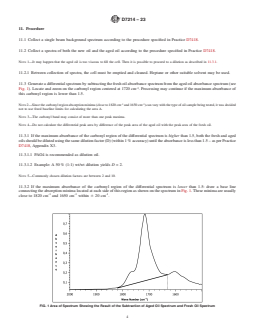
sample in the original container. connecting the absorption minima located at each side of this
region as shown on the spectrum in Fig. 1. These minima are
-1 -1 -1
11. Procedure usually close to 1820 cm and 1650 cm within 6 20 cm .
11.3.3 Calculate and record the differential peak area as area
11.1 Collect a single beam background spectrum according
A. (This may be done automatically with the spectrometer
to the procedure specified in Practice D7418.
software.)
11.2 Collect a spectra of both the new oil and the aged oil
according to the procedure specified in Practice D7418. 12. Calcul
...
This document is not an ASTM standard and is intended only to provide the user of an ASTM standard an indication of what changes have been made to the previous version. Because
it may not be technically possible to adequately depict all changes accurately, ASTM recommends that users consult prior editions as appropriate. In all cases only the current version
of the standard as published by ASTM is to be considered the official document.
Designation: D7214 − 22 D7214 − 23
Standard Test Method for
Determination of the Oxidation of Used Lubricants by FT-IR
Using Peak Area Increase Calculation
This standard is issued under the fixed designation D7214; the number immediately following the designation indicates the year of
original adoption or, in the case of revision, the year of last revision. A number in parentheses indicates the year of last reapproval. A
superscript epsilon (´) indicates an editorial change since the last revision or reapproval.
INTRODUCTION
This test method was jointly developed with “Groupement Francais de Coordination” (GFC),
technical committee LM5 and “Coordinating European Council” (CEC) Surveillance Group T-048 for
the purpose of monitoring the oxidation stability of artificially aged automotive transmission fluids.
This test method has been used in the CEC L-48-A-00 method as an end of test measurement
parameter.
1. Scope*
1.1 This test method covers the determination of the oxidation of used lubricants by FT-IR (Fourier Transform Infrared
Spectroscopy). It measures the concentration change of constituents containing a carbonyl function that have formed during the
oxidation of the lubricant.
1.2 This test method may be used to indicate relative changes that occur in an oil under oxidizing conditions. The test method is
not intended to measure an absolute oxidation property that can be used to predict performance of an oil in service.
1.3 This test method was developed for transmission oils which have been degraded either in service, or in a laboratory test, for
example a bulk oxidation test. It may be used for other in-service oils, but the stated precision may not apply.
1.4 The results of this test method may be affected by the presence of other components with an absorbance band in the zone of
-1 -1
1600 cm to 1800 cm . Low PAI values may be difficult to determine in those cases. Section 6 describes these possible
interferences in more detail.
1.5 The values stated in SI units are to be regarded as standard. No other units of measurement are included in this standard.
1.6 This standard does not purport to address all of the safety concerns, if any, associated with its use. It is the responsibility
of the user of this standard to establish appropriate safety, health, and environmental practices and determine the applicability of
regulatory limitations prior to use.
1.7 This international standard was developed in accordance with internationally recognized principles on standardization
established in the Decision on Principles for the Development of International Standards, Guides and Recommendations issued
by the World Trade Organization Technical Barriers to Trade (TBT) Committee.
This test method is under the jurisdiction of ASTM Committee D02 on Petroleum Products, Liquid Fuels, and Lubricants and is the direct responsibility of Subcommittee
D02.96.03 on FTIR Testing Practices and Techniques Related to In-Service Lubricants.
Current edition approved Oct. 1, 2022March 1, 2023. Published October 2022March 2023. Originally approved in 2006. Last previous edition approved in 20202022 as
D7214D7214 – 22.–20. DOI: 10.1520/D7214-22.10.1520/D7214-23.
*A Summary of Changes section appears at the end of this standard
Copyright © ASTM International, 100 Barr Harbor Drive, PO Box C700, West Conshohocken, PA 19428-2959. United States
D7214 − 23
2. Referenced Documents
2.1 ASTM Standards:
D4057 Practice for Manual Sampling of Petroleum and Petroleum Products
D4175 Terminology Relating to Petroleum Products, Liquid Fuels, and Lubricants
D4177 Practice for Automatic Sampling of Petroleum and Petroleum Products
D6299 Practice for Applying Statistical Quality Assurance and Control Charting Techniques to Evaluate Analytical Measure-
ment System Performance
D7418 Practice for Set-Up and Operation of Fourier Transform Infrared (FT-IR) Spectrometers for In-Service Oil Condition
Monitoring
E131 Terminology Relating to Molecular Spectroscopy
2.2 CEC Standard:
CEC L-48-A-00 Oxidation Stability of Lubricating Oils Used in Automotive Transmissions by Artificial Aging
3. Terminology
3.1 Definitions—For terminology relating to molecular spectroscopic methods, refer to Terminology E131. For definitions of terms
related to in-service oil condition monitoring, refer to Practice D7418 and Terminology D4175.
3.2 Definitions of Terms Specific to This Standard:
3.2.1 carbonyl region, n—region of the FT-IR spectrum corresponding to the absorbance of compounds containing a carbonyl
-1
function. Depending on the nature of the carbonyl compounds, this region is usually located between approximately 1820 cm and
-1
1650 cm .
3.2.2 differential spectrum, n—FT-IR absorbance spectrum resulting from the subtraction of the fresh oil from the used oil.
3.2.3 PAI (peak area increase), n—area of the carbonyl region of the differential FT-IR spectrum, divided by the cell pathlength
in millimetres. In this standard, PAI refers to a relative measurement of the oxidation of a used lubricant by FT-IR.
4. Summary of Test Method
4.1 FT-IR spectra of the fresh oil and of the used oil are recorded in a transmission cell of known pathlength. Both spectra are
converted to absorbance and then subtracted. Using the resulting differential spectrum, a baseline is set under the peak
-1 -1
corresponding to the carbonyl region around 1650 cm and 1820 cm and the area created by this baseline and the carbonyl peak
is calculated. The area of the carbonyl region is divided by the cell pathlength in millimeters and this result is reported as Peak
Area Increase (PAI).
5. Significance and Use
5.1 The PAI is representative of the quantity of all the compounds containing a carbonyl function that have formed by the
oxidation of the lubricant (aldehydes, ketones, carboxylic acids, esters, anhydrides, etc.). The PAI gives representative information
on the chemical degradation of the lubricant which has been caused by oxidation.
5.2 This test method was developed for transmission oils and is used in the CEC L-48-A-00 test (Oxidation Stability of
Lubricating Oils Used in Automotive Transmissions by Artificial Aging) as a parameter for the end of test evaluation.
6. Interferences
6.1 Refer to Practice D7418 for a list of common interferents affecting the quality of all FTIR generated spectra.
6.2 When the sample has increased baseline (soot >2.5 %) or interferent peak present, follow the optional procedure in Practice
D7418 Section 11 depending on measurement accuracy needs.
For referenced ASTM standards, visit the ASTM website, www.astm.org, or contact ASTM Customer Service at service@astm.org. For Annual Book of ASTM Standards
volume information, refer to the standard’s Document Summary page on the ASTM website.
Available from Coordinating European Council (CEC), c/o Interlynk Administrative Services, Ltd., P.O. Box 6475, Earl Shilton, Leicester, LE9 9ZB, U.K.
D7214 − 23
7. Apparatus
7.1 Fourier transform infrared spectrometer equipped with sample cell, filter (optional) and pumping system (optional) as specified
in Practice D7418.
7.1.1 Transmission Cell, with windows of potassium bromide, having a known pathlength of approximately 0.025 mm to 0.1 mm.
7.1.1.1 Other cell window types such as Zinc Selenide, with a known pathlength of approximately 0.025 mm to 0.1 mm, may also
be used. ZnSe is known to have a greater durability in the presence of moisture.
7.1.2 Syringe, Automated, or Semi-Automated Device (Pumping System), with adequate volume to fill the cell.
7.2 FT-IR Spectral Acquisition Parameters—Set FT-IR spectral acquisition parameters according to instructions in Practice
D7418.
8. Reagents and Materials
8.1 Purity of Reagents—Reagent grade chemicals shall be used in all tests. Unless otherwise indicated, it is intended that all
reagents shall conform to the specifications of the committee on Analytical Reagents of the American Chemical Society, where
such specifications are available. Other grades may be used, provided it is first ascertained that the reagent is of sufficiently high
purity to permit its use without lessening the accuracy of the determination.
8.2 Heptane, used as cleaning solvent. Other solvents and solvent mixtures may be used provided they adequately clean the cell(s)
between samples. A 50/50 mixture of cyclohexane and toluene has been found to be useful in cleaning cells after highly
contaminated and degraded samples have been run. (Warning—Flammable.)
8.3 PAO4, used as dilution oil (PAO4: PolyAlphaOlefin with a kinematic viscosity at 100 °C of approximately 4 mm /s).
9. Preparation and Maintenance of Apparatus
9.1 Rinse, flush, and clean the sample cell, inlet lines, and inlet filter according to instructions in Practice D7418.
9.2 Determine the cell pathlength daily as specified in Practice D7418.
9.2.1 Cell path shall be determined whenever maintenance is performed on the cell.
9.3 Instrument Performance Checks shall be performed in accordance with Practice D7418.
10. Preparation of Sample of Used Oil
10.1 Refer to Practice D4057 (Manual Sampling) or Practice D4177 (Automatic Sampling) for proper sampling techniques.
10.2 When sampling used lubricants, the specimen shall be representative of the system sampled and shall be free of
contamination from external sources. As used oil can change appreciably in storage, test samples as soon as possible after removal
from the lubricating system and note the dates of sampling and testing.
10.3 If the sample of used oil contains visible sediment, heat to 60 °C 6 5 °C in the original container and agitate until all of the
sediment is homogeneously suspended in the oil.
10.4 If the original container is a can or if it is glass and more than three-fourths full, transfer the entire sample to a clear-glass
bottle having a capacity at least one third greater than the volume of the sample.
10.5 Transfer all traces of sediment from the original container to the bottle by vigorous agitation of portions of the sample in the
original container.
D7214 − 23
11. Procedure
11.1 Collect a single beam background spectrum according to the procedure specified in Practice D7418.
11.2 Collect a spectra of both the new oil and the aged oil according to the procedure specified in Practice D7418.
NOTE 1—It may happen that the aged oil is too viscous to fill the cell. Then it is possible to proceed to a dilution as described in 11.3.1.
11.2.1 Between collection of spectra, the cell must be emptied and cleaned. Heptane or other suitable solvent may be used.
11.3 Generate a differential spectrum by subtracting the fresh oil absorbance spectrum from the aged oil absorbance spectrum (see
-1
Fig. 1). Locate
...