

ASTM D2656-20
(Specification)Standard Specification for Crosslinked Polyethylene Insulation for Wire and Cable Rated 2001 to 35 000 V
General Information
- Abstract
ABSTRACT
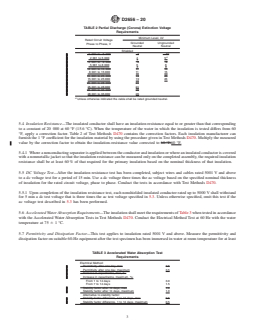
This specification covers a crosslinked polyethylene insulation for electrical wires and cables for conductor sizes 8 AWG (8.37 mm2) and larger. The base polymer of this insulation consists substantially of polyethylene. The partial discharge, ac voltage, insulation resistance, and dc voltage shall be tested to meet the requirements prescribed. The accelerated water absorption, permittivity and dissipation factor, U-bend discharge, and surface resistivity shall be tested to meet the requirements prescribed. The heat distortion, and percent hot creep and percent hot set shall be tested to meet the requirements prescribed.
SCOPE
1.1 This specification covers a crosslinked polyethylene insulation for electrical wires and cables for conductor sizes 8 AWG (8.37 mm2) and larger. The base polymer of this insulation consists substantially of polyethylene.
1.2 This type of insulation is suitable for use on power cables in wet and dry locations at conductor temperatures not exceeding 90 °C for continuous operation, 130 °C for emergency overload conditions, and 250 °C for short-circuit conditions. It is considered suitable for all sizes and voltage classifications of single- and multiple-conductor power cables at voltage ratings of 2001 to 35 000 V phase-to-phase at the 100 % insulation level and at voltage ratings of 2001 to 25 000 V at the 133 % insulation level as listed in Table 1C of Test Methods D470.
1.3 Materials covered by this specification are not sunlight- and weather-resistant unless they are carbon black pigmented or contain an additive system designed for this protection.
1.4 In many instances the insulation cannot be tested unless it has been formed around a conductor. Therefore, tests are done on insulated wire in this standard solely to determine the relevant property of the insulation and not to test the conductor or completed cable.
1.5 Whenever two sets of values are stated, in different units, the values in the first set are regarded as standard, while the values in parentheses are provided for information only and are not considered standard.
1.6 This international standard was developed in accordance with internationally recognized principles on standardization established in the Decision on Principles for the Development of International Standards, Guides and Recommendations issued by the World Trade Organization Technical Barriers to Trade (TBT) Committee.
- Status
- Published
- Publication Date
- 30-Sep-2020
- Technical Committee
- D09 - Electrical and Electronic Insulating Materials
- Drafting Committee
- D09.07 - Electrical Insulating Materials
Buy Documents
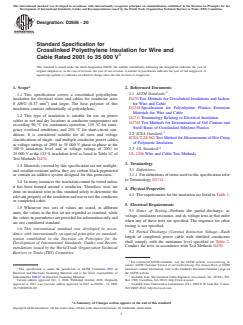
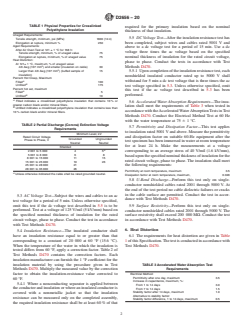


ASTM D2656-20 - Standard Specification for Crosslinked Polyethylene Insulation for Wire and<brk/> Cable Rated 2001 to 35 000 V
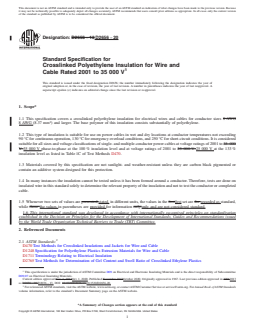
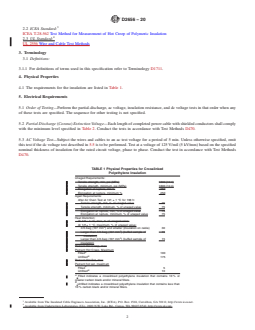
REDLINE ASTM D2656-20 - Standard Specification for Crosslinked Polyethylene Insulation for Wire and<brk/> Cable Rated 2001 to 35 000 V
Overview
ASTM D2656-20 – Standard Specification for Crosslinked Polyethylene Insulation for Wire and Cable Rated 2001 to 35 000 V provides requirements for crosslinked polyethylene (XLPE) insulation used in medium and high voltage power cables. This specification applies to conductor sizes 8 AWG (8.37 mm²) and larger, with the insulation base polymer consisting substantially of polyethylene. The standard outlines key performance properties, including electrical, mechanical, and environmental criteria, to ensure the reliable functioning of insulated power cables in both wet and dry locations.
Key Topics
- Voltage Ratings: XLPE insulation covered under this standard is suitable for use in cables rated from 2001 to 35,000 volts, with different criteria for 100% and 133% insulation levels.
- Operating Temperatures: The insulation is designed for continuous operation at conductor temperatures up to 90°C, 130°C for emergency overloads, and 250°C for short-circuit conditions.
- Performance Criteria:
- Electrical Properties: Partial discharge (corona) performance, AC and DC voltage endurance, insulation resistance, permittivity, dissipation factor, and surface resistivity.
- Mechanical Properties: Unaged and aged tensile strength, elongation at rupture, heat distortion, percent hot creep, and hot set.
- Water Absorption: Accelerated testing ensures XLPE insulation’s stability and low absorption to maintain performance in humid or submerged environments.
- Special Properties: Insulation materials require specific additives or pigmentation (e.g., carbon black) to be sunlight- and weather-resistant.
- Test Requirements: Testing is performed on formed insulated conductors to evaluate insulation performance, not conductor or finished cable performance.
Applications
ASTM D2656-20 is widely used by manufacturers, utilities, and designers of power distribution and transmission systems. Typical applications and practical benefits include:
- Medium and High Voltage Power Cables: Reliable insulation for both single and multi-conductor cables, ensuring operational safety in substations, power grids, industrial plants, and large-building electrical systems.
- Wet and Dry Locations: XLPE insulation maintains electrical integrity and mechanical robustness even in damp or submerged environments as well as dry, enclosed conduit systems.
- Overload and Emergency Operations: Designed to withstand the thermal and electrical stresses of emergency power surges and short-circuit events, ensuring continuous operation and system reliability.
- Enhanced Durability: When formulated for weather and sunlight resistance, XLPE-insulated cables are also suited for outdoor installations exposed to UV light and varying weather conditions.
Related Standards
The ASTM D2656-20 specification closely interacts with several other key standards to ensure consistency and comprehensive testing:
- ASTM D470 – Test Methods for Crosslinked Insulations and Jackets for Wire and Cable
- ASTM D1248 – Specification for Polyethylene Plastics Extrusion Materials for Wire and Cable
- ASTM D1711 – Terminology Relating to Electrical Insulation
- ASTM D2765 – Test Methods for Determination of Gel Content and Swell Ratio of Crosslinked Ethylene Plastics
- ICEA T-28-562 – Test Method for Measurement of Hot Creep of Polymeric Insulation
- UL 2556 – Wire and Cable Test Methods
These related documents establish standardized terminology, testing procedures, and material classifications essential for the design, manufacture, and verification of XLPE-insulated power cables.
Keywords: ASTM D2656-20, crosslinked polyethylene insulation, XLPE, power cable insulation, medium voltage cable, high voltage insulation, electrical insulation, cable testing, insulation resistance, heat distortion, hot creep, weather resistance.
Relations
- Effective Date
- 01-Mar-2024
- Effective Date
- 01-Feb-2024
- Effective Date
- 15-Nov-2016
- Effective Date
- 01-Sep-2016
- Effective Date
- 01-Nov-2015
- Effective Date
- 01-Nov-2014
- Effective Date
- 01-May-2014
- Effective Date
- 01-Nov-2013
- Effective Date
- 01-Apr-2012
- Effective Date
- 01-Aug-2011
- Effective Date
- 01-May-2008
- Effective Date
- 01-Apr-2006
- Effective Date
- 01-Apr-2006
- Refers
ASTM D470-05 - Standard Test Methods for Crosslinked Insulations and Jackets for Wire and Cable - Effective Date
- 01-Sep-2005
- Effective Date
- 01-Mar-2005
Buy Documents
ASTM D2656-20 - Standard Specification for Crosslinked Polyethylene Insulation for Wire and<brk/> Cable Rated 2001 to 35 000 V
REDLINE ASTM D2656-20 - Standard Specification for Crosslinked Polyethylene Insulation for Wire and<brk/> Cable Rated 2001 to 35 000 V
Get Certified
Connect with accredited certification bodies for this standard

IMQ S.p.A. (Certification)
Italian electrical product certification.

SLG Prüf- und Zertifizierungs GmbH
German testing and certification body.

UL Solutions
Global safety science company with testing, inspection and certification.
Sponsored listings
Frequently Asked Questions
ASTM D2656-20 is a technical specification published by ASTM International. Its full title is "Standard Specification for Crosslinked Polyethylene Insulation for Wire and<brk/> Cable Rated 2001 to 35 000 V". This standard covers: ABSTRACT This specification covers a crosslinked polyethylene insulation for electrical wires and cables for conductor sizes 8 AWG (8.37 mm2) and larger. The base polymer of this insulation consists substantially of polyethylene. The partial discharge, ac voltage, insulation resistance, and dc voltage shall be tested to meet the requirements prescribed. The accelerated water absorption, permittivity and dissipation factor, U-bend discharge, and surface resistivity shall be tested to meet the requirements prescribed. The heat distortion, and percent hot creep and percent hot set shall be tested to meet the requirements prescribed. SCOPE 1.1 This specification covers a crosslinked polyethylene insulation for electrical wires and cables for conductor sizes 8 AWG (8.37 mm2) and larger. The base polymer of this insulation consists substantially of polyethylene. 1.2 This type of insulation is suitable for use on power cables in wet and dry locations at conductor temperatures not exceeding 90 °C for continuous operation, 130 °C for emergency overload conditions, and 250 °C for short-circuit conditions. It is considered suitable for all sizes and voltage classifications of single- and multiple-conductor power cables at voltage ratings of 2001 to 35 000 V phase-to-phase at the 100 % insulation level and at voltage ratings of 2001 to 25 000 V at the 133 % insulation level as listed in Table 1C of Test Methods D470. 1.3 Materials covered by this specification are not sunlight- and weather-resistant unless they are carbon black pigmented or contain an additive system designed for this protection. 1.4 In many instances the insulation cannot be tested unless it has been formed around a conductor. Therefore, tests are done on insulated wire in this standard solely to determine the relevant property of the insulation and not to test the conductor or completed cable. 1.5 Whenever two sets of values are stated, in different units, the values in the first set are regarded as standard, while the values in parentheses are provided for information only and are not considered standard. 1.6 This international standard was developed in accordance with internationally recognized principles on standardization established in the Decision on Principles for the Development of International Standards, Guides and Recommendations issued by the World Trade Organization Technical Barriers to Trade (TBT) Committee.
ABSTRACT This specification covers a crosslinked polyethylene insulation for electrical wires and cables for conductor sizes 8 AWG (8.37 mm2) and larger. The base polymer of this insulation consists substantially of polyethylene. The partial discharge, ac voltage, insulation resistance, and dc voltage shall be tested to meet the requirements prescribed. The accelerated water absorption, permittivity and dissipation factor, U-bend discharge, and surface resistivity shall be tested to meet the requirements prescribed. The heat distortion, and percent hot creep and percent hot set shall be tested to meet the requirements prescribed. SCOPE 1.1 This specification covers a crosslinked polyethylene insulation for electrical wires and cables for conductor sizes 8 AWG (8.37 mm2) and larger. The base polymer of this insulation consists substantially of polyethylene. 1.2 This type of insulation is suitable for use on power cables in wet and dry locations at conductor temperatures not exceeding 90 °C for continuous operation, 130 °C for emergency overload conditions, and 250 °C for short-circuit conditions. It is considered suitable for all sizes and voltage classifications of single- and multiple-conductor power cables at voltage ratings of 2001 to 35 000 V phase-to-phase at the 100 % insulation level and at voltage ratings of 2001 to 25 000 V at the 133 % insulation level as listed in Table 1C of Test Methods D470. 1.3 Materials covered by this specification are not sunlight- and weather-resistant unless they are carbon black pigmented or contain an additive system designed for this protection. 1.4 In many instances the insulation cannot be tested unless it has been formed around a conductor. Therefore, tests are done on insulated wire in this standard solely to determine the relevant property of the insulation and not to test the conductor or completed cable. 1.5 Whenever two sets of values are stated, in different units, the values in the first set are regarded as standard, while the values in parentheses are provided for information only and are not considered standard. 1.6 This international standard was developed in accordance with internationally recognized principles on standardization established in the Decision on Principles for the Development of International Standards, Guides and Recommendations issued by the World Trade Organization Technical Barriers to Trade (TBT) Committee.
ASTM D2656-20 is classified under the following ICS (International Classification for Standards) categories: 29.035.20 - Plastics and rubber insulating materials. The ICS classification helps identify the subject area and facilitates finding related standards.
ASTM D2656-20 has the following relationships with other standards: It is inter standard links to ASTM D1711-24, ASTM D2765-16(2024), ASTM D1248-16, ASTM D2765-16, ASTM D1711-15, ASTM D1711-14a, ASTM D1711-14, ASTM D1711-13, ASTM D1248-12, ASTM D1711-11a, ASTM D1711-08, ASTM D2765-11, ASTM D2765-01(2006), ASTM D470-05, ASTM D1248-05. Understanding these relationships helps ensure you are using the most current and applicable version of the standard.
ASTM D2656-20 is available in PDF format for immediate download after purchase. The document can be added to your cart and obtained through the secure checkout process. Digital delivery ensures instant access to the complete standard document.
Standards Content (Sample)
This international standard was developed in accordance with internationally recognized principles on standardization established in the Decision on Principles for the
Development of International Standards, Guides and Recommendations issued by the World Trade Organization Technical Barriers to Trade (TBT) Committee.
Designation:D2656 −20
Standard Specification for
Crosslinked Polyethylene Insulation for Wire and
Cable Rated 2001 to 35 000 V
This standard is issued under the fixed designation D2656; the number immediately following the designation indicates the year of
original adoption or, in the case of revision, the year of last revision. A number in parentheses indicates the year of last reapproval. A
superscript epsilon (´) indicates an editorial change since the last revision or reapproval.
1. Scope* 2. Referenced Documents
2.1 ASTM Standards:
1.1 This specification covers a crosslinked polyethylene
D470 Test Methods for Crosslinked Insulations and Jackets
insulation for electrical wires and cables for conductor sizes
for Wire and Cable
8 AWG (8.37 mm ) and larger. The base polymer of this
D1248 Specification for Polyethylene Plastics Extrusion
insulation consists substantially of polyethylene.
Materials for Wire and Cable
1.2 This type of insulation is suitable for use on power
D1711 Terminology Relating to Electrical Insulation
cables in wet and dry locations at conductor temperatures not
D2765 Test Methods for Determination of Gel Content and
exceeding 90 °C for continuous operation, 130 °C for emer-
Swell Ratio of Crosslinked Ethylene Plastics
gency overload conditions, and 250 °C for short-circuit con-
2.2 ICEA Standard:
ditions. It is considered suitable for all sizes and voltage
ICEAT-28-562 Test Method for Measurement of Hot Creep
classifications of single- and multiple-conductor power cables
of Polymeric Insulation
at voltage ratings of 2001 to 35 000 V phase-to-phase at the
100 % insulation level and at voltage ratings of 2001 to 2.3 UL Standard:
25 000 V at the 133 % insulation level as listed in Table 1C of UL 2556 Wire and Cable Test Methods
Test Methods D470.
3. Terminology
1.3 Materials covered by this specification are not sunlight-
3.1 Definitions:
and weather-resistant unless they are carbon black pigmented
3.1.1 For definitions of terms used in this specification refer
or contain an additive system designed for this protection.
to Terminology D1711.
1.4 In many instances the insulation cannot be tested unless
it has been formed around a conductor. Therefore, tests are
4. Physical Properties
done on insulated wire in this standard solely to determine the
4.1 The requirements for the insulation are listed in Table 1.
relevant property of the insulation and not to test the conductor
or completed cable.
5. Electrical Requirements
1.5 Whenever two sets of values are stated, in different
5.1 Order of Testing—Perform the partial-discharge, ac
units, the values in the first set are regarded as standard, while
voltage, insulation resistance, and dc voltage tests in that order
thevaluesinparenthesesareprovidedforinformationonlyand
when any of these tests are specified. The sequence for other
are not considered standard.
testing is not specified.
1.6 This international standard was developed in accor-
5.2 Partial Discharge (Corona) Extinction Voltage—Each
dance with internationally recognized principles on standard-
length of completed power cable with shielded conductors
ization established in the Decision on Principles for the
shall comply with the minimum level specified in Table 2.
Development of International Standards, Guides and Recom-
Conduct the tests in accordance with Test Methods D470.
mendations issued by the World Trade Organization Technical
Barriers to Trade (TBT) Committee.
For referenced ASTM standards, visit the ASTM website, www.astm.org, or
contact ASTM Customer Service at service@astm.org. For Annual Book of ASTM
This specification is under the jurisdiction of ASTM Committee D09 on Standards volume information, refer to the standard’s Document Summary page on
Electrical and Electronic Insulating Materials and is the direct responsibility of the ASTM website.
Subcommittee D09.07 on Electrical Insulating Materials. Available from The Insulated Cable Engineers Association, Inc. (ICEA), P.O.
Current edition approved Oct. 1, 2020. Published October 2020. Originally Box 1568, Carrollton, GA 30112, http://www.icea.net.
approved in 1967. Last previous edition approved in 2013 as D2656 – 13. DOI: Available from Underwriters Laboratories (UL), 2600 N.W. Lake Rd., Camas,
10.1520/D2656-20. WA 98607-8542, http://www.ul.com.
*A Summary of Changes section appears at the end of this standard
Copyright © ASTM International, 100 Barr Harbor Drive, PO Box C700, West Conshohocken, PA 19428-2959. United States
D2656−20
TABLE 1 Physical Properties for Crosslinked
required for the primary insulation based on the nominal
Polyethylene Insulation
thickness of that insulation.
Unaged Requirements:
5.5 DC Voltage Test—After the insulation resistance test has
Tensile strength, minimum, psi (MPa) 1800 (12.4)
Elongation at rupture, minimum % 250
been completed, subject wires and cables rated 5001 V and
Aged Requirements:
above to a dc voltage test for a period of 15 min. Use a dc
After Air Oven Test at 121±1°Cfor 168 h:
voltage three times the ac voltage based on the specified
Tensile strength, minimum, % of unaged value 75
Elongation at rupture, minimum, % of unaged value 75 nominal thickness of insulation for the rated circuit voltage,
Heat Distortion:
phase to phase. Conduct the tests in accordance with Test
At 121± 1 °C, maximum, % of unaged value:
2 Methods D470.
4/0 Awg (107 mm ) and smaller (insulation on cable) 30
Larger than 4/0 Awg (107 mm ) (buffed sample of 15
5.5.1 Uponcompletionoftheinsulationresistancetest,each
insulation)
nonshielded insulated conductor rated up to 5000 V shall
Percent Hot Creep, Maximum
A
withstand for 5 min a dc test voltage that is three times the ac
Filled 100
B
Unfilled 175
test voltage specified in 5.3. Unless otherwise specified, omit
Percent hot set, maximum
this test if the ac voltage test described in 5.3 has been
A
Filled 5
B
performed.
Unfilled 10
A
Filled indicates a crosslinked polyethylene insulation that contains 10 % or
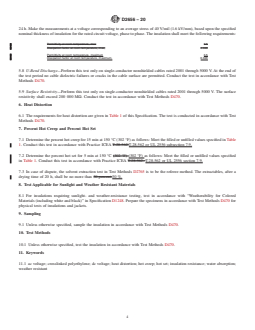
5.6 Accelerated Water Absorption Requirements—The insu-
greater carbon black and/or mineral fillers.
lation shall meet the requirements of Table 3 when tested in
B
Unfilled indicates a crosslinked polyethylene insulation that contains less than
accordancewiththeAcceleratedWaterAbsorptionTestsinTest
10 % carbo
...
This document is not an ASTM standard and is intended only to provide the user of an ASTM standard an indication of what changes have been made to the previous version. Because
it may not be technically possible to adequately depict all changes accurately, ASTM recommends that users consult prior editions as appropriate. In all cases only the current version
of the standard as published by ASTM is to be considered the official document.
Designation: D2656 − 13 D2656 − 20
Standard Specification for
Crosslinked Polyethylene Insulation for Wire and
Cable Rated 2001 to 35 000 V
This standard is issued under the fixed designation D2656; the number immediately following the designation indicates the year of
original adoption or, in the case of revision, the year of last revision. A number in parentheses indicates the year of last reapproval. A
superscript epsilon (´) indicates an editorial change since the last revision or reapproval.
1. Scope*
1.1 This specification covers a crosslinked polyethylene insulation for electrical wires and cables for conductor sizes 8 AWG
8 AWG (8.37 mm ) and larger. The base polymer of this insulation consists substantially of polyethylene.
1.2 This type of insulation is suitable for use on power cables in wet and dry locations at conductor temperatures not exceeding
90 °C for continuous operation, 130 °C for emergency overload conditions, and 250 °C for short-circuit conditions. It is considered
suitable for all sizes and voltage classifications of single- and multiple-conductor power cables at voltage ratings of 2001 to 35 000
V 35 000 V phase-to-phase at the 100 % insulation level and at voltage ratings of 2001 to 25 000 V 25 000 V at the 133 %
insulation level as listed in Table 1C of Test Methods D470.
1.3 Materials covered by this specification are not sunlight- and weather-resistant unless they are carbon black pigmented or
contain an additive system designed for this protection.
1.4 In many instances the insulation cannot be tested unless it has been formed around a conductor. Therefore, tests are done on
insulated wire in this standard solely to determine the relevant property of the insulation and not to test the conductor or completed
cable.
1.5 Whenever two sets of values are presented,stated, in different units, the values in the firstfirst set are the regarded as standard,
while those the values in parentheses are provided for information only.only and are not considered standard.
1.6 This international standard was developed in accordance with internationally recognized principles on standardization
established in the Decision on Principles for the Development of International Standards, Guides and Recommendations issued
by the World Trade Organization Technical Barriers to Trade (TBT) Committee.
2. Referenced Documents
2.1 ASTM Standards:
D470 Test Methods for Crosslinked Insulations and Jackets for Wire and Cable
D1248 Specification for Polyethylene Plastics Extrusion Materials for Wire and Cable
D1711 Terminology Relating to Electrical Insulation
D2765 Test Methods for Determination of Gel Content and Swell Ratio of Crosslinked Ethylene Plastics
This specification is under the jurisdiction of ASTM Committee D09 on Electrical and Electronic Insulating Materials and is the direct responsibility of Subcommittee
D09.07 on Electrical Insulating Materials.
Current edition approved Nov. 1, 2013Oct. 1, 2020. Published November 2013October 2020. Originally approved in 1967. Last previous edition approved in 20062013
as D2656 – 06.D2656 – 13. DOI: 10.1520/D2656-13.10.1520/D2656-20.
For referenced ASTM standards, visit the ASTM website, www.astm.org, or contact ASTM Customer Service at service@astm.org. For Annual Book of ASTM Standards
volume information, refer to the standard’s Document Summary page on the ASTM website.
*A Summary of Changes section appears at the end of this standard
Copyright © ASTM International, 100 Barr Harbor Drive, PO Box C700, West Conshohocken, PA 19428-2959. United States
D2656 − 20
2.2 ICEA Standard:
ICEA T-28-562 Test Method for Measurement of Hot Creep of Polymeric Insulation
2.3 UL Standard:
UL 2556 Wire and Cable Test Methods
3. Terminology
3.1 Definitions:
3.1.1 For definitions of terms used in this specification refer to Terminology D1711.
4. Physical Properties
4.1 The requirements for the insulation are listed in Table 1.
5. Electrical Requirements
5.1 Order of Testing—Perform the partial-discharge, ac voltage, insulation resistance, and dc voltage tests in that order when any
of these tests are specified. The sequence for other testing is not specified.
5.2 Partial Discharge (Corona) Extinction Voltage—Each length of completed power cable with shielded conductors shall comply
with the minimum level specified in Table 2. Conduct the tests in accordance with Test Methods D470.
5.3 AC Voltage Test—Subject the wires and cables to an ac test voltage for a period of 5 min. Unless otherwise specified, omit
this test if the dc voltage test described in 5.5 is to be performed. Test at a voltage of 125 V/mil (5 kV/mm) based on the specified
nominal thickness of insulation for the rated circuit voltage, phase to phase. Conduct the test in accordance with Test Methods
D470.
TABLE 1 Physical Properties for Crosslinked
Polyethylene Insulation
Unaged Requirements:
Tensile strength, min, psi (MPa) 1800 (12.4)
Tensile strength, minimum, psi (MPa) 1800 (12.4)
Elongation at rupture, min % 250
Elongation at rupture, minimum % 250
Aged Requirements:
After Air Oven Test at 121 ± 1 °C for 168 h:
Tensile strength, min, % of unaged value 75
Tensile strength, minimum, % of unaged value 75
Elongation at rupture, min, % of unaged value 75
Elongation at rupture, minimum, % of unaged value 75
Heat Distortion:
At 121± 1 °C, max, % of unaged value:
At 121± 1 °C, maximum, % of unaged value:
4/0 Awg (107 mm ) and smaller (insulation on cable) 30
Larger than 4/0 Awg (107 mm ) (buffed sample of 15
insulation)
Larger than 4/0 Awg (107 mm ) (buffed sample of 15
insulation)
Percent Hot Creep, max
Percent Hot Creep, Maximum
A
Filled 100
B
Unfilled 175
Percent Hot Set, max
Percent hot set, maximum
A
Filled 5
B
Unfilled 10
A
Filled indicates a crosslinked polyethylene insulation that contains 10 % or
greater carbon black and/or mineral fillers.
B
Unfilled indicates a crosslinked polyethylene insulation that contains less than
10 % carbon black and/or mineral fillers.
Available from The Insulated Cable Engineers Association, Inc. (ICEA), P.O. Box 1568, Carrollton, GA 30112, http://www.icea.net.
Available from Underwriters Laboratories (UL), 2600 N.W. Lake Rd., Camas, WA 98607-8542, http://www.ul.com.
D2656 − 20
TABLE 2 Partial Discharge (Corona) Extinction Voltage
Requirements
Minimum Level, kV
Rated Circuit Voltage
Grounded Ungrounded
Phase to Phase, V
Neutral Neutral
Shielded
A
2 001 to 5 000 4 5
A
2 001 to 5 000 4 5
5 001 to 8 000 6 8
5 001 to 8 000 6 8
8 001 to 15 000 11 15
8 001 to 15 000 11 15
15 001 to 25 000 19 26
15 001 to 25 000 19 26
25 001 to 28 000 21
25 001 to 28 000 21
28 001 to 35 000 26
28 001 to 35 000 26
A
Unless otherwise indicated the cable shall be rated grounded neutral.
5.4 Insula
...