

ASTM D5705-20
(Test Method)Standard Test Method for Measurement of Hydrogen Sulfide in the Vapor Phase Above Residual Fuel Oils
General Information
- Abstract
SIGNIFICANCE AND USE
5.1 Residual fuel oils can contain H2S in the liquid phase and this can result in hazardous vapor phase levels of H2S in storage tank headspaces. The vapor phase levels can vary significantly according to the headspace volume, fuel temperature and agitation. Measurement of H2S levels in the liquid phase provides a useful indication of the residual fuel oil’s propensity to form high vapor phase levels, and lower levels in the residual fuel oil will directly reduce risk of H2S exposure. It is critical, however, that anyone involved in handling fuel oil, such as vessel owners and operators, continue to maintain appropriate safety practices designed to protect the crew, tank farm operators and others who can be exposed to H2S.
5.1.1 The measurement of H2S in the liquid phase is appropriate for product quality control, while the measurement of H2S in the vapor phase is appropriate for health and safety purposes.
5.2 This test method was developed to provide refineries, fuel terminals and independent testing laboratories, which do not have access to analytical instruments such as a gas chromatograph, with a simple and consistent field test method for the rapid determination of H2S in the vapor phase above residual fuel oils.
Note 1: D5705 is one of three test methods for quantitatively measuring H2S in residual fuels:
1) Test Method D6021 is an analytical test method to determine H2S levels in the liquid phase.
2) Test Method D7621 is a rapid test method to determine H2S levels in the liquid phase.
Note 2: Because of the reactivity, absorptivity and volatility of H2S, any measurement method only provides an H2S concentration at a given moment in time.
5.3 This test method does not necessarily simulate the vapor phase H2S concentration in a fuel storage tank. It does, however, provide a level of consistency so that the test result is only a function of the residual fuel oil sample and not the test method, operator, or location. No general correlation can b...
SCOPE
1.1 This test method covers the field determination of hydrogen sulfide (H2S) in the vapor phase (equilibrium headspace) of a residual fuel oil sample.
1.2 The test method is applicable to liquids with a viscosity range of 5.5 mm2/s at 40 °C to 50 mm2/s at 100 °C. The test method is applicable to fuels conforming to Specification D396 Grade Nos. 4, 5 (Heavy), and 6.
1.3 The applicable range is from 5 μmol/mol to 4000 μmol/mol (micromoles per mole) (5 ppm v/v to 4000 ppm v/v (parts per million by volume)).
1.4 The values stated in SI units are to be regarded as standard. The values given in parentheses are for information only.
1.5 This standard does not purport to address all of the safety concerns, if any, associated with its use. It is the responsibility of the user of this standard to establish appropriate safety, health, and environmental practices and determine the applicability of regulatory limitations prior to use.
1.6 This international standard was developed in accordance with internationally recognized principles on standardization established in the Decision on Principles for the Development of International Standards, Guides and Recommendations issued by the World Trade Organization Technical Barriers to Trade (TBT) Committee.
- Status
- Published
- Publication Date
- 30-Sep-2020
- Technical Committee
- D02 - Petroleum Products, Liquid Fuels, and Lubricants
- Drafting Committee
- D02.14 - Stability, Cleanliness and Compatibility of Liquid Fuels
Buy Documents
ASTM D5705-20 - Standard Test Method for Measurement of Hydrogen Sulfide in the Vapor Phase Above Residual Fuel Oils
REDLINE ASTM D5705-20 - Standard Test Method for Measurement of Hydrogen Sulfide in the Vapor Phase Above Residual Fuel Oils
Overview
ASTM D5705-20 is the Standard Test Method for Measurement of Hydrogen Sulfide in the Vapor Phase Above Residual Fuel Oils. Developed by ASTM International, this method enables rapid field determination of hydrogen sulfide (H₂S) concentrations in the vapor phase (equilibrium headspace) of residual fuel oil samples. Accurate H₂S measurement is critical in the petroleum industry for ensuring both product quality and the safety of personnel handling heavy fuel oils, such as those used in marine transportation, power generation, and industrial facilities.
The standard is especially useful for refineries, fuel terminals, and independent laboratories lacking advanced analytical equipment. ASTM D5705 offers a consistent, reliable field approach for quickly assessing the risk of hazardous H₂S vapor concentrations above stored fuel oils.
Key Topics
- Applicability: Covers testing for H₂S in the vapor phase of residual fuel oils with viscosities from 5.5 mm²/s at 40°C to 50 mm²/s at 100°C. Applies to ASTM D396 Grade Nos. 4, 5 (Heavy), and 6 fuel oils.
- Measurement Range: Provides quantitative results from 5 to 4000 micromoles per mole (μmol/mol), or 5 to 4000 parts per million by volume (ppm v/v).
- Purpose:
- Measurement in the liquid phase is important for product quality control.
- Measurement in the vapor phase, as specified in this standard, directly addresses occupational health and safety concerns by highlighting the risk of H₂S exposure in storage or transport.
- Test Method Summary:
- Sample collection uses H₂S-inert containers, typically glass.
- The headspace above a 50% filled test sample is purged with nitrogen, heated, and agitated in a controlled environment to establish equilibrium.
- H₂S concentration in the vapor phase is determined using a length-of-stain detector tube, providing a direct and easy-to-read measurement.
- Field Focus: The method does not require laboratory chromatographs, making it suitable for rapid assessments in field settings. Results are specific to the fuel oil sample, ensuring consistency regardless of operator or location.
Applications
- Health and Safety: Monitoring H₂S in vapor phases above residual fuel oils is vital for protecting personnel (such as vessel crews, tank farm and terminal operators) from toxic gas exposure.
- Industry Sectors:
- Petroleum refining
- Marine fuel supply
- Storage tank operation and maintenance
- Independent fuel testing laboratories
- Quality Control: Helps facilities assess and manage the risk of excessive H₂S in stored or transported fuel oils, supporting compliance with safety guidelines and local regulations.
- Operational Decision Making: Rapid, field-based H₂S assessments can inform storage practices, emergency response, and handling procedures to mitigate exposure risks.
Related Standards
Several ASTM standards are closely connected to ASTM D5705-20, supporting comprehensive fuel oil analysis and safety:
- ASTM D396: Specification for Fuel Oils, detailing fuel grades covered under D5705.
- ASTM D6021: Analytical method for total hydrogen sulfide determination in the liquid phase of residual fuels.
- ASTM D7621: Rapid test method for hydrogen sulfide in fuel oils by liquid phase extraction.
- ASTM D4057: Practice for Manual Sampling of Petroleum and Petroleum Products.
- ASTM D4175: Terminology relating to petroleum products, liquid fuels, and lubricants.
Practical Value
Using ASTM D5705-20 improves workplace safety, ensures regulatory compliance, and supports effective risk management by providing a standardized, rapid field test for H₂S in the vapor phase above residual fuel oils. Regular monitoring using this method helps protect workers, maintain product integrity, and optimize fuel handling operations. For organizations aiming to strengthen safety culture within the petroleum sector, ASTM D5705-20 is an essential reference for hydrogen sulfide testing.
Relations
- Refers
ASTM D4175-23a - Standard Terminology Relating to Petroleum Products, Liquid Fuels, and Lubricants - Effective Date
- 15-Dec-2023
- Refers
ASTM D4175-23e1 - Standard Terminology Relating to Petroleum Products, Liquid Fuels, and Lubricants - Effective Date
- 01-Jul-2023
- Effective Date
- 15-Dec-2019
- Effective Date
- 01-May-2019
- Effective Date
- 01-Oct-2018
- Effective Date
- 01-May-2018
- Effective Date
- 01-Dec-2017
- Effective Date
- 01-Jul-2017
- Effective Date
- 01-Oct-2016
- Effective Date
- 01-Oct-2016
- Effective Date
- 01-Dec-2015
- Effective Date
- 01-Oct-2015
- Effective Date
- 01-Oct-2015
- Effective Date
- 01-Jun-2015
- Effective Date
- 15-Apr-2015
Buy Documents
ASTM D5705-20 - Standard Test Method for Measurement of Hydrogen Sulfide in the Vapor Phase Above Residual Fuel Oils
REDLINE ASTM D5705-20 - Standard Test Method for Measurement of Hydrogen Sulfide in the Vapor Phase Above Residual Fuel Oils
Get Certified
Connect with accredited certification bodies for this standard

Element Materials Technology
Materials testing and product certification.

ABS Group Brazil
ABS Group certification services in Brazil.

ABS Quality Evaluations Inc.
American Bureau of Shipping quality certification.
Sponsored listings
Frequently Asked Questions
ASTM D5705-20 is a standard published by ASTM International. Its full title is "Standard Test Method for Measurement of Hydrogen Sulfide in the Vapor Phase Above Residual Fuel Oils". This standard covers: SIGNIFICANCE AND USE 5.1 Residual fuel oils can contain H2S in the liquid phase and this can result in hazardous vapor phase levels of H2S in storage tank headspaces. The vapor phase levels can vary significantly according to the headspace volume, fuel temperature and agitation. Measurement of H2S levels in the liquid phase provides a useful indication of the residual fuel oil’s propensity to form high vapor phase levels, and lower levels in the residual fuel oil will directly reduce risk of H2S exposure. It is critical, however, that anyone involved in handling fuel oil, such as vessel owners and operators, continue to maintain appropriate safety practices designed to protect the crew, tank farm operators and others who can be exposed to H2S. 5.1.1 The measurement of H2S in the liquid phase is appropriate for product quality control, while the measurement of H2S in the vapor phase is appropriate for health and safety purposes. 5.2 This test method was developed to provide refineries, fuel terminals and independent testing laboratories, which do not have access to analytical instruments such as a gas chromatograph, with a simple and consistent field test method for the rapid determination of H2S in the vapor phase above residual fuel oils. Note 1: D5705 is one of three test methods for quantitatively measuring H2S in residual fuels: 1) Test Method D6021 is an analytical test method to determine H2S levels in the liquid phase. 2) Test Method D7621 is a rapid test method to determine H2S levels in the liquid phase. Note 2: Because of the reactivity, absorptivity and volatility of H2S, any measurement method only provides an H2S concentration at a given moment in time. 5.3 This test method does not necessarily simulate the vapor phase H2S concentration in a fuel storage tank. It does, however, provide a level of consistency so that the test result is only a function of the residual fuel oil sample and not the test method, operator, or location. No general correlation can b... SCOPE 1.1 This test method covers the field determination of hydrogen sulfide (H2S) in the vapor phase (equilibrium headspace) of a residual fuel oil sample. 1.2 The test method is applicable to liquids with a viscosity range of 5.5 mm2/s at 40 °C to 50 mm2/s at 100 °C. The test method is applicable to fuels conforming to Specification D396 Grade Nos. 4, 5 (Heavy), and 6. 1.3 The applicable range is from 5 μmol/mol to 4000 μmol/mol (micromoles per mole) (5 ppm v/v to 4000 ppm v/v (parts per million by volume)). 1.4 The values stated in SI units are to be regarded as standard. The values given in parentheses are for information only. 1.5 This standard does not purport to address all of the safety concerns, if any, associated with its use. It is the responsibility of the user of this standard to establish appropriate safety, health, and environmental practices and determine the applicability of regulatory limitations prior to use. 1.6 This international standard was developed in accordance with internationally recognized principles on standardization established in the Decision on Principles for the Development of International Standards, Guides and Recommendations issued by the World Trade Organization Technical Barriers to Trade (TBT) Committee.
SIGNIFICANCE AND USE 5.1 Residual fuel oils can contain H2S in the liquid phase and this can result in hazardous vapor phase levels of H2S in storage tank headspaces. The vapor phase levels can vary significantly according to the headspace volume, fuel temperature and agitation. Measurement of H2S levels in the liquid phase provides a useful indication of the residual fuel oil’s propensity to form high vapor phase levels, and lower levels in the residual fuel oil will directly reduce risk of H2S exposure. It is critical, however, that anyone involved in handling fuel oil, such as vessel owners and operators, continue to maintain appropriate safety practices designed to protect the crew, tank farm operators and others who can be exposed to H2S. 5.1.1 The measurement of H2S in the liquid phase is appropriate for product quality control, while the measurement of H2S in the vapor phase is appropriate for health and safety purposes. 5.2 This test method was developed to provide refineries, fuel terminals and independent testing laboratories, which do not have access to analytical instruments such as a gas chromatograph, with a simple and consistent field test method for the rapid determination of H2S in the vapor phase above residual fuel oils. Note 1: D5705 is one of three test methods for quantitatively measuring H2S in residual fuels: 1) Test Method D6021 is an analytical test method to determine H2S levels in the liquid phase. 2) Test Method D7621 is a rapid test method to determine H2S levels in the liquid phase. Note 2: Because of the reactivity, absorptivity and volatility of H2S, any measurement method only provides an H2S concentration at a given moment in time. 5.3 This test method does not necessarily simulate the vapor phase H2S concentration in a fuel storage tank. It does, however, provide a level of consistency so that the test result is only a function of the residual fuel oil sample and not the test method, operator, or location. No general correlation can b... SCOPE 1.1 This test method covers the field determination of hydrogen sulfide (H2S) in the vapor phase (equilibrium headspace) of a residual fuel oil sample. 1.2 The test method is applicable to liquids with a viscosity range of 5.5 mm2/s at 40 °C to 50 mm2/s at 100 °C. The test method is applicable to fuels conforming to Specification D396 Grade Nos. 4, 5 (Heavy), and 6. 1.3 The applicable range is from 5 μmol/mol to 4000 μmol/mol (micromoles per mole) (5 ppm v/v to 4000 ppm v/v (parts per million by volume)). 1.4 The values stated in SI units are to be regarded as standard. The values given in parentheses are for information only. 1.5 This standard does not purport to address all of the safety concerns, if any, associated with its use. It is the responsibility of the user of this standard to establish appropriate safety, health, and environmental practices and determine the applicability of regulatory limitations prior to use. 1.6 This international standard was developed in accordance with internationally recognized principles on standardization established in the Decision on Principles for the Development of International Standards, Guides and Recommendations issued by the World Trade Organization Technical Barriers to Trade (TBT) Committee.
ASTM D5705-20 is classified under the following ICS (International Classification for Standards) categories: 75.160.20 - Liquid fuels. The ICS classification helps identify the subject area and facilitates finding related standards.
ASTM D5705-20 has the following relationships with other standards: It is inter standard links to ASTM D4175-23a, ASTM D4175-23e1, ASTM D396-19a, ASTM D396-19, ASTM D396-18a, ASTM D396-18, ASTM D396-17a, ASTM D396-17, ASTM D396-16e1, ASTM D396-16, ASTM D7621-15b, ASTM D396-15c, ASTM D7621-15a, ASTM D396-15b, ASTM D7621-15. Understanding these relationships helps ensure you are using the most current and applicable version of the standard.
ASTM D5705-20 is available in PDF format for immediate download after purchase. The document can be added to your cart and obtained through the secure checkout process. Digital delivery ensures instant access to the complete standard document.
Standards Content (Sample)
This international standard was developed in accordance with internationally recognized principles on standardization established in the Decision on Principles for the
Development of International Standards, Guides and Recommendations issued by the World Trade Organization Technical Barriers to Trade (TBT) Committee.
Designation:D5705 −20
Standard Test Method for
Measurement of Hydrogen Sulfide in the Vapor Phase
Above Residual Fuel Oils
This standard is issued under the fixed designation D5705; the number immediately following the designation indicates the year of
original adoption or, in the case of revision, the year of last revision. A number in parentheses indicates the year of last reapproval. A
superscript epsilon (´) indicates an editorial change since the last revision or reapproval.
1. Scope* D4175 Terminology Relating to Petroleum Products, Liquid
Fuels, and Lubricants
1.1 This test method covers the field determination of
D6021 Test Method for Measurement of Total Hydrogen
hydrogen sulfide (H S) in the vapor phase (equilibrium head-
Sulfide in Residual Fuels by Multiple Headspace Extrac-
space) of a residual fuel oil sample.
tion and Sulfur Specific Detection
1.2 The test method is applicable to liquids with a viscosity
D7621 Test Method for Determination of Hydrogen Sulfide
2 2
range of 5.5 mm /s at 40 °C to 50 mm /s at 100 °C. The test
in Fuel Oils by Rapid Liquid Phase Extraction
methodisapplicabletofuelsconformingtoSpecificationD396
Grade Nos. 4, 5 (Heavy), and 6.
3. Terminology
1.3 The applicable range is from 5 µmol⁄mol to 3.1 Definitions:
4000 µmol⁄mol (micromoles per mole) (5 ppm v⁄v to
3.1.1 For definitions of terms used in this test method, see
4000 ppm v/v (parts per million by volume)). Terminology D4175.
3.1.2 equilibrium headspace, n—the vapor space above the
1.4 The values stated in SI units are to be regarded as
liquid in which all vapor components are in equilibrium with
standard. The values given in parentheses are for information
the liquid components.
only.
3.1.3 residual fuel oil, n—a fuel oil comprising a blend of
1.5 This standard does not purport to address all of the
viscous long, short, or cracked residue from a petroleum
safety concerns, if any, associated with its use. It is the
refining process and lighter distillates blended to a fuel oil
responsibility of the user of this standard to establish appro-
viscosity specification.
priate safety, health, and environmental practices and deter-
3.1.3.1 Discussion—Under the conditions of this test (1:1
mine the applicability of regulatory limitations prior to use.
liquid/vapor ratio, temperature, and agitation) the HSinthe
1.6 This international standard was developed in accor-
vapor phase (sample’s headspace) will be in equilibrium with
dance with internationally recognized principles on standard-
the H S in the liquid phase.
ization established in the Decision on Principles for the
Development of International Standards, Guides and Recom-
4. Summary of Test Method
mendations issued by the World Trade Organization Technical
4.1 A1 L H S-inert test container (glass test bottle) is filled
Barriers to Trade (TBT) Committee.
to 50 % by volume with fuel oil from a filled H S-inert
container (glass sample bottle) just prior to testing. In the test
2. Referenced Documents
2 container, the vapor space above the fuel oil sample is purged
2.1 ASTM Standards:
with nitrogen to displace air. The test container with sample is
D396 Specification for Fuel Oils
heated in an oven to 60 °C, and agitated on an orbital shaker at
D4057 Practice for Manual Sampling of Petroleum and
-1 -1
3.67 s 6 0.08 s (220 r⁄min 6 5 r⁄min (revolutions per
Petroleum Products
minute)) for 3 min.
4.2 Alength-of-stain detector tube and hand-operated pump
This test method is under the jurisdiction of ASTM Committee D02 on are used to measure the H S concentration in the vapor phase
Petroleum Products, Liquid Fuels, and Lubricants and is the direct responsibility of
of the test container. The length-of-stain detector tube should
Subcommittee D02.14 on Stability, Cleanliness and Compatibility of Liquid Fuels.
be close to but not in contact with the liquid surface.
Current edition approved Oct. 1, 2020. Published October 2020. Originally
approved in 1995. Last previous edition approved in 2015 as D5705 – 15. DOI:
5. Significance and Use
10.1520/D5705-20.
For referenced ASTM standards, visit the ASTM website, www.astm.org, or
5.1 Residual fuel oils can contain H S in the liquid phase
contact ASTM Customer Service at service@astm.org. For Annual Book of ASTM
and this can result in hazardous vapor phase levels of HSin
Standards volume information, refer to the standard’s Document Summary page on 2
the ASTM website. storage tank headspaces. The vapor phase levels can vary
*A Summary of Changes section appears at the end of this standard
Copyright © ASTM International, 100 Barr Harbor Drive, PO Box C700, West Conshohocken, PA 19428-2959. United States
D5705−20
significantly according to the headspace volume, fuel tempera- through it that is capable of accurately measuring the tempera-
ture and agitation. Measurement of H S levels in the liquid ture of the sample at 60 °C 6 1 °C as required in the procedure
phase provides a useful indication of the residual fuel oil’s and extending at least 25 mm into the residual fuel but no
propensity to form high vapor phase levels, and lower levels in closer than 25 mm from the bottom of a test bottle (see Fig.
the residual fuel oil will directly reduce risk of H S exposure. 1(a)). A dial thermometer having a range of –18 °C to 82 °C
Itiscritical,however,thatanyoneinvolvedinhandlingfueloil, and a 200 mm stem has been found suitable to use.
such as vessel owners and operators, continue to maintain
7.4 Oven or Water Bath, capable of heating the fuel oil
appropriate safety practices designed to protect the crew, tank
samples to 60 °C 6 1 °C.
farm operators and others who can be exposed to H S.
7.5 Detector Tube Pump,ahand-operatedpistonorbellows-
5.1.1 The measurement of H S in the liquid phase is
3 3
type (Fig. 1(b)) pump with a capacity of 100 cm 65cm per
appropriate for product quality control, while the measurement
stroke. It must be specifically designed for use with detector
of H S in the vapor phase is appropriate for health and safety
tubes. (Warning—A detector tube and pump together form a
purposes.
unit and must be used as such. Each manufacturer calibrates
5.2 This test method was developed to provide refineries,
detector tubes to match the flow characteristics of its specific
fuel terminals and independent testing laboratories, which do
pump. Crossing brands of pumps and tubes is not permitted, as
not have access to analytical instruments such as a gas
considerable loss of system accuracy is likely to occur.)
chromatograph, with a simple and consistent field test method
for the rapid determination of H S in the vapor phase above
8. Reagents and Materials
residual fuel oils.
8.1 Containers—Both sample and test containers are com-
NOTE 1—D5705 is one of three test methods for quantitatively posed of H S-inert material such as 1 L size (clear Boston
measuring H S in residual fuels:
1)TestMethodD6021isananalyticaltestmethodtodetermineH Slevels
in the liquid phase.
Direct Reading Colorimetric Indicator Tubes Manual, First Edition, American
2) Test Method D7621 is a rapid test method to determine H S levels in
2 Industrial Hygiene Association, Akron, OH 44311, 1976.
the liquid phase.
NOTE 2—Because of the reactivity, absorptivity and volatility of H S,
any measurement method only provides an H S concentration at a given
moment in time.
5.3 This test method does not necessarily simulate the vapor
phase H S concentration in a fuel storage tank. It does,
however, provide a level of consistency so that the test result is
only a function of the residual fuel oil sample and not the test
method, operator, or location. No general correlation can be
established between this field test and actual vapor phase
concentrations of H S in residual fuel oil storage or transports.
However, a facility that produces fuel oil from the same crude
source under essentially constant conditions might be able to
develop a correlation for its individual case.
6. Interferences
6.1 Typically, sulfur dioxide and mercaptans may cause
positive interferences. In some cases, nitrogen dioxide can
cause a negative interference. Most detector tubes will have a
precleanse layer designed to remove certain interferences up to
some maximum interferant level. Consult the manufacturer’s
instructions for specific interference information.
7. Apparatus
7.1 Shaker, a bench-top orbital shaker and platform
equipped with a four-prong clamp to hold 1 L Boston round-
-1
bottom glass bottles and capable of operation at 3.67 s 6
-1
0.08 s (220 r⁄min 6 5 r⁄min (revolutions per minute)).
NOTE 3—An orbital shaker with an orbit of 19 mm has been found to
be suitable.
7.2 Timer, capable of measuring from 1 s to 30 min at
second intervals.
7.3 Stopper with Temperature Measuring Device, a No. 2
FIG. 1 Measurement of H S in the Vapor Phase of Residual Fuel
cork stopper with a temperature measuring devices inserted Oil
D5705−20
round-bottom) glass bottles with screw caps. The bottles are test bottle such that it is filled 50 % 6 5 % by volume with the
cleananddry.Marktestcontainersatthe50 %volumelevelby sample.Discardtheremainingcontentsofthesamplecontainer
using a ruler. (Warning—Hydrogen sulfide reacts with metal in compliance with applicable laws. A single test is to be
surfaces and is easily oxidized, which depletes its concentra- performed on material from an individual sample container.
tion and gives false low test results. Containers such as
10.2 Insert a nitrogen purge line outlet to within about
epoxy-lacquered cans are suitable for sample collection.Alter-
13 mm above the fuel surface. Nitrogen purge at 2 L⁄min for
nativecontainersmustgiveequivalentresultstothoseobtained
30 s the headspace above the test sample to displace air and
by using glass.)
water vapor. Minimize the time the bottle is open to avoid
8.2 Length-of-Stain Detector Tube and Calibration Scale, a
furtherlossofsamplevapors.Closethetestbottleopening(gas
sealed glass tube with breakoff tips sized to fit the tube holder
tight) with a cork stopper fitted with a dial thermometer (Fig.
of the detector tube pump. The reagent layer inside the tube,
1(a)) immediately after nitrogen purging.
typicallyasilicagelsubstratecoatedwiththeactivechemicals,
10.3 Placeeachtestbottlewithsampleinanovenorawater
must be specific for hydrogen sulfide and must produce a
bath, set at 60 °C 6 1 °C, until the sample temperature reaches
distinct color change when exposed to a sample of gas
60 °C 6 1 °C. Keep the sample in the oven or bath for a
containing hydrogen sulfide. Any substances known to inter-
minimum of 30 min, which includes the time for the sample to
fere must be listed in the instructions accompanying the tubes.
reach 60 °C.
A calibration scale should be marked directly on the tube, or
other markings that provide for easy interpretation (reading) of NOTE 5—If the sample temperature does not reach 60 °C, low results
will be obtained for the H S concentration. If the temperature exceeds
hydrogen sulfide content from a separate calibration scale
60 °C, high results will be obtained for the H S concentration.
should be supplied with the tubes. The calibration scale shall
correlate H S concentrat
...
This document is not an ASTM standard and is intended only to provide the user of an ASTM standard an indication of what changes have been made to the previous version. Because
it may not be technically possible to adequately depict all changes accurately, ASTM recommends that users consult prior editions as appropriate. In all cases only the current version
of the standard as published by ASTM is to be considered the official document.
Designation: D5705 − 15 D5705 − 20
Standard Test Method for
Measurement of Hydrogen Sulfide in the Vapor Phase
Above Residual Fuel Oils
This standard is issued under the fixed designation D5705; the number immediately following the designation indicates the year of
original adoption or, in the case of revision, the year of last revision. A number in parentheses indicates the year of last reapproval. A
superscript epsilon (´) indicates an editorial change since the last revision or reapproval.
1. Scope*
1.1 This test method covers the field determination of hydrogen sulfide (H S) in the vapor phase (equilibrium headspace) of a
residual fuel oil sample.
2 2
1.2 The test method is applicable to liquids with a viscosity range of 5.5 mm /s at 40°C40 °C to 50 mm /s at 100°C.100 °C. The
test method is applicable to fuels conforming to Specification D396 Grade Nos. 4, 5 (Heavy), and 6.
1.3 The applicable range is from 5 μmol ⁄mol to 4000 μmol ⁄mol (micromoles per mole) (5 ppm v ⁄v to 4000 ppm v/v (parts per
million by volume)).
1.4 The values stated in SI units are to be regarded as standard. The values given in parentheses are for information only.
1.5 This standard does not purport to address all of the safety concerns, if any, associated with its use. It is the responsibility
of the user of this standard to establish appropriate safety safety, health, and healthenvironmental practices and determine the
applicability of regulatory limitations prior to use.
1.6 This international standard was developed in accordance with internationally recognized principles on standardization
established in the Decision on Principles for the Development of International Standards, Guides and Recommendations issued
by the World Trade Organization Technical Barriers to Trade (TBT) Committee.
2. Referenced Documents
2.1 ASTM Standards:
D396 Specification for Fuel Oils
D4057 Practice for Manual Sampling of Petroleum and Petroleum Products
D4175 Terminology Relating to Petroleum Products, Liquid Fuels, and Lubricants
D6021 Test Method for Measurement of Total Hydrogen Sulfide in Residual Fuels by Multiple Headspace Extraction and Sulfur
Specific Detection
D7621 Test Method for Determination of Hydrogen Sulfide in Fuel Oils by Rapid Liquid Phase Extraction
3. Terminology
3.1 Definitions:
This test method is under the jurisdiction of ASTM Committee D02 on Petroleum Products, Liquid Fuels, and Lubricants and is the direct responsibility of Subcommittee
D02.14 on Stability Stability, Cleanliness and CleanlinessCompatibility of Liquid Fuels.
Current edition approved April 1, 2015Oct. 1, 2020. Published July 2015October 2020. Originally approved in 1995. Last previous edition approved in 20142015 as
D5705 – 14.D5705 – 15. DOI: 10.1520/D5705-15.10.1520/D5705-20.
For referenced ASTM standards, visit the ASTM website, www.astm.org, or contact ASTM Customer Service at service@astm.org. For Annual Book of ASTM Standards
volume information, refer to the standard’s Document Summary page on the ASTM website.
*A Summary of Changes section appears at the end of this standard
Copyright © ASTM International, 100 Barr Harbor Drive, PO Box C700, West Conshohocken, PA 19428-2959. United States
D5705 − 20
3.1.1 For definitions of terms used in this test method, see Terminology D4175.
3.1.2 equilibrium headspace, n—the vapor space above the liquid in which all vapor components are in equilibrium with the liquid
components.
3.1.3 residual fuel oil, n—a fuel oil comprising a blend of viscous long, short, or cracked residue from a petroleum refining process
and lighter distillates blended to a fuel oil viscosity specification.
3.1.3.1 Discussion—
Under the conditions of this test (1:1 liquid/vapor ratio, temperature, and agitation) the H S in the vapor phase (sample’s
headspace) will be in equilibrium with the H S in the liquid phase.
4. Summary of Test Method
4.1 A 1 L H S-inert test container (glass test bottle) is filled to 50 % by volume with fuel oil from a filled H S-inert container (glass
2 2
sample bottle) just prior to testing. In the test container, the vapor space above the fuel oil sample is purged with nitrogen to
-1 -1
displace air. The test container with sample is heated in an oven to 60 °C, and agitated on an orbital shaker at 3.67 s 6 0.08 s
(220 r ⁄min 6 5 r ⁄min (revolutions per minute)) for 3 min.
4.2 A length-of-stain detector tube and hand-operated pump are used to measure the H S concentration in the vapor phase of the
test container. The length-of-stain detector tube should be close to but not in contact with the liquid surface.
5. Significance and Use
5.1 Residual fuel oils can contain H S in the liquid phase and this can result in hazardous vapor phase levels of H S in storage
2 2
tank headspaces. The vapor phase levels can vary significantly according to the headspace volume, fuel temperature and agitation.
Measurement of H S levels in the liquid phase provides a useful indication of the residual fuel oil’s propensity to form high vapor
phase levels, and lower levels in the residual fuel oil will directly reduce risk of H S exposure. It is critical, however, that anyone
involved in handling fuel oil, such as vessel owners and operators, continue to maintain appropriate safety practices designed to
protect the crew, tank farm operators and others who can be exposed to H S.
5.1.1 The measurement of H S in the liquid phase is appropriate for product quality control, while the measurement of H S in the
2 2
vapor phase is appropriate for health and safety purposes.
5.2 This test method was developed to provide refineries, fuel terminals and independent testing laboratories, which do not have
access to analytical instruments such as a gas chromatograph, with a simple and consistent field test method for the rapid
determination of H S in the vapor phase above residual fuel oils.
NOTE 1—D5705 is one of three test methods for quantitatively measuring H S in residual fuels:
1) Test Method D6021 is an analytical test method to determine H S levels in the liquid phase.
2) Test Method D7621 is a rapid test method to determine H S levels in the liquid phase.
NOTE 2—Because of the reactivity, absorptivity and volatility of H S, any measurement method only provides an H S concentration at a given moment
2 2
in time.
5.3 This test method does not necessarily simulate the vapor phase H S concentration in a fuel storage tank. It does, however,
provide a level of consistency so that the test result is only a function of the residual fuel oil sample and not the test method,
operator, or location. No general correlation can be established between this field test and actual vapor phase concentrations of H S
in residual fuel oil storage or transports. However, a facility that produces fuel oil from the same crude source under essentially
constant conditions might be able to develop a correlation for its individual case.
6. Interferences
6.1 Typically, sulfur dioxide and mercaptans may cause positive interferences. In some cases, nitrogen dioxide can cause a
negative interference. Most detector tubes will have a precleanse layer designed to remove certain interferences up to some
maximum interferant level. Consult the manufacturer’s instructions for specific interference information.
D5705 − 20
7. Apparatus
7.1 Shaker, a bench-top orbital shaker and platform equipped with a four-prong clamp to hold 1 L Boston round-bottom glass
-1 -1
bottles and capable of operation at 3.67 s 6 0.08 s (220 r ⁄min 6 5 r ⁄min (revolutions per minute)).
NOTE 3—An orbital shaker with an orbit of 19 mm has been found to be suitable.
7.2 Timer, capable of measuring from 1 s to 30 min at second intervals.
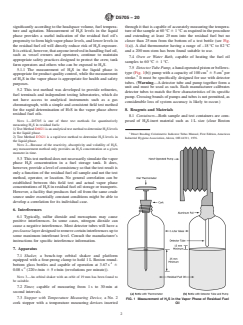
7.3 Stopper with Temperature Measuring Device, a No. 2 cork stopper with a temperature measuring devices inserted through it
that is capable of accurately measuring the temperature of the sample at 60 °C 6 1 °C as required in the procedure and extending
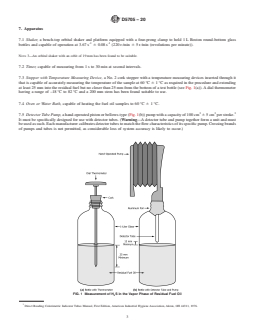
at least 25 mm into the residual fuel but no closer than 25 mm from the bottom of a test bottle (see Fig. 1(a)). A dial thermometer
having a range of –18 °C to 82 °C and a 200 mm stem has been found suitable to use.
7.4 Oven or Water Bath, capable of heating the fuel oil samples to 60 °C 6 1 °C.
3 3 3
7.5 Detector Tube Pump, a hand-operated piston or bellows-type (Fig. 1(b)) pump with a capacity of 100 cm 6 5 cm per stroke.
It must be specifically designed for use with detector tubes. (Warning—A detector tube and pump together form a unit and must
be used as such. Each manufacturer calibrates detector tubes to match the flow characteristics of its specific pump. Crossing brands
of pumps and tubes is not permitted, as considerable loss of system accuracy is likely to occur.)
FIG. 1 Measurement of H S in the Vapor Phase of Residual Fuel Oil
Direct Reading Colorimetric Indicator Tubes Manual, First Edition, American Industrial Hygiene Association, Akron, OH 44311, 1976.
D5705 − 20
8. Reagents and Materials
8.1 Containers—Both sample and test containers are composed of H S-inert material such as 1 L size (clear Boston round-bottom)
glass bottles with screw caps. The bottles are clean and dry. Mark test containers at the 50 % volume level by using a ruler.
(Warning—Hydrogen sulfide reacts with metal surfaces and is easily oxidized, which depletes its concentration and gives false
low test results. Containers such as epoxy-lacquered cans are suitable for sample collection. Alternative containers must give
equivalent results to those obtained by using glass.)
8.2 Length-of-Stain Detector Tube and Calibration Scale, a sealed glass tube with breakoff tips sized to fit the tube holder of the
detector tube pump. The reagent layer inside the tube, typically a silica gel substrate coated with the active chemicals, must be
specific for hydrogen sulfide and must produce a distinct color change when exposed to a sample of gas containing hydrogen
sulfide. Any substances known to interfere must be listed in the instructions accompanying the tubes. A calibration scale should
be marked directly on the tube, or other markings that provide for easy interpretation (reading) of hydrogen sulfide content from
a separate calibration scale should be supplied with the tubes. The calibration scale shall correlate H S concentration to the length
of the color stain. Annex A1 provides additional information. Shelf life of the detector tubes must be a minimum of two years from
the date of manufacture, when stored according to the manufacturer’s recommendations.
9. Sampling
9.1 The sampling of residual fuel oils is done according to Practice D4057 for the sampling of storage tanks, ships, or barges.
Composite sampling or running samples can be taken; spot samples should be taken from the midpoint or below midpoint of the
fuel oil in a storage tank by first sufficiently purging sample transfer lines and then taking single samples where each sample
comprises one and only one test. (Warning—Samples taken for this test method shall be dedicated to a single H S determination
and not used for any other purpose, as any additional handling can lead to loss of H S and thus low results.)
NOTE 4—Liquid samples taken well into the fuel oil have had less H S lost by degassing as compared with a fuel oil’s surface. Samples taken from well
within the fuel oil storage provide material that represents the greatest potential for H S exposure during fuel oil movements. Hydrogen sulfide is lost
by
...