

ASTM D7917-14(2018)
(Practice)Standard Practice for Inductive Wear Debris Sensors in Gearbox and Drivetrain Applications
General Information
- Abstract
SIGNIFICANCE AND USE
5.1 This practice is intended for the application of online, full-flow, or slip-stream sampling of wear debris via inductive sensors for gearbox and drivetrain applications.
5.2 Periodic sampling and analysis of lubricants have long been used as a means to determine overall machinery health. The implementation of smaller oil filter pore sizes for machinery has reduced the effectiveness of sampled oil analysis for determining abnormal wear prior to severe damage. In addition, sampled oil analysis for equipment that is remote or otherwise difficult to monitor or access is not always sufficient or practical. For these machinery systems, in-line wear debris sensors can be very useful to provide real-time and near-real-time condition monitoring data.
5.3 Online inductive debris sensors have demonstrated the capability to detect and quantify both ferromagnetic and non-ferromagnetic metallic wear debris (1, 2). These sensors record metallic wear debris according to size, count, and type (ferromagnetic or non-ferromagnetic). Sensors can be fitted to virtually any lubricating system. The sensors are particularly effective for the protection of rolling element bearings and gears in critical machine applications. Bearings are key elements in machines since their failure often leads to significant secondary damage that can adversely affect safety, operational availability, operational/maintenance costs, or combinations thereof.
5.4 The key advantage of online metallic debris sensors is the ability to detect early bearing and gear damage and to quantify the severity of damage and rate of progression toward failure. Sensor capabilities are summarized as follows:
5.4.1 Can detect both ferromagnetic and non-ferromagnetic metallic wear debris.
5.4.2 Can detect 95 % or more of metallic wear debris above some minimum particle size threshold.
5.4.3 Can count and size wear debris detected.
5.4.4 Can provide total mass loss.
Note 1: Mass is an inferred value which ...
SCOPE
1.1 This practice covers the minimum requirements for an online inductive sensor system to monitor ferromagnetic and non-ferromagnetic metallic wear debris present in in-service lubricating fluids residing in gearboxes and drivetrains.
1.2 Metallic wear debris considered in this practice can range in size from 40 μm to greater than 1000 μm of equivalent spherical diameter (ESD).
1.3 This practice is suitable for use with the following lubricants: industrial gear oils, petroleum crankcase oils, polyalkylene glycol, polyol esters, and phosphate esters.
1.4 This practice is for metallic wear debris detection, not oil cleanliness.
1.5 The values stated in SI units are to be regarded as standard. No other units of measurement are included in this standard.
1.5.1 Exception—Subsection 7.7 uses “G’s”.
1.6 This standard does not purport to address all of the safety concerns, if any, associated with its use. It is the responsibility of the user of this standard to establish appropriate safety, health, and environmental practices and determine the applicability of regulatory limitations prior to use.
1.7 This international standard was developed in accordance with internationally recognized principles on standardization established in the Decision on Principles for the Development of International Standards, Guides and Recommendations issued by the World Trade Organization Technical Barriers to Trade (TBT) Committee.
- Status
- Published
- Publication Date
- 30-Sep-2018
- Technical Committee
- D02 - Petroleum Products, Liquid Fuels, and Lubricants
Overview
ASTM D7917-14(2018), titled Standard Practice for Inductive Wear Debris Sensors in Gearbox and Drivetrain Applications, establishes minimum requirements and best practices for the use of inductive wear debris sensors in monitoring the condition of gearboxes and drivetrains. Developed by ASTM International, this standard is intended for online, real-time measurement and analysis of metallic wear debris in lubricating fluids, supporting proactive maintenance and operational reliability in industries such as wind energy, aviation, and industrial machinery.
Inductive wear debris sensors play a crucial role in detecting early signs of abnormal wear, especially as traditional oil analysis via periodic sampling becomes less effective due to advancements in filtration systems and increasing equipment complexity. This standard ensures consistent sensor performance and data interpretation across applications.
Key Topics
- Scope and Coverage
The standard applies to online inductive sensor systems for detecting ferromagnetic and non-ferromagnetic metallic debris in lubricants ranging from 40 μm to over 1000 μm in diameter. It is designed for lubricants including industrial gear oils, petroleum crankcase oils, polyalkylene glycol, polyol esters, and phosphate esters. - Sensor Capabilities
Inductive sensors must detect and size metallic debris, differentiate ferromagnetic from non-ferromagnetic particles, and provide quantitative data on particle counts, sizes, and inferred mass loss. - Sensor Installation and Operation
Best practices include sensor placement (in-line or bypass loop), compatibility with flow rates and pressures, and resilience to environmental factors such as vibration and temperature extremes. - Data Interpretation
The standard describes recommended approaches for trending debris data, setting alarm/warning thresholds, and leveraging cumulative counts and mass calculations for machinery health assessment. - Applications in Condition Monitoring Inductive wear debris sensors help in real-time detection of wear events, enabling early maintenance actions that can prevent catastrophic failures and reduce downtime and costs.
- Safety and Compliance
Users must ensure appropriate safety, health, and environmental practices when employing these sensors, and consult applicable regulatory requirements.
Applications
ASTM D7917-14(2018) is essential for industries that rely on the health and longevity of gearboxes and rotating machinery. Key applications include:
- Wind Turbine Gearboxes
Real-time debris detection is critical due to the high failure rates of gearboxes. Sensors provide timely warnings, allowing maintenance scheduling before costly breakdowns. - Aviation and Turbomachinery
Continuous monitoring of oil-borne debris offers significant benefit in aircraft gas turbines and industrial aero-derivative engines, where bearing failures can lead to severe secondary damage. - Remote and Hard-to-Access Machinery
Sensors support effective condition monitoring even in remote installations, where traditional oil analysis is impractical. - Predictive Maintenance Programs
The standard facilitates integration of inductive debris sensors into predictive maintenance strategies, improving asset management and operational efficiency.
Related Standards
For comprehensive implementation and enhanced data analysis, consider these related ASTM and ISO standards:
- ASTM D7669 - Guide for Practical Lubricant Condition Data Trend Analysis
- ASTM D7685 - Practice for In-Line, Full Flow, Inductive Sensor for Ferromagnetic and Non-Ferromagnetic Wear Debris Determination
- ASTM D7720 - Guide for Statistically Evaluating Measurand Alarm Limits when Using Oil Analysis to Monitor Equipment
- ASTM D4175 - Terminology Relating to Petroleum Products, Liquid Fuels, and Lubricants
- ISO/TC 108 N 605 - Terminology for the Field of Condition Monitoring and Diagnostics of Machines
- SAE AIR 1828 - Guide to Engine Lubrication System Monitoring
By following ASTM D7917-14(2018), industries can improve reliability, enhance machinery protection, and support effective, data-driven maintenance decisions using state-of-the-art online wear debris detection.
Relations
- Effective Date
- 01-Oct-2018
- Refers
ASTM D4175-23a - Standard Terminology Relating to Petroleum Products, Liquid Fuels, and Lubricants - Effective Date
- 15-Dec-2023
- Refers
ASTM D4175-23e1 - Standard Terminology Relating to Petroleum Products, Liquid Fuels, and Lubricants - Effective Date
- 01-Jul-2023
- Effective Date
- 01-Nov-2015
- Effective Date
- 01-Jun-2013
- Effective Date
- 01-May-2012
- Effective Date
- 01-Jun-2011
- Effective Date
- 15-Feb-2011
- Effective Date
- 01-Jan-2011
- Effective Date
- 01-Dec-2010
- Effective Date
- 01-Jul-2010
- Effective Date
- 01-Jan-2010
- Effective Date
- 15-Nov-2009
- Effective Date
- 01-May-2005
- Effective Date
- 01-Dec-2004
Get Certified
Connect with accredited certification bodies for this standard

BSMI (Bureau of Standards, Metrology and Inspection)
Taiwan's standards and inspection authority.
Sponsored listings
Frequently Asked Questions
ASTM D7917-14(2018) is a standard published by ASTM International. Its full title is "Standard Practice for Inductive Wear Debris Sensors in Gearbox and Drivetrain Applications". This standard covers: SIGNIFICANCE AND USE 5.1 This practice is intended for the application of online, full-flow, or slip-stream sampling of wear debris via inductive sensors for gearbox and drivetrain applications. 5.2 Periodic sampling and analysis of lubricants have long been used as a means to determine overall machinery health. The implementation of smaller oil filter pore sizes for machinery has reduced the effectiveness of sampled oil analysis for determining abnormal wear prior to severe damage. In addition, sampled oil analysis for equipment that is remote or otherwise difficult to monitor or access is not always sufficient or practical. For these machinery systems, in-line wear debris sensors can be very useful to provide real-time and near-real-time condition monitoring data. 5.3 Online inductive debris sensors have demonstrated the capability to detect and quantify both ferromagnetic and non-ferromagnetic metallic wear debris (1, 2). These sensors record metallic wear debris according to size, count, and type (ferromagnetic or non-ferromagnetic). Sensors can be fitted to virtually any lubricating system. The sensors are particularly effective for the protection of rolling element bearings and gears in critical machine applications. Bearings are key elements in machines since their failure often leads to significant secondary damage that can adversely affect safety, operational availability, operational/maintenance costs, or combinations thereof. 5.4 The key advantage of online metallic debris sensors is the ability to detect early bearing and gear damage and to quantify the severity of damage and rate of progression toward failure. Sensor capabilities are summarized as follows: 5.4.1 Can detect both ferromagnetic and non-ferromagnetic metallic wear debris. 5.4.2 Can detect 95 % or more of metallic wear debris above some minimum particle size threshold. 5.4.3 Can count and size wear debris detected. 5.4.4 Can provide total mass loss. Note 1: Mass is an inferred value which ... SCOPE 1.1 This practice covers the minimum requirements for an online inductive sensor system to monitor ferromagnetic and non-ferromagnetic metallic wear debris present in in-service lubricating fluids residing in gearboxes and drivetrains. 1.2 Metallic wear debris considered in this practice can range in size from 40 μm to greater than 1000 μm of equivalent spherical diameter (ESD). 1.3 This practice is suitable for use with the following lubricants: industrial gear oils, petroleum crankcase oils, polyalkylene glycol, polyol esters, and phosphate esters. 1.4 This practice is for metallic wear debris detection, not oil cleanliness. 1.5 The values stated in SI units are to be regarded as standard. No other units of measurement are included in this standard. 1.5.1 Exception—Subsection 7.7 uses “G’s”. 1.6 This standard does not purport to address all of the safety concerns, if any, associated with its use. It is the responsibility of the user of this standard to establish appropriate safety, health, and environmental practices and determine the applicability of regulatory limitations prior to use. 1.7 This international standard was developed in accordance with internationally recognized principles on standardization established in the Decision on Principles for the Development of International Standards, Guides and Recommendations issued by the World Trade Organization Technical Barriers to Trade (TBT) Committee.
SIGNIFICANCE AND USE 5.1 This practice is intended for the application of online, full-flow, or slip-stream sampling of wear debris via inductive sensors for gearbox and drivetrain applications. 5.2 Periodic sampling and analysis of lubricants have long been used as a means to determine overall machinery health. The implementation of smaller oil filter pore sizes for machinery has reduced the effectiveness of sampled oil analysis for determining abnormal wear prior to severe damage. In addition, sampled oil analysis for equipment that is remote or otherwise difficult to monitor or access is not always sufficient or practical. For these machinery systems, in-line wear debris sensors can be very useful to provide real-time and near-real-time condition monitoring data. 5.3 Online inductive debris sensors have demonstrated the capability to detect and quantify both ferromagnetic and non-ferromagnetic metallic wear debris (1, 2). These sensors record metallic wear debris according to size, count, and type (ferromagnetic or non-ferromagnetic). Sensors can be fitted to virtually any lubricating system. The sensors are particularly effective for the protection of rolling element bearings and gears in critical machine applications. Bearings are key elements in machines since their failure often leads to significant secondary damage that can adversely affect safety, operational availability, operational/maintenance costs, or combinations thereof. 5.4 The key advantage of online metallic debris sensors is the ability to detect early bearing and gear damage and to quantify the severity of damage and rate of progression toward failure. Sensor capabilities are summarized as follows: 5.4.1 Can detect both ferromagnetic and non-ferromagnetic metallic wear debris. 5.4.2 Can detect 95 % or more of metallic wear debris above some minimum particle size threshold. 5.4.3 Can count and size wear debris detected. 5.4.4 Can provide total mass loss. Note 1: Mass is an inferred value which ... SCOPE 1.1 This practice covers the minimum requirements for an online inductive sensor system to monitor ferromagnetic and non-ferromagnetic metallic wear debris present in in-service lubricating fluids residing in gearboxes and drivetrains. 1.2 Metallic wear debris considered in this practice can range in size from 40 μm to greater than 1000 μm of equivalent spherical diameter (ESD). 1.3 This practice is suitable for use with the following lubricants: industrial gear oils, petroleum crankcase oils, polyalkylene glycol, polyol esters, and phosphate esters. 1.4 This practice is for metallic wear debris detection, not oil cleanliness. 1.5 The values stated in SI units are to be regarded as standard. No other units of measurement are included in this standard. 1.5.1 Exception—Subsection 7.7 uses “G’s”. 1.6 This standard does not purport to address all of the safety concerns, if any, associated with its use. It is the responsibility of the user of this standard to establish appropriate safety, health, and environmental practices and determine the applicability of regulatory limitations prior to use. 1.7 This international standard was developed in accordance with internationally recognized principles on standardization established in the Decision on Principles for the Development of International Standards, Guides and Recommendations issued by the World Trade Organization Technical Barriers to Trade (TBT) Committee.
ASTM D7917-14(2018) is classified under the following ICS (International Classification for Standards) categories: 17.220.20 - Measurement of electrical and magnetic quantities. The ICS classification helps identify the subject area and facilitates finding related standards.
ASTM D7917-14(2018) has the following relationships with other standards: It is inter standard links to ASTM D7917-14, ASTM D4175-23a, ASTM D4175-23e1, ASTM G40-15, ASTM G40-13, ASTM G40-12, ASTM D7720-11, ASTM D7669-11, ASTM D7685-11, ASTM G40-10b, ASTM G40-10a, ASTM G40-10, ASTM G40-09, ASTM G40-05, ASTM G40-04. Understanding these relationships helps ensure you are using the most current and applicable version of the standard.
ASTM D7917-14(2018) is available in PDF format for immediate download after purchase. The document can be added to your cart and obtained through the secure checkout process. Digital delivery ensures instant access to the complete standard document.
Standards Content (Sample)
This international standard was developed in accordance with internationally recognized principles on standardization established in the Decision on Principles for the
Development of International Standards, Guides and Recommendations issued by the World Trade Organization Technical Barriers to Trade (TBT) Committee.
Designation: D7917 − 14 (Reapproved 2018)
Standard Practice for
Inductive Wear Debris Sensors in Gearbox and Drivetrain
Applications
This standard is issued under the fixed designation D7917; the number immediately following the designation indicates the year of
original adoption or, in the case of revision, the year of last revision. A number in parentheses indicates the year of last reapproval. A
superscript epsilon (´) indicates an editorial change since the last revision or reapproval.
INTRODUCTION
Wear debris sensors, employing inductive sensing technologies (1, 2), are able to quantify wear
debris to classify size and material composition (ferrous/non-ferrous) of metallic debris found in
lubricating oil as a consequence of wear. Initial applications have been largely confined to industrial
aero-derivative and aircraft gas turbine engine monitoring installations where the failure of high speed
ball and roller bearings results in significant secondary damage (2, 3). With an almost exponential
growth in the wind turbine industry, one engineering issue still to be resolved is the unacceptable
gearbox failure rate (4). Wear debris sensors can play an important role in understanding the varied
bearing failure modes observed. There are thousands of inductive sensors operating in wind turbines
and other gearbox and drivetrain applications accruing millions of operational hours. While it is
generally accepted that these sensors provide early warning of abnormal condition, the industry will
benefit from a standard practice for data usage and interpretation.
1. Scope 1.6 This standard does not purport to address all of the
safety concerns, if any, associated with its use. It is the
1.1 This practice covers the minimum requirements for an
responsibility of the user of this standard to establish appro-
online inductive sensor system to monitor ferromagnetic and
priate safety, health, and environmental practices and deter-
non-ferromagnetic metallic wear debris present in in-service
mine the applicability of regulatory limitations prior to use.
lubricating fluids residing in gearboxes and drivetrains.
1.7 This international standard was developed in accor-
1.2 Metallic wear debris considered in this practice can
dance with internationally recognized principles on standard-
rangeinsizefrom40 µmtogreaterthan1000 µmofequivalent
ization established in the Decision on Principles for the
spherical diameter (ESD).
Development of International Standards, Guides and Recom-
mendations issued by the World Trade Organization Technical
1.3 This practice is suitable for use with the following
Barriers to Trade (TBT) Committee.
lubricants: industrial gear oils, petroleum crankcase oils, poly-
alkylene glycol, polyol esters, and phosphate esters.
2. Referenced Documents
1.4 This practice is for metallic wear debris detection, not
2.1 ASTM Standards:
oil cleanliness.
D4175 Terminology Relating to Petroleum Products, Liquid
Fuels, and Lubricants
1.5 The values stated in SI units are to be regarded as
D7669 Guide for Practical Lubricant Condition Data Trend
standard. No other units of measurement are included in this
Analysis
standard.
D7685 Practice for In-Line, Full Flow, Inductive Sensor for
1.5.1 Exception—Subsection 7.7 uses “G’s”.
Ferromagnetic and Non-ferromagnetic Wear Debris De-
termination and Diagnostics for Aero-Derivative and Air-
craft Gas Turbine Engine Bearings
This practice is under the jurisdiction ofASTM Committee D02 on Petroleum
D7720 Guide for Statistically Evaluating Measurand Alarm
Products, Liquid Fuels, and Lubricants and is the direct responsibility of Subcom-
Limits when Using Oil Analysis to Monitor Equipment
mittee D02.96.07 on Integrated Testers, Instrumentation Techniques for In-Service
Lubricants.
Current edition approved Oct. 1, 2018. Published November 2018. Originally
approved in 2014. Last previous edition approved in 2014 as D7917 – 14. DOI: For referenced ASTM standards, visit the ASTM website, www.astm.org, or
10.1520/D7917-14R18. contact ASTM Customer Service at service@astm.org. For Annual Book of ASTM
The boldface numbers in parentheses refer to the list of references at the end of Standards volume information, refer to the standard’s Document Summary page on
this standard. the ASTM website.
Copyright © ASTM International, 100 Barr Harbor Drive, PO Box C700, West Conshohocken, PA 19428-2959. United States
D7917 − 14 (2018)
and Oil for Fitness and Contamination travel through unimpeded. In the latter case of the bypass loop,
G40 Terminology Relating to Wear and Erosion care must be taken to ensure a representative sample is flowing
through the sensor.
2.2 ISO Standards:
ISO/TC 108 N 605 Terminology for the Field of Condition 3.2 trend analysis, n—monitoring of the level and rate of
Monitoring and Diagnostics of Machines change over operating time of measured parameters.
3. Terminology
4. Summary of Practice
3.1 Definitions:
4.1 An inductive sensor is fitted either in-line with, or in a
3.1.1 condition monitoring, n—a field of technical activity
bypass loop of, the lubricant flow. The sensor locations and
in which selected physical parameters associated with an
connection method chosen will depend on the individual
operating machine are periodically or continuously sensed,
installationbutshouldsupplyarepresentativeportionoftheoil
measured, and recorded for the interim purpose of reducing,
flow and debris from the gearbox or drivetrain through the
analyzing, comparing, and displaying the data and information
sensor before any filtration. The minimum requirements of a
soobtained,andfortheultimatepurposeofusinginterimresult
system are the detection and counting of ferrous and non-
to support decisions related to the operation and maintenance
ferrous metallic wear debris carried in the oil flow. Counts are
of the machine.
often accumulated in one or more material channels for binned
size ranges. Bin size ranges can be configurable, as are the
3.1.2 equivalent spherical diameter (ESD) , n—the equiva-
number of bins. Example options are one to five bins, spanning
lent spherical diameter of an irregularly shaped object is the
the range from an equivalent sphere diameter (ESD) of 40 µm
diameter of a sphere of equivalent volume.
to greater than 1000 µm in the case of ferromagnetic debris, or
3.1.2.1 Discussion—Metallic particles used to test and cali-
from 135 µm to greater than 1000 µm for non-ferromagnetic
brate inductive wear debris sensors are manufactured as
debris. Bins can be extended to as many as 20 for finer
spheres. A range of diameters, from smallest to largest sizes
granularityandprecisioninparticlesizeormassestimates.The
investigated, is utilized to vet the sensor’s capabilities and
upper size limits are determined by signal saturation of the
calibrate it. Spheres ranging from ~40 µm to 1000 µm are used
particularsensors.Estimatesofcumulateddebriscountsand/or
for this exercise. In vivo ferrous and non-ferrous debris will
mass may also be calculated as a function of time. Correlation
rarely be spherical; however all particles detected and counted
of the rate of change of accumulated counts and/or mass
are deemed to be spheres for reporting purposes, with the
providesinformationonthehealthofthemachineryandcanbe
reasonable assumption that the ESD mass will be close to the
usedtoinformplanningdecisionsonmaintenanceschedulesor
equivalent mass of the non-spherical particle measured.
estimate remaining useful life (RUL).
3.1.3 inductive debris sensor, n—a device that creates an
electromagnetic field as a medium to permit the detection and
5. Significance and Use
measurement of metallic wear debris.
3.1.3.1 Discussion—A device that detects metallic wear 5.1 This practice is intended for the application of online,
debris that causes fluctuations of the magnetic field. A device full-flow, or slip-stream sampling of wear debris via inductive
that generates a signal proportional to the size and presence of sensors for gearbox and drivetrain applications.
metallic wear debris with respect to time.
5.2 Periodic sampling and analysis of lubricants have long
3.1.4 machinery health, n—a qualitative expression of the
been used as a means to determine overall machinery health.
operational status of a machine subcomponent, component, or
The implementation of smaller oil filter pore sizes for machin-
entire machine, used to communicate maintenance and opera-
ery has reduced the effectiveness of sampled oil analysis for
tional recommendations or requirements in order to continue
determining abnormal wear prior to severe damage. In
operation, schedule maintenance, or take immediate mainte-
addition, sampled oil analysis for equipment that is remote or
nance action.
otherwise difficult to monitor or access is not always sufficient
or practical. For these machinery systems, in-line wear debris
3.1.5 metallic wear debris, n—in tribology, metallic par-
sensors can be very useful to provide real-time and near-real-
ticles that have become detached in wear or erosion processes.
time condition monitoring data.
3.1.5.1 Discussion—This practice declares 40 µm ESD as
the lower limit of detection for inductive debris sensors. This
5.3 Online inductive debris sensors have demonstrated the
has not been shown to be a limiting factor for this real-time
capability to detect and quantify both ferromagnetic and
monitoring.
non-ferromagnetic metallic wear debris (1, 2). These sensors
record metallic wear debris according to size, count, and type
3.1.6 online sensor, n—a monitoring device that can be
installed fully in-line or in a bypass loop with the lubrication (ferromagnetic or non-ferromagnetic). Sensors can be fitted to
virtually any lubricating system. The sensors are particularly
system.
3.1.6.1 Discussion—Intheformercase,thesensorshouldbe effective for the protection of rolling element bearings and
gears in critical machine applications. Bearings are key ele-
capable of allowing the full flow of the lubrication fluid to
ments in machines since their failure often leads to significant
secondary damage that can adversely affect safety, operational
availability, operational/maintenance costs, or combinations
Available fromAmerican National Standards Institute (ANSI), 25 W. 43rd St.,
4th Floor, New York, NY 10036, http://www.ansi.org. thereof.
D7917 − 14 (2018)
5.4 The key advantage of online metallic debris sensors is
the ability to detect early bearing and gear damage and to
quantify the severity of damage and rate of progression toward
failure. Sensor capabilities are summarized as follows:
5.4.1 Can detect both ferromagnetic and non-ferromagnetic
metallic wear debris.
5.4.2 Can detect 95 % or more of metallic wear debris
above some minimum particle size threshold.
5.4.3 Can count and size wear debris detected.
5.4.4 Can provide total mass loss.
NOTE 1—Mass is an inferred value which assumes the debris is
spherical and made of a specific grade of steel.
5.4.5 Can provide algorithms for RUL warnings and limits.
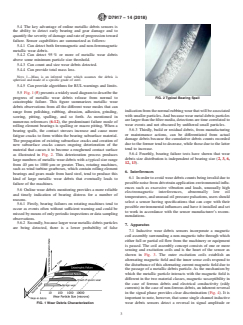
5.5 Fig.1(5)presentsawidelyuseddiagramtodescribethe
progress of metallic wear debris release from normal to
FIG. 2 Typical Bearing Spall
catastrophic failure. This figure summarizes metallic wear
debris observations from all the different wear modes that can
indicationfromthenormalrubbingwearthatwillbeassociated
range from polishing, rubbing, abrasion, adhesion, grinding,
with smaller particles.And because wear metal debris particles
scoring, pitting, spalling, and so forth. As mentioned in
arelargerthanthefiltermedia,detectionsaretimecorrelatedto
numerous references (6-12), the predominant failure mode of
wear events and not obscured by unfiltered small particles.
rolling element bearings is spalling or macro pitting. When a
5.6.3 Thirdly, build or residual debris, from manufacturing
bearing spalls, the contact stresses increase and cause more
or maintenance actions, can be differentiated from actual
fatigue cracks to form within the bearing subsurface material.
damage debris because the cumulative debris counts recorded
The propagation of existing subsurface cracks and creation of
due to the former tend to decrease, while those due to the latter
new subsurface cracks causes ongoing deterioration of the
tend to increase.
material that causes it to become a roughened contact surface
5.6.4 Fourthly, bearing failure tests have shown that wear
as illustrated in Fig. 2. This deterioration process produces
debris size distribution is independent of bearing size (2, 3, 6,
large numbers of metallic wear debris with a typical size range
12, 13).
from 40 µm to 1000 µm or greater. Thus, rotating machines,
such as wind turbine gearboxes, which contain rolling element
6. Interferences
bearings and gears made from hard steel, tend to produce this
6.1 Inordertoavoidweardebriscountsbeinginvaliddueto
kind of large metallic wear debris that eventually leads to
possible noise from drivetrain application environmental influ-
failure of the machines.
ences such as excessive vibration and loads, unusually high
5.6 Online wear debris monitoring provides a more reliable
electromagnetic interferences, abnormally low oil
and timely indication of bearing distress for a number of
temperatures, and unusual oil pressure pulsations, users should
reasons.
select a sensor having specifications that can cope with their
5.6.1 Firstly, bearing failures on rotating machines tend to
possible environmental influences and have it installed and set
occur as events often without sufficient warning and could be
to work in accordance with the sensor manufacturer’s recom-
missed by means of only periodic inspections or data sampling
mendations.
observations.
5.6.2 Secondly,becauselargerwearmetallicdebrisparticles
7. Apparatus
are being detected, there is a lower probability of false
7.1 Inductive wear debris sensors incorporate a magnetic
coil assembly surrounding a non-magnetic tube through which
either full or partial oil flow from the machinery or equipment
is passed. The coil assembly concept consists of one or more
sensing and excitation coils and is the heart of the sensor as
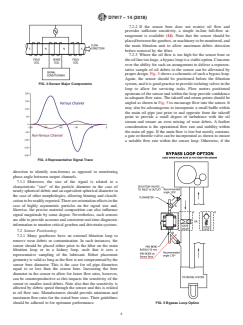
shown in Fig. 3. The outer excitation coils establish an
alternating magnetic field and the inner sense coils respond to
the disturbance of this alternating current magnetic field due to
the passage of a metallic debris particle.As the mechanism by
which the metallic particle interacts with the magnetic field is
different in the two material classes, magnetic susceptibility in
the case of ferrous debris and electrical conductivity (eddy
currents) in the case of non-ferrous debris, an inherent reversal
in the signal phase provides clear discrimination (Fig. 4). It is
important to note, however, that some single channel inductive
FIG. 1 Wear Debris Characterization wear debris sensors detect a reversal in signal amplitude or
D7917 − 14 (2018)
7.2.2 If the sensor bore does not restrict oil flow and
provides sufficient sensitivity, a simple in-line full-flow ar-
rangement is available (14). Note that the sensor should be
placedbetweenthegearbox,ormachinerytobemonitored,and
the main filtration unit to allow maximum debris detection
before removal by the filter.
7.2.3 Where the oil flow is too high for the sensor bore or
theoillinetoolarge,abypassloopisaviableoption.Concerns
over the ability for such an arrangement to deliver a represen-
tative sample of oil debris to the sensor can be alleviated by
proper design. Fig. 5 shows a schematic of such a bypass loop.
Again, the sensor should be positioned before the filtration
FIG. 3 Sensor Major Components system,anditisgoodpracticetoprovideisolatingvalvesinthe
loop to allow for servicing tasks. Flow meters positioned
upstream of the sensor and within the loop provide confidence
in adequate flow rates. The takeoff and return points should be
angled as shown in Fig. 5 to encourage flow into the sensor. It
may also be advantageous to incorporate a small baffle within
the main oil pipe just prior to and opposite from the takeoff
point to provide a small degree of turbulence with the oil
stream and ensure an even mixing of wear debris. A further
consideration is the operational flow rate and stability within
the main oil pipe. If the main flow is low but mostly constant,
a gate or throttle valve can be incorporated as shown to ensure
a suitable flow rate within the sensor loop. Otherwise, if the
FIG. 4 Representative Signal Trace
direction to identify non-ferrous as opposed to monitoring
phase angle between output channels.
7.1.1 Moreover, the size of the signal is related to a
characteristic “size” of the particle diameter in the case of
nearly spherical debris and an equivalent spherical diameter in
the case of other morphologies, allowing binning and classifi-
cationtobereadilyreported.Thereareorientationeffectsinthe
case of highly asymmetric particles on the signal size and,
likewise, the precise material composition can also influence
signal magnitude by some degree. Nevertheless, such sensors
are able to provide accurate and consistent real-time diagnostic
information to monitor critical gearbox and drivetrain systems.
7.2 Sensor Positioning:
7.2.1 Many gearboxes have an external filtration loop to
remove wear debris or contamination. In such instances, the
sensor should be placed either prior to the filter on the main
filtration loop or in a kidney loop, such that it sees a
representative sampling of the lubricant. Either placement
geometryisvalidaslongastheflowisnotcompromisedbythe
sensor bore diameter. This is the case for oil pipe diameters
equal to or less than the sensor bore. Increasing the bore
diameter in the sensor to allow for faster flow rates, however,
can be counterproductive as this impacts the sensitivity of the
sensor to smaller sized debris. Note also that the sensitivity is
affected by debris speed through the sensor and this is related
to oil flow rate. Manufacturers should provide minimum and
maximum flow rates for the stated bore sizes. Their guidelines
should be adhered to for optimum performance. FIG. 5 Bypass Loop Option
D7917 − 14 (2018)
main flow is likely to be variable, a check valve can be 9. Data Processing
substituted with a cracking pressure that ensures that the check
9.1 Numerous data points are provided from which diag-
valve is fully open before the sensor flow rate is exceeded.
nostic information can be interpreted. Health indices can be set
7.3 Dynamic Range—The dynamic range depends on the on total mass detected, total ferrous particles, total non-ferrous
nominal line diameter, spanning the range from an equivalent particles, total mass per time, and metallic concentration.
spherediameter(ESD)of40µmtogreaterthan1000µminthe Alarm limits and trends can be set on these values.
case of ferromagnetic debris, or from 135 µm to greater than
9.2 Guidance for statistically rendering data to establish
1000 µm for non-ferromagnetic debris.
limits and trends is provided in Guides D7669 and D7720, and
7.4 Operating Temperature Range—Sensors may be in Practice D7685.
mounted in harsh environments, though exact temperature
9.3 Practice D7685 provides detailed discussion and spe-
ranges vary depending on the manufacturer. Minimum and
cific guidance and formulas for rolling element bearings.
maximum ambient temperatures range from as low as –40 °C
9.4 Appendix X2 provides detailed discussion and specific
to as high as +85 °C, with oil temperatures ranging from
guidance and formulas for generating wind turbine gearbox
–40 °C to +85 °C.
alarm and warning limits.
7.5 Operating Pressure—Sensors can be installed directly
9.5 Appendix X4 provides detailed discussion and specific
into the fluid line without adversely affecting the lubrication
guidance and formulas for setting alarm and warning limits for
system. The allowable maximum operating pressure depends
any gearbox application.
on the bore size of the sensor and manufacturer with maximum
operating pressures as high as 2000 kPa.
10. Report
7.6 Flow Rate—Sensorsarecommerciallyavailablethatcan
10.1 The particle sensor will detect and count individual
accommodate flow rate ranges from 0.5 L/min to 1000 L/min.
metallic particles. A history is kept on the particle count.
The flow rate through a sensor in a specific application should
10.1.1 Optional Features:
be selected in accordance with the lubrication system design
10.1.1.1 The size of the particles can be determined. Each
and the sensor manufactur
...