

ASTM D4306-20
(Practice)Standard Practice for Aviation Fuel Sample Containers for Tests Affected by Trace Contamination
General Information
- Abstract
SIGNIFICANCE AND USE
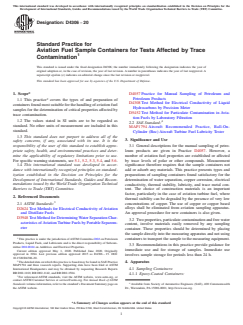
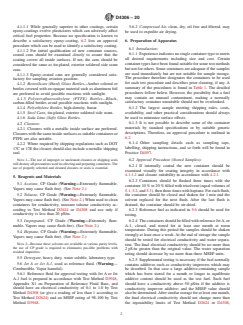
3.1 General descriptions for the manual sampling of petroleum products are given in Practice D4057. However, a number of aviation fuel properties are established or affected by trace levels of polar or other compounds. Measurement significance therefore requires that the sample containers not add or adsorb any materials. This practice presents types and preparations of sampling containers found satisfactory for the determination of water separation, copper corrosion, electrical conductivity, thermal stability, lubricity, and trace metal content. The choice of construction materials is an important factor, particularly in the case of aviation turbine fuel, where thermal stability can be degraded by the presence of very low concentrations of copper. The use of copper or copper based alloys shall be eliminated from aviation sampling apparatus. An approval procedure for new containers is also given.
3.2 Two properties, particulate contamination and free water content, involve materials easily removed by any sampling container. These properties should be determined by placing the sample directly into the measuring apparatus and not using containers to transport the sample to the measuring equipment.
3.3 Recommendations in this practice provide guidance for immediate use and for storage of samples. Immediate use involves sample storage for periods less than 24 h.
SCOPE
1.1 This practice2 covers the types of and preparation of containers found most suitable for the handling of aviation fuel samples for the determination of critical properties affected by trace contamination.
1.2 The values stated in SI units are to be regarded as standard. No other units of measurement are included in this standard.
1.3 This standard does not purport to address all of the safety concerns, if any, associated with its use. It is the responsibility of the user of this standard to establish appropriate safety, health, and environmental practices and determine the applicability of regulatory limitations prior to use. For specific warning statements, see 5.1, 5.2, 5.3, 5.4, and 5.6.
1.4 This international standard was developed in accordance with internationally recognized principles on standardization established in the Decision on Principles for the Development of International Standards, Guides and Recommendations issued by the World Trade Organization Technical Barriers to Trade (TBT) Committee.
- Status
- Published
- Publication Date
- 30-Apr-2020
- Technical Committee
- D02 - Petroleum Products, Liquid Fuels, and Lubricants
- Drafting Committee
- D02.J0.04 - Additives and Electrical Properties
Buy Documents
ASTM D4306-20 - Standard Practice for Aviation Fuel Sample Containers for Tests Affected by Trace Contamination
REDLINE ASTM D4306-20 - Standard Practice for Aviation Fuel Sample Containers for Tests Affected by Trace Contamination
Overview
ASTM D4306-20 is the internationally recognized standard practice for selecting, preparing, and approving aviation fuel sample containers for testing properties affected by trace contamination. Developed by ASTM, this standard is crucial for ensuring the reliability and accuracy of critical aviation fuel analyses, including water separation, copper corrosion, electrical conductivity, thermal stability, lubricity, and trace metal content.
Proper container selection and preparation help prevent the introduction or removal of trace contaminants during fuel sampling, preserving the integrity of tests. ASTM D4306-20 is widely referenced within the aviation and petroleum industries to ensure compliance, safety, and quality control in aviation turbine fuel testing.
Key Topics
Container Types and Materials
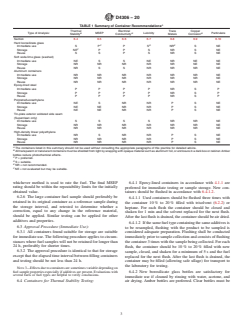
The standard covers acceptable container materials such as epoxy-coated steel, borosilicate glass (preferably amber), PTFE (polytetrafluoroethylene), high-density linear polyethylene, and tin-plated soldered steel. It specifically discourages the use of copper or copper-based alloys, which can degrade fuel properties, especially thermal stability in aviation turbine fuel.Preparation and Cleaning Procedures Proper preparation is essential to avoid contamination. The document details step-by-step procedures for flushing, cleaning, and drying containers with specified solvents and detergents to remove any residues that could impact test results.
Approval of New Containers ASTM D4306-20 includes a formal approval protocol for new sample containers, involving testing with reference fuels to ensure containers do not leach or absorb trace constituents. Containers must maintain strict performance criteria for electrical conductivity and water separation.
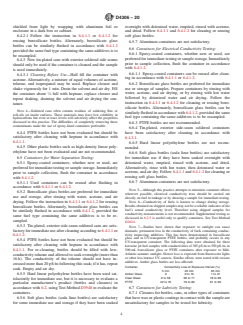
Guidance for Immediate and Stored Samples The practice distinguishes between containers intended for immediate analysis (less than 24 hours of storage) and those suitable for longer storage periods, providing recommendations for both situations.
Suitability for Specific Tests The standard specifies which container types are appropriate for various aviation fuel analyses, such as thermal stability, lubricity, or trace metal content, maximizing test integrity and repeatability.
Applications
ASTM D4306-20 is applied across several key sectors where aviation fuel quality and testing precision are mission-critical:
Aviation Fuel Quality Control:
Ensures reliable testing of jet fuel properties, supporting safe aircraft operation.Laboratory Testing Protocols:
Outlines best practices for laboratories conducting trace contamination analyses in aviation fuels.Regulatory Compliance:
Provides a framework for compliance with industry regulations and quality assurance programs for fuel producers, suppliers, and aviation operators.Equipment Approval:
Serves as a reference for selecting and approving new sampling and shipping containers as part of fuel handling protocols.R&D and Additive Evaluation:
Supports research where accurate measurement of fuel properties is needed to validate new additives or processing technologies.
Related Standards
Organizations working with ASTM D4306-20 will benefit from familiarity with the following referenced or related standards:
- ASTM D4057: Practice for Manual Sampling of Petroleum and Petroleum Products
- ASTM D2624: Test Methods for Electrical Conductivity of Aviation and Distillate Fuels
- ASTM D3948: Test Method for Determining Water Separation Characteristics of Aviation Turbine Fuels by Portable Separometer
- ASTM D4308: Test Method for Electrical Conductivity of Liquid Hydrocarbons by Precision Meter
- ASTM D5452: Test Method for Particulate Contamination in Aviation Fuels by Laboratory Filtration
- SAE MAP1794: Aircraft Recommended Practice for Ball-On-Cylinder Lubricity Testing
Keywords:
aviation fuel sampling containers, trace contamination, aviation turbine fuel, container approval, fuel testing, ASTM D4306, aviation fuel analysis, quality control, sample preparation.
By following ASTM D4306-20, organizations can be confident in the precision and reliability of aviation fuel sampling, maintaining compliance with international best practices.
Relations
- Effective Date
- 15-Jun-2013
- Effective Date
- 01-Dec-2012
- Effective Date
- 01-Oct-2011
- Refers
ASTM D4057-06(2011) - Standard Practice for Manual Sampling of Petroleum and Petroleum Products - Effective Date
- 01-Jun-2011
- Effective Date
- 01-Oct-2010
- Effective Date
- 15-Feb-2010
- Refers
ASTM D2624-09 - Standard Test Methods for Electrical Conductivity of Aviation and Distillate Fuels - Effective Date
- 01-Dec-2009
- Effective Date
- 01-Dec-2008
- Effective Date
- 01-Jul-2007
- Refers
ASTM D2624-07 - Standard Test Methods for Electrical Conductivity of Aviation and Distillate Fuels - Effective Date
- 01-Jul-2007
- Refers
ASTM D2624-06a - Standard Test Methods for Electrical Conductivity of Aviation and Distillate Fuels - Effective Date
- 01-Dec-2006
- Effective Date
- 01-Dec-2006
- Refers
ASTM D2624-06 - Standard Test Methods for Electrical Conductivity of Aviation and Distillate Fuels - Effective Date
- 01-Jan-2006
- Effective Date
- 01-Dec-2005
- Effective Date
- 01-Dec-2005
Buy Documents
ASTM D4306-20 - Standard Practice for Aviation Fuel Sample Containers for Tests Affected by Trace Contamination
REDLINE ASTM D4306-20 - Standard Practice for Aviation Fuel Sample Containers for Tests Affected by Trace Contamination
Get Certified
Connect with accredited certification bodies for this standard

Element Materials Technology
Materials testing and product certification.

ABS Group Brazil
ABS Group certification services in Brazil.

ABS Quality Evaluations Inc.
American Bureau of Shipping quality certification.
Sponsored listings
Frequently Asked Questions
ASTM D4306-20 is a standard published by ASTM International. Its full title is "Standard Practice for Aviation Fuel Sample Containers for Tests Affected by Trace Contamination". This standard covers: SIGNIFICANCE AND USE 3.1 General descriptions for the manual sampling of petroleum products are given in Practice D4057. However, a number of aviation fuel properties are established or affected by trace levels of polar or other compounds. Measurement significance therefore requires that the sample containers not add or adsorb any materials. This practice presents types and preparations of sampling containers found satisfactory for the determination of water separation, copper corrosion, electrical conductivity, thermal stability, lubricity, and trace metal content. The choice of construction materials is an important factor, particularly in the case of aviation turbine fuel, where thermal stability can be degraded by the presence of very low concentrations of copper. The use of copper or copper based alloys shall be eliminated from aviation sampling apparatus. An approval procedure for new containers is also given. 3.2 Two properties, particulate contamination and free water content, involve materials easily removed by any sampling container. These properties should be determined by placing the sample directly into the measuring apparatus and not using containers to transport the sample to the measuring equipment. 3.3 Recommendations in this practice provide guidance for immediate use and for storage of samples. Immediate use involves sample storage for periods less than 24 h. SCOPE 1.1 This practice2 covers the types of and preparation of containers found most suitable for the handling of aviation fuel samples for the determination of critical properties affected by trace contamination. 1.2 The values stated in SI units are to be regarded as standard. No other units of measurement are included in this standard. 1.3 This standard does not purport to address all of the safety concerns, if any, associated with its use. It is the responsibility of the user of this standard to establish appropriate safety, health, and environmental practices and determine the applicability of regulatory limitations prior to use. For specific warning statements, see 5.1, 5.2, 5.3, 5.4, and 5.6. 1.4 This international standard was developed in accordance with internationally recognized principles on standardization established in the Decision on Principles for the Development of International Standards, Guides and Recommendations issued by the World Trade Organization Technical Barriers to Trade (TBT) Committee.
SIGNIFICANCE AND USE 3.1 General descriptions for the manual sampling of petroleum products are given in Practice D4057. However, a number of aviation fuel properties are established or affected by trace levels of polar or other compounds. Measurement significance therefore requires that the sample containers not add or adsorb any materials. This practice presents types and preparations of sampling containers found satisfactory for the determination of water separation, copper corrosion, electrical conductivity, thermal stability, lubricity, and trace metal content. The choice of construction materials is an important factor, particularly in the case of aviation turbine fuel, where thermal stability can be degraded by the presence of very low concentrations of copper. The use of copper or copper based alloys shall be eliminated from aviation sampling apparatus. An approval procedure for new containers is also given. 3.2 Two properties, particulate contamination and free water content, involve materials easily removed by any sampling container. These properties should be determined by placing the sample directly into the measuring apparatus and not using containers to transport the sample to the measuring equipment. 3.3 Recommendations in this practice provide guidance for immediate use and for storage of samples. Immediate use involves sample storage for periods less than 24 h. SCOPE 1.1 This practice2 covers the types of and preparation of containers found most suitable for the handling of aviation fuel samples for the determination of critical properties affected by trace contamination. 1.2 The values stated in SI units are to be regarded as standard. No other units of measurement are included in this standard. 1.3 This standard does not purport to address all of the safety concerns, if any, associated with its use. It is the responsibility of the user of this standard to establish appropriate safety, health, and environmental practices and determine the applicability of regulatory limitations prior to use. For specific warning statements, see 5.1, 5.2, 5.3, 5.4, and 5.6. 1.4 This international standard was developed in accordance with internationally recognized principles on standardization established in the Decision on Principles for the Development of International Standards, Guides and Recommendations issued by the World Trade Organization Technical Barriers to Trade (TBT) Committee.
ASTM D4306-20 is classified under the following ICS (International Classification for Standards) categories: 75.160.20 - Liquid fuels. The ICS classification helps identify the subject area and facilitates finding related standards.
ASTM D4306-20 has the following relationships with other standards: It is inter standard links to ASTM D3948-13, ASTM D4308-12, ASTM D3948-11, ASTM D4057-06(2011), ASTM D4308-10, ASTM D4308-95(2010), ASTM D2624-09, ASTM D3948-08, ASTM D3948-07, ASTM D2624-07, ASTM D2624-06a, ASTM D5452-06, ASTM D2624-06, ASTM D3948-05, ASTM D5452-05. Understanding these relationships helps ensure you are using the most current and applicable version of the standard.
ASTM D4306-20 is available in PDF format for immediate download after purchase. The document can be added to your cart and obtained through the secure checkout process. Digital delivery ensures instant access to the complete standard document.
Standards Content (Sample)
This international standard was developed in accordance with internationally recognized principles on standardization established in the Decision on Principles for the
Development of International Standards, Guides and Recommendations issued by the World Trade Organization Technical Barriers to Trade (TBT) Committee.
Designation: D4306 − 20
Standard Practice for
Aviation Fuel Sample Containers for Tests Affected by Trace
Contamination
This standard is issued under the fixed designation D4306; the number immediately following the designation indicates the year of
original adoption or, in the case of revision, the year of last revision. A number in parentheses indicates the year of last reapproval. A
superscript epsilon (´) indicates an editorial change since the last revision or reapproval.
This standard has been approved for use by agencies of the U.S. Department of Defense.
1. Scope* D4057 Practice for Manual Sampling of Petroleum and
2 Petroleum Products
1.1 This practice covers the types of and preparation of
D4308 Test Method for Electrical Conductivity of Liquid
containers found most suitable for the handling of aviation fuel
Hydrocarbons by Precision Meter
samples for the determination of critical properties affected by
D5452 Test Method for Particulate Contamination in Avia-
trace contamination.
tion Fuels by Laboratory Filtration
1.2 The values stated in SI units are to be regarded as 4
2.2 SAE Standard:
standard. No other units of measurement are included in this
MAP1794 Aircraft Recommended Practice, Ball-On-
standard.
Cylinder (Boc) Aircraft Turbine Fuel Lubricity Tester
1.3 This standard does not purport to address all of the
3. Significance and Use
safety concerns, if any, associated with its use. It is the
responsibility of the user of this standard to establish appro- 3.1 General descriptions for the manual sampling of petro-
priate safety, health, and environmental practices and deter- leum products are given in Practice D4057. However, a
mine the applicability of regulatory limitations prior to use. number of aviation fuel properties are established or affected
For specific warning statements, see 5.1, 5.2, 5.3, 5.4, and 5.6. by trace levels of polar or other compounds. Measurement
1.4 This international standard was developed in accor- significance therefore requires that the sample containers not
dance with internationally recognized principles on standard- add or adsorb any materials. This practice presents types and
ization established in the Decision on Principles for the preparations of sampling containers found satisfactory for the
Development of International Standards, Guides and Recom- determination of water separation, copper corrosion, electrical
mendations issued by the World Trade Organization Technical conductivity, thermal stability, lubricity, and trace metal con-
Barriers to Trade (TBT) Committee. tent. The choice of construction materials is an important
factor, particularly in the case of aviation turbine fuel, where
2. Referenced Documents
thermal stability can be degraded by the presence of very low
2.1 ASTM Standards: concentrations of copper. The use of copper or copper based
alloys shall be eliminated from aviation sampling apparatus.
D2624 Test Methods for Electrical Conductivity ofAviation
and Distillate Fuels An approval procedure for new containers is also given.
D3948 TestMethodforDeterminingWaterSeparationChar-
3.2 Twoproperties,particulatecontaminationandfreewater
acteristicsofAviationTurbineFuelsbyPortableSeparom-
content, involve materials easily removed by any sampling
eter
container. These properties should be determined by placing
the sample directly into the measuring apparatus and not using
containers to transport the sample to the measuring equipment.
This practice is under the jurisdiction of ASTM Committee D02 on Petroleum
Products, Liquid Fuels, and Lubricants and is the direct responsibility of Subcom-
3.3 Recommendations in this practice provide guidance for
mittee D02.J0.04 on Additives and Electrical Properties.
immediate use and for storage of samples. Immediate use
Current edition approved May 1, 2020. Published June 2020. Originally
approved in 1984. Last previous edition approved 2015 as D4306 – 15. DOI:
involves sample storage for periods less than 24 h.
10.1520/D4306-20.
The detailed data on which this practice is based may be found in SAE Practice
4. Apparatus
MAP1794 and three research reports. Supporting data have been filed at ASTM
4.1 Sampling Containers:
International Headquarters and may be obtained by requesting Research Reports
RR:D02-1169, RR:D02-1142, and RR:D02-1504.
4.1.1 Epoxy-Coated Containers:
For referenced ASTM standards, visit the ASTM website, www.astm.org, or
contact ASTM Customer Service at service@astm.org. For Annual Book of ASTM
Standards volume information, refer to the standard’s Document Summary page on Available from Society of Automotive Engineers (SAE), 400 Commonwealth
the ASTM website. Dr., Warrendale, PA 15096-0001, http://www.sae.org.
*A Summary of Changes section appears at the end of this standard
Copyright © ASTM International, 100 Barr Harbor Drive, PO Box C700, West Conshohocken, PA 19428-2959. United States
D4306 − 20
4.1.1.1 While generally superior to other coatings, certain 5.6.2 Compressed Air, clean, dry, oil free and filtered, may
epoxy-coatings evolve plasticizers which can adversely affect be used to expedite air drying.
critical fuel properties. Because no specification is known to
describe a satisfactory epoxy-coating, 6.2 lists an approval 6. Preparation of Apparatus
procedure which can be used to identify a satisfactory coating.
6.1 Introduction:
4.1.1.2 For initial qualification of new container sources,
6.1.1 Experience indicates no single container type to meets
coated cans should be examined closely to assure that the
all desired requirements including size and cost. Certain
coating covers all inside surfaces. If not, the cans should be
containertypeshavebeenfoundsuitableforsometestmethods
considered the same as tin-plated, exterior soldered side seam
but not for others. Some containers are adequate if the samples
cans.
are used immediately but are not suitable for sample storage.
4.1.1.3 Epoxy-coated cans are generally considered satis-
The procedure therefore designates the containers to be used
factory for sampling aviation gasoline.
for each test procedure and describes prior cleaning, if any. A
4.1.2 Borosilicate (Hard) Glass Bottles—Amber colored or
summary of the procedures is found in Table 1. The detailed
bottles covered with an opaque material such as aluminum foil
procedures follow below. However, the possibility that a fuel
are preferred to avoid possible reactions with sunlight.
may contain an unusual contaminant, making a normally
4.1.3 Polytetrafluoroethylene (PTFE) Bottles—Black,
satisfactory container unsuitable should not be overlooked.
carbon-filled bottles avoid possible reactions with sunlight.
4.1.4 Polyethylene Bottles, high-density, linear. 6.1.2 The largest sample meeting shipping rules, costs,
availability, and other practical considerations should always
4.1.5 Steel Cans, tin-plated, exterior soldered side seam.
be used to minimize surface effects.
4.1.6 Soda Lime (Soft) Glass Bottles.
6.1.3 It is not possible to describe some of the container
4.2 Closures:
materials by standard specifications or by suitable generic
4.2.1 Closures with a metallic inside surface are preferred.
descriptions. Therefore, an approval procedure is outlined in
Closureswiththesameinsidesurfacesassuitablecontainersor
6.2.
PTFE are also suitable.
6.1.4 Other sampling details such as sampling taps,
4.2.2 Where required by shipping regulations such as DOT
labelling, shipping instructions, and so forth will be found in
17C or 17E the closure should also include a metallic shipping
Practice D4057.
seal.
NOTE 1—The use of improper or uncleaned closures or shipping seals 6.2 Approval Procedure (Stored Samples):
willdestroyallprecautionsusedinselectingandpreparingcontainers.The
6.2.1 If internally coated the new container should be
use of properly selected and cleaned closures or seals is essential.
examined visually for coating integrity in accordance with
4.1.1.2 and closure suitability in accordance with 4.2.1.
5. Reagents and Materials
6.2.2 Containers should be flushed three times with the
5.1 Acetone, CP Grade (Warning—Extremely flammable.
container 10 % to 20 % filled with trisolvent (equal volumes of
Vapors may cause flash fire). (See Note 2.)
5.1,5.2,and5.3),thenthreetimeswithheptane.Foreachflush,
5.2 Toluene, CP Grade (Warning—Extremely flammable. the container should be closed and shaken for 1 min and the
Vapors may cause flash fire). (See Note 2.)When used to clean solvent replaced for the next flush. After the last flush is
containers for conductivity, measure toluene conductivity ac-
drained, the container should be air-dried.
cording to Test Method D2624 or D4308 and use only if
6.2.3 Reference fuel as indicated in 5.6 should be used for
conductivity is less than 20 pS/m.
testing.
5.3 Isopropanol, CP Grade (Warning—Extremely flam- 6.2.4 ThecontainersshouldbefilledwithreferenceJetA,or
mable. Vapors may cause flash fire). (See Note 2.) A-1, closed, and stored for at least one month at room
temperature. During this period the samples should be shaken
5.4 Heptane, CP Grade (Warning—Extremely flammable.
strongly at least once a week.At the end of storage the sample
Vapors may cause flash fire). (See Note 2.)
should be tested for electrical conductivity and water separa-
NOTE 2—Because these solvents are available at various purity levels,
tion. The final electrical conductivity should be no more than
the use of CP grade is required to eliminates possible problems with
2 pS⁄m greater than the original value. The water separation
residual impurities.
rating should decrease by no more than three MSEP units.
5.5 Detergent, heavy duty, water soluble, laboratory type.
6.2.5 Supplemental testing is necessary if the fuel normally
5.6 Jet A or Jet A-1, used as reference fluid. (Warning— contains additives such as conductivity improvers which may
Combustible. Vapor harmful).
be desorbed. In that case a large additive-containing sample
5.6.1 Reference fluid for approval testing with Jet A or Jet which has been stored for a month or longer to equilibrate
A-1 fuel is prepared in accordance with Test Method D3948, additive content should be used as the test fuel. Such fuel
Appendix X1 on Preparation of Reference Fluid Base, and should have a conductivity above 50 pS/m if the additive is
should have an electrical conductivity of 0.1 to 1.0 by Test conductivity improver additive; and the MSEP value should
Method D4308 (or give a reading of less than 1 according to alsobedetermined.Aftersimilarstorageforatleastonemonth,
Test Method D2624) and an MSEP rating of 98-100 by Test the final electrical conductivity should not change more than
Method D3948. the repeatability limits of Test Method D2624 or D4308,
D4306 − 20
A
TABLE 1 Summary of Container Recommendations
Thermal Electrical Trace Copper
Type of Analysis: MSEP Lubricity Particulate
B B B
Stability Conductivity Metals Corrosion
Section 6.4 6.5 6.6 6.7 6.8 6.9 6.10
Hard borosilicate glass
C D E
Immediate use S P PS NR SNE
F
Storage NE PPS NR S NE
Reuse S S P S NR S NE
Soft soda lime glass (washed)
Immediate use NE S S NE NR NE NE
Storage NR NR NR NR NR NE NE
Reuse NR S S NR NR NR NE
Aluminum containers
Immediate use NR NR NR NR NR NR NE
Storage NR NR NR NR NR NR NE
Reuse NR NR NR NR NR NR NE
Epoxy-lined steel
Immediate use P P P P NR S P
Storage P P P P NR S P
Reuse P P P P NR S P
Polytetrafluoroethylene
Immediate use NE S NR NR P S NE
Storage NE NE NR NR P S NE
Reuse NE NE NR NR P S NE
Tin-plate exterior soldered side seam
(Superclean only)
Immediate use S S S S NR NR NE
Storage NR NR NR NR NR NR NE
Reuse NR NR NR NR NR NR NE
High-density linear polyethylene
Immediate use NR S NR NR P S NE
Storage NR NR NR NR P S NE
Reuse NR NR NR NR P S NE
A
The containers listed in this summary should not be used without consulting the appropriate paragraphs of this practice for detailed advice.
B
Alltransparentortranslucentcontainersmustbeshieldedfromlightbywrappingwithopaquematerialsuchasaluminumfoil,orenclosureinadarkboxorcabinet.Amber
bottles reduce photochemical effects.
C
P = preferred.
D
S = suitable.
E
NR = not recommended.
F
NE = not evaluated but may be suitable.
whichever method is used to rate the fuel. The final MSEP 6.4.1 Epoxy-lined containers in accordance with 4.1.1 are
rating should be within the repeatability limits for the initially preferred for immediate testing or sample storage. New con-
obtained value. tainers should be flushed in accordance with 6.4.1.2.
6.2.6 The large container fuel sample should preferably be
6.4.1.1 Used containers should be flushed three times with
retained in its original container as a reference sample during
the container 10 % to 20 % filled with trisolvent (6.2.2)or
the storage interval, and retested to determine whether a
heptane. For each flush the container should be closed and
correction, equal to any change in the reference material,
shaken for 1 min and the solvent replaced for the next flush.
should be applied
...
This document is not an ASTM standard and is intended only to provide the user of an ASTM standard an indication of what changes have been made to the previous version. Because
it may not be technically possible to adequately depict all changes accurately, ASTM recommends that users consult prior editions as appropriate. In all cases only the current version
of the standard as published by ASTM is to be considered the official document.
Designation: D4306 − 15 D4306 − 20 An American National Standard
Standard Practice for
Aviation Fuel Sample Containers for Tests Affected by Trace
Contamination
This standard is issued under the fixed designation D4306; the number immediately following the designation indicates the year of
original adoption or, in the case of revision, the year of last revision. A number in parentheses indicates the year of last reapproval. A
superscript epsilon (´) indicates an editorial change since the last revision or reapproval.
This standard has been approved for use by agencies of the U.S. Department of Defense.
1. Scope*
1.1 This practice covers the types of and preparation of containers found most suitable for the handling of aviation fuel samples
for the determination of critical properties affected by trace contamination.
1.2 The values stated in SI units are to be regarded as standard. No other units of measurement are included in this standard.
1.3 This standard does not purport to address all of the safety concerns, if any, associated with its use. It is the responsibility
of the user of this standard to establish appropriate safety safety, health, and healthenvironmental practices and determine the
applicability of regulatory limitations prior to use. For specific warning statements, see 5.1, 5.2, 5.3, 5.4, and 5.6.
1.4 This international standard was developed in accordance with internationally recognized principles on standardization
established in the Decision on Principles for the Development of International Standards, Guides and Recommendations issued
by the World Trade Organization Technical Barriers to Trade (TBT) Committee.
2. Referenced Documents
2.1 ASTM Standards:
D2624 Test Methods for Electrical Conductivity of Aviation and Distillate Fuels
D3948 Test Method for Determining Water Separation Characteristics of Aviation Turbine Fuels by Portable Separometer
D4057 Practice for Manual Sampling of Petroleum and Petroleum Products
D4308 Test Method for Electrical Conductivity of Liquid Hydrocarbons by Precision Meter
D5452 Test Method for Particulate Contamination in Aviation Fuels by Laboratory Filtration
2.2 SAE Standard:
MAP1794 Aircraft Recommended Practice, Ball-On-Cylinder (Boc) Aircraft Turbine Fuel Lubricity Tester
3. Significance and Use
3.1 General descriptions for the manual sampling of petroleum products are given in Practice D4057. However, a number of
aviation fuel properties are established or affected by trace levels of polar or other compounds. Measurement significance therefore
requires that the sample containers not add or adsorb any materials. This practice presents types and preparations of sampling
containers found satisfactory for the determination of water separation, copper corrosion, electrical conductivity, thermal stability,
lubricity, and trace metal content. The choice of construction materials is an important factor, particularly in the case of aviation
turbine fuel, where thermal stability can be degraded by the presence of very low concentrations of copper. The use of copper or
copper based alloys shall be eliminated from aviation sampling apparatus. An approval procedure for new containers is also given.
3.2 Two properties, particulate contamination and free water content, involve materials easily removed by any sampling
container. These properties should be determined by placing the sample directly into the measuring apparatus and not using
containers to transport the sample to the measuring equipment.
This practice is under the jurisdiction of ASTM Committee D02 on Petroleum Products, Liquid Fuels, and Lubricants and is the direct responsibility of Subcommittee
D02.J0.04 on Additives and Electrical Properties.
Current edition approved Oct. 1, 2015May 1, 2020. Published October 2015June 2020. Originally approved in 1984. Last previous edition approved 20132015 as
D4306 – 13.D4306 – 15. DOI: 10.1520/D4306-15.10.1520/D4306-20.
The detailed data on which this practice is based may be found in SAE Practice MAP1794 and three research reports. Supporting data have been filed at ASTM
International Headquarters and may be obtained by requesting Research Reports RR:D02-1169, RR:D02-1142, and RR:D02-1504.
For referenced ASTM standards, visit the ASTM website, www.astm.org, or contact ASTM Customer Service at service@astm.org. For Annual Book of ASTM Standards
volume information, refer to the standard’s Document Summary page on the ASTM website.
Available from Society of Automotive Engineers (SAE), 400 Commonwealth Dr., Warrendale, PA 15096-0001, http://www.sae.org.
*A Summary of Changes section appears at the end of this standard
Copyright © ASTM International, 100 Barr Harbor Drive, PO Box C700, West Conshohocken, PA 19428-2959. United States
D4306 − 20
3.3 Recommendations in this practice provide guidance for immediate use and for storage of samples. Immediate use involves
sample storage for periods less than 24 h.
4. Apparatus
4.1 Sampling Containers:
4.1.1 Epoxy-Coated Containers:
4.1.1.1 While generally superior to other coatings, certain epoxy-coatings evolve plasticizers which can adversely affect critical
fuel properties. Because no specification is known to describe a satisfactory epoxy-coating, 6.2 lists an approval procedure which
can be used to identify a satisfactory coating.
4.1.1.2 For initial qualification of new container sources, coated cans should be examined closely to assure that the coating
covers all inside surfaces. If not, the cans should be considered the same as tin-plated, exterior soldered side seam cans.
4.1.1.3 Epoxy-coated cans are generally considered satisfactory for sampling aviation gasoline.
4.1.2 Borosilicate (Hard) Glass Bottles—Amber colored or bottles covered with an opaque material such as aluminum foil are
preferred to avoid possible reactions with sunlight.
4.1.3 Polytetrafluoroethylene (PTFE) Bottles—Black, carbon-filled bottles avoid possible reactions with sunlight.
4.1.4 Polyethylene Bottles, high-density, linear.
4.1.5 Steel Cans, tin-plated, exterior soldered side seam.
4.1.6 Soda Lime (Soft) Glass Bottles.
4.2 Closures:
4.2.1 Closures with a metallic inside surface are preferred. Closures with the same inside surfaces as suitable containers or PTFE
are also suitable.
4.2.2 Where required by shipping regulations such as DOT 17C or 17E the closure should also include a metallic shipping seal.
NOTE 1—The use of improper or uncleaned closures or shipping seals will destroy all precautions used in selecting and preparing containers. The use
of properly selected and cleaned closures or seals is essential.
5. Reagents and Materials
5.1 Acetone, CP Grade (Warning—Extremely flammable. Vapors may cause flash fire). (See Note 2).)
5.2 Toluene, CP Grade (Warning—Extremely flammable. Vapors may cause flash fire). (See Note 2).) When used to clean
containers for conductivity, measure toluene conductivity according to Test Method D2624 or D4308 and use only if conductivity
is less than 20 pS/m.
5.3 Isopropanol, CP Grade (Warning—Extremely flammable. Vapors may cause flash fire). (See Note 2).)
5.4 Heptane, CP Grade (Warning—Extremely flammable. Vapors may cause flash fire). (See Note 2).)
NOTE 2—Because these solvents are available at various purity levels, the use of CP grade is required to eliminates possible problems with residual
impurities.
5.5 Detergent, heavy duty, water soluble, laboratory type.
5.6 Jet A or Jet A-1, used as reference fluid. (Warning—Combustible. Vapor harmful).
5.6.1 Reference fluid for approval testing with Jet A or Jet A-1 fuel is prepared in accordance with Test Method D3948,
Appendix X1 on Preparation of Reference Fluid Base, and should have an electrical conductivity of 0.1 to 1.0 by Test Method
D4308 (or give a reading of less than 1 according to Test Method D2624) and an MSEP rating of 98-100 by Test Method D3948.
5.6.2 Compressed Air, clean, dry, oil free and filtered, may be used to expedite air drying.
6. Preparation of Apparatus
6.1 Introduction:
6.1.1 Experience indicates no single container type to meets all desired requirements including size and cost. Certain container
types have been found suitable for some test methods but not for others. Some containers are adequate if the samples are used
immediately but are not suitable for sample storage. The procedure therefore designates the containers to be used for each test
procedure and describes prior cleaning, if any. A summary of the procedures is found in Table 1. The detailed procedures follow
below. However, the possibility that a fuel may contain an unusual contaminant, making a normally satisfactory container
unsuitable should not be overlooked.
6.1.2 The largest sample meeting shipping rules, costs, availability, and other practical considerations should always be used
to minimize surface effects.
6.1.3 It is not possible to describe some of the container materials by standard specifications or by suitable generic descriptions.
Therefore, an approval procedure is outlined in 6.2.
6.1.4 Other sampling details such as sampling taps, labelling, shipping instructions, and so forth will be found in Practice
D4057.
6.2 Approval Procedure (Stored Samples):
D4306 − 20
A
TABLE 1 Summary of Container Recommendations
Thermal Electrical Trace Copper
Type of Analysis: MSEP Lubricity Particulate
B B B
Stability Conductivity Metals Corrosion
Section 6.4 6.5 6.6 6.7 6.8 6.9 6.10
Hard borosilicate glass
C D E
Immediate use S P P S NR S NE
F
Storage NE P P S NR S NE
Reuse S S P S NR S NE
Soft soda lime glass (washed)
Immediate use NE S S NE NR NE NE
Storage NR NR NR NR NR NE NE
Reuse NR S S NR NR NR NE
Aluminum containers
Immediate use NR NR NR NR NR NR NE
Storage NR NR NR NR NR NR NE
Reuse NR NR NR NR NR NR NE
Epoxy-lined steel
Immediate use P P P P NR S P
Storage P P P P NR S P
Reuse P P P P NR S P
Polytetrafluoroethylene
Immediate use NE S NR NR P S NE
Storage NE NE NR NR P S NE
Reuse NE NE NR NR P S NE
Tin-plate soldered steel
(Superclean only)
Tin-plate exterior soldered side seam
(Superclean only)
Immediate use S S S S NR NR NE
Storage NR NR NR NR NR NR NE
Reuse NR NR NR NR NR NR NE
High-density linear polyethylene
Immediate use NR S NR NR P S NE
Storage NR NR NR NR P S NE
Reuse NR NR NR NR P S NE
A
The containers listed in this summary should not be used without consulting the appropriate paragraphs of this practice for detailed advice.
B
All transparent or translucent containers must be shielded from light by wrapping with opaque material such as aluminum foil, or enclosure in a dark box or cabinet. Amber
bottles reduce photochemical effects.
C
P = preferred.
D
S = suitable.
E
NR = not recommended.
F
NE = not evaluated but may be suitable.
6.2.1 If internally coated the new container should be examined visually for coating integrity in accordance with 4.1.1.2 and
closure suitability in accordance with 4.2.1.
6.2.2 Containers should be flushed three times with the container 10 % to 20 % filled with trisolvent (equal volumes of 5.1, 5.2,
and 5.3), then three times with heptane. For each flush, the container should be closed and shaken for 1 min and the solvent
replaced for the next flush. After the last flush is drained, the container should be air-dried.
6.2.3 Reference fuel as indicated in 5.6 should be used for testing.
6.2.4 The containers should be filled with reference Jet A, or A-1, closed, and stored for at least one month at room temperature.
During this period the samples should be shaken strongly at least once a week. At the end of storage the sample should be tested
for electrical conductivity and water separation. The final electrical conductivity should be no more than 2 pS ⁄m greater than the
original value. The water separation rating should decrease by no more than three MSEP units.
6.2.5 Supplemental testing is necessary if the fuel normally contains additives such as conductivity improvers which may be
desorbed. In that case a large additive-containing sample which has been stored for a month or longer to equilibrate additive
content should be used as the test fuel. Such fuel should have a conductivity above 50 pS/m if the additive is conductivity improver
additive; and the MSEP value should also be determined. After similar storage for at least one month, the final electrical
conductivity should not change more than the repeatability limits of Test Method D2624 or D4308, whichever method is used to
rate the fuel. The final MSEP rating should be within the repeatability limits for the initially obtained value.
6.2.6 The large container fuel sample should preferably be retained in its original container as a reference sample during the
storage interval, and retested to determine whether a correction, equal to any change in the reference material, should be applied.
Similar testing can be applied for other additives and properties.
6.3 Approval Procedure (Immediate Use):
6.3.1 All containers found suitable for storage are suitable for immediate use. The following procedure applies to circumstances
where fuel samples will not be retained for longer than 24 h
...