

ASTM D5777-18
(Guide)Standard Guide for Using the Seismic Refraction Method for Subsurface Investigation
General Information
- Abstract
SIGNIFICANCE AND USE
5.1 Concepts:
5.1.1 This guide summarizes the equipment, field procedures, and interpretation methods used for the determination of the depth, thickness and the seismic velocity of subsurface soil and rock or engineered materials, using the seismic refraction method.
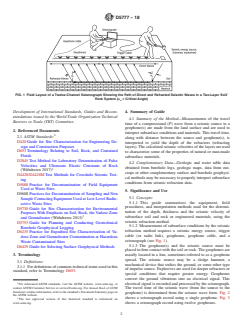
5.1.2 Measurement of subsurface conditions by the seismic refraction method requires a seismic energy source, trigger cable (or radio link), geophones, geophone cable, and a seismograph (see Fig. 1).
FIG. 1 Field Layout of a Twelve-Channel Seismograph Showing the Path of Direct and Refracted Seismic Waves in a Two-Layer Soil/Rock System (αc = Critical Angle)
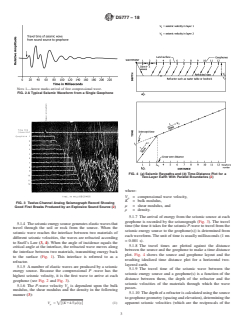
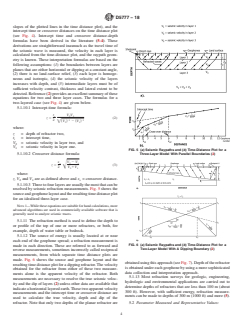
5.1.3 The geophone(s) and the seismic source must be placed in firm contact with the soil or rock. The geophones are usually located in a line, sometimes referred to as a geophone spread. The seismic source may be a sledge hammer, a mechanical device that strikes the ground, or some other type of impulse source. Explosives are used for deeper refractors or special conditions that require greater energy. Geophones convert the ground vibrations into an electrical signal. This electrical signal is recorded and processed by the seismograph. The travel time of the seismic wave (from the source to the geophone) is determined from the seismic wave form. Fig. 2 shows a seismograph record using a single geophone. Fig. 3 shows a seismograph record using twelve geophones.
FIG. 2 A Typical Seismic Waveform from a Single Geophone
Note 1: Arrow marks arrival of first compressional wave.
FIG. 3 Twelve-Channel Analog Seismograph Record Showing Good First Breaks Produced by an Explosive Sound Source (2)
5.1.4 The seismic energy source generates elastic waves that travel through the soil or rock from the source. When the seismic wave reaches the interface between two materials of different seismic velocities, the waves are refracted according to Snell's Law (3, 4). When the angle of incidence equals the critical angle at the i...
SCOPE
1.1 Purpose and Application—This guide covers the equipment, field procedures, and interpretation methods for the assessment of subsurface conditions using the seismic refraction method. Seismic refraction measurements as described in this guide are applicable in mapping subsurface conditions for various uses including geologic, geotechnical, hydrologic, environmental (1), mineral exploration, petroleum exploration, and archaeological investigations. The seismic refraction method is used to map geologic conditions including depth of bedrock, or the water table, stratigraphy, lithology, structure, and fractures or all of these. The calculated seismic wave velocity is related to mechanical material properties. Therefore, characterization of the material (type of rock, degree of weathering, and rippability) is made on the basis of seismic velocity and other geologic information.
1.1.1 The geotechnical industry uses English or SI units.
1.2 Limitations:
1.2.1 This guide provides an overview of the seismic refraction method using compressional (P) waves. It does not address the details of the seismic refraction theory, field procedures, or interpretation of the data. Numerous references are included for that purpose and are considered an essential part of this guide. It is recommended that the user of the seismic refraction method be familiar with the relevant material in this guide and the references cited in the text and with appropriate ASTM standards cited in 2.1.
1.2.2 This guide is limited to the commonly used approach to seismic refraction measurements made on land. The seismic refraction method can be adapted for a number of special uses, on land, within a borehole and on water. However, a discussion of these other adaptations of seismic refraction measurements is not included in this guide.
1.2.3 There are certain cases in which shear waves need to be measured to satisfy project requirements. The meas...
- Status
- Published
- Publication Date
- 14-Dec-2018
- Technical Committee
- D18 - Soil and Rock
- Drafting Committee
- D18.01 - Surface and Subsurface Investigation
Buy Documents
ASTM D5777-18 - Standard Guide for Using the Seismic Refraction Method for Subsurface Investigation
REDLINE ASTM D5777-18 - Standard Guide for Using the Seismic Refraction Method for Subsurface Investigation
Overview
ASTM D5777-18: Standard Guide for Using the Seismic Refraction Method for Subsurface Investigation provides a comprehensive framework for assessing subsurface soil, rock, or engineered materials using seismic refraction. Developed by ASTM Committee D18, this guide details best practices for equipment selection, field procedures, and interpretation methodologies. The seismic refraction method leverages the propagation of seismic waves to determine critical subsurface properties, including depth, thickness, and seismic wave velocity of various layers. This information is essential for geological, geotechnical, hydrological, environmental, and exploration applications.
Key Topics
- Purpose and Scope: The standard outlines procedures for applying the seismic refraction method, focusing on measurements made on land using compressional (P) waves. It provides recommendations but does not address the full theoretical background or all possible adaptations of seismic refraction, such as borehole or marine applications.
- Equipment: Key components include a seismic energy source, seismograph, geophones (typically arranged in a linear spread), cables, and triggers. The energy source can vary from sledge hammers for shallow investigations to explosives for deeper layers.
- Field Procedures: Proper contact between geophones and ground is crucial. Data collection involves recording the travel time of seismic waves from the source to each geophone, then analyzing the patterns to interpret subsurface layering.
- Interpretation Methods: The guide introduces several interpretation approaches:
- Planar refractor methods (e.g., intercept time and crossover distance) are suited for simple geologic conditions.
- Methods for non-planar and complex refractors (e.g., common reciprocal method, generalized reciprocal method) allow for more detailed resolution where subsurface conditions are irregular.
- Limitations and Considerations: Technical constraints include decreased resolution with depth, need for sufficient seismic velocity contrast among layers, and challenges such as velocity reversals or low-contrast boundaries. External noise, geologic variability, and cultural interference can impact data quality.
- Safety and Professional Judgment: Users are responsible for safety practices, regulatory compliance (especially when using explosives), and should combine standard procedures with site-specific professional judgment.
Applications
Seismic refraction is a widely used geophysical technique for subsurface investigation, providing valuable data for:
- Geological mapping: Identifying depth and profiles of bedrock, water tables, and subsurface stratigraphy.
- Geotechnical engineering: Assessing the mechanical properties of soils and rocks for construction, foundation, and stability studies.
- Hydrologic studies: Locating groundwater tables and aquifer boundaries.
- Environmental site assessment: Evaluating contaminant migration pathways and subsurface integrity for remediation projects.
- Mineral and petroleum exploration: Detecting resource-bearing layers and guiding further exploratory drilling.
- Archaeological investigations: Delineating subsurface features of interest before excavation.
Related Standards
Several ASTM standards are referenced and provide added guidance for specific aspects of geophysical survey and site characterization:
- ASTM D420: Guide for Site Characterization for Engineering Design and Construction Purposes
- ASTM D653: Terminology Relating to Soil, Rock, and Contained Fluids
- ASTM D2845: Laboratory Determination of Pulse Velocities and Ultrasonic Elastic Constants of Rock
- ASTM D4428/D4428M: Test Methods for Crosshole Seismic Testing
- ASTM D5088: Practice for Decontamination of Field Equipment Used at Waste Sites
- ASTM D5730: Guide for Site Characterization for Environmental Purposes
- ASTM D5753: Guide for Planning and Conducting Geotechnical Borehole Geophysical Logging
- ASTM D6235: Practice for Expedited Site Characterization at Hazardous Waste Sites
- ASTM D6429: Guide for Selecting Surface Geophysical Methods
ASTM D5777-18 emphasizes integrating seismic refraction with complementary site data and professional expertise to optimize subsurface investigation results, ensuring accurate, effective, and safe application across a wide range of geoscience and engineering projects.
Relations
- Effective Date
- 01-May-2020
- Effective Date
- 15-Dec-2018
- Refers
ASTM D5753-18 - Standard Guide for Planning and Conducting Geotechnical Borehole Geophysical Logging - Effective Date
- 01-Feb-2018
- Effective Date
- 01-Feb-2018
- Effective Date
- 01-Feb-2016
- Effective Date
- 01-Aug-2015
- Effective Date
- 15-Jan-2015
- Effective Date
- 01-Aug-2014
- Effective Date
- 01-Sep-2011
- Refers
ASTM D6429-99(2011)e1 - Standard Guide for Selecting Surface Geophysical Methods (Withdrawn 2020) - Effective Date
- 01-Jul-2011
- Effective Date
- 01-May-2010
- Effective Date
- 01-May-2010
- Effective Date
- 01-May-2010
- Effective Date
- 01-Jan-2009
- Effective Date
- 01-Dec-2008
Buy Documents
ASTM D5777-18 - Standard Guide for Using the Seismic Refraction Method for Subsurface Investigation
REDLINE ASTM D5777-18 - Standard Guide for Using the Seismic Refraction Method for Subsurface Investigation
Get Certified
Connect with accredited certification bodies for this standard

CIS Institut d.o.o.
Personal Protective Equipment (PPE) certification body. Notified Body NB-2890 for EU Regulation 2016/425 PPE.

Kiwa BDA Testing
Building and construction product certification.
Kmetijski inštitut Slovenije
Agricultural Institute of Slovenia. Soil testing, plant health, agricultural product analysis.
Sponsored listings
Frequently Asked Questions
ASTM D5777-18 is a guide published by ASTM International. Its full title is "Standard Guide for Using the Seismic Refraction Method for Subsurface Investigation". This standard covers: SIGNIFICANCE AND USE 5.1 Concepts: 5.1.1 This guide summarizes the equipment, field procedures, and interpretation methods used for the determination of the depth, thickness and the seismic velocity of subsurface soil and rock or engineered materials, using the seismic refraction method. 5.1.2 Measurement of subsurface conditions by the seismic refraction method requires a seismic energy source, trigger cable (or radio link), geophones, geophone cable, and a seismograph (see Fig. 1). FIG. 1 Field Layout of a Twelve-Channel Seismograph Showing the Path of Direct and Refracted Seismic Waves in a Two-Layer Soil/Rock System (αc = Critical Angle) 5.1.3 The geophone(s) and the seismic source must be placed in firm contact with the soil or rock. The geophones are usually located in a line, sometimes referred to as a geophone spread. The seismic source may be a sledge hammer, a mechanical device that strikes the ground, or some other type of impulse source. Explosives are used for deeper refractors or special conditions that require greater energy. Geophones convert the ground vibrations into an electrical signal. This electrical signal is recorded and processed by the seismograph. The travel time of the seismic wave (from the source to the geophone) is determined from the seismic wave form. Fig. 2 shows a seismograph record using a single geophone. Fig. 3 shows a seismograph record using twelve geophones. FIG. 2 A Typical Seismic Waveform from a Single Geophone Note 1: Arrow marks arrival of first compressional wave. FIG. 3 Twelve-Channel Analog Seismograph Record Showing Good First Breaks Produced by an Explosive Sound Source (2) 5.1.4 The seismic energy source generates elastic waves that travel through the soil or rock from the source. When the seismic wave reaches the interface between two materials of different seismic velocities, the waves are refracted according to Snell's Law (3, 4). When the angle of incidence equals the critical angle at the i... SCOPE 1.1 Purpose and Application—This guide covers the equipment, field procedures, and interpretation methods for the assessment of subsurface conditions using the seismic refraction method. Seismic refraction measurements as described in this guide are applicable in mapping subsurface conditions for various uses including geologic, geotechnical, hydrologic, environmental (1), mineral exploration, petroleum exploration, and archaeological investigations. The seismic refraction method is used to map geologic conditions including depth of bedrock, or the water table, stratigraphy, lithology, structure, and fractures or all of these. The calculated seismic wave velocity is related to mechanical material properties. Therefore, characterization of the material (type of rock, degree of weathering, and rippability) is made on the basis of seismic velocity and other geologic information. 1.1.1 The geotechnical industry uses English or SI units. 1.2 Limitations: 1.2.1 This guide provides an overview of the seismic refraction method using compressional (P) waves. It does not address the details of the seismic refraction theory, field procedures, or interpretation of the data. Numerous references are included for that purpose and are considered an essential part of this guide. It is recommended that the user of the seismic refraction method be familiar with the relevant material in this guide and the references cited in the text and with appropriate ASTM standards cited in 2.1. 1.2.2 This guide is limited to the commonly used approach to seismic refraction measurements made on land. The seismic refraction method can be adapted for a number of special uses, on land, within a borehole and on water. However, a discussion of these other adaptations of seismic refraction measurements is not included in this guide. 1.2.3 There are certain cases in which shear waves need to be measured to satisfy project requirements. The meas...
SIGNIFICANCE AND USE 5.1 Concepts: 5.1.1 This guide summarizes the equipment, field procedures, and interpretation methods used for the determination of the depth, thickness and the seismic velocity of subsurface soil and rock or engineered materials, using the seismic refraction method. 5.1.2 Measurement of subsurface conditions by the seismic refraction method requires a seismic energy source, trigger cable (or radio link), geophones, geophone cable, and a seismograph (see Fig. 1). FIG. 1 Field Layout of a Twelve-Channel Seismograph Showing the Path of Direct and Refracted Seismic Waves in a Two-Layer Soil/Rock System (αc = Critical Angle) 5.1.3 The geophone(s) and the seismic source must be placed in firm contact with the soil or rock. The geophones are usually located in a line, sometimes referred to as a geophone spread. The seismic source may be a sledge hammer, a mechanical device that strikes the ground, or some other type of impulse source. Explosives are used for deeper refractors or special conditions that require greater energy. Geophones convert the ground vibrations into an electrical signal. This electrical signal is recorded and processed by the seismograph. The travel time of the seismic wave (from the source to the geophone) is determined from the seismic wave form. Fig. 2 shows a seismograph record using a single geophone. Fig. 3 shows a seismograph record using twelve geophones. FIG. 2 A Typical Seismic Waveform from a Single Geophone Note 1: Arrow marks arrival of first compressional wave. FIG. 3 Twelve-Channel Analog Seismograph Record Showing Good First Breaks Produced by an Explosive Sound Source (2) 5.1.4 The seismic energy source generates elastic waves that travel through the soil or rock from the source. When the seismic wave reaches the interface between two materials of different seismic velocities, the waves are refracted according to Snell's Law (3, 4). When the angle of incidence equals the critical angle at the i... SCOPE 1.1 Purpose and Application—This guide covers the equipment, field procedures, and interpretation methods for the assessment of subsurface conditions using the seismic refraction method. Seismic refraction measurements as described in this guide are applicable in mapping subsurface conditions for various uses including geologic, geotechnical, hydrologic, environmental (1), mineral exploration, petroleum exploration, and archaeological investigations. The seismic refraction method is used to map geologic conditions including depth of bedrock, or the water table, stratigraphy, lithology, structure, and fractures or all of these. The calculated seismic wave velocity is related to mechanical material properties. Therefore, characterization of the material (type of rock, degree of weathering, and rippability) is made on the basis of seismic velocity and other geologic information. 1.1.1 The geotechnical industry uses English or SI units. 1.2 Limitations: 1.2.1 This guide provides an overview of the seismic refraction method using compressional (P) waves. It does not address the details of the seismic refraction theory, field procedures, or interpretation of the data. Numerous references are included for that purpose and are considered an essential part of this guide. It is recommended that the user of the seismic refraction method be familiar with the relevant material in this guide and the references cited in the text and with appropriate ASTM standards cited in 2.1. 1.2.2 This guide is limited to the commonly used approach to seismic refraction measurements made on land. The seismic refraction method can be adapted for a number of special uses, on land, within a borehole and on water. However, a discussion of these other adaptations of seismic refraction measurements is not included in this guide. 1.2.3 There are certain cases in which shear waves need to be measured to satisfy project requirements. The meas...
ASTM D5777-18 is classified under the following ICS (International Classification for Standards) categories: 13.080.01 - Soil quality and pedology in general. The ICS classification helps identify the subject area and facilitates finding related standards.
ASTM D5777-18 has the following relationships with other standards: It is inter standard links to ASTM D5088-20, ASTM D6235-18, ASTM D5753-18, ASTM D420-18, ASTM D5608-16, ASTM D5088-15a, ASTM D5088-15, ASTM D653-14, ASTM D653-11, ASTM D6429-99(2011)e1, ASTM D5608-10, ASTM D5753-05(2010), ASTM D6235-04(2010), ASTM D653-09, ASTM D653-08a. Understanding these relationships helps ensure you are using the most current and applicable version of the standard.
ASTM D5777-18 is available in PDF format for immediate download after purchase. The document can be added to your cart and obtained through the secure checkout process. Digital delivery ensures instant access to the complete standard document.
Standards Content (Sample)
This international standard was developed in accordance with internationally recognized principles on standardization established in the Decision on Principles for the
Development of International Standards, Guides and Recommendations issued by the World Trade Organization Technical Barriers to Trade (TBT) Committee.
Designation: D5777 − 18
Standard Guide for
Using the Seismic Refraction Method for Subsurface
Investigation
This standard is issued under the fixed designation D5777; the number immediately following the designation indicates the year of
original adoption or, in the case of revision, the year of last revision. A number in parentheses indicates the year of last reapproval. A
superscript epsilon (´) indicates an editorial change since the last revision or reapproval.
1. Scope of seismic shear waves is a subset of seismic refraction. This
guide is not intended to include this topic and focuses only on
1.1 Purpose and Application—This guide covers the
P wave measurements.
equipment, field procedures, and interpretation methods for the
1.2.4 Theapproachessuggestedinthisguidefortheseismic
assessment of subsurface conditions using the seismic refrac-
refraction method are commonly used, widely accepted, and
tion method. Seismic refraction measurements as described in
proven; however, other approaches or modifications to the
this guide are applicable in mapping subsurface conditions for
seismic refraction method that are technically sound may be
various uses including geologic, geotechnical, hydrologic,
substituted.
environmental (1), mineral exploration, petroleum exploration,
1.2.5 Technical limitations and interferences of the seismic
and archaeological investigations. The seismic refraction
refraction method are discussed in D420, D653, D2845,
method is used to map geologic conditions including depth of
D4428/D4428M, D5088, D5730, D5753, D6235, and D6429.
bedrock, or the water table, stratigraphy, lithology, structure,
and fractures or all of these. The calculated seismic wave 1.3 Precautions:
velocityisrelatedtomechanicalmaterialproperties.Therefore, 1.3.1 It is the responsibility of the user of this guide to
characterization of the material (type of rock, degree of follow any precautions within the equipment manufacturer’s
weathering, and rippability) is made on the basis of seismic recommendations, establish appropriate health and safety
velocity and other geologic information. practices, and consider the safety and regulatory implications
1.1.1 The geotechnical industry uses English or SI units. when explosives are used.
1.3.2 If the method is applied at sites with hazardous
1.2 Limitations:
materials, operations, or equipment, it is the responsibility of
1.2.1 This guide provides an overview of the seismic
the user of this guide to establish appropriate safety and health
refraction method using compressional (P) waves. It does not
practices and determine the applicability of any regulations
address the details of the seismic refraction theory, field
prior to use.
procedures, or interpretation of the data. Numerous references
are included for that purpose and are considered an essential 1.4 This standard does not purport to address all of the
safety concerns, if any, associated with its use. It is the
part of this guide. It is recommended that the user of the
seismic refraction method be familiar with the relevant mate- responsibility of the user of this standard to establish appro-
priate safety, health, and environmental practices and deter-
rial in this guide and the references cited in the text and with
appropriate ASTM standards cited in 2.1. mine the applicability of regulatory limitations prior to use.
1.5 This guide offers an organized collection of information
1.2.2 This guide is limited to the commonly used approach
to seismic refraction measurements made on land. The seismic or a series of options and does not recommend a specific
course of action. This document cannot replace education or
refraction method can be adapted for a number of special uses,
onland,withinaboreholeandonwater.However,adiscussion experience and should be used in conjunction with professional
judgment. Not all aspects of this guide may be applicable in all
of these other adaptations of seismic refraction measurements
is not included in this guide. circumstances. This ASTM standard is not intended to repre-
sent or replace the standard of care by which the adequacy of
1.2.3 There are certain cases in which shear waves need to
be measured to satisfy project requirements. The measurement a given professional service must be judged, nor should this
document be applied without consideration of a project’s many
unique aspects. The word “Standard” in the title of this guide
means only that the document has been approved through the
ThisguideisunderthejurisdictionofASTMCommitteeD18onSoilandRock
ASTM consensus process.
and is the direct responsibility of Subcommittee D18.01 on Surface and Subsurface
Characterization.
1.6 This international standard was developed in accor-
Current edition approved Dec. 15, 2018. Published January 2019. Originally
ɛ1
dance with internationally recognized principles on standard-
approved in 1995. Last previous edition approved in 2011 as D5777 – 00 (2011) .
DOI: 10.1520/D5777-18. ization established in the Decision on Principles for the
Copyright © ASTM International, 100 Barr Harbor Drive, PO Box C700, West Conshohocken, PA 19428-2959. United States
D5777 − 18
FIG. 1 Field Layout of a Twelve-Channel Seismograph Showing the Path of Direct and Refracted Seismic Waves in a Two-Layer Soil/
Rock System (α = Critical Angle)
c
Development of International Standards, Guides and Recom- 4. Summary of Guide
mendations issued by the World Trade Organization Technical
4.1 Summary of the Method—Measurements of the travel
Barriers to Trade (TBT) Committee.
time of a compressional (P) wave from a seismic source to a
geophone(s) are made from the land surface and are used to
2. Referenced Documents
interpret subsurface conditions and materials. This travel time,
2.1 ASTM Standards:
along with distance between the source and geophone(s), is
D420 Guide for Site Characterization for Engineering De-
interpreted to yield the depth of the refractors (refracting
sign and Construction Purposes
layers).The calculated seismic velocities of the layers are used
D653 Terminology Relating to Soil, Rock, and Contained
to characterize some of the properties of natural or man-made
Fluids
subsurface materials.
D2845 Test Method for Laboratory Determination of Pulse
4.2 Complementary Data—Geologic and water table data
Velocities and Ultrasonic Elastic Constants of Rock
obtained from borehole logs, geologic maps, data from out-
(Withdrawn 2017)
crops or other complementary surface and borehole geophysi-
D4428/D4428M Test Methods for Crosshole Seismic Test-
cal methods may be necessary to properly interpret subsurface
ing
conditions from seismic refraction data.
D5088 Practice for Decontamination of Field Equipment
Used at Waste Sites
5. Significance and Use
D5608 Practices for Decontamination of Sampling and Non
5.1 Concepts:
Sample Contacting Equipment Used at Low Level Radio-
5.1.1 This guide summarizes the equipment, field
active Waste Sites
procedures, and interpretation methods used for the determi-
D5730 Guide for Site Characterization for Environmental
nation of the depth, thickness and the seismic velocity of
Purposes With Emphasis on Soil, Rock, the Vadose Zone
subsurface soil and rock or engineered materials, using the
and Groundwater (Withdrawn 2013)
seismic refraction method.
D5753 Guide for Planning and Conducting Geotechnical
5.1.2 Measurement of subsurface conditions by the seismic
Borehole Geophysical Logging
refraction method requires a seismic energy source, trigger
D6235 Practice for Expedited Site Characterization of Va-
cable (or radio link), geophones, geophone cable, and a
dose Zone and Groundwater Contamination at Hazardous
seismograph (see Fig. 1).
Waste Contaminated Sites
5.1.3 The geophone(s) and the seismic source must be
D6429 Guide for Selecting Surface Geophysical Methods
placed in firm contact with the soil or rock. The geophones are
usually located in a line, sometimes referred to as a geophone
3. Terminology
spread. The seismic source may be a sledge hammer, a
3.1 Definitions:
mechanical device that strikes the ground, or some other type
3.1.1 Fordefinitionsofcommontechnicaltermsusedinthis
of impulse source. Explosives are used for deeper refractors or
standard, refer to Terminology D653.
special conditions that require greater energy. Geophones
convert the ground vibrations into an electrical signal. This
electrical signal is recorded and processed by the seismograph.
For referenced ASTM standards, visit the ASTM website, www.astm.org, or
contact ASTM Customer Service at service@astm.org. For Annual Book of ASTM
The travel time of the seismic wave (from the source to the
Standards volume information, refer to the standard’s Document Summary page on
geophone) is determined from the seismic wave form. Fig. 2
the ASTM website.
shows a seismograph record using a single geophone. Fig. 3
The last approved version of this historical standard is referenced on
www.astm.org. shows a seismograph record using twelve geophones.
D5777 − 18
NOTE 1—Arrow marks arrival of first compressional wave.
FIG. 2 A Typical Seismic Waveform from a Single Geophone
FIG. 4 (a) Seismic Raypaths and (b) Time-Distance Plot for a
Two-Layer Earth With Parallel Boundaries (2)
where:
V = compressional wave velocity,
p
K = bulk modulus,
FIG. 3 Twelve-Channel Analog Seismograph Record Showing
µ = shear modulus, and
Good First Breaks Produced by an Explosive Sound Source (2)
ρ = density.
5.1.7 The arrival of energy from the seismic source at each
geophone is recorded by the seismograph (Fig. 3). The travel
5.1.4 Theseismicenergysourcegenerateselasticwavesthat
time(thetimeittakesfortheseismic P-wavetotravelfromthe
travel through the soil or rock from the source. When the
seismic energy source to the geophone(s)) is determined from
seismic wave reaches the interface between two materials of
each waveform. The unit of time is usually milliseconds (1 ms
different seismic velocities, the waves are refracted according
= 0.001 s).
to Snell’s Law (3, 4). When the angle of incidence equals the
5.1.8 The travel times are plotted against the distance
critical angle at the interface, the refracted wave moves along
between the source and the geophone to make a time distance
the interface between two materials, transmitting energy back
plot. Fig. 4 shows the source and geophone layout and the
to the surface (Fig. 1). This interface is referred to as a
resulting idealized time distance plot for a horizontal two-
refractor.
layered earth.
5.1.5 A number of elastic waves are produced by a seismic
5.1.9 The travel time of the seismic wave between the
energy source. Because the compressional P -wave has the
seismic energy source and a geophone(s) is a function of the
highest seismic velocity, it is the first wave to arrive at each
distance between them, the depth of the refractor and the
geophone (see Fig. 2 and Fig. 3).
seismic velocities of the materials through which the wave
5.1.6 The P-wave velocity V is dependent upon the bulk
p
passes.
modulus, the shear modulus and the density in the following
5.1.10 Thedepthofarefractoriscalculatedusingthesource
manner (3):
togeophonegeometry(spacingandelevation),determiningthe
V 5 = K14/3µ /ρ (1) apparent seismic velocities (which are the reciprocals of the
@~ ! #
p
D5777 − 18
slopes of the plotted lines in the time distance plot), and the
intercept time or crossover distances on the time distance plot
(see Fig. 4). Intercept time and crossover distance-depth
formulas have been derived in the literature (5-4). These
derivations are straightforward inasmuch as the travel time of
the seismic wave is measured, the velocity in each layer is
calculated from the time-distance plot, and the raypath geom-
etry is known. These interpretation formulas are based on the
following assumptions: (1) the boundaries between layers are
planes that are either horizontal or dipping at a constant angle,
(2) there is no land-surface relief, (3) each layer is homoge-
neous and isotropic, (4) the seismic velocity of the layers
increases with depth, and (5) intermediate layers must be of
sufficient velocity contrast, thickness and lateral extent to be
detected.Reference (2)providesanexcellentsummaryofthese
equations for two and three layer cases. The formulas for a
two-layered case (see Fig. 4) are given below.
5.1.10.1 Intercept-time formula:
t V V
i 2 1
z 5 (2)
2 2 2
= V 2 V
~ ! ~ !
2 1
where:
z = depth of refractor two,
t = intercept time,
i
V = seismic velocity in layer two, and
V = seismic velocity in layer one.
FIG. 5 (a) Seismic Raypaths and (b) Time-Distance Plot for a
5.1.10.2 Crossover distance formula: Three-Layer Model With Parallel Boundaries (2)
x V 2 V
c 2 1
z 5 Π(3)
2 V 1V
2 1
where:
z, V and V are as defined above and x = crossover distance.
2 1 c
5.1.10.3 Threetofourlayersareusuallythemostthatcanbe
resolved by seismic refraction measurements. Fig. 5 shows the
sourceandgeophonelayoutandtheresultingtimedistanceplot
for an idealized three-layer case.
NOTE1—Whiletheseequationsaresuitableforhandcalculations,more
advanced algorithms are used in commercially available software that is
generally used to analyze seismic traces.
5.1.11 The refraction method is used to define the depth to
or profile of the top of one or more refractors, or both, for
example, depth of water table or bedrock.
5.1.12 The source of energy is usually located at or near
each end of the geophone spread; a refraction measurement is
FIG. 6 (a) Seismic Raypaths and (b) Time-Distance Plot for a
made in each direction. These are referred to as forward and
Two-Layer Model With A Dipping Boundary (2)
reverse measurements, sometimes incorrectly called reciprocal
measurements, from which separate time distance plots are
made. Fig. 6 shows the source and geophone layout and the
obtainedusingthisapproach(seeFig.7).Depthoftherefractor
resultingtimedistanceplotforadippingrefractor.Thevelocity
is obtained under each geophone by using a more sophisticated
obtained for the refractor from either of these two measure-
data collection and interpretation approach.
ments alone is the apparent velocity of the refractor. Both
5.1.13 Most refraction surveys for geologic, engineering,
measurements are necessary to resolve the true seismic veloc-
hydrologic and environmental applications are carried out to
ity and the dip of layers (2) unless other data are available that
determine depths of refractors that are less than 100 m (about
indicateahorizontallayeredearth.Thesetwoapparentvelocity
300 ft). However, with sufficient energy, refraction measure-
measurements and the intercept time or crossover distance are
ments can be made to depths of 300 m (1000 ft) and more (5).
used to calculate the true velocity, depth and dip of the
refractor. Note that only two depths of the planar refractor are 5.2 Parameter Measured and Representative Values:
D5777 − 18
TABLE 1 Range of Velocities For Compressional Waves in Soil
and Rock (3)
Materials Velocity
Natural Soil and Rock ft/s m/s
Weathered surface material 800 to 2000 240 to 610
Gravel or dry sand 1500 to 3000 460 to 915
Sand (saturated) 4000 to 6000 1220 to 1830
Clay (saturated) 3000 to 9000 915 to 2750
A
Water 4700 to 5500 1430 to 1665
A
Sea water 4800 to 5000 1460 to 1525
Sandstone 6000 to 13 000 1830 to 3960
Shale 9000 to 14 000 2750 to 4270
Chalk 6000 to 13 000 1830 to 3960
Limestone 7000 to 20 000 2134 to 6100
Granite 15 000 to 19 000 4575 to 5800
Metamorphic rock 10 000 to 23 000 3050 to 7000
A
Depending on temperature and salt content.
equipment is available and the choice of equipment for a
seismic refraction survey should be made in order to meet the
objectives of the survey.
5.3.1 Seismographs—A wide variety of seismographs are
available from different manufacturers. They range from rela-
tively simple, single-channel units to very sophisticated mul-
tichannel units. Most engineering seismographs sample, record
and display the seismic wave digitally.
5.3.1.1 Single Channel Seismograph—A single channel
seismograph is the simplest seismic refraction instrument and
is normally used with a single geophone. The geophone is
usually placed at a fixed location and the ground is struck with
the hammer at increasing distances from the geophone. First
seismic wave arrival times (Fig. 2 and Fig. 3) are identified on
FIG. 7 Time Distance Plot (a) and Interpreted Seismic Section (b
)(7)
the instrument display of the seismic waveform. For some
simple geologic conditions and small projects a single-channel
unit is satisfactory. Single channel systems are also used to
5.2.1 Theseismicrefractionmethodprovidesthevelocityof
measure the seismic velocity of rock samples or engineered
compressional P-waves in subsurface materials. Although the
materials.
P-wave velocity is a good indicator of the type of soil or rock,
5.3.1.2 Multi-Channel Seismograph—Multi-channel seis-
it is not a unique indicator. Table 1 shows that each type of
mographs use 6, 12, 24, 48 or more geophones. With a
sediment or rock has a wide range of seismic velocities, and
multi-channel seismograph, the seismic wave forms are re-
many of these ranges overlap. While the seismic refraction
corded simultaneously for all geophones (see Fig. 3).
technique measures the seismic velocity of seismic waves in
5.3.1.3 The simultaneous display of waveforms enables the
earthmaterials,itistheinterpreterwho,basedonknowledgeof
operator to observe trends in the data and helps in making
the local conditions and other data, must interpret the seismic
reliable picks of first arrival times. This is useful in areas that
refraction data and arrive at a geologically feasible solution.
are seismically noisy and in areas with complex geologic
5.2.2 P-wave velocities are generally greater for:
conditions. Computer programs are available that help the
5.2.2.1 Denser rocks than lighter rocks;
interpreter pick the first arrival time.
5.2.2.2 Older rocks than younger rocks;
5.3.1.4 Signal Enhancement—Signalenhancementusingfil-
5.2.2.3 Igneous rocks than sedimentary rocks;
tering and stacking that improve the signal to noise ratio is
5.2.2.4 Solid rocks than rocks with cracks or fractures;
available in most seismographs. It is an aid when working in
5.2.2.5 Unweathered rocks than weathered rocks;
noisy areas or with small energy sources. Signal stacking is
5.2.2.6 Consolidated sediments than unconsolidated sedi-
accomplished by adding the refracted seismic signals for a
ments;
number of impacts. This process increases the signal to noise
5.2.2.7 Water-saturated unconsolidated sediments than dry
ratiobysummingtheamplitudeofthecoherentseismicsignals
unconsolidated sediments; and
while reducing the amplitude of the random noise by averag-
5.2.2.8 Wet soils than dry soils.
ing.
5.3 Equipment—Geophysical equipment used for surface 5.3.2 Geophone and Cable:
seismic refraction measurement includes a seismograph, 5.3.2.1 A geophone transforms the P-wave energy into a
geophones, geophone cable, an energy source and a trigger voltage that is recorded by the seismograph. For refraction
cable or radio link. A wide variety of seismic geophysical work, the frequency of the geophones varies from 8 to 14 Hz.
D5777 − 18
The geophones are connected to a geophone cable that is cal measurements alone cannot resolve all ambiguities, and
connected to the seismograph (see Fig. 1).The geophone cable someadditionalinformation,suchasboreholedata,isrequired.
has electrical connection points (take outs) for each geophone, Because of this inherent limitation in the geophysical methods,
usually located at uniform intervals along the cable. Geophone a seismic refraction survey is not a complete assessment of
placementsarespacedfromabout1mtohundredsofmeters(2 subsurface conditions. Properly integrated with other geologic
or 3 ft to hundreds of feet) apart depending upon the level of information, seismic refraction surveying is an effective,
detail needed to describe the surface of the refractor and the accurate, and cost-effective method of obtaining subsurface
depth of the refractor(s). The geophone intervals may be information.
adjustedattheshotendofacabletoprovideadditionalseismic
5.4.1.2 All surface geophysical methods are inherently lim-
velocity information in the shallow subsurface. ited by decreasing resolution with depth.
5.3.2.2 If connections between geophones and cables are
5.4.2 Limitations Specific to the Seismic Refraction Method:
not waterproof, care must be taken to assure they will not be
5.4.2.1 When refraction measurements are made over a
shorted out by wet grass, rain, etc. Special waterproof geo-
layered earth, the seismic velocity of the layers are assumed to
phones (marsh geophones), geophone cables and connectors
be uniform and isotropic. If actual conditions in the subsurface
are required for areas covered with shallow water.
layers deviate significantly from this idealized model, then any
5.3.3 Energy Sources:
interpretation also deviates from the ideal.An increasing error
5.3.3.1 The selection of seismic refraction energy sources is
isintroducedinthedepthcalculationsastheangleofdipofthe
dependent upon the depth of investigation and geologic con-
layer increases. The error is a function of dip angle and the
ditions. Four types of energy sources are commonly used in
velocity contrast between dipping layers (8, 9).
seismic refraction surveys: sledge hammers, mechanical
5.4.2.2 Another limitation inherent to seismic refraction
weight drop or impact devices, projectile (gun) sources, and
surveys is referred to as a blind-zone problem (3, 2, 10). There
explosives.
mustbeasufficientcontrastbetweentheseismicvelocityofthe
5.3.3.2 For shallow depths of investigation, 5 to 10 m (15 to
overlying material and that of the refractor for the refractor to
30ft),a4to7kg(10to15lb) sledge hammer may be used.
be detected. Some significant geologic or hydrogeologic
Three to five hammer blows using signal enhancement capa-
boundaries have no field-measurable seismic velocity contrast
bilities of the seismograph will usually be sufficient. A strike
across them and consequently cannot be detected with this
plate on the ground is used to improve the coupling of energy
technique.
from the hammer to the soil.
5.4.2.3 Alayer must also have a sufficient thickness in order
5.3.3.3 For deeper investigations in dry and loose materials,
to be detected (10).
more seismic energy is required, and a mechanized or a
5.4.2.4 If a layer has a seismic velocity lower than that of
projectile (gun) source may be selected. Projectile sources are
thelayeraboveit(avelocityreversal),thelowseismicvelocity
discharged at or below the ground surface. Mechanical seismic
layer cannot be detected. As a result, the computed depths of
sources use a large weight (of about 100 to 500 lb or 45 to 225
deeper layers are greater than the actual depths (although the
kg)thatisdroppedordrivendownwardunderpower.Mechani-
most common geologic condition is that of increasing seismic
cal weight drops are usually trailer mounted because of their
velocity with depth, there are situations in which seismic
size.
velocity reversals occur). Interpretation methods are available
5.3.3.4 Asmall amount of explosives provides a substantial
to address this problem in some instances (11).
increase in energy levels. Explosive charges are usually buried
5.4.3 Interferences Caused by Natural and by Cultural
to reduce energy losses and for safety reasons. Burial of small
Conditions:
amounts of explosives (less than 1 lb or 0.5 kg) at 1 to 2 m (3
5.4.3.1 The seismic refraction method is sensitive to ground
to6ft)iseffectiveforshallowdepthsofinvestigation(lessthan
vibrations (time-variable noise) from a variety of sources.
300ftor100m)ifbackfilledandtamped.Forgreaterdepthsof
Geologic and cultural factors also produce unwanted noise.
investigation (below 300 ft or 100 m), larger explosives
5.4.3.2 Ambient Sources—Ambient sources of noise include
charges (greater than 1 lb or 0.5 kg) are required and usually
any vibration of the ground due to wind, water movement (for
are buried2m(6ft) deep or more. Use of explosives requires
example, waves breaking on a nearby beach), natural seismic
specially-trained personnel and special procedures.
activity, or by rainfall on the geophones.
5.3.4 Timing—A timing signal at the time of impact (t=0)
5.4.3.3 Geologic Sources—Geologic sources of noise in-
is sent to the seismograph (see Fig. 1). The time of impact (t =
clude unsuspected variations in travel time due to lateral and
0) is detected with mechanical switches, piezoelectric devices
vertical variations in seismic velocity of subsurface layers (for
or a geophone (or accelerometer), or with a signal from a
example, the presence of large boulders within a soil).
blasting unit. Special seismic blasting caps should be used for
5.4.3.4 Cultural Sources—Cultural sources of noise include
accurate timing.
vibration due to movement of the field crew, nearby vehicles,
5.4 Limitations and Interference:
and construction equipment, aircraft, or blasting. Cultural
factors such as buried structures under or near the survey line
5.4.1 General Limitations Inherent to Geophysical Meth-
ods: also may lead to unsuspected variations in travel time. Nearby
powerlines may induce noise in long geophone cables.
5.4.1.1 Afundamentallimitationofallgeophysicalmethods
isthatagivensetofdatacannotbeassociatedwithauniqueset 5.4.3.5 During the course of designing and carrying out a
of subsurface conditions. In most situations, surface geophysi- refraction survey, sources of ambient, geologic, and cultural
D5777 − 18
noise should be considered and its time of occurrence and refraction data is relatively low, but the resulting subsurface
location noted. The interference is not always predictable data are not very detailed. In a detailed survey, the spacing
because it depends upon the magnitude of the noises and the between the geophone spreads, or geophone spacing, is small,
geometry and spacing of the geophones and source. multiple shot-points are used, and elevations and locations of
geophones and shot-points are more accurately determined.
5.5 Alternative Methods—The limitations discussed above
Undertheseconditions,thecostofobtainingseismicrefraction
maypreventtheuseoftheseismicrefractionmethod,andother
data is higher, but can still be cost-effective because the
geophysical or non-geophysical methods may be required to
resulting subsurface data is more detailed.
investigate subsurface conditions (see Guide D5753).
6.2.2 Assess Seismic Velocity Contrast:
6. Procedure
6.2.2.1 One of the most critical elements in planning a
seismic refraction survey is the determination of whether there
6.1 This section includes a discussion of personnel
is an adequate seismic velocity contrast between the two
qualification,planningandimplementingtheseismicrefraction
geologic or hydrologic units of interest.
survey, and interpretation of seismic refraction data.
6.2.2.2 Information from previous seismic refraction sur-
6.1.1 Qualification of Personnel—The success of a seismic
veys in the area, knowledge of the geology, published refer-
refraction survey, as with most geophysical techniques, is
ences containing the seismic velocities of earth materials, and
dependent upon many factors. One of the most important
publishedreportsofseismicrefractionstudiesperformedunder
factors is the competence of the person(s) responsible for
similar conditions should be used.
planning, carrying out the survey, and interpreting the data.An
6.2.2.3 When there is doubt that sufficient seismic velocity
understanding of the theory, field procedures, and methods for
contrast exists, a pre-survey test is desirable at a control point,
interpretation of seismic refraction data and an understanding
suchasaboreholeorwell,wherethestratigraphyisknownand
ofthesitegeologyisnecessarytocompleteaseismicrefraction
the seismic velocities can be determined. Three types of tests
survey. Personnel not having specialized training and
may be considered: a vertical seismic profile (VSP) (4)
experience, should be cautious about using this technique and
borehole log (such as a density log or sonic log, Guide D5753)
solicit assistance from qualified practitioners.
that provide an indication of subsurface velocity layering, and
6.2 Planning the Survey—Successful use of the surface
a test refraction line near a known point of control. From this
seismic refraction method depends to a great extent on careful
information, the feasibility of using the seismic refraction
and detailed planning.
method at the site is assessed.
6.2.1 Objective(s) of the Seismic Refraction Survey:
6.2.2.4 Forward modeling using mathematical equations (6,
6.2.1.1 Planning and design of a seismic refraction survey
4, 2) can be used to develop theoretical time distance plots.
should consider the objectives of the survey and the character-
Given the thickness and the seismic velocity of the subsurface
isticsofthesite.Thesefactorsdeterminethesurveydesign,the
layers, these plots are used to assess the feasibility of conduct-
equipment used, the level of effort, the interpretation method
ing a seismic refraction survey and to determine the geometry
selected, and budget necessary to achieve the desired results.
of the field-survey. Sufficient information about layer thickness
Important considerations include site geology, depth of
andseismicvelocitiesmaynotbeavailabletoaccuratelymodel
investigation, topography, and access. The presence of noise-
a site before field work is carried out. In this case, initial field
generating activities (for example, on-site utilities, man-made
measurements should be taken to assess whether an adequate
structures), and operational constraints (for example, restric-
seismic velocity contrast exists between the subsurface layers
tions on the use of explosives), must also be considered. It is
of interest.
good practice to obtain as much relevant information (for
6.2.3 Selection of the Approach:
example, data from any previous seismic refraction work,
6.2.3.1 The desired level of detail and geologic complexity
boring, geologic and geophysical logs in the study area,
will determine the interpretation method to be used for a
topographic maps or aerial photos, or both) as possible about
refraction survey, which in turn will determine the field
the site prior to designing a survey and mobilization to the
procedures to be followed (3, 4, 2, 11-13).
field.
6.2.3.2 Numerous approaches are used to quantitatively
6.2.1.2 Ageologic/hydrologic model of the subsurface con-
interpret seismic refraction data; however, the most commonly
ditionsatthesiteshouldbedevelopedearlyinthedesignphase
used interpretation methods are classified into two general
and should include the thickness and type of soil cover, depth
groups: methods that are used to define planar refractors and
and type of rock, depth of water table and a stratigraphic
methods that are used to define nonplanar refractors.
section with the horizons to be mapped with the seismic
6.2.4 Methods Used To Define Planar Refractors:
refraction method.
6.2.1.3 Theobjectiveofthesurveymaybeareconnaissance 6.2.4.1 The intercept time method (ITM) and crossover
of subsurface conditions or it may provide the most detailed distance method are the simplest and probably the best known
subsurface information possible. In reconnaissance surveys, of all the methods for the interpretation of seismic refraction
such as regional geologic or ground water studies and prelimi- data (4, 9).Theycanbedescribedastherigorousapplicationof
nary engineering studies, the spacing between the geophone Snell’s law to a subsurface model consisting of homogeneous
spreads, or geophone spacing, is large, a few shot-points are layers and horizontal or dipping planar interfaces. The inter-
used, and topographic maps or hand-level elevations are cept time method requires that a constant seismic velocity
sufficient.Undertheseconditions,thecostofobtainingseismic exists in the overburden and in the refractor within a single
D5777 − 18
geophone spread (between the shot points). The intercept time in resolving complex conditions including undetected layers,
method uses simple field and interpretation procedures. Mea- lateral changes in seismic velocity and anisotropy. The GRM
surements are usually made from each end of the seismic includes as special cases the delay time method and Hales
refraction line (a minimum of one off-end shot-point on each method (9).TheGRMmethodrequiresalargedataset(intime
end of the geophone spread). The results obtained using this and space) to achieve the necessary resolution; therefore, a
method include the thickness of the overburden and the dip of relatively small geophone spacing is required. This method
the refractor at two points (see Fig. 6). It is also common to usually requires that travel times be measured in both forward
place one shot in the middle of the geophone spread. Shots off and reverse directions from five to seven shot-points per
of each end of the spread may also be made to provide geophone spread. The generalized reciprocal method survey
additional data. Additional shot-points increase the number of incorporates the strengths of most other seismic refraction
points along the refractor where depth can be determined. methods and can provide the most detailed profile of a
refractor, but requires considerably more effort in field data
6.2.4.2 The intercept time or crossover distance method can
collection and interpretation. The full use of the generalized
be used under the following conditions: where a limited
reciprocalmethod,whichhasbeendemonstratedbyPalmerfor
number of refractor depth determinations are required within a
model data and case histories, has still to achieve routine
single geophone spread; the surface of the refractor can be
acceptance in engineering geophysics because it requires a
satisfactorily approximated by a plane (horizontal or dipping);
greater field effort. The case histories in Palmer (16) demon-
lateral variations in seismic velocity of the subsurface layers
strate the application of the generalized reciprocal method to
(over the length of the geophone spread) can be neglected; and
shallow targets of geotechnical significance.
thin intermediate seismic velocity layers and seismic velocity
6.2.7.2 The generalized reciprocal method can sometimes
inversions can be neglected.
be used where lateral variations in seismic velocity within a
6.2.4.3 Additional discussion of survey design and field
single geophone spread, thin intermediate seismic velocity
considerations for the intercept-time method are given by Refs
layers, and seismic velocity inversions cannot be neglected.
(3 and 2).
Geophone spacing for this method is smaller to provide
6.2.5 Methods Used To Define Nonplanar Refractors—A
sufficient spatial data.
number of methods can be viewed as an extension of the
6.2.7.3 Additional discussions of survey design and field
intercept time method, whereby the depth to the refractor is
considerations for this method are given by Palmer (14);
calculated at the shot-points and at each geophone location.
Lankston and Lankston (17); and Lankston (12, 18).
These methods require a greater level of effort in data
6.2.8 Summary of Two Approaches:
acquisition, processing, and interpretation.
6.2.8.1 If it is acceptable to describe the surface of a
6.2.6 Common Reciprocal Methods:
refractor as a plane with a limited number of points, and lateral
6.2.6.1 A group of methods (referred to as the common
seismic velocity changes within a geophone spread can be
reciprocal methods (CRM) by Palmer (9)). These methods can
neglected, then the intercept time or crossover distance meth-
provide a more detailed interpretation of nonplanar refractors.
ods may be sufficient.
Depths are obtained under each geophone, thereby accounting
6.2.8.2 Ifthereisaneedtodefinethedepthandapproximate
for irregular refracting surfaces (nonplanar refractors). The
shape of a non-planar refractor at each geophone location, and
CRM has many variations including the plus-minus method,
the lateral seismic velocity in subsurface layers within a
theABC Method and Hagiwaras Method. Most, but not all, of
geophone spread can be neglected, then one of the many
the methods are based on the assumption that within a single
common reciprocal methods that define nonplanar refractors
geophone spread, seismic velocity in the overlying units and in
can be used.
the refractor do not vary laterally. Fig. 7 shows an interpreted
seismicrefractionsectionofanirregularrocksurfaceusingthis 6.2.8.3 If there is a need to account for lateral seismic
approach.Allthesemethodsusuallyrequirethattraveltimesbe velocity changes in subsurface layers and account for interme-
measured in both forward and reverse directions from three to diate seismic velocity layers and seismic velocity inversions,
seven shot-points per single geophone spread. The resolution then the generalized reciprocal method can be used.
of the surface of the refractor obtained by the survey is
6.2.8.4 Table 2 summarizes the features and limitations of
dependent on the spacing between the geophones and the each of these methods. It is modified from Palmer (9).
number of shot-points. Additional discussion of survey design
6.2.8.5 The choice of interpretation method may vary from
andfieldconsiderationsforthesemethodsaregiveninRefs (3)
site to site and depends upon the detail required from the
and (8).
seismic refraction survey and the complexity of the geology at
6.2.6.2 These methods can be applied where depths to the the site. The interpretation method in turn determines the
refractor are required at each geophone; the surface of the
approach and level of effort required in the field.
refractor has some relief; lateral variations in seismic velocity
6.2.8.6 When selecting the approach for data acquisition the
of the subsurface layers (over the length of the spread) can be
specific processing and interpretation method that is used must
neglected; and thin intermediate seismic velocity layers and
be considered since most processing and interpretation meth-
seismic velocity inversions can be neglected.
ods have specific requirements for data acquisition.
6.2.7 Generalized Reciprocal Method:
6.2.8.7 There are many field and interpretation methods that
6.2.7.1 The generalized reciprocal method (GRM), as de- fall under the broad categories listed above. No attempt has
scribed by Palmer (10, 14-16) and Lankston (12, 17), can aid been made to list all of the individual field and interpretation
D5777 − 18
TABLE 2 Features and Limitations of Methods (Modified from Ref
to the orientation of lines with respect to geologic features of
(9))
interest, such as, buried channels, faults, or fractures, etc.
Methods Used For Defining Planar Refractors
When mapping a buried channel, the refraction survey line
Include the Time Intercept and Crossover Distance Methods
should cross over the channel so that its boundaries can be
These methods require the least field and interpretation effort and are,
determined. The number and locations of shot-points will
therefore, the lowest cost.
They can be applied where: depend upon the method chosen to collect and interpret the
• Depth computations are provided near shot-points;
seismic refraction data. Geophone spacing is determined by
• The refractor is approximated by a plane
two factors: the expected depth of the refractor(s) and desired
(horizontal or dipping);
• Lateral variations in seismic velocity within a single degree of definition (lateral resolution) of the surface of the
geophone spread are neglected; and
refractor. The geophone to shot-point separation will be larger
• Thin intermediate velocity layers and velocity
for deeper refractors and smaller for shallow refractors. For
inversions are neglected.
Methods Used for Defining Non-Planar Refractors
reconnaissance measurements that do not require extensive
The Common Reciprocal Method (CRM) Including Plus-Minus Method, the ABC
detailed mapping of the top of the refractor, widely spaced
Method, and the Hagiwaras Method
geophones may be used. For detailed mapping of the top of a
These CRM methods require additional field and interpretation effort and are
intermediate in cost.
refractor, more closely-spaced geophones are required. To
They can be applied where:
define the surface of a refractor in detail, the geophone spacing
• Depth computations are provided at geophones;
• The refractor has some relief; must be smaller than the size of the spatial changes in the
• Lateral variations in seismic velocity within a single
refractor. Geophone spacing can be varied from less than 1 m
geophone spread are neglected; and
(3 ft) to more than 100 m (300 ft) depending upon the depth of
• Thin intermediate velocity layers and velocity
the refractor and lateral resolution needed to define the top of
inversions are neglected.
The Generalized Reciprocal Method (GRM)
a refractor. Examples of geophone spacing and shot distance
The Delay Time Method and Hales Method are special cases of the GRM
needed to define various geologic conditions are given by
In addition to all the features of the CRM methods, the Generalized Reciprocal
Method (GRM) may account for: Haeni (2). A refraction survey line may require a source-to-
• Lateral variation in seismic velocity within a single
geophone distance of up to three to five times the required
geophone spread;
depth of investigation. Therefore, adequate space for the
• Thin intermediate velocity layers and velocity
inversions.
refraction line is a consideration. If the length of the geophone
The GRM requires the greatest level of field and interpretation effort and is the
spread and the source to geophone offset are not sufficient to
most costly.
reach the maximum depth of investigation, then the source to
geophone offset distance must be increased until a sufficient
depth is obtained. If the length of the line to be surveyed is
methods. Each one has strengths and weaknesses and must be
longer than a single geophone spread, data can be obtained by
selected to meet the project needs. The use of other field and
using multiple geophone spreads.
interpretation methods not specifically mentioned are not
6.2.9.4 Refraction surveys along a line with multiple geo-
precluded by this guide.
phone spreads may be reconnaissance or detailed. For recon-
6.2.9 Survey Design:
naissance surveys, a gap may be left between the ends of
6.2.9.1 Location of Survey Lines—Preliminary location of
successive spreads. As more detailed data is required, the gap
survey lines is usually done with the aid of site plans (and
will decrease until the geophone spreads overlap and provide a
possibly with topographic maps and aerial photos). Consider-
continuous profile of the refractor being mapped. The geo-
ation should be given to: the need for data at a given location;
phone spacing and the amount of overlap of the geophones
theaccessibilityofthearea;theproximityofwellsortestholes
from each cable spread will depend upon the detail and
for control data; the extent and location of any asphalt or
continuity required to map the desired refractor. Since the
concrete surface, buried structures and utilities and other
common reciprocal method and generalized reciprocal method
sources of cultural noise that will prevent measurements from
are used to obtain depth of a refractor under individual
being made, or introduce noise into the data (see 5.4.3); and
geophones, the geophone spreads must be overlapped if
adequate space for the refraction line.
continuous coverage of the refractor is desired. The overlap
6.2.9.2 The geophone stations should lie along as straight a
will commonly range from one to two geophones for common
line as possible. Deviations from a straight path may result in
reciprocal method and from two to five geophones for gener-
inaccuracies unless the line is carefully surveyed and appro-
alized reciprocal method. Greater overlaps may be necessary
priate geometric corrections are applied to the data. Often the
for deeper refractors. The time-distance plots for the seismic
location of the line will be determined by topography. Line
refraction measurements can be constructed by combin
...
This document is not an ASTM standard and is intended only to provide the user of an ASTM standard an indication of what changes have been made to the previous version. Because
it may not be technically possible to adequately depict all changes accurately, ASTM recommends that users consult prior editions as appropriate. In all cases only the current version
of the standard as published by ASTM is to be considered the official document.
´1
Designation: D5777 − 00 (Reapproved 2011) D5777 − 18
Standard Guide for
Using the Seismic Refraction Method for Subsurface
Investigation
This standard is issued under the fixed designation D5777; the number immediately following the designation indicates the year of
original adoption or, in the case of revision, the year of last revision. A number in parentheses indicates the year of last reapproval. A
superscript epsilon (´) indicates an editorial change since the last revision or reapproval.
ε NOTE—Added a units statement as new 1.1.1 and revised Section 3 editorially in July 2011.
1. Scope
1.1 Purpose and Application—This guide covers the equipment, field procedures, and interpretation methods for the assessment
of subsurface conditions using the seismic refraction method. Seismic refraction measurements as described in this guide are
applicable in mapping subsurface conditions for various uses including geologic, geotechnical, hydrologic, environmental (1),
mineral exploration, petroleum exploration, and archaeological investigations. The seismic refraction method is used to map
geologic conditions including depth toof bedrock, or tothe water table, stratigraphy, lithology, structure, and fractures or all of
these. The calculated seismic wave velocity is related to mechanical material properties. Therefore, characterization of the material
(type of rock, degree of weathering, and rippability) is made on the basis of seismic velocity and other geologic information.
1.1.1 The geotechnical industry uses English or SI units.
1.2 Limitations:
1.2.1 This guide provides an overview of the seismic refraction method using compressional (P) waves. It does not address the
details of the seismic refraction theory, field procedures, or interpretation of the data. Numerous references are included for that
purpose and are considered an essential part of this guide. It is recommended that the user of the seismic refraction method be
familiar with the relevant material in this guide and the references cited in the text and with appropriate ASTM standards cited in
2.1.
1.2.2 This guide is limited to the commonly used approach to seismic refraction measurements made on land. The seismic
refraction method can be adapted for a number of special uses, on land, within a borehole and on water. However, a discussion
of these other adaptations of seismic refraction measurements is not included in this guide.
1.2.3 There are certain cases in which shear waves need to be measured to satisfy project requirements. The measurement of
seismic shear waves is a subset of seismic refraction. This guide is not intended to include this topic and focuses only on P wave
measurements.
1.2.4 The approaches suggested in this guide for the seismic refraction method are commonly used, widely accepted, and
proven; however, other approaches or modifications to the seismic refraction method that are technically sound may be substituted.
1.2.5 Technical limitations and interferences of the seismic refraction method are discussed in D420, D653, D2845,
D4428/D4428M, D5088, D5730, D5753, D6235, and D6429.
1.3 Precautions:
1.3.1 It is the responsibility of the user of this guide to follow any precautions within the equipment manufacturer’s
recommendations, establish appropriate health and safety practices, and consider the safety and regulatory implications when
explosives are used.
1.3.2 If the method is applied at sites with hazardous materials, operations, or equipment, it is the responsibility of the user of
this guide to establish appropriate safety and health practices and determine the applicability of any regulations prior to use.
1.4 This standard does not purport to address all of the safety concerns, if any, associated with its use. It is the responsibility
of the user of this standard to establish appropriate safety safety, health, and healthenvironmental practices and determine the
applicability of regulatory limitations prior to use.
1.5 This guide offers an organized collection of information or a series of options and does not recommend a specific course
of action. This document cannot replace education or experience and should be used in conjunction with professional judgment.
This guide is under the jurisdiction of ASTM Committee D18 on Soil and Rock and is the direct responsibility of Subcommittee D18.01 on Surface and Subsurface
Characterization.
Current edition approved July 1, 2011Dec. 15, 2018. Published September 2011January 2019. Originally approved in 1995. Last previous edition approved in 20062011
ɛ1
as D5777 – 00 (2006).(2011) . DOI: 10.1520/D5777-00R11E01.10.1520/D5777-18.
Copyright © ASTM International, 100 Barr Harbor Drive, PO Box C700, West Conshohocken, PA 19428-2959. United States
D5777 − 18
Not all aspects of this guide may be applicable in all circumstances. This ASTM standard is not intended to represent or replace
the standard of care by which the adequacy of a given professional service must be judged, nor should this document be applied
without consideration of a project’s many unique aspects. The word “Standard” in the title of this guide means only that the
document has been approved through the ASTM consensus process.
1.6 This international standard was developed in accordance with internationally recognized principles on standardization
established in the Decision on Principles for the Development of International Standards, Guides and Recommendations issued
by the World Trade Organization Technical Barriers to Trade (TBT) Committee.
2. Referenced Documents
2.1 ASTM Standards:
D420 Guide for Site Characterization for Engineering Design and Construction Purposes
D653 Terminology Relating to Soil, Rock, and Contained Fluids
D2845 Test Method for Laboratory Determination of Pulse Velocities and Ultrasonic Elastic Constants of Rock (Withdrawn
2017)
D4428/D4428M Test Methods for Crosshole Seismic Testing
D5088 Practice for Decontamination of Field Equipment Used at Waste Sites
D5608 Practices for Decontamination of Sampling and Non Sample Contacting Equipment Used at Low Level Radioactive
Waste Sites
D5730 Guide for Site Characterization for Environmental Purposes With Emphasis on Soil, Rock, the Vadose Zone and
Groundwater (Withdrawn 2013)
D5753 Guide for Planning and Conducting Geotechnical Borehole Geophysical Logging
D6235 Practice for Expedited Site Characterization of Vadose Zone and Groundwater Contamination at Hazardous Waste
Contaminated Sites
D6429 Guide for Selecting Surface Geophysical Methods
3. Terminology
3.1 Definitions:
3.1.1 Definitions shall be in accordance with the terms and symbols given inFor definitions of common technical terms used
in this standard, refer to Terminology D653.
3.2 Definitions of Terms Specific to This Standard:
3.2.1 The majority of the technical terms used in this guide are defined in Refs (2) and (3).
4. Summary of Guide
4.1 Summary of the Method—Measurements of the travel time of a compressional (P) wave from a seismic source to a
geophone(s) are made from the land surface and are used to interpret subsurface conditions and materials. This travel time, along
with distance between the source and geophone(s), is interpreted to yield the depth to of the refractors refractors (refracting layers).
The calculated seismic velocities of the layers are used to characterize some of the properties of natural or man-made man
subsurface materials.
4.2 Complementary Data—Geologic and water table data obtained from borehole logs, geologic maps, data from outcrops or
other complementary surface and borehole geophysical methods may be necessary to properly interpret subsurface conditions from
seismic refraction data.
5. Significance and Use
5.1 Concepts:
5.1.1 This guide summarizes the equipment, field procedures, and interpretation methods used for the determination of the
depth, thickness and the seismic velocity of subsurface soil and rock or engineered materials, using the seismic refraction method.
5.1.2 Measurement of subsurface conditions by the seismic refraction method requires a seismic energy source, trigger cable
(or radio link), geophones, geophone cable, and a seismograph (see Fig. 1).
5.1.3 The geophone(s) and the seismic source must be placed in firm contact with the soil or rock. The geophones are usually
located in a line, sometimes referred to as a geophone spread. The seismic source may be a sledge hammer, a mechanical device
that strikes the ground, or some other type of impulse source. Explosives are used for deeper refractors or special conditions that
require greater energy. Geophones convert the ground vibrations into an electrical signal. This electrical signal is recorded and
For referenced ASTM standards, visit the ASTM website, www.astm.org, or contact ASTM Customer Service at service@astm.org. For Annual Book of ASTM Standards
volume information, refer to the standard’s Document Summary page on the ASTM website.
The last approved version of this historical standard is referenced on www.astm.org.
D5777 − 18
FIG. 1 Field Layout of a Twelve-Channel Seismograph Showing the Path of Direct and Refracted Seismic Waves in a Two-Layer Soil/
Rock System (α = Critical Angle)
c
processed by the seismograph. The travel time of the seismic wave (from the source to the geophone) is determined from the
seismic wave form. Fig. 2 shows a seismograph record using a single geophone. Fig. 3 shows a seismograph record using twelve
geophones.
5.1.4 The seismic energy source generates elastic waves that travel through the soil or rock from the source. When the seismic
wave reaches the interface between two materials of different seismic velocities, the waves are refracted according to Snell’s Law
(53, 64). When the angle of incidence equals the critical angle at the interface, the refracted wave moves along the interface
between two materials, transmitting energy back to the surface (Fig. 1). This interface is referred to as a refractor.
5.1.5 A number of elastic waves are produced by a seismic energy source. Because the compressional P -wave has the highest
seismic velocity, it is the first wave to arrive at each geophone (see Fig. 2 and Fig. 3).
5.1.6 The P-wave velocity V is dependent upon the bulk modulus, the shear modulus and the density in the following manner
p
(53):
V 5=@~K14/3μ!/ρ# (1)
p
where:
V = compressional wave velocity,
p
K = bulk modulus,
μ = shear modulus, and
ρ = density.
5.1.7 The arrival of energy from the seismic source at each geophone is recorded by the seismograph (Fig. 3). The travel time
(the time it takes for the seismic P-wave to travel from the seismic energy source to the geophone(s)) is determined from each
waveform. The unit of time is usually milliseconds (1 ms = 0.001 s).
5.1.8 The travel times are plotted against the distance between the source and the geophone to make a time distance plot. Fig.
4 shows the source and geophone layout and the resulting idealized time distance plot for a horizontal two-layered earth.
5.1.9 The travel time of the seismic wave between the seismic energy source and a geophone(s) is a function of the distance
between them, the depth toof the refractor and the seismic velocities of the materials through which the wave passes.
5.1.10 The depth toof a refractor is calculated using the source to geophone geometry (spacing and elevation), determining the
apparent seismic velocities (which are the reciprocals of the slopes of the plotted lines in the time distance plot), and the intercept
time or crossover distances on the time distance plot (see Fig. 4). Intercept time and crossover distance-depth formulas have been
derived in the literature (7-5-64). These derivations are straightforward inasmuch as the travel time of the seismic wave is
measured, the velocity in each layer is calculated from the time-distance plot, and the raypath geometry is known. These
interpretation formulas are based on the following assumptions: (1) the boundaries between layers are planes that are either
horizontal or dipping at a constant angle, (2) there is no land-surface relief, (3) each layer is homogeneous and isotropic, (4) the
seismic velocity of the layers increases with depth, and (5) intermediate layers must be of sufficient velocity contrast, thickness
and lateral extent to be detected. Reference (42) provides an excellent summary of these equations for two and three layer cases.
The formulas for a two-layered case (see Fig. 4) are given below.
5.1.10.1 Intercept-time formula:
t V V
i 2 1
z 5 (2)
2 2 2
= V 2 V
~ ! ~ !
2 1
D5777 − 18
NOTE 1—Arrow marks arrival of first compressional wave.
FIG. 2 A Typical Seismic Waveform from a Single Geophone
FIG. 3 Twelve-Channel Analog Seismograph Record Showing Good First Breaks Produced by an Explosive Sound Source (42)
where:
z = depth to refractor two,
z = depth of refractor two,
t = intercept time,
i
V = seismic velocity in layer two, and
V = seismic velocity in layer one.
5.1.10.2 Crossover distance formula:
x V 2 V
c 2 1
z 5 Π(3)
2 V 1V
2 1
where:
z, V and V are as defined above and x = crossover distance.
2 1 c
5.1.10.3 Three to four layers are usually the most that can be resolved by seismic refraction measurements. Fig. 5 shows the
source and geophone layout and the resulting time distance plot for an idealized three-layer case.
NOTE 1—While these equations are suitable for hand calculations, more advanced algorithms are used in commercially available software that is
generally used to analyze seismic traces.
5.1.11 Three to four layers are usually the most that can be resolved by seismic refraction measurements. Fig. 5 shows the
source and geophone layout and the resulting time distance plot for an idealized three-layer case.
D5777 − 18
FIG. 4 (a) Seismic Raypaths and (b) Time-Distance Plot for a Two-Layer Earth With Parallel Boundaries (42)
5.1.11 The refraction method is used to define the depth to or profile of the top of one or more refractors, or both, for example,
depth toof water table or bedrock.
5.1.12 The source of energy is usually located at or near each end of the geophone spread; a refraction measurement is made
in each direction. These are referred to as forward and reverse measurements, sometimes incorrectly called reciprocal
measurements, from which separate time distance plots are made. Fig. 6 shows the source and geophone layout and the resulting
time distance plot for a dipping refractor. The velocity obtained for the refractor from either of these two measurements alone is
the apparent velocity of the refractor. Both measurements are necessary to resolve the true seismic velocity and the dip of layers
(42) unless other data are available that indicate a horizontal layered earth. These two apparent velocity measurements and the
intercept time or crossover distance are used to calculate the true velocity, depth and dip of the refractor. Note that only two depths
of the planar refractor are obtained using this approach (see Fig. 7). Depth toof the refractor is obtained under each geophone by
using a more sophisticated data collection and interpretation approach.
5.1.13 Most refraction surveys for geologic, engineering, hydrologic and environmental applications are carried out to
determine depths of refractors that are less than 100 m (about 300 ft). However, with sufficient energy, refraction measurements
can be made to depths of 300 m (1000 ft) and more (75).
5.2 Parameter Measured and Representative Values:
5.2.1 The seismic refraction method provides the velocity of compressional P-waves in subsurface materials. Although the
P-wave velocity is a good indicator of the type of soil or rock, it is not a unique indicator. Table 1 shows that each type of sediment
or rock has a wide range of seismic velocities, and many of these ranges overlap. While the seismic refraction technique measures
the seismic velocity of seismic waves in earth materials, it is the interpreter who, based on knowledge of the local conditions and
other data, must interpret the seismic refraction data and arrive at a geologically feasible solution.
5.2.2 P-wave velocities are generally greater for:
5.2.2.1 Denser rocks than lighter rocks;
5.2.2.2 Older rocks than younger rocks;
5.2.2.3 Igneous rocks than sedimentary rocks;
5.2.2.4 Solid rocks than rocks with cracks or fractures;
D5777 − 18
FIG. 5 (a) Seismic Raypaths and (b) Time-Distance Plot for a Three-Layer Model With Parallel Boundaries (42)
FIG. 6 (a) Seismic Raypaths and (b) Time-Distance Plot for a Two-Layer Model With A Dipping Boundary (42)
5.2.2.5 Unweathered rocks than weathered rocks;
5.2.2.6 Consolidated sediments than unconsolidated sediments;
5.2.2.7 Water-saturated unconsolidated sediments than dry unconsolidated sediments; and
5.2.2.8 Wet soils than dry soils.
5.3 Equipment—Geophysical equipment used for surface seismic refraction measurement includes a seismograph, geophones,
geophone cable, an energy source and a trigger cable or radio link. A wide variety of seismic geophysical equipment is available
and the choice of equipment for a seismic refraction survey should be made in order to meet the objectives of the survey.
5.3.1 Seismographs—A wide variety of seismographs are available from different manufacturers. They range from relatively
simple, single-channel units to very sophisticated multichannel units. Most engineering seismographs sample, record and display
the seismic wave digitally.
D5777 − 18
FIG. 7 Time Distance Plot (a) and Interpreted Seismic Section (b ) (97)
TABLE 1 Range of Velocities For Compressional Waves in Soil
and Rock (53)
Materials Velocity
Natural Soil and Rock ft/s m/s
Weathered surface material 800 to 2000 240 to 610
Gravel or dry sand 1500 to 3000 460 to 915
Sand (saturated) 4000 to 6000 1220 to 1830
Clay (saturated) 3000 to 9000 915 to 2750
A
Water 4700 to 5500 1430 to 1665
A
Sea water 4800 to 5000 1460 to 1525
Sandstone 6000 to 13 000 1830 to 3960
Shale 9000 to 14 000 2750 to 4270
Chalk 6000 to 13 000 1830 to 3960
Limestone 7000 to 20 000 2134 to 6100
Granite 15 000 to 19 000 4575 to 5800
Metamorphic rock 10 000 to 23 000 3050 to 7000
A
Depending on temperature and salt content.
5.3.1.1 Single Channel Seismograph—A single channel seismograph is the simplest seismic refraction instrument and is
normally used with a single geophone. The geophone is usually placed at a fixed location and the ground is struck with the hammer
at increasing distances from the geophone. First seismic wave arrival times (Fig. 2 and Fig. 3) are identified on the instrument
display of the seismic waveform. For some simple geologic conditions and small projects a single-channel unit is satisfactory.
Single channel systems are also used to measure the seismic velocity of rock samples or engineered materials.
5.3.1.2 Multi-Channel Seismograph—Multi-channel seismographs use 6, 12, 24, 48 or more geophones. With a multi-channel
seismograph, the seismic wave forms are recorded simultaneously for all geophones (see Fig. 3).
5.3.1.3 The simultaneous display of waveforms enables the operator to observe trends in the data and helps in making reliable
picks of first arrival times. This is useful in areas that are seismically noisy and in areas with complex geologic conditions.
Computer programs are available that help the interpreter pick the first arrival time.
D5777 − 18
5.3.1.4 Signal Enhancement—Signal enhancement using filtering and stacking that improve the signal to noise ratio is available
in most seismographs. It is an aid when working in noisy areas or with small energy sources. Signal stacking is accomplished by
adding the refracted seismic signals for a number of impacts. This process increases the signal to noise ratio by summing the
amplitude of the coherent seismic signals while reducing the amplitude of the random noise by averaging.
5.3.2 Geophone and Cable:
5.3.2.1 A geophone transforms the P-wave energy into a voltage that is recorded by the seismograph. For refraction work, the
frequency of the geophones varies from 8 to 14 Hz. The geophones are connected to a geophone cable that is connected to the
seismograph (see Fig. 1). The geophone cable has electrical connection points (take outs) for each geophone, usually located at
uniform intervals along the cable. Geophone placements are spaced from about 1 m to hundreds of meters (2 or 3 ft to hundreds
of feet) apart depending upon the level of detail needed to describe the surface of the refractor and the depth of the refractor(s).
The geophone intervals may be adjusted at the shot end of a cable to provide additional seismic velocity information in the shallow
subsurface.
5.3.2.2 If connections between geophones and cables are not waterproof, care must be taken to assure they will not be shorted
out by wet grass, rain, etc. Special waterproof geophones (marsh geophones), geophone cables and connectors are required for
areas covered with shallow water.
5.3.3 Energy Sources:
5.3.3.1 The selection of seismic refraction energy sources is dependent upon the depth of investigation and geologic conditions.
Four types of energy sources are commonly used in seismic refraction surveys: sledge hammers, mechanical weight drop or impact
devices, projectile (gun) sources, and explosives.
5.3.3.2 For shallow depths of investigation, 5 to 10 m (15 to 30 ft), a 4 to 7 kg (10 to 15 lb) sledge hammer may be used. Three
to five hammer blows using signal enhancement capabilities of the seismograph will usually be sufficient. A strike plate on the
ground is used to improve the coupling of energy from the hammer to the soil.
5.3.3.3 For deeper investigations in dry and loose materials, more seismic energy is required, and a mechanized or a projectile
(gun) source may be selected. Projectile sources are discharged at or below the ground surface. Mechanical seismic sources use
a large weight (of about 100 to 500 lb or 45 to 225 kg) that is dropped or driven downward under power. Mechanical weight drops
are usually trailer mounted because of their size.
5.3.3.4 A small amount of explosives provides a substantial increase in energy levels. Explosive charges are usually buried to
reduce energy losses and for safety reasons. Burial of small amounts of explosives (less than 1 lb or 0.5 kg) at 1 to 2 m (3 to 6
ft) is effective for shallow depths of investigation (less than 300 ft or 100 m) if backfilled and tamped. For greater depths of
investigation (below 300 ft or 100 m), larger explosives charges (greater than 1 lb or 0.5 kg) are required and usually are buried
2 m (6 ft) deep or more. Use of explosives requires specially-trained personnel and special procedures.
5.3.4 Timing—A timing signal at the time of impact (t = 0) is sent to the seismograph (see Fig. 1). The time of impact (t = 0)
is detected with mechanical switches, piezoelectric devices or a geophone (or accelerometer), or with a signal from a blasting unit.
Special seismic blasting caps should be used for accurate timing.
5.4 Limitations and Interference:
5.4.1 General Limitations Inherent to Geophysical Methods:
5.4.1.1 A fundamental limitation of all geophysical methods is that a given set of data cannot be associated with a unique set
of subsurface conditions. In most situations, surface geophysical measurements alone cannot resolve all ambiguities, and some
additional information, such as borehole data, is required. Because of this inherent limitation in the geophysical methods, a seismic
refraction survey is not a complete assessment of subsurface conditions. Properly integrated with other geologic information,
seismic refraction surveying is an effective, accurate, and cost-effective method of obtaining subsurface information.
5.4.1.2 All surface geophysical methods are inherently limited by decreasing resolution with depth.
5.4.2 Limitations Specific to the Seismic Refraction Method:
5.4.2.1 When refraction measurements are made over a layered earth, the seismic velocity of the layers are assumed to be
uniform and isotropic. If actual conditions in the subsurface layers deviate significantly from this idealized model, then any
interpretation also deviates from the ideal. An increasing error is introduced in the depth calculations as the angle of dip of the layer
increases. The error is a function of dip angle and the velocity contrast between dipping layers (108, 119).
5.4.2.2 Another limitation inherent to seismic refraction surveys is referred to as a blind-zone problem (53, 42, 1210). There
must be a sufficient contrast between the seismic velocity of the overlying material and that of the refractor for the refractor to be
detected. Some significant geologic or hydrogeologic boundaries have no field-measurable seismic velocity contrast across them
and consequently cannot be detected with this technique.
5.4.2.3 A layer must also have a sufficient thickness in order to be detected (1210).
5.4.2.4 If a layer has a seismic velocity lower than that of the layer above it (a velocity reversal), the low seismic velocity layer
cannot be detected. As a result, the computed depths of deeper layers are greater than the actual depths (although the most common
geologic condition is that of increasing seismic velocity with depth, there are situations in which seismic velocity reversals occur).
Interpretation methods are available to address this problem in some instances (1311).
5.4.3 Interferences Caused by Natural and by Cultural Conditions:
D5777 − 18
5.4.3.1 The seismic refraction method is sensitive to ground vibrations (time-variable noise) from a variety of sources. Geologic
and cultural factors also produce unwanted noise.
5.4.3.2 Ambient Sources—Ambient sources of noise include any vibration of the ground due to wind, water movement (for
example, waves breaking on a nearby beach), natural seismic activity, or by rainfall on the geophones.
5.4.3.3 Geologic Sources—Geologic sources of noise include unsuspected variations in travel time due to lateral and vertical
variations in seismic velocity of subsurface layers (for example, the presence of large boulders within a soil).
5.4.3.4 Cultural Sources—Cultural sources of noise include vibration due to movement of the field crew, nearby vehicles, and
construction equipment, aircraft, or blasting. Cultural factors such as buried structures under or near the survey line also may lead
to unsuspected variations in travel time. Nearby powerlines may induce noise in long geophone cables.
5.4.3.5 During the course of designing and carrying out a refraction survey, sources of ambient, geologic, and cultural noise
should be considered and its time of occurrence and location noted. The interference is not always predictable because it depends
upon the magnitude of the noises and the geometry and spacing of the geophones and source.
5.5 Alternative Methods—The limitations discussed above may prevent the use of the seismic refraction method, and other
geophysical or non-geophysical methods may be required to investigate subsurface conditions (see Guide D5753).
6. Procedure
6.1 This section includes a discussion of personnel qualification, planning and implementing the seismic refraction survey, and
interpretation of seismic refraction data.
6.1.1 Qualification of Personnel—The success of a seismic refraction survey, as with most geophysical techniques, is dependent
upon many factors. One of the most important factors is the competence of the person(s) responsible for planning, carrying out
the survey, and interpreting the data. An understanding of the theory, field procedures, and methods for interpretation of seismic
refraction data and an understanding of the site geology is necessary to complete a seismic refraction survey. Personnel not having
specialized training and experience, should be cautious about using this technique and solicit assistance from qualified
practitioners.
6.2 Planning the Survey—Successful use of the surface seismic refraction method depends to a great extent on careful and
detailed planning.
6.2.1 Objective(s) of the Seismic Refraction Survey:
6.2.1.1 Planning and design of a seismic refraction survey should consider the objectives of the survey and the characteristics
of the site. These factors determine the survey design, the equipment used, the level of effort, the interpretation method selected,
and budget necessary to achieve the desired results. Important considerations include site geology, depth of investigation,
topography, and access. The presence of noise-generating activities (for example, on-site utilities, man-made structures), and
operational constraints (for example, restrictions on the use of explosives), must also be considered. It is good practice to obtain
as much relevant information (for example, data from any previous seismic refraction work, boring, geologic and geophysical logs
in the study area, topographic maps or aerial photos, or both) as possible about the site prior to designing a survey and mobilization
to the field.
6.2.1.2 A geologic/hydrologic model of the subsurface conditions at the site should be developed early in the design phase and
should include the thickness and type of soil cover, depth and type of rock, depth toof water table and a stratigraphic section with
the horizons to be mapped with the seismic refraction method.
6.2.1.3 The objective of the survey may be a reconnaissance of subsurface conditions or it may provide the most detailed
subsurface information possible. In reconnaissance surveys, such as regional geologic or ground water studies and preliminary
engineering studies, the spacing between the geophone spreads, or geophone spacing, is large, a few shot-points are used, and
topographic maps or hand-level elevations are sufficient. Under these conditions, the cost of obtaining seismic refraction data is
relatively low, but the resulting subsurface data are not very detailed. In a detailed survey, the spacing between the geophone
spreads, or geophone spacing, is small, multiple shot-points are used, and elevations and locations of geophones and shot-points
are more accurately determined. Under these conditions, the cost of obtaining seismic refraction data is higher, but can still be
cost-effective because the resulting subsurface data is more detailed.
6.2.2 Assess Seismic Velocity Contrast:
6.2.2.1 One of the most critical elements in planning a seismic refraction survey is the determination of whether there is an
adequate seismic velocity contrast between the two geologic or hydrologic units of interest.
6.2.2.2 Information from previous seismic refraction surveys in the area, knowledge of the geology, published references
containing the seismic velocities of earth materials, and published reports of seismic refraction studies performed under similar
conditions should be used.
6.2.2.3 When there is doubt that sufficient seismic velocity contrast exists, a pre-survey test is desirable at a control point, such
as a borehole or well, where the stratigraphy is known and the seismic velocities can be determined. Three types of tests may be
considered: a vertical seismic profile (VSP) (64) borehole log (such as a density log or sonic log, Guide D5753) that provide an
indication of subsurface velocity layering, and a test refraction line near a known point of control. From this information, the
feasibility of using the seismic refraction method at the site is assessed.
D5777 − 18
6.2.2.4 Forward modeling using mathematical equations (86, 64, 42) can be used to develop theoretical time distance plots.
Given the thickness and the seismic velocity of the subsurface layers, these plots are used to assess the feasibility of conducting
a seismic refraction survey and to determine the geometry of the field-survey. Sufficient information about layer thickness and
seismic velocities may not be available to accurately model a site before field work is carried out. In this case, initial field
measurements should be taken to assess whether an adequate seismic velocity contrast exists between the subsurface layers of
interest.
6.2.3 Selection of the Approach:
6.2.3.1 The desired level of detail and geologic complexity will determine the interpretation method to be used for a refraction
survey, which in turn will determine the field procedures to be followed (53, 64, 42, 13-11-1513).
6.2.3.2 Numerous approaches are used to quantitatively interpret seismic refraction data; however, the most commonly used
interpretation methods are classified into two general groups: methods that are used to define planar refractors and methods that
are used to define nonplanar refractors.
6.2.4 Methods Used To Define Planar Refractors:
6.2.4.1 The intercept time method (ITM) and crossover distance method are the simplest and probably the best known of all
the methods for the interpretation of seismic refraction data (64, 119). They can be described as the rigorous application of Snell’s
law to a subsurface model consisting of homogeneous layers and horizontal or dipping planar interfaces. The intercept time method
requires that a constant seismic velocity exists in the overburden and in the refractor within a single geophone spread (between
the shot points). The intercept time method uses simple field and interpretation procedures. Measurements are usually made from
each end of the seismic refraction line (a minimum of one off-end shot-point on each end of the geophone spread). The results
obtained using this method include the thickness of the overburden and the dip of the refractor at two points (see Fig. 6). It is also
common to place one shot in the middle of the geophone spread. Shots off of each end of the spread may also be made to provide
additional data. Additional shot-points increase the number of points along the refractor where depth can be determined.
6.2.4.2 The intercept time or crossover distance method can be used under the following conditions: where a limited number
of refractor depth determinations are required within a single geophone spread; the surface of the refractor can be satisfactorily
approximated by a plane (horizontal or dipping); lateral variations in seismic velocity of the subsurface layers (over the length of
the geophone spread) can be neglected; and thin intermediate seismic velocity layers and seismic velocity inversions can be
neglected.
6.2.4.3 Additional discussion of survey design and field considerations for the intercept-time method are given by Refs (53 and
42).
6.2.5 Methods Used To Define Nonplanar Refractors—A number of methods can be viewed as an extension of the intercept time
method, whereby the depth to the refractor is calculated at the shot-points and at each geophone location. These methods require
a greater level of effort in data acquisition, processing, and interpretation.
6.2.6 Common Reciprocal Methods:
6.2.6.1 A group of methods (referred to as the common reciprocal methods (CRM) by Palmer (119)). These methods can
provide a more detailed interpretation of nonplanar refractors. Depths are obtained under each geophone, thereby accounting for
irregular refracting surfaces (nonplanar refractors). The CRM has many variations including the plus-minus method, the ABC
Method and Hagiwaras Method. Most, but not all, of the methods are based on the assumption that within a single geophone
spread, seismic velocity in the overlying units and in the refractor do not vary laterally. Fig. 7 shows an interpreted seismic
refraction section of an irregular rock surface using this approach. All these methods usually require that travel times be measured
in both forward and reverse directions from three to seven shot-points per single geophone spread. The resolution of the surface
of the refractor obtained by the survey is dependent on the spacing between the geophones and the number of shot-points.
Additional discussion of survey design and field considerations for these methods are given in Refs (53) and (108).
6.2.6.2 These methods can be applied where depths to the refractor are required at each geophone; the surface of the refractor
has some relief; lateral variations in seismic velocity of the subsurface layers (over the length of the spread) can be neglected; and
thin intermediate seismic velocity layers and seismic velocity inversions can be neglected.
6.2.7 Generalized Reciprocal Method:
6.2.7.1 The generalized reciprocal method (GRM), as described by Palmer (1210, 16-14-1816) and Lankston (1412, 1917), can
aid in resolving complex conditions including undetected layers, lateral changes in seismic velocity and anisotropy. The GRM
includes as special cases the delay time method and Hales method (119). The GRM method requires a large data set (in time and
space) to achieve the necessary resolution; therefore, a relatively small geophone spacing is required. This method usually requires
that travel times be measured in both forward and reverse directions from five to seven shot-points per geophone spread. The
generalized reciprocal method survey incorporates the strengths of most other seismic refraction methods and can provide the most
detailed profile of a refractor, but requires considerably more effort in field data collection and interpretation. The full use of the
generalized reciprocal method, which has been demonstrated by Palmer for model data and case histories, has still to achieve
routine acceptance in engineering geophysics because it requires a greater field effort. The case histories in Palmer (1816)
demonstrate the application of the generalized reciprocal method to shallow targets of geotechnical significance.
D5777 − 18
TABLE 2 Features and Limitations of Methods (Modified from Ref
(119))
Methods Used For Defining Planar Refractors
Include the Time Intercept and Crossover Distance Methods
These methods require the least field and interpretation effort and are,
therefore, the lowest cost.
They can be applied where:
• Depth computations are provided near shot-points;
• The refractor is approximated by a plane
(horizontal or dipping);
• Lateral variations in seismic velocity within a single
geophone spread are neglected; and
• Thin intermediate velocity layers and velocity
inversions are neglected.
Methods Used for Defining Non-Planar Refractors
The Common Reciprocal Method (CRM) Including Plus-Minus Method, the ABC
Method, and the Hagiwaras Method
These CRM methods require additional field and interpretation effort and are
intermediate in cost.
They can be applied where:
• Depth computations are provided at geophones;
• The refractor has some relief;
• Lateral variations in seismic velocity within a single
geophone spread are neglected; and
• Thin intermediate velocity layers and velocity
inversions are neglected.
The Generalized Reciprocal Method (GRM)
The Delay Time Method and Hales Method are special cases of the GRM
In addition to all the features of the CRM methods, the Generalized Reciprocal
Method (GRM) may account for:
• Lateral variation in seismic velocity within a single
geophone spread;
• Thin intermediate velocity layers and velocity
inversions.
The GRM requires the greatest level of field and interpretation effort and is the
most costly.
6.2.7.2 The generalized reciprocal method can sometimes be used where lateral variations in seismic velocity within a single
geophone spread, thin intermediate seismic velocity layers, and seismic velocity inversions cannot be neglected. Geophone spacing
for this method is smaller to provide sufficient spatial data.
6.2.7.3 Additional discussions of survey design and field considerations for this method are given by Palmer (1614); Lankston
and Lankston (1917); and Lankston (1412, 2018).
6.2.8 Summary of Two Approaches:
6.2.8.1 If it is acceptable to describe the surface of a refractor as a plane with a limited number of points, and lateral seismic
velocity changes within a geophone spread can be neglected, then the intercept time or crossover distance methods may be
sufficient.
6.2.8.2 If there is a need to define the depth and approximate shape of a non-planar refractor at each geophone location, and
the lateral seismic velocity in subsurface layers within a geophone spread can be neglected, then one of the many common
reciprocal methods that define nonplanar refractors can be used.
6.2.8.3 If there is a need to account for lateral seismic velocity changes in subsurface layers and account for intermediate seismic
velocity layers and seismic velocity inversions, then the generalized reciprocal method can be used.
6.2.8.4 Table 2 summarizes the features and limitations of each of these methods. It is modified from Palmer (119).
6.2.8.5 The choice of interpretation method may vary from site to site and depends upon the detail required from the seismic
refraction survey and the complexity of the geology at the site. The interpretation method in turn determines the approach and level
of effort required in the field.
6.2.8.6 When selecting the approach for data acquisition the specific processing and interpretation method that is used must be
considered since most processing and interpretation methods have specific requirements for data acquisition.
6.2.8.7 There are many field and interpretation methods that fall under the broad categories listed above. No attempt has been
made to list all of the individual field and interpretation methods. Each one has strengths and weaknesses and must be selected
to meet the project needs. The use of other field and interpretation methods not specifically mentioned are not precluded by this
guide.
6.2.9 Survey Design:
6.2.9.1 Location of Survey Lines—Preliminary location of survey lines is usually done with the aid of site plans (and possibly
with topographic maps and aerial photos if an on-site visit is not possible. photos). Consideration should be given to: the need for
data at a given location; the accessibility of the area; the proximity of wells or test holes for control data; the extent and location
D5777 − 18
of any asphalt or concrete surface, buried structures and utilities and other sources of cultural noise that will prevent measurements
from being made, or introduce noise into the data (see 5.4.3section 5.7.3); ); and adequate space for the refraction line.
6.2.9.2 The geophone stations should lie along as straight a line as possible. Deviations from a straight path may result in
inaccuracies unless the line is carefully surveyed and appropriate geometric corrections are applied to the data. Often the location
of the line will be determined by topography. Line locations should be selected so that the ground surface along each geophone
spread (cable) is as flat as possible or an interpretation method should be selected that accounts for topography.
6.2.9.3 Coverage—Survey coverage and orientation of survey lines should be designed to meet survey objectives. The area of
survey should be larger than the area of interest so that measurements are taken in both “background” conditions and over any
anomalous conditions. Consideration should be given to the orientation of lines with respect to geologic features of interest, such
as, buried channels, faults, or fractures, etc. When mapping a buried channel, the refraction survey line should cross over the
channel so that its boundaries can be determined. The number and locations of shot-points will depend upon the method chosen
to collect and interpret the seismic refraction data. Geophone spacing is determined by two factors: the expected depth of the
refractor(s) and desired degree of definition (lateral resolution) of the surface of the refractor. The geophone to shot-point
separation will be larger for deeper refractors and smaller for shallow refractors. For reconnaissance measurements that do not
require extensive detailed mapping of the top of the refractor, widely spaced geophones may be used. For detailed mapping of the
top of a refractor, more closely-spaced geophones are required. To define the surface of a refractor in det
...