

ASTM C441/C441M-17
(Test Method)Standard Test Method for Effectiveness of Pozzolans or Ground Blast-Furnace Slag in Preventing Excessive Expansion of Concrete Due to the Alkali-Silica Reaction
General Information
- Abstract
SIGNIFICANCE AND USE
4.1 This test method may be used as a preliminary or screening test to evaluate the relative effectiveness of a number of different materials being considered for use to prevent excessive expansion due to alkali-silica reaction.
4.2 This test method may also be used to evaluate materials proposed for use on a particular job to prevent excessive expansion due to alkali-silica reaction, by testing in the quantity and in combination with the cement or cements to be used on the job.
4.3 This test method does not assess the suitability of pozzolans or slag for use in concrete. These materials should comply with Specification C618, Specification C989/C989M or Specification C1240.
SCOPE
1.1 This test method covers the determination of the effectiveness of pozzolans or slag in preventing the excessive expansion caused by reaction between aggregates and alkalies in portland cement mixtures. The evaluation is based on the expansion developed in mortar bars by a combination of portland cement and a pozzolan or slag, made with reactive aggregates (borosilicate glass), during storage under prescribed conditions of test.
1.2 Units—The values stated in either SI units or inch-pound units are to be regarded separately as standard. The values stated in each system may not be exact equivalents; therefore, each system shall be used independently of the other. Combining values from the two systems may result in non-conformance with the standard. Some values have only SI units because the inch-pound equivalents are not used in practice.
1.3 This standard does not purport to address all of the safety concerns, if any, associated with its use. It is the responsibility of the user of this standard to establish appropriate safety, health, and environmental practices and determine the applicability of regulatory limitations prior to use.
1.4 This international standard was developed in accordance with internationally recognized principles on standardization established in the Decision on Principles for the Development of International Standards, Guides and Recommendations issued by the World Trade Organization Technical Barriers to Trade (TBT) Committee.
- Status
- Published
- Publication Date
- 14-Dec-2017
- Technical Committee
- C09 - Concrete and Concrete Aggregates
- Drafting Committee
- C09.50 - Aggregate Reactions in Concrete
Buy Documents
ASTM C441/C441M-17 - Standard Test Method for Effectiveness of Pozzolans or Ground Blast-Furnace Slag in Preventing Excessive Expansion of Concrete Due to the Alkali-Silica Reaction
REDLINE ASTM C441/C441M-17 - Standard Test Method for Effectiveness of Pozzolans or Ground Blast-Furnace Slag in Preventing Excessive Expansion of Concrete Due to the Alkali-Silica Reaction
Overview
ASTM C441/C441M-17 is the Standard Test Method for Effectiveness of Pozzolans or Ground Blast-Furnace Slag in Preventing Excessive Expansion of Concrete Due to the Alkali-Silica Reaction (ASR). Issued by ASTM International, this test method is widely used as a preliminary or screening means to evaluate whether pozzolans or slag can limit expansion in concrete mixtures caused by the alkali-silica reaction. The method assesses expansion in mortar bars made with a combination of portland cement and a pozzolan or slag and reactive aggregate (typically borosilicate glass), when stored under specified test conditions.
By providing a standardized protocol, ASTM C441/C441M supports quality assurance and risk mitigation in concrete production, ensuring durable infrastructure and compliance with construction specifications.
Key Topics
- Alkali-Silica Reaction (ASR) Mitigation: The test focuses on determining the effectiveness of pozzolans or slag in reducing the potential for damaging ASR expansion in concrete.
- Material Screening: Mainly used to compare the relative effectiveness of different materials, such as coal fly ash, ground granulated blast-furnace slag, or silica fume.
- Test Conditions: Mortar bars prepared with reactive aggregates are subjected to controlled temperature and humidity to simulate aggressive conditions for ASR.
- Measurement and Reporting: The method specifies preparation, storage, measurement of length change, and calculation of expansion reduction compared to a control mix.
Important Notes:
- The standard evaluates the potential of supplementary cementitious materials (SCM) to mitigate ASR expansion, not their overall suitability for concrete - compliance with ASTM C618, C989/C989M, or C1240 is also required.
- The standard can be applied using either SI or inch-pound units, but values in each system must be used independently.
Applications
ASTM C441/C441M-17 is highly relevant in:
- Concrete Material Selection: Used by concrete producers, consultants, and engineers as a practical tool to select effective pozzolans or slags, minimizing ASR-induced expansion and related damage in concrete structures.
- Project-Specific Evaluation: Enables testing of particular cement-pozzolan or cement-slag combinations intended for use in specific projects, supporting project-specific durability and performance requirements.
- Quality Control and Specification Compliance: Helps ensure compliance with project specifications regarding mitigation of alkali-silica reactivity, often a requirement in major infrastructure and precast production.
- Research and Development: Used by materials researchers and laboratories to compare new SCMs or explore blends for improved ASR resistance.
Practical Benefits
- Reduced Risk of Cracking and Deterioration: By selecting and validating effective SCMs, the risk of premature joint and surface cracking in concrete structures is reduced.
- Extended Service Life: Structures benefit from improved durability and resistance to ASR-related damage.
- Standardized Comparison: Ensures consistency when comparing results across labs, projects, or materials.
Related Standards
For complete evaluation and specification of concrete materials with SCMs, consider these related ASTM standards:
- ASTM C618: Specification for Coal Fly Ash and Raw or Calcined Natural Pozzolan for Use in Concrete.
- ASTM C989/C989M: Specification for Slag Cement for Use in Concrete and Mortars.
- ASTM C1240: Specification for Silica Fume Used in Cementitious Mixtures.
- ASTM C109/C109M: Test Method for Compressive Strength of Hydraulic Cement Mortars.
- ASTM C227: Test Method for Potential Alkali Reactivity of Cement-Aggregate Combinations (Mortar-Bar Method).
- ASTM C511: Specification for Rooms and Water Storage Tanks Used in Testing.
- ASTM C1437: Test Method for Flow of Hydraulic Cement Mortar.
Keywords: alkali-silica reaction, concrete expansion, pozzolan, slag, fly ash, ground granulated blast-furnace slag, silica fume, durability, ASTM C441, ASR prevention, mortar bar test.
Relations
- Effective Date
- 15-Dec-2017
- Effective Date
- 01-Feb-2024
- Effective Date
- 15-Dec-2023
- Effective Date
- 15-Jul-2020
- Effective Date
- 15-Dec-2019
- Effective Date
- 01-Apr-2019
- Effective Date
- 01-Jan-2019
- Effective Date
- 01-Oct-2018
- Effective Date
- 01-Jul-2018
- Effective Date
- 01-Jan-2018
- Effective Date
- 01-Oct-2017
- Effective Date
- 01-Oct-2017
- Effective Date
- 15-Dec-2016
- Effective Date
- 15-Dec-2016
- Effective Date
- 15-Mar-2016
Buy Documents
ASTM C441/C441M-17 - Standard Test Method for Effectiveness of Pozzolans or Ground Blast-Furnace Slag in Preventing Excessive Expansion of Concrete Due to the Alkali-Silica Reaction
REDLINE ASTM C441/C441M-17 - Standard Test Method for Effectiveness of Pozzolans or Ground Blast-Furnace Slag in Preventing Excessive Expansion of Concrete Due to the Alkali-Silica Reaction
Get Certified
Connect with accredited certification bodies for this standard

DIBt (Deutsches Institut für Bautechnik)
German Institute for Building Technology.
DIN CERTCO
DIN Group product certification.

Aboma Certification B.V.
Specialized in construction, metal, and transport sectors.
Sponsored listings
Frequently Asked Questions
ASTM C441/C441M-17 is a standard published by ASTM International. Its full title is "Standard Test Method for Effectiveness of Pozzolans or Ground Blast-Furnace Slag in Preventing Excessive Expansion of Concrete Due to the Alkali-Silica Reaction". This standard covers: SIGNIFICANCE AND USE 4.1 This test method may be used as a preliminary or screening test to evaluate the relative effectiveness of a number of different materials being considered for use to prevent excessive expansion due to alkali-silica reaction. 4.2 This test method may also be used to evaluate materials proposed for use on a particular job to prevent excessive expansion due to alkali-silica reaction, by testing in the quantity and in combination with the cement or cements to be used on the job. 4.3 This test method does not assess the suitability of pozzolans or slag for use in concrete. These materials should comply with Specification C618, Specification C989/C989M or Specification C1240. SCOPE 1.1 This test method covers the determination of the effectiveness of pozzolans or slag in preventing the excessive expansion caused by reaction between aggregates and alkalies in portland cement mixtures. The evaluation is based on the expansion developed in mortar bars by a combination of portland cement and a pozzolan or slag, made with reactive aggregates (borosilicate glass), during storage under prescribed conditions of test. 1.2 Units—The values stated in either SI units or inch-pound units are to be regarded separately as standard. The values stated in each system may not be exact equivalents; therefore, each system shall be used independently of the other. Combining values from the two systems may result in non-conformance with the standard. Some values have only SI units because the inch-pound equivalents are not used in practice. 1.3 This standard does not purport to address all of the safety concerns, if any, associated with its use. It is the responsibility of the user of this standard to establish appropriate safety, health, and environmental practices and determine the applicability of regulatory limitations prior to use. 1.4 This international standard was developed in accordance with internationally recognized principles on standardization established in the Decision on Principles for the Development of International Standards, Guides and Recommendations issued by the World Trade Organization Technical Barriers to Trade (TBT) Committee.
SIGNIFICANCE AND USE 4.1 This test method may be used as a preliminary or screening test to evaluate the relative effectiveness of a number of different materials being considered for use to prevent excessive expansion due to alkali-silica reaction. 4.2 This test method may also be used to evaluate materials proposed for use on a particular job to prevent excessive expansion due to alkali-silica reaction, by testing in the quantity and in combination with the cement or cements to be used on the job. 4.3 This test method does not assess the suitability of pozzolans or slag for use in concrete. These materials should comply with Specification C618, Specification C989/C989M or Specification C1240. SCOPE 1.1 This test method covers the determination of the effectiveness of pozzolans or slag in preventing the excessive expansion caused by reaction between aggregates and alkalies in portland cement mixtures. The evaluation is based on the expansion developed in mortar bars by a combination of portland cement and a pozzolan or slag, made with reactive aggregates (borosilicate glass), during storage under prescribed conditions of test. 1.2 Units—The values stated in either SI units or inch-pound units are to be regarded separately as standard. The values stated in each system may not be exact equivalents; therefore, each system shall be used independently of the other. Combining values from the two systems may result in non-conformance with the standard. Some values have only SI units because the inch-pound equivalents are not used in practice. 1.3 This standard does not purport to address all of the safety concerns, if any, associated with its use. It is the responsibility of the user of this standard to establish appropriate safety, health, and environmental practices and determine the applicability of regulatory limitations prior to use. 1.4 This international standard was developed in accordance with internationally recognized principles on standardization established in the Decision on Principles for the Development of International Standards, Guides and Recommendations issued by the World Trade Organization Technical Barriers to Trade (TBT) Committee.
ASTM C441/C441M-17 is classified under the following ICS (International Classification for Standards) categories: 91.100.30 - Concrete and concrete products. The ICS classification helps identify the subject area and facilitates finding related standards.
ASTM C441/C441M-17 has the following relationships with other standards: It is inter standard links to ASTM C441/C441M-11, ASTM C989/C989M-24, ASTM C109/C109M-23, ASTM C305-20, ASTM C125-19a, ASTM C150/C150M-19, ASTM C125-19, ASTM C125-18b, ASTM C125-18a, ASTM C125-18, ASTM C618-17, ASTM C989/C989M-17, ASTM C125-16, ASTM C989/C989M-16e1, ASTM C150/C150M-16. Understanding these relationships helps ensure you are using the most current and applicable version of the standard.
ASTM C441/C441M-17 is available in PDF format for immediate download after purchase. The document can be added to your cart and obtained through the secure checkout process. Digital delivery ensures instant access to the complete standard document.
Standards Content (Sample)
This international standard was developed in accordance with internationally recognized principles on standardization established in the Decision on Principles for the
Development of International Standards, Guides and Recommendations issued by the World Trade Organization Technical Barriers to Trade (TBT) Committee.
Designation: C441/C441M − 17
Standard Test Method for
Effectiveness of Pozzolans or Ground Blast-Furnace Slag in
Preventing Excessive Expansion of Concrete Due to the
Alkali-Silica Reaction
This standard is issued under the fixed designation C441/C441M; the number immediately following the designation indicates the year
of original adoption or, in the case of revision, the year of last revision.Anumber in parentheses indicates the year of last reapproval.
A superscript epsilon (´) indicates an editorial change since the last revision or reapproval.
1. Scope* C109/C109MTest Method for Compressive Strength of
Hydraulic Cement Mortars (Using 2-in. or [50-mm] Cube
1.1 This test method covers the determination of the effec-
Specimens)
tiveness of pozzolans or slag in preventing the excessive
C125Terminology Relating to Concrete and Concrete Ag-
expansion caused by reaction between aggregates and alkalies
gregates
in portland cement mixtures. The evaluation is based on the
C150/C150MSpecification for Portland Cement
expansion developed in mortar bars by a combination of
C305Practice for Mechanical Mixing of Hydraulic Cement
portland cement and a pozzolan or slag, made with reactive
Pastes and Mortars of Plastic Consistency
aggregates(borosilicateglass),duringstorageunderprescribed
C490/C490MPractice for Use of Apparatus for the Deter-
conditions of test.
mination of Length Change of Hardened Cement Paste,
1.2 Units—The values stated in either SI units or inch-
Mortar, and Concrete
pound units are to be regarded separately as standard. The
C511Specification for Mixing Rooms, Moist Cabinets,
values stated in each system may not be exact equivalents;
Moist Rooms, and Water Storage Tanks Used in the
therefore,eachsystemshallbeusedindependentlyoftheother.
Testing of Hydraulic Cements and Concretes
Combining values from the two systems may result in non-
C618Specification for Coal Fly Ash and Raw or Calcined
conformancewiththestandard.SomevalueshaveonlySIunits
Natural Pozzolan for Use in Concrete
because the inch-pound equivalents are not used in practice.
C989/C989MSpecification for Slag Cement for Use in
1.3 This standard does not purport to address all of the Concrete and Mortars
safety concerns, if any, associated with its use. It is the
C1240Specification for Silica Fume Used in Cementitious
responsibility of the user of this standard to establish appro- Mixtures
priate safety, health, and environmental practices and deter- C1437Test Method for Flow of Hydraulic Cement Mortar
mine the applicability of regulatory limitations prior to use.
E11Specification forWovenWireTest Sieve Cloth andTest
1.4 This international standard was developed in accor- Sieves
dance with internationally recognized principles on standard-
ization established in the Decision on Principles for the
3. Terminology
Development of International Standards, Guides and Recom-
3.1 Definitions: For definitions of terms used in this test
mendations issued by the World Trade Organization Technical
method, refer to Terminology C125.
Barriers to Trade (TBT) Committee.
4. Significance and Use
2. Referenced Documents
4.1 This test method may be used as a preliminary or
2.1 ASTM Standards:
screeningtesttoevaluatetherelativeeffectivenessofanumber
of different materials being considered for use to prevent
excessive expansion due to alkali-silica reaction.
This test method is under the jurisdiction of ASTM Committee C09 on
4.2 This test method may also be used to evaluate materials
Concrete and ConcreteAggregates and is the direct responsibility of Subcommittee
C09.50 on Aggregate Reactions in Concrete.
proposed for use on a particular job to prevent excessive
Current edition approved Dec. 15, 2017. Published January 2018. Originally
expansion due to alkali-silica reaction, by testing in the
approved in 1959. Last previous edition approved in 2011 as C441/C441M–11.
quantity and in combination with the cement or cements to be
DOI: 10.1520/C0441_C0441M–17.
For referenced ASTM standards, visit the ASTM website, www.astm.org, or used on the job.
contact ASTM Customer Service at service@astm.org. For Annual Book of ASTM
4.3 This test method does not assess the suitability of
Standards volume information, refer to the standard’s Document Summary page on
the ASTM website. pozzolans or slag for use in concrete. These materials should
*A Summary of Changes section appears at the end of this standard
Copyright © ASTM International, 100 Barr Harbor Drive, PO Box C700, West Conshohocken, PA 19428-2959. United States
C441/C441M − 17
comply with Specification C618, Specification C989/C989M end of the bars 25 65mm[1 6 0.2 in.] above the surface of
or Specification C1240. the water in the containers. The weight of the specimens shall
not be supported on the metal gage studs. A supporting rack
5. Apparatus
shallbeprovidedtoensurethatthespecimensdonottouchthe
wicking material or each other. The supporting rack shall be
5.1 The apparatus shall conform to Practice C490/C490M,
except as follows: constructed of brass wire or other material that is resistant to
corrosion under the test conditions and shall not act as a vapor
5.2 Sieves—Square hole, woven-wire cloth sieves, shall
barrier but provide free movement of water vapors within the
conform to Specification E11.
container. Provisions shall be made to prevent water from
5.3 Mixer, Paddle, and Mixing Bowl—Mixer, paddle, and
splashing and dripping onto the specimens (Notes 4 and 5). If
mixing bowl shall conform to the requirements of Practice
required to prevent the growth of mold on the wicking, add a
C305, except that the clearance between the lower end of the
suitable fungicide to the water in the container. The container
paddle and the bottom of the bowl shall be 5 to 6 mm [0.20 to
size and internal arrangement of the specimens and wicking
0.24 in.].
maybevariedattheusersdiscretion,providingexpansiondata
for all specimens can be shown to be equivalent to that
5.4 Tamper and Trowel—The tamper and trowel shall
developed with the container herein described.
conform to Test Method C109/C109M.
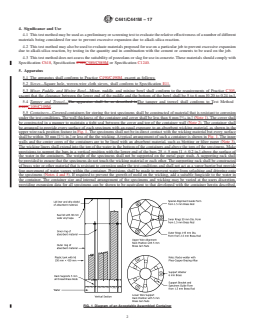
5.5 Containers—Covered containers for storing the test
NOTE 1—The purpose of this limit is to reduce the insulating effect and
provide a rapid heat transfer for the initial 14-day test period.
specimens shall be constructed of material that is resistant to
NOTE 2—This seal may be achieved by a double wrap of vinyl tape 38
corrosion under the test conditions. The wall thickness of the
mm [1 ⁄2 in.] or greater in width, overlaying the lid and container wall
container and cover shall be less than 6 mm [ ⁄16 in.] (Note 1).
along its full circumference.
The cover shall be constructed in a manner to maintain a tight
NOTE 3—The purpose of this material is to act as a wick and to ensure
seal between the cover and top of the container wall (Note 2).
that the atmosphere in the container is quickly saturated with water vapor
The container shall be arranged to provide every surface of
when it is sealed after the specimens are placed therein.
eachspecimenwithanequalexposuretoanabsorbentwicking NOTE 4—The shape and spacing of the center wicking material may
bemaintainedduringthetestbytheuseofrubberbandsorhardwarecloth.
material, as shown in the upper wire rack position feature in
NOTE5—Thecontainerdescribedin5.5andinFig.1hasbeenshown
Fig. 1. The specimens shall not be in direct contact with the
to produce large and reproducible expansions with cement-aggregate
wicking material but every surface shall be within 30 mm [1 ⁄4
combinations such as borosilicate glass and high-alkali cement combina-
in.] or less of the the wicking.Atypical arrangement of such a
tion called for by this method. However, studies suggest that the same
container is shown in Fig. 1. The inner walls and the center factors that are responsible for the success of this method (high, constant,
uniform internal relative humidity) will, under certain permitted
cores of the containers are to be lined with an absorbent
conditions, promote leaching of alkali from the specimens and result in
material, such as blotting or filter paper (Note 3). The wicking
little or no expansion from some combinations of high-alkali cement and
linersshallextendintothetopofthewaterinthebottomofthe
aggregate known to be deleteriously alkali reactive. Each laboratory
containers and above the tops of the specimens. Make provi-
should evaluate its containers with a known deleteriously alkali-reactive
sions to support the bars in a vertical position with the lower aggregate (not borosilicate glass which releases alkali) and a high-alkali
FIG. 1 Diagram of an Acceptable Assembled Container
C441/C441M − 17
TABLE 1 Grading Requirements
7.4 A smaller quantity of the pozzolan or slag and a
Sieve Size proportionately large quantity of cement may be used if there
Mass, %
Passing Retained on
is evidence that it is unusually effective in reducing expansion
4.75-mm (No. 4) 2.36-mm (No. 8) 10
due to the alkali-silica reaction and that the use of a smaller
2.36-mm (No. 8) 1.18-mm (No. 16) 25
quantity is likely to produce a large reduction of expansion of
1.18-mm (No. 16) 600-µm (No. 30) 25
600-µm (No. 30) 300-µm (No. 50) 25 the test mixture as compared to that of the control mixture.
300-µm (No. 50) 150-µm (No. 100) 15
7.5 Job Mixture—The quantities of dry materials used for
the job mixture shall be in accordance with the requirements
given above, except that the cement or cements to be used on
cement, to establish that the expected level of expansion is obtained. If
the job shall be used instead of the high-alkali cement. Also,
not, try removing the wicking to reduce the condensation and leaching.
the quantity of pozzolan or slag, by mass, used with the
Minimizing the temperature variation within the storage room and the
portlandcementshallbeequivalenttothatproposedforuseon
roominwhichthebarsaremeasuredmayalsoreducecondensationonand
leaching from the bars. the job.
7.6 Flow—The amount of mixing water, measured in
6. Materials
millilitres, shall be such as to produce a flow of between 100
6.1 Borosilicate Glass —Borosilicate glass granules graded
and115asdeterminedinaccordancewithTestMethodC1437.
accordingtoTable1orcrushedPyrexGlassNo.7740culletor
solid glass rod crushed and graded according to Table 1.After
8. Temperature and Humidity
the glass cullet or rod has been crushed and separated into the
8.1 The temperature of the molding room and dry materials
various sieve sizes, wash with a water spray over the sieve to
shall be maintained at not less than 20°C [68°F] and not more
remove adhering dust and fine particles from the aggregate.
than 27.5°C [81.5°F]. The temperature of the mixing water, of
Drytheportionsretainedonthevarioussievesand,unlessused
the moist closet or moist room, and of the room in which the
immediately, store each such portion individually in a clean
length measurements are made shall not vary from 23.0°C
container provided with a tight-fitting cover.
[73.5°F] by more than 2.0°C [3.5°F].
6.2 High-Alkali Cement—Forthepreparationofmortarbars
8.2 The relative humidity of the molding room shall be not
for the preliminary or screening tests, use a blend of cement or
less than 50 %. The moist closet or room shall conform to
cements t
...
This document is not an ASTM standard and is intended only to provide the user of an ASTM standard an indication of what changes have been made to the previous version. Because
it may not be technically possible to adequately depict all changes accurately, ASTM recommends that users consult prior editions as appropriate. In all cases only the current version
of the standard as published by ASTM is to be considered the official document.
Designation: C441/C441M − 11 C441/C441M − 17
Standard Test Method for
Effectiveness of Pozzolans or Ground Blast-Furnace Slag in
Preventing Excessive Expansion of Concrete Due to the
Alkali-Silica Reaction
This standard is issued under the fixed designation C441/C441M; the number immediately following the designation indicates the year
of original adoption or, in the case of revision, the year of last revision. A number in parentheses indicates the year of last reapproval.
A superscript epsilon (´) indicates an editorial change since the last revision or reapproval.
1. Scope*
1.1 This test method covers the determination of the effectiveness of pozzolans or slag in preventing the excessive expansion
caused by reaction between aggregates and alkalies in portland cement mixtures. The evaluation is based on the expansion
developed in mortar bars by a combination of portland cement and a pozzolan or slag, made with reactive aggregates (borosilicate
glass), during storage under prescribed conditions of test.
1.2 Units—The values stated in either SI units or inch-pound units are to be regarded separately as standard. The values stated
in each system may not be exact equivalents; therefore, each system shall be used independently of the other. Combining values
from the two systems may result in non-conformance with the standard. Some values have only SI units because the inch-pound
equivalents are not used in practice.
1.3 This standard does not purport to address all of the safety concerns, if any, associated with its use. It is the responsibility
of the user of this standard to establish appropriate safety safety, health, and healthenvironmental practices and determine the
applicability of regulatory limitations prior to use.
1.4 This international standard was developed in accordance with internationally recognized principles on standardization
established in the Decision on Principles for the Development of International Standards, Guides and Recommendations issued
by the World Trade Organization Technical Barriers to Trade (TBT) Committee.
2. Referenced Documents
2.1 ASTM Standards:
C109/C109M Test Method for Compressive Strength of Hydraulic Cement Mortars (Using 2-in. or [50-mm] Cube Specimens)
C125 Terminology Relating to Concrete and Concrete Aggregates
C150C150/C150M Specification for Portland Cement
C227C305 Test Method for Potential Alkali Reactivity of Cement-Aggregate Combinations (Mortar-Bar Method)Practice for
Mechanical Mixing of Hydraulic Cement Pastes and Mortars of Plastic Consistency
C490/C490M Practice for Use of Apparatus for the Determination of Length Change of Hardened Cement Paste, Mortar, and
Concrete
C511 Specification for Mixing Rooms, Moist Cabinets, Moist Rooms, and Water Storage Tanks Used in the Testing of Hydraulic
Cements and Concretes
C618 Specification for Coal Fly Ash and Raw or Calcined Natural Pozzolan for Use in Concrete
C989C989/C989M Specification for Slag Cement for Use in Concrete and Mortars
C1240 Specification for Silica Fume Used in Cementitious Mixtures
C1437 Test Method for Flow of Hydraulic Cement Mortar
E11 Specification for Woven Wire Test Sieve Cloth and Test Sieves
3. Terminology
3.1 Definitions: For definitions of terms used in this test method, refer to Terminology C125.
This test method is under the jurisdiction of ASTM Committee C09 on Concrete and Concrete Aggregates and is the direct responsibility of Subcommittee C09.50 on
Aggregate Reactions in Concrete.
Current edition approved Oct. 15, 2011Dec. 15, 2017. Published November 2011January 2018. Originally approved in 1959. Last previous edition approved in 20052011
as C441/C441M–05.–11. DOI: 10.1520/C0441_C0441M–11.10.1520/C0441_C0441M–17.
For referenced ASTM standards, visit the ASTM website, www.astm.org, or contact ASTM Customer Service at service@astm.org. For Annual Book of ASTM Standards
volume information, refer to the standard’s Document Summary page on the ASTM website.
*A Summary of Changes section appears at the end of this standard
Copyright © ASTM International, 100 Barr Harbor Drive, PO Box C700, West Conshohocken, PA 19428-2959. United States
C441/C441M − 17
4. Significance and Use
4.1 This test method may be used as a preliminary or screening test to evaluate the relative effectiveness of a number of different
materials being considered for use to prevent excessive expansion due to alkali-silica reaction.
4.2 This test method may also be used to evaluate materials proposed for use on a particular job to prevent excessive expansion
due to alkali-silica reaction, by testing in the quantity and in combination with the cement or cements to be used on the job.
4.3 This test method does not assess the suitability of pozzolans or slag for use in concrete. These materials should comply with
Specification C618, Specification C989C989/C989M or Specification C1240.
5. Apparatus
5.1 The apparatus shall conform to Practice C490/C490M, except as follows:
5.2 Sieves—Square hole, woven-wire cloth sieves, shall conform to Specification E11.
5.3 Mixer, Paddle, and Mixing Bowl—Mixer, paddle, and mixing bowl shall conform to the requirements of Practice C305,
except that the clearance between the lower end of the paddle and the bottom of the bowl shall be 5 to 6 mm [0.20 to 0.24 in.].
5.4 Tamper and Trowel—The apparatus shall be as described inThe tamper and trowel shall conform to Test Method
C227C109/C109M.
5.5 Containers—Covered containers for storing the test specimens shall be constructed of material that is resistant to corrosion
under the test conditions. The wall thickness of the container and cover shall be less than 6 mm [ ⁄16 in.] (Note 1). The cover shall
be constructed in a manner to maintain a tight seal between the cover and top of the container wall (Note 2). The container shall
be arranged to provide every surface of each specimen with an equal exposure to an absorbent wicking material, as shown in the
upper wire rack position feature in Fig. 1. The specimens shall not be in direct contact with the wicking material but every surface
shall be within 30 mm [1 ⁄4 in.] or less of the the wicking. A typical arrangement of such a container is shown in Fig. 1. The inner
walls and the center cores of the containers are to be lined with an absorbent material, such as blotting or filter paper (Note 3).
The wicking liners shall extend into the top of the water in the bottom of the containers and above the tops of the specimens. Make
provisions to support the bars in a vertical position with the lower end of the bars 25 6 5 mm [1 6 0.2 in.] above the surface of
the water in the containers. The weight of the specimens shall not be supported on the metal gage studs. A supporting rack shall
be provided to ensure that the specimens do not touch the wicking material or each other. The supporting rack shall be constructed
of brass wire or other material that is resistant to corrosion under the test conditions and shall not act as a vapor barrier but provide
free movement of water vapors within the container. Provisions shall be made to prevent water from splashing and dripping onto
the specimens (Notes 4 and 5). If required to prevent the growth of mold on the wicking, add a suitable fungicide to the water in
the container. The container size and internal arrangement of the specimens and wicking may be varied at the users discretion,
providing expansion data for all specimens can be shown to be equivalent to that developed with the container herein described.
FIG. 1 Diagram of an Acceptable Assembled Container
C441/C441M − 17
NOTE 1—The purpose of this limit is to reduce the insulating effect and provide a rapid heat transfer for the initial 14-day test period.
NOTE 2—This seal may be achieved by a double wrap of vinyl tape 38 mm [1 ⁄2 in.] or greater in width, overlaying the lid and container wall along
its full circumference.
NOTE 3—The purpose of this material is to act as a wick and to ensure that the atmosphere in the container is quickly saturated with water vapor when
it is sealed after the specimens are placed therein.
NOTE 4—The shape and spacing of the center wicking material may be maintained during the test by the use of rubber bands or hardware cloth.
NOTE 5—The container described in 5.5 and in Fig. 1 has been shown to produce large and reproducible expansions with cement-aggregate
combinations such as borosilicate glass and high-alkali cement combination called for by this method. However, studies suggest that the same factors
that are responsible for the success of this method (high, constant, uniform internal relative humidity) will, under certain permitted conditions, promote
leaching of alkali from the specimens and result in little or no expansion from some combinations of high-alkali cement and aggregate known to be
deleteriously alkali reactive. Each laboratory should evaluate its containers with a known deleteriously alkali-reactive aggregate (not borosilicate glass
which releases alkali) and a high-alkali cement, to establish that the expected level of expansion is obtained. If not, try removing the wicking to reduce
the condensation and leaching. Minimizing the temperature variation within the storage room and the room in which the bars are measured may also
reduce condensation on and leaching from the bars.
6. Materials
6.1 Borosilicate Glass —Borosilicate glass granules graded according to Table 1 or crushed Pyrex Glass No. 7740 cullet or
solid glass rod crushed and graded according to Table 1. After the glass cullet or rod has been crushed and separated into the
various sieve sizes, wash with a water spray over the sieve to remove adhering dust and fine particles from the aggregate. Dry the
portions retained on the various sieves and, unless used immediately, store each such portion individually in a clean container
provided with a tight-fitting cover.
6.2 High-Alkali Cement—For the preparation of mortar bars for the preliminary or screening tests, use a blend of cement or
cements that conform to Specification C150C150/C150M and contain between 0.95 and 1.05 % total alkalies as sodium oxide
(Na O) calculated as % Na O + 0.658 × % potassium oxide (K O). If blending is needed, introduce the individual cements into the
2 2 2
batch separately.
7. Proportioning and Consistency of Mortar
7.1 Control Mixture—The quantities of dry materials for the control mixture shall be 400 g of high-alkali cement and 900 g of
glass aggregate made by recombining the portions retained on the various sieves in the prescribed grading (Table 1). Test
specimens made from the control mixture shall have a 14-day increase in length of at least 0.250 %.
7.2 Test Mixture Using Pozzolans—The quantities of dry materials for the test mixture shall be 300 g of high-alkali cement, a
mass of pozzolan having an absolute volume equal to the absolute volume of 100 g of portland cement (100 × density of
pozzolan/3.15) and 900 g of glass aggregate made as described for the control mixture.
7.3 Test Mixture Using Slag—The quantities of dry materials for this test mixture shall be 200 g of high-alkali cement, a mass
of slag having an absolute volume of 200 g of portland cement (200 × density of slag/3.15) and 900 g of glass made in accordance
with 7.1.
7.4 A smaller quantity of the pozzolan or slag and a proportionately large quantity of cement may be used if there is evidence
that it is unusually effective in reducing expansion due to the alkali-silica reaction and that the use of a smaller quantity is likely
to produce a large reduction of expansion of the test mixture as compared to that of the control mixture.
7.5 Job Mixture—The quantities of dry materials used for the job mixture shall be in accordance with the requirements given
above, except that the cement or cements to be used on the
...