

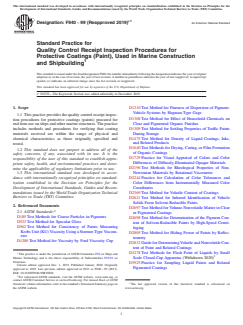
ASTM F940-99(2019)e1
(Practice)Standard Practice for Quality Control Receipt Inspection Procedures for Protective Coatings (Paint), Used in Marine Construction and Shipbuilding
General Information
- Abstract
SIGNIFICANCE AND USE
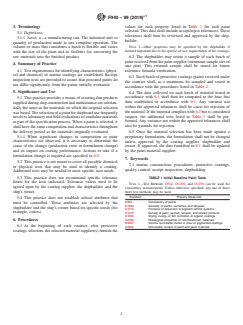
5.1 This practice provides a means of assuring that products supplied during ship construction and maintenance are substantially the same as the materials on which the original selection was based. The selection of a paint for shipboard use frequently involves laboratory and field evaluations of candidate materials as part of the specification process. When a paint is selected, it shall have the same composition and characteristics throughout the delivery period as the materials originally evaluated.
5.1.1 When significant changes in composition or paint characteristics are observed, it is necessary to determine the cause of the change (production error or formulation change) and its impact on coating performance. Actions to take if a formulation change is required are specified in 6.5.
5.2 This practice is not meant to cover all possible chemical or physical tests that may be used to identify a coating. Additional tests may be needed to meet specific user needs.
5.3 This practice does not recommend specific tolerance limits for the tests indicated. Tolerance values need to be agreed upon by the coating supplier, the shipbuilder, and the ship’s owner.
5.4 This practice does not establish critical attributes that must be controlled. These attributes are selected by the shipbuilder and the ship’s owner based on specific needs (for example, colors).
SCOPE
1.1 This practice provides the quality control receipt inspection procedures for protective coatings (paints) procured for end item use on ships and other marine structures. The practice includes methods and procedures for verifying that coating materials received are within the range of physical and chemical characteristics as those originally specified and tested.
1.2 This standard does not purport to address all of the safety concerns, if any, associated with its use. It is the responsibility of the user of this standard to establish appropriate safety, health, and environmental practices and determine the applicability of regulatory limitations prior to use.
1.3 This international standard was developed in accordance with internationally recognized principles on standardization established in the Decision on Principles for the Development of International Standards, Guides and Recommendations issued by the World Trade Organization Technical Barriers to Trade (TBT) Committee.
- Status
- Published
- Publication Date
- 30-Nov-2019
- Technical Committee
- F25 - Ships and Marine Technology
- Drafting Committee
- F25.01 - Structures

Overview
ASTM F940-99(2019)e1 is a widely recognized standard developed by ASTM International for the quality control receipt inspection procedures for protective coatings (paint) in marine construction and shipbuilding. This practice ensures that protective coatings delivered for use on ships and marine structures maintain consistent composition and characteristics throughout production and delivery, matching the standards established during initial selection and testing.
This standard is vital for industries involved in ship construction, maintenance, and repair, where the reliability and durability of protective coatings are central to long-term performance against harsh marine environments.
Key Topics
- Quality Control of Protective Coatings: Establishes systematic procedures for inspecting batches of protective coatings upon receipt to verify compliance with initially approved samples.
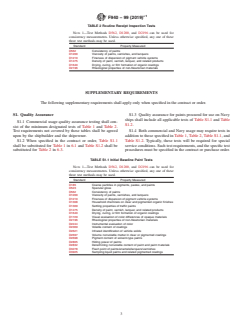
- Inspection Procedures: Details methods for sampling and testing physical and chemical properties such as viscosity, consistency, fineness of dispersion, density, drying time, and rheological properties.
- Baseline and Routine Testing: Outlines both initial baseline testing for new materials and routine testing for each batch received. This helps detect formulation changes or inconsistencies that might impact performance.
- Tolerance Agreement: Does not specify universal tolerance limits; instead, requires the shipbuilder, coating supplier, and ship’s owner to mutually agree on acceptable tolerance values for each relevant property.
- Flexibility for User Needs: Allows inclusion of further physical or chemical tests and setting of specific critical attributes by end users based on project requirements, such as color or special service conditions.
- Change Management: Explains the process for approving and documenting formulation changes, ensuring that all stakeholders remain informed and that updated data is used for future comparisons.
Applications
The ASTM F940-99(2019)e1 standard is essential for any organization involved in marine construction, shipbuilding, and marine maintenance projects. Its implementation has several practical advantages:
- Material Consistency: Assures that paints and coatings used on vessels remain consistent with those evaluated during the selection phase, reducing the risk of premature failure due to material variability.
- Regulatory Compliance: Helps shipbuilders and owners meet contractual, governmental, and industry requirements related to product quality and safety.
- Risk Mitigation: Early detection of formulation changes or batch defects prevents costly rework or failures in the marine environment.
- Traceability: Retention of batch samples and comprehensive inspection records supports traceability and accountability throughout the supply chain.
- Quality Assurance Programs: Forms the backbone of coating quality assurance for both commercial and military projects, supporting robust procurement and verification processes.
This standard supports project managers, quality inspectors, suppliers, and regulatory bodies in ensuring that marine coatings meet stringent durability and performance expectations.
Related Standards
ASTM F940-99(2019)e1 references and complements several other ASTM standards and international guidelines, including:
- ASTM D562 – Consistency of Paints
- ASTM D1200 – Viscosity by Ford Viscosity Cup
- ASTM D1210 – Fineness of Dispersion of Pigment-Vehicle Systems
- ASTM D1475 – Density of Liquid Coatings
- ASTM D1640 – Drying, Curing, or Film Formation of Organic Coatings
- ASTM D2196 – Rheological Properties of Non-Newtonian Materials
- ASTM D3925 – Sampling Liquid Paints and Related Pigmented Coatings
- International guidance: Compliance with WTO TBT Committee principles
Implementing ASTM F940-99(2019)e1 promotes greater consistency, reliability, and safety in marine coatings receipt inspection and quality control, supporting the longevity and effectiveness of protective systems in marine environments.
Relations
- Effective Date
- 01-Dec-2019
- Effective Date
- 01-Feb-2024
- Effective Date
- 01-Jun-2018
- Effective Date
- 01-Dec-2016
- Effective Date
- 01-Apr-2016
- Effective Date
- 01-Aug-2015
- Effective Date
- 01-Jun-2015
- Effective Date
- 01-Jun-2015
- Effective Date
- 01-Jan-2015
- Effective Date
- 01-Jan-2015
- Effective Date
- 01-Dec-2014
- Effective Date
- 01-Dec-2014
- Effective Date
- 01-May-2014
- Effective Date
- 01-Jan-2014
- Effective Date
- 01-Nov-2012
Get Certified
Connect with accredited certification bodies for this standard

DNV
DNV is an independent assurance and risk management provider.

Lloyd's Register
Lloyd's Register is a global professional services organisation specialising in engineering and technology.

FSC International
Forest Stewardship Council certification.
Sponsored listings
Frequently Asked Questions
ASTM F940-99(2019)e1 is a standard published by ASTM International. Its full title is "Standard Practice for Quality Control Receipt Inspection Procedures for Protective Coatings (Paint), Used in Marine Construction and Shipbuilding". This standard covers: SIGNIFICANCE AND USE 5.1 This practice provides a means of assuring that products supplied during ship construction and maintenance are substantially the same as the materials on which the original selection was based. The selection of a paint for shipboard use frequently involves laboratory and field evaluations of candidate materials as part of the specification process. When a paint is selected, it shall have the same composition and characteristics throughout the delivery period as the materials originally evaluated. 5.1.1 When significant changes in composition or paint characteristics are observed, it is necessary to determine the cause of the change (production error or formulation change) and its impact on coating performance. Actions to take if a formulation change is required are specified in 6.5. 5.2 This practice is not meant to cover all possible chemical or physical tests that may be used to identify a coating. Additional tests may be needed to meet specific user needs. 5.3 This practice does not recommend specific tolerance limits for the tests indicated. Tolerance values need to be agreed upon by the coating supplier, the shipbuilder, and the ship’s owner. 5.4 This practice does not establish critical attributes that must be controlled. These attributes are selected by the shipbuilder and the ship’s owner based on specific needs (for example, colors). SCOPE 1.1 This practice provides the quality control receipt inspection procedures for protective coatings (paints) procured for end item use on ships and other marine structures. The practice includes methods and procedures for verifying that coating materials received are within the range of physical and chemical characteristics as those originally specified and tested. 1.2 This standard does not purport to address all of the safety concerns, if any, associated with its use. It is the responsibility of the user of this standard to establish appropriate safety, health, and environmental practices and determine the applicability of regulatory limitations prior to use. 1.3 This international standard was developed in accordance with internationally recognized principles on standardization established in the Decision on Principles for the Development of International Standards, Guides and Recommendations issued by the World Trade Organization Technical Barriers to Trade (TBT) Committee.
SIGNIFICANCE AND USE 5.1 This practice provides a means of assuring that products supplied during ship construction and maintenance are substantially the same as the materials on which the original selection was based. The selection of a paint for shipboard use frequently involves laboratory and field evaluations of candidate materials as part of the specification process. When a paint is selected, it shall have the same composition and characteristics throughout the delivery period as the materials originally evaluated. 5.1.1 When significant changes in composition or paint characteristics are observed, it is necessary to determine the cause of the change (production error or formulation change) and its impact on coating performance. Actions to take if a formulation change is required are specified in 6.5. 5.2 This practice is not meant to cover all possible chemical or physical tests that may be used to identify a coating. Additional tests may be needed to meet specific user needs. 5.3 This practice does not recommend specific tolerance limits for the tests indicated. Tolerance values need to be agreed upon by the coating supplier, the shipbuilder, and the ship’s owner. 5.4 This practice does not establish critical attributes that must be controlled. These attributes are selected by the shipbuilder and the ship’s owner based on specific needs (for example, colors). SCOPE 1.1 This practice provides the quality control receipt inspection procedures for protective coatings (paints) procured for end item use on ships and other marine structures. The practice includes methods and procedures for verifying that coating materials received are within the range of physical and chemical characteristics as those originally specified and tested. 1.2 This standard does not purport to address all of the safety concerns, if any, associated with its use. It is the responsibility of the user of this standard to establish appropriate safety, health, and environmental practices and determine the applicability of regulatory limitations prior to use. 1.3 This international standard was developed in accordance with internationally recognized principles on standardization established in the Decision on Principles for the Development of International Standards, Guides and Recommendations issued by the World Trade Organization Technical Barriers to Trade (TBT) Committee.
ASTM F940-99(2019)e1 is classified under the following ICS (International Classification for Standards) categories: 47.020.05 - Materials and components for shipbuilding. The ICS classification helps identify the subject area and facilitates finding related standards.
ASTM F940-99(2019)e1 has the following relationships with other standards: It is inter standard links to ASTM F940-99(2013), ASTM D2369-24, ASTM D2196-18, ASTM D2621-87(2016), ASTM D2832-92(2016), ASTM D2244-15a, ASTM D2369-10(2015)e1, ASTM D1309-93(2015), ASTM D2244-15, ASTM D2244-15e1, ASTM D562-10(2014), ASTM D1200-10(2014), ASTM D2244-14, ASTM D523-14, ASTM D1475-98(2012). Understanding these relationships helps ensure you are using the most current and applicable version of the standard.
ASTM F940-99(2019)e1 is available in PDF format for immediate download after purchase. The document can be added to your cart and obtained through the secure checkout process. Digital delivery ensures instant access to the complete standard document.
Standards Content (Sample)
This international standard was developed in accordance with internationally recognized principles on standardization established in the Decision on Principles for the
Development of International Standards, Guides and Recommendations issued by the World Trade Organization Technical Barriers to Trade (TBT) Committee.
´1
Designation: F940 − 99 (Reapproved 2019) An American National Standard
Standard Practice for
Quality Control Receipt Inspection Procedures for
Protective Coatings (Paint), Used in Marine Construction
and Shipbuilding
ThisstandardisissuedunderthefixeddesignationF940;thenumberimmediatelyfollowingthedesignationindicatestheyearoforiginal
adoption or, in the case of revision, the year of last revision.Anumber in parentheses indicates the year of last reapproval.Asuperscript
epsilon (´) indicates an editorial change since the last revision or reapproval.
This standard has been approved for use by agencies of the U.S. Department of Defense.
ε NOTE—The Keywords Section was added editorially in December 2019.
1. Scope D1210 Test Method for Fineness of Dispersion of Pigment-
Vehicle Systems by Hegman-Type Gage
1.1 This practice provides the quality control receipt inspec-
D1308 Test Method for Effect of Household Chemicals on
tion procedures for protective coatings (paints) procured for
Clear and Pigmented Organic Finishes
end item use on ships and other marine structures.The practice
D1309 Test Method for Settling Properties of Traffic Paints
includes methods and procedures for verifying that coating
During Storage
materials received are within the range of physical and
D1475 Test Method for Density of Liquid Coatings, Inks,
chemical characteristics as those originally specified and
tested. and Related Products
D1640 Test Methods for Drying, Curing, or Film Formation
1.2 This standard does not purport to address all of the
of Organic Coatings
safety concerns, if any, associated with its use. It is the
D1729 Practice for Visual Appraisal of Colors and Color
responsibility of the user of this standard to establish appro-
Differences of Diffusely-Illuminated Opaque Materials
priate safety, health, and environmental practices and deter-
D2196 Test Methods for Rheological Properties of Non-
mine the applicability of regulatory limitations prior to use.
1.3 This international standard was developed in accor- Newtonian Materials by Rotational Viscometer
dance with internationally recognized principles on standard- D2244 Practice for Calculation of Color Tolerances and
ization established in the Decision on Principles for the
Color Differences from Instrumentally Measured Color
Development of International Standards, Guides and Recom-
Coordinates
mendations issued by the World Trade Organization Technical
D2369 Test Method for Volatile Content of Coatings
Barriers to Trade (TBT) Committee.
D2621 Test Method for Infrared Identification of Vehicle
Solids From Solvent-Reducible Paints
2. Referenced Documents
D2697 Test Method for Volume Nonvolatile Matter in Clear
2.1 ASTM Standards:
or Pigmented Coatings
D185 Test Methods for Coarse Particles in Pigments
D2698 Test Method for Determination of the Pigment Con-
D523 Test Method for Specular Gloss
tent of Solvent-Reducible Paints by High-Speed Centri-
D562 Test Method for Consistency of Paints Measuring
fuging
KrebsUnit(KU)ViscosityUsingaStormer-TypeViscom-
D2805 Test Method for Hiding Power of Paints by Reflec-
eter
tometry
D1200 Test Method for Viscosity by Ford Viscosity Cup
D2832 GuideforDeterminingVolatileandNonvolatileCon-
tent of Paint and Related Coatings
D3278 Test Methods for Flash Point of Liquids by Small
This practice is under the jurisdiction of ASTM Committee F25 on Ships and
Marine Technology and is the direct responsibility of Subcommittee F25.01 on Scale Closed-Cup Apparatus (Withdrawn 2020)
Structures.
D3925 Practice for Sampling Liquid Paints and Related
Current edition approved Dec. 1, 2019. Published January 2020. Originally
Pigmented Coatings
approved in 1985. Last previous edition approved in 2013 as F940 – 99 (2013).
DOI: 10.1520/F0940-99R19E01.
For referenced ASTM standards, visit the ASTM website, www.astm.org, or
contact ASTM Customer Service at service@astm.org. For Annual Book of ASTM
Standards volume information, refer to the standard’s Document Summary page on The last approved version of this historical standard is referenced on
the ASTM website. www.astm.org.
Copyright © ASTM International, 100 Barr Harbor Drive, PO Box C700, West Conshohocken, PA 19428-2959. United States
´1
F940 − 99 (2019)
3. Terminology values for each property listed in Table 1 for each paint
selected.This data shall include accept/reject tolerances.These
3.1 Definitions:
tolerances shall then be reviewed and approved by the ship-
3.1.1 batch, n—a manufacturing run. The industrial unit or
builder.
quantity of production made in one complete operation. The
volume or mass that constitutes a batch is flexible and varies NOTE 1—Other properties may be specified by the shipbuilder if
deemed important due to the special service requirements of the coatings.
with the size of the plant and its facilities for converting the
raw materials into the finished product. 6.2 The shipbuilder may retain a sample of each batch of
paintreceivedfromthepaintsupplier(minimumsamplesizeof
4. Summary of Practice
one pint). This retained sample shall be stored for future
4.1 Test requirements for identifying characteristics (physi-
reference formula verification.
cal and chemical) of marine coatings are established. Receipt
6.3 Each batch of protective coatings (paint) received under
inspection tests are provided to assure that procured paints do
the contract shall, as a minimum, be sampled and tested in
not differ significantly from the paints initially evaluated.
accordance with the procedures listed in Table 2.
5. Significance and Use
6.4 The data collected on each batch of material tested in
accordance with 6.3 shall then be compared to the base line
5.1 This practice provides a means of assuring that products
data established in accordance with 6.1. Any variance not
suppliedduringshipconstructionandmaintenancearesubstan-
within the approved tolerances shall be cause for rejection of
tially the same as the materials on which the original selection
thematerial.Ifthematerialcomplieswith6.3butisconsidered
wasbased.Theselectionofapaintforshipboardusefrequently
suspect, the additional tests listed in Table 1 shall be per-
involveslaboratoryandfieldevaluationsofcandidatematerials
formed.Any variance not within the approved tolerances shall
as part of the specification process. When a paint is selected, it
also be grounds for rejection.
shallhavethesamecompositionandcharacteristicsthroughout
the delivery period as the materials originally evaluated.
6.5 Once the material selection has been made against a
5.1.1 When significant changes in composition or paint
proprietary formulation, the formulation shall not be changed
characteristics are observed, it is necessary to determine the
unless approved by the coating supplier, shipbuilder and
cause of the change (production error
...