

ASTM F3143-20
(Test Method)Standard Test Method for Determination of Frictional Torque and Friction Factor for Hip Replacement Bearings under Standard Conditions Using a Reciprocal Friction Simulator
General Information
- Abstract
SIGNIFICANCE AND USE
5.1 This test procedure provides a method of evaluating the frictional torque and friction factor of hip replacement bearings.
5.2 The procedure may be used as a standardized method of measuring friction to investigate the effects of specific test parameters such as hip materials, sizes, designs, radial or diametral clearance, different lubricants, different deformation levels of the acetabular cup, clamping (non-uniform sphericity), damaged/scratched bearings, artificial ageing, misalignments during installation, etc.
5.3 Friction torque, and in particular the maximum value, is useful to assess the applicable torques that may compromise fixation, or even risk disassociation of modular components in the acetabular cup or liner/shell assemblies through a lever-out or torsion-out mechanism.
5.4 Friction factor is a useful parameter for comparison of materials and designs, and provides insights into the lubrication regime operating in the implant system. Friction factor measurement may also be able to detect acetabular liner deformation (clamping referred to earlier).
5.5 The loading and motion of a hip replacement in vivo differ from the loading and the motion defined in this standard. The amount of frictional forces in vivo will, in general, differ from the frictional forces evaluated by this standard test method. The results obtained from this test method cannot be used to directly predict in vivo performance. However, this standard is designed to allow for in-vitro comparisons for different hip designs, when tested under similar conditions.
5.6 Although this test method can be used to investigate the many variables listed in 1.2 and 5.2, it does not either provide a method to determine beforehand the combination of these variables that will produce the worst-case couple(s) among a range of sizes; the worst-case testing condition(s) for “normal” or “adverse” conditions; or provide specific methods to deform the acetabular cup, simulate Mode 3 wear con...
SCOPE
1.1 This test procedure provides a method of determining the frictional torque and friction factor of artificial hip joint bearings used in total hip replacement (THR) systems under laboratory conditions using a reciprocal friction simulator. This test method specifies the angular movement between the articulating components, the pattern of applied force, and the way data can be measured and analyzed.
1.2 Many variables can be investigated using this test method including, but not limited to, the effect of head size, different inclination/version angles, different deformation levels of the acetabular cup, bearing clearances, lubrication, scratched heads, and artificial ageing.
1.3 The values stated in SI units are to be regarded as standard. No other units of measurement are included in this standard.
1.4 This standard does not purport to address all of the safety concerns, if any, associated with its use. It is the responsibility of the user of this standard to establish appropriate safety, health, and environmental practices and determine the applicability of regulatory limitations prior to use.
1.5 This international standard was developed in accordance with internationally recognized principles on standardization established in the Decision on Principles for the Development of International Standards, Guides and Recommendations issued by the World Trade Organization Technical Barriers to Trade (TBT) Committee.
- Status
- Published
- Publication Date
- 30-Sep-2020
- Technical Committee
- F04 - Medical and Surgical Materials and Devices
- Drafting Committee
- F04.22 - Arthroplasty
Overview
ASTM F3143-20 is a standardized test method developed by ASTM International to determine the frictional torque and friction factor of artificial hip joint bearings used in total hip replacement (THR) systems. This standard uses a reciprocal friction simulator under controlled laboratory conditions to assess how hip replacement bearings perform in terms of resistance to motion. The procedure specifies essential aspects such as the angular movement between articulating components, applied force patterns, and data measurement protocols. Results from this test method provide critical insights for comparing materials, evaluating hip designs, and understanding variables that affect implant performance.
Key Topics
- Frictional Torque in Hip Bearings: The standard describes how to measure the overall tangential force exerted on the bearing’s surface, providing valuable information on the forces that may affect the stability and fixation of the implant.
- Friction Factor Measurement: It establishes effective techniques to calculate the friction factor (a nominal coefficient of friction), enabling comparisons across different materials, designs, or testing parameters.
- Variables Investigated: ASTM F3143-20 supports systematic investigation of parameters such as bearing size, design, material choice, radial clearance, lubricant type, acetabular cup deformation, bearing damage (e.g., scratches), installation misalignment, and artificial ageing.
- Test Method Consistency: The standard emphasizes regular equipment calibration, controlled specimen preparation, and robust test protocols to ensure reproducibility and reliability.
- Limitations: The testing conditions simulate but do not replicate in vivo (within the body) conditions; results are intended for comparative laboratory analysis and should not be directly interpreted as clinical performance predictions.
Applications
The practical value of ASTM F3143-20 lies in its ability to provide a repeatable, unbiased framework for the assessment and comparison of hip replacement bearing systems in laboratory settings. Typical applications include:
- Design and Material Selection: Manufacturers and researchers can utilize this standard to differentiate how various materials and component geometries impact the frictional properties of hip prostheses.
- Quality Control and Regulatory Submissions: The data and reporting protocols are instrumental for regulatory submissions, supporting claims of equivalence or improved performance.
- Research and Development: By systematically altering variables-such as liner deformation, head roughness, or lubrication regimes-R&D teams can optimize hip replacement systems for longevity and reduced failure risk.
- Benchmarking: The method enables direct comparison of prototype or commercial products against control samples under identical testing conditions.
- Implant Safety Analysis: The measurements of maximum frictional torque contribute to understanding the risk factors for implant dislocation and modular component dissociation.
Related Standards
ASTM F3143-20 references and complements several other key standards in the orthopedic and implant testing fields:
- ASTM E4 - Practices for Force Verification of Testing Machines
- ASTM F86 - Practice for Surface Preparation and Marking of Metallic Surgical Implants
- ISO 14242 Series:
- ISO 14242-1: Wear testing parameters for total hip-joint prostheses
- ISO 14242-2: Measurement methods for hip-joint prostheses
- ISO 14242-3: Orbital bearing wear testing parameters
- ASTM E122 - Practice for Calculating Sample Size to Estimate the Average for a Characteristic of a Lot or Process
Summary
ASTM F3143-20 offers a rigorous, standardized approach for the evaluation of frictional performance in hip replacement bearings. By enabling systematic, reproducible measurement of frictional torque and friction factor, the standard supports implant comparison, research innovation, and regulatory compliance, contributing to safer and more durable total hip replacement solutions.
Relations
- Effective Date
- 01-Jun-2014
- Refers
ASTM F86-12a - Standard Practice for Surface Preparation and Marking of Metallic Surgical Implants - Effective Date
- 01-Dec-2012
- Refers
ASTM F86-12 - Standard Practice for Surface Preparation and Marking of Metallic Surgical Implants - Effective Date
- 15-May-2012
- Effective Date
- 01-Aug-2011
- Effective Date
- 01-Jun-2010
- Effective Date
- 01-Dec-2009
- Effective Date
- 01-Nov-2009
- Effective Date
- 01-Aug-2009
- Effective Date
- 01-Apr-2009
- Effective Date
- 01-Dec-2008
- Effective Date
- 01-Oct-2007
- Effective Date
- 01-Jan-2007
- Refers
ASTM F86-04 - Standard Practice for Surface Preparation and Marking of Metallic Surgical Implants - Effective Date
- 01-Oct-2004
- Effective Date
- 10-Aug-2003
- Effective Date
- 10-Nov-2002
Get Certified
Connect with accredited certification bodies for this standard

BSI Group
BSI (British Standards Institution) is the business standards company that helps organizations make excellence a habit.

TÜV Rheinland
TÜV Rheinland is a leading international provider of technical services.

TÜV SÜD
TÜV SÜD is a trusted partner of choice for safety, security and sustainability solutions.
Sponsored listings
Frequently Asked Questions
ASTM F3143-20 is a standard published by ASTM International. Its full title is "Standard Test Method for Determination of Frictional Torque and Friction Factor for Hip Replacement Bearings under Standard Conditions Using a Reciprocal Friction Simulator". This standard covers: SIGNIFICANCE AND USE 5.1 This test procedure provides a method of evaluating the frictional torque and friction factor of hip replacement bearings. 5.2 The procedure may be used as a standardized method of measuring friction to investigate the effects of specific test parameters such as hip materials, sizes, designs, radial or diametral clearance, different lubricants, different deformation levels of the acetabular cup, clamping (non-uniform sphericity), damaged/scratched bearings, artificial ageing, misalignments during installation, etc. 5.3 Friction torque, and in particular the maximum value, is useful to assess the applicable torques that may compromise fixation, or even risk disassociation of modular components in the acetabular cup or liner/shell assemblies through a lever-out or torsion-out mechanism. 5.4 Friction factor is a useful parameter for comparison of materials and designs, and provides insights into the lubrication regime operating in the implant system. Friction factor measurement may also be able to detect acetabular liner deformation (clamping referred to earlier). 5.5 The loading and motion of a hip replacement in vivo differ from the loading and the motion defined in this standard. The amount of frictional forces in vivo will, in general, differ from the frictional forces evaluated by this standard test method. The results obtained from this test method cannot be used to directly predict in vivo performance. However, this standard is designed to allow for in-vitro comparisons for different hip designs, when tested under similar conditions. 5.6 Although this test method can be used to investigate the many variables listed in 1.2 and 5.2, it does not either provide a method to determine beforehand the combination of these variables that will produce the worst-case couple(s) among a range of sizes; the worst-case testing condition(s) for “normal” or “adverse” conditions; or provide specific methods to deform the acetabular cup, simulate Mode 3 wear con... SCOPE 1.1 This test procedure provides a method of determining the frictional torque and friction factor of artificial hip joint bearings used in total hip replacement (THR) systems under laboratory conditions using a reciprocal friction simulator. This test method specifies the angular movement between the articulating components, the pattern of applied force, and the way data can be measured and analyzed. 1.2 Many variables can be investigated using this test method including, but not limited to, the effect of head size, different inclination/version angles, different deformation levels of the acetabular cup, bearing clearances, lubrication, scratched heads, and artificial ageing. 1.3 The values stated in SI units are to be regarded as standard. No other units of measurement are included in this standard. 1.4 This standard does not purport to address all of the safety concerns, if any, associated with its use. It is the responsibility of the user of this standard to establish appropriate safety, health, and environmental practices and determine the applicability of regulatory limitations prior to use. 1.5 This international standard was developed in accordance with internationally recognized principles on standardization established in the Decision on Principles for the Development of International Standards, Guides and Recommendations issued by the World Trade Organization Technical Barriers to Trade (TBT) Committee.
SIGNIFICANCE AND USE 5.1 This test procedure provides a method of evaluating the frictional torque and friction factor of hip replacement bearings. 5.2 The procedure may be used as a standardized method of measuring friction to investigate the effects of specific test parameters such as hip materials, sizes, designs, radial or diametral clearance, different lubricants, different deformation levels of the acetabular cup, clamping (non-uniform sphericity), damaged/scratched bearings, artificial ageing, misalignments during installation, etc. 5.3 Friction torque, and in particular the maximum value, is useful to assess the applicable torques that may compromise fixation, or even risk disassociation of modular components in the acetabular cup or liner/shell assemblies through a lever-out or torsion-out mechanism. 5.4 Friction factor is a useful parameter for comparison of materials and designs, and provides insights into the lubrication regime operating in the implant system. Friction factor measurement may also be able to detect acetabular liner deformation (clamping referred to earlier). 5.5 The loading and motion of a hip replacement in vivo differ from the loading and the motion defined in this standard. The amount of frictional forces in vivo will, in general, differ from the frictional forces evaluated by this standard test method. The results obtained from this test method cannot be used to directly predict in vivo performance. However, this standard is designed to allow for in-vitro comparisons for different hip designs, when tested under similar conditions. 5.6 Although this test method can be used to investigate the many variables listed in 1.2 and 5.2, it does not either provide a method to determine beforehand the combination of these variables that will produce the worst-case couple(s) among a range of sizes; the worst-case testing condition(s) for “normal” or “adverse” conditions; or provide specific methods to deform the acetabular cup, simulate Mode 3 wear con... SCOPE 1.1 This test procedure provides a method of determining the frictional torque and friction factor of artificial hip joint bearings used in total hip replacement (THR) systems under laboratory conditions using a reciprocal friction simulator. This test method specifies the angular movement between the articulating components, the pattern of applied force, and the way data can be measured and analyzed. 1.2 Many variables can be investigated using this test method including, but not limited to, the effect of head size, different inclination/version angles, different deformation levels of the acetabular cup, bearing clearances, lubrication, scratched heads, and artificial ageing. 1.3 The values stated in SI units are to be regarded as standard. No other units of measurement are included in this standard. 1.4 This standard does not purport to address all of the safety concerns, if any, associated with its use. It is the responsibility of the user of this standard to establish appropriate safety, health, and environmental practices and determine the applicability of regulatory limitations prior to use. 1.5 This international standard was developed in accordance with internationally recognized principles on standardization established in the Decision on Principles for the Development of International Standards, Guides and Recommendations issued by the World Trade Organization Technical Barriers to Trade (TBT) Committee.
ASTM F3143-20 is classified under the following ICS (International Classification for Standards) categories: 11.040.40 - Implants for surgery, prosthetics and orthotics. The ICS classification helps identify the subject area and facilitates finding related standards.
ASTM F3143-20 has the following relationships with other standards: It is inter standard links to ASTM E4-14, ASTM F86-12a, ASTM F86-12, ASTM E122-09e1, ASTM E4-10, ASTM F86-04(2009), ASTM E4-09a, ASTM E122-09, ASTM E4-09, ASTM E4-08, ASTM E122-07, ASTM E4-07, ASTM F86-04, ASTM E4-03, ASTM E4-02. Understanding these relationships helps ensure you are using the most current and applicable version of the standard.
ASTM F3143-20 is available in PDF format for immediate download after purchase. The document can be added to your cart and obtained through the secure checkout process. Digital delivery ensures instant access to the complete standard document.
Standards Content (Sample)
This international standard was developed in accordance with internationally recognized principles on standardization established in the Decision on Principles for the
Development of International Standards, Guides and Recommendations issued by the World Trade Organization Technical Barriers to Trade (TBT) Committee.
Designation: F3143 − 20
Standard Test Method for
Determination of Frictional Torque and Friction Factor for
Hip Replacement Bearings under Standard Conditions
Using a Reciprocal Friction Simulator
This standard is issued under the fixed designation F3143; the number immediately following the designation indicates the year of
original adoption or, in the case of revision, the year of last revision. A number in parentheses indicates the year of last reapproval. A
superscript epsilon (´) indicates an editorial change since the last revision or reapproval.
1. Scope E122 Practice for Calculating Sample Size to Estimate,With
Specified Precision, the Average for a Characteristic of a
1.1 This test procedure provides a method of determining
Lot or Process
the frictional torque and friction factor of artificial hip joint
F86 Practice for Surface Preparation and Marking of Metal-
bearings used in total hip replacement (THR) systems under
lic Surgical Implants
laboratoryconditionsusingareciprocalfrictionsimulator.This
test method specifies the angular movement between the
2.2 Other Standards:
articulating components, the pattern of applied force, and the
ISO 14242-1 Implants for Surgery—Wear of total hip-joint
way data can be measured and analyzed.
prostheses, Part 1: Loading and displacement parameters
forwear-testingmachinesandcorrespondingenvironmen-
1.2 Many variables can be investigated using this test
tal conditions for test
method including, but not limited to, the effect of head size,
ISO 14242-2 Implants for Surgery—Wear of total hip-joint
different inclination/version angles, different deformation lev-
prostheses, Part 2: Methods of measurement
els of the acetabular cup, bearing clearances, lubrication,
ISO 14242-3 Implants for Surgery—Wear of total hip-joint
scratched heads, and artificial ageing.
prostheses, Part 3: Loading and displacement parameters
1.3 The values stated in SI units are to be regarded as
for orbital bearing type wear testing machines and corre-
standard. No other units of measurement are included in this
sponding environmental conditions for test
standard.
1.4 This standard does not purport to address all of the
3. Terminology
safety concerns, if any, associated with its use. It is the
3.1 Definitions:
responsibility of the user of this standard to establish appro-
3.1.1 friction, n—the resisting force tangential to the com-
priate safety, health, and environmental practices and deter-
mine the applicability of regulatory limitations prior to use. mon boundary between two bodies when, under the action of
1.5 This international standard was developed in accor- an external force, one body moves or tends to move relative to
dance with internationally recognized principles on standard- the surface of the other.
ization established in the Decision on Principles for the
3.1.2 friction factor, n—in the spherical portions of articu-
Development of International Standards, Guides and Recom-
lar surfaces, friction factor is defined as an effective (nominal)
mendations issued by the World Trade Organization Technical
frictional coefficient, equal to the overall total tangential
Barriers to Trade (TBT) Committee.
frictional forces on the hip divided by the overall compressive
force on the hip.
2. Referenced Documents
3.1.3 frictional torque, n—in the case of spherical portions
2.1 ASTM Standards:
of articular surfaces such as those of a THR, the actual
E4 Practices for Force Verification of Testing Machines
frictionalforceatanyinstantvariesatdifferentlocationsonthe
surfaces.Theoverallfrictioncanbeconvenientlycharacterized
This test method is under the jurisdiction ofASTM Committee F04 on Medical
as a frictional torque, which represents the overall tangential
and Surgical Materials and Devices and is the direct responsibility of Subcommittee
forces on the bearing surface multiplied by a nominal radius of
F04.22 on Arthroplasty.
the spherical articulating surfaces.
Current edition approved Oct. 1, 2020. Published November 2020. DOI:
10.1520/F3143-20.
For referenced ASTM standards, visit the ASTM website, www.astm.org, or
contact ASTM Customer Service at service@astm.org. For Annual Book of ASTM
Standards volume information, refer to the standard’s Document Summary page on Available fromAmerican National Standards Institute (ANSI), 25 W. 43rd St.,
the ASTM website. 4th Floor, New York, NY 10036, http://www.ansi.org.
Copyright © ASTM International, 100 Barr Harbor Drive, PO Box C700, West Conshohocken, PA 19428-2959. United States
F3143 − 20
3.1.4 overall tangential force, n—total of all tangential or “adverse” conditions; or provide specific methods to deform
forces on the hip surface equal to the overall frictional torque the acetabular cup, simulate Mode 3 wear conditions (for
divided by the nominal radius of the articular surfaces of the example, third-body particles, scratched heads), or artificially
THR system. aged materials. As these methods are not included in the
standard and if they are to become the subject of the investi-
4. Summary of Test Method
gation then it is up to the user to justify the couple(s) selected
4.1 The total frictional torque under dynamic simulated and method(s) used in the test and, if necessary, provide a
loading and angular motion regime is determined by using a rationale for how the “worst-case” couple(s) and method(s)
force transducer and a friction simulator with a low friction were selected to represent clinically relevant “normal” and
bearing with a coefficient of friction less than 0.001 such as a “adverse” conditions as part of the report.
hydrostatic or pneumatic bearing.
6. Confounding Variables
4.2 The input profile is a simplified loading cycle and
6.1 The natural deterioration of the machine can affect the
angular motion of the head with respect to the cup.
results. Therefore accurate calibration and verification of the
4.3 Calf serum is used as the base lubricant.
equipment used shall be carried out on regular basis to ensure
4.4 The frictional torque is determined at the highest force thatthemeasuredandtheappliedforcesarecorrect,repeatable,
and reliable.
and highest velocity part of the testing cycle.
4.5 The friction factor, f, is calculated using the following 6.2 Deterioration of the low-friction bearing or oil within
T
the hydrostatic bearing, if used, can lead to generation of
equation: f5 where T is the total frictional torque
rL
friction that can affect the frictional torque of the hip bearing
determined, r is the radius of the femoral head, and L is the
being measured.
applied force.
6.3 Incorrect fixturing and alignment of the test samples
such as the center of the acetabular cup not being concentric
5. Significance and Use
with the center of angular rotations of the test machine may
5.1 This test procedure provides a method of evaluating the
result in incorrect friction values and errors in calculating the
frictional torque and friction factor of hip replacement bear-
frictional torque and friction factor.
ings.
5.2 The procedure may be used as a standardized method of 7. Apparatus
measuring friction to investigate the effects of specific test
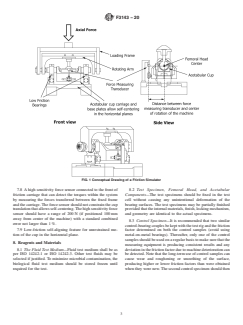
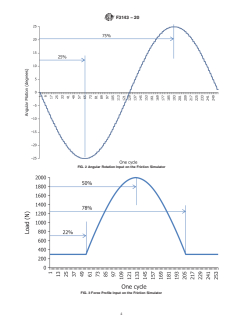
7.1 Testing machine (Fig. 1) capable of producing an
parameters such as hip materials, sizes, designs, radial or
angular displacement of 625° (Fig. 2) and applying a dynamic
diametral clearance, different lubricants, different deformation
axial force of a range of 300 N to 2000 N (Fig. 3) while
levels of the acetabular cup, clamping (non-uniform
operating at a frequency of 1 Hz.
sphericity), damaged/scratched bearings, artificial ageing, mis-
7.2 Means of aligning and positioning the femoral head so
alignments during installation, etc.
that its center is situated at the center of the axes of rotation of
5.3 Friction torque, and in particular the maximum value, is
the test machine and so that the same position and orientation
useful to assess the applicable torques that may compromise
may be reproduced following removal for measurement or
fixation, or even risk disassociation of modular components in
cleaning if required.
the acetabular cup or liner/shell assemblies through a lever-out
7.3 Means of aligning and positioning the acetabular cup so
or torsion-out mechanism.
that its center is situated at the center of the axes of rotation of
5.4 Friction factor is a useful parameter for comparison of
the test machine and so that the same position and orientation
materials and designs, and provides insights into the lubrica-
may be reproduced following removal for measurement or
tion regime operating in the implant system. Friction factor
cleaning if required.
measurement may also be able to detect acetabular liner
7.4 Motioncontrolsystemcapableofgeneratingtheangular
deformation (clamping referred to earlier).
movement of the femoral component given in Fig. 2 with an
5.5 The loading and motion of a hip replacement in vivo
accuracy of 63° at the maxima and minima of the motion and
differ from the loading and the motion defined in this standard.
61 % of the cycle time for phasing.
The amount of frictional forces in vivo will, in general, differ
7.5 Force control system capable of generating a dynamic
from the frictional forces evaluated by this standard test
force and maintaining the magnitude of the maxima of this
method. The results obtained from this test method cannot be
force cycle to a tolerance of 65 % of the force value for the
used to directly predict in vivo performance. However, this
cycle and 65 % of the cycle time for phasing.
standard is designed to allow for in-vitro comparisons for
different hip designs, when tested under similar conditions. 7.6 The loading frame should be free to move in the vertical
axisallowingtheverticalforcetobetransmittedfreelythrough
5.6 Although this test method can be used to investigate the
the center of the femoral head.
many variables listed in 1.2 and 5.2, it does not either provide
a method to determine beforehand the combination of these 7.7 Low friction bearings (machine bearings) capable of
variables that will produce the worst-case couple(s) among a providing a low-friction environment under the testing condi-
range of sizes; the worst-case testing condition(s) for “normal” tions.
F3143 − 20
FIG. 1 Conceptual Drawing of a Friction Simulator
7.8 Ahigh sensitivity force sensor connected to the front of 8.2 Test Specimen, Femoral Head, and Acetabular
friction carriage that can detect the torques within the system Components—The test specimens should be fixed in the test
by measuring the forces transferred between the fixed frame cell without causing any unintentional deformation of the
and the carriage. The force sensor should not constrain the cup bearing surfaces. The test specimens may be partially finished
translationthatallowsself-centering.Thehighsensitivityforce providedthattheinternalmaterials,finish,lockingmechanism,
sensor should have a range of 200 N (if positioned 100 mm and geometry are identical to the actual specimens.
away from center of the machine) with a standard combined
8.3 Control Specimen—It is recommended that two similar
error not larger than 1 %.
control-bearingcouplesbekeptwiththetestrigandthefriction
7.9 Low-friction self-aligning feature for unrestrained mo- factor determined on both the control samples (avoid using
tion of the cup in the horizontal plane.
metal-on-metal bearings). Thereafter, only one of the control
samples should be used on a regular basis to make sure that the
8. Reagents and Materials
measuring equipment is producing consistent results and any
8.1 The Fluid Test Medium—Fluid test medium shall be as deviationinthefrictionfactorduetomachinedeteriorationcan
per ISO 14242-1 or ISO 14242-3. Other test fluids may be be detected. Note that the long-term use of control samples can
selected if justified. To minimize microbial contamination, the cause wear and roughening or smoothing of the surface,
biological fluid test medium should be stored frozen until producing higher or lower friction factors than were obtained
required for the test. when they were new.The second control specimen should then
F3143 − 20
FIG. 2 Angular Rotation Input on the Friction Simulator
FIG. 3 Force Profile Input on the Friction Simulator
F3143 − 20
beusedforcomparisonwhenanewcontrolsampleisrequired. 11.5 The position of the center of the cup versus the force
Thenewcontrolsamplethenreplacesthecontrolspecimenthat sensor (see 7.8) shall be known within 60.2 mm. The position
has only been used once. This removes the drift in machine of the femoral head in respect to the machine axis is not as
performancethatcouldbeseenbetweentheproductionandtest critical; however, larger offsets shall be avoided as they result
of the control samples. in greater motion of the cup in the horizontal plane.
11.6 It is advisable to have alignment marks on the test
9. Hazards
specimens in case it is necessary to repeat the test.
9.1 Appropriate personal protective equipment should be
used at all times during the operation of the machine. 12. Calibration and Standardization
12.1 Accurate calibration an
...