

ASTM D2068-20
(Test Method)Standard Test Method for Determining Filter Blocking Tendency
General Information
- Abstract
SIGNIFICANCE AND USE
5.1 This test method is intended for use in evaluating the cleanliness of middle distillate fuels, and biodiesel and biodiesel blends for specifications and quality control purposes.
5.2 The filter media specified in the three procedures are all suitable for the materials in the Scope. Specifications calling up this test method should state the procedure required.
5.3 A change in filtration performance after storage or pretreatment can be indicative of changes of fuel condition.
5.4 The filterability of fuels varies depending on filter porosity and structure and therefore results from this test method might not correlate with full-scale filtration.
5.5 Causes of poor filterability in industrial/refinery filters include fuel degradation products, contaminants (including water) picked up during storage or transfer, effects due to temperature or composition for bio fuels, incompatibility of commingled fuels, or interaction of the fuel with the filter media. Any of these could correlate with orifice or filter system plugging, or both.
5.6 The results of the FBT test can range from 1 with a fuel with very good filterability, to over 100 for a fuel with poor filterability. The selection of a single FBT number to define a pass or fail criteria is not possible as this will be dependent on the fuel type and applications.
SCOPE
1.1 This test method covers three procedures for the determination of the filter blocking tendency (FBT) and filterability of middle distillate fuel oils and liquid fuels such as biodiesel and biodiesel blends. The three procedures and associated filter types are applicable to fuels within the viscosity range of 1.3 mm2 to 6.0 mm2/s at 40 °C.
Note 1: ASTM specification fuels falling within the scope of this test method are: Specification D396 Grades No 1 and 2; Specification D975 Grades 1-D, low sulfur 1-D and 2-D; Specification D2880 Grades 1-GT and 2-GT; Specification D6751.
1.2 This test method is not applicable to fuels that contain free (undissolved) water (see 7.3).
1.3 The values stated in SI units are to be regarded as standard. No other units of measurement are included in this standard.
1.4 This standard does not purport to address all of the safety concerns, if any, associated with its use. It is the responsibility of the user of this standard to establish appropriate safety, health, and environmental practices and determine the applicability of regulatory limitations prior to use.
1.5 This international standard was developed in accordance with internationally recognized principles on standardization established in the Decision on Principles for the Development of International Standards, Guides and Recommendations issued by the World Trade Organization Technical Barriers to Trade (TBT) Committee.
- Status
- Published
- Publication Date
- 30-Sep-2020
- Technical Committee
- D02 - Petroleum Products, Liquid Fuels, and Lubricants
- Drafting Committee
- D02.14 - Stability, Cleanliness and Compatibility of Liquid Fuels
Overview
ASTM D2068-20 is the internationally recognized standard test method for determining the filter blocking tendency (FBT) and filterability of middle distillate fuel oils, such as diesel, gas oil, and liquid fuels including biodiesel and biodiesel blends. Developed by ASTM International, this method supports fuel cleanliness evaluation for specification compliance and quality control, helping to detect issues that could cause filter plugging or operational challenges in storage, distribution, or engine use.
This standard employs three procedures, each specifying a distinct filter type, designed for fuels with viscosities from 1.3 mm²/s to 6.0 mm²/s at 40°C. ASTM D2068-20 provides critical information for fuel producers, refiners, suppliers, and users to monitor fuel quality and prevent costly operational issues related to poor filterability.
Key Topics
- Fuel Cleanliness Assessment: ASTM D2068-20 is primarily applied to evaluate the presence of particulates and other contaminants in fuels that could lead to filter plugging.
- Three Test Procedures: The standard outlines three procedures (A, B, C) using different filter media tailored for various fuel types and applications.
- Filter Blocking Tendency (FBT): The FBT value quantifies the likelihood of a fuel to block a filter, supporting comparability and trend tracking.
- Applicability: The method is appropriate for middle distillate fuels such as diesel (including marine and automotive grades), gas turbines, and biodiesel blends, provided the sample does not contain undissolved water.
- Quality Control: Routine use of this test aids in maintaining product cleanliness throughout the fuel supply chain.
Applications
- Fuel Production and Refinery Operations: Refineries use ASTM D2068-20 to confirm that outgoing fuel meets cleanliness specifications and is unlikely to cause filter plugging in downstream equipment.
- Biodiesel and Blending Facilities: The test is suited for biodiesel (B100) and diesel/biodiesel blends, helping producers assess the impact of blending and storage on filterability.
- Storage and Distribution: Storage operators and fuel distributors employ this method to assess whether fuels have degraded over time or accumulated particulates during transfer, reducing the risk of filter blockages during end use.
- Specification Testing: Fuels supplied under ASTM D396, D975, D2880, or D6751 are frequently tested using this method to ensure compliance with industry standards.
- Failure Investigation: A sudden increase in FBT after storage, pretreatment, or blending can indicate contamination or instability, guiding quality investigations and corrective actions.
Related Standards
- ASTM D396: Specification for Fuel Oils, referenced for applicable fuel types.
- ASTM D975: Specification for Diesel Fuel, covering automotive and certain marine grades.
- ASTM D2880: Specification for Gas Turbine Fuel Oils, related to aviation and stationary turbines.
- ASTM D6751: Specification for Biodiesel Fuel Blend Stock (B100).
- ASTM D6426: Test Method for Determining Filterability of Middle Distillate Fuel Oils, closely related in scope.
- ASTM D4176, D4860: Methods for assessing free water and particulate contamination.
- ISO 5636-5: For filter media air resistance benchmarking.
- ASTM D4057, D4177: Practices for sampling petroleum and petroleum products.
Practical Value
Adhering to ASTM D2068-20 enables stakeholders in the fuel supply chain to proactively manage fuel cleanliness, reducing operational risks linked to clogged filters, equipment downtime, and associated maintenance costs. The FBT test supports risk mitigation for fuel producers, distributors, and end users, especially in sectors reliant on diesel and biodiesel. By identifying and addressing fuel degradation or contamination before distribution, organizations safeguard engine performance, regulatory compliance, and customer satisfaction, making ASTM D2068-20 a key element of modern fuel quality assurance programs.
Relations
- Effective Date
- 01-Mar-2024
- Effective Date
- 01-Mar-2024
- Effective Date
- 15-Dec-2023
- Effective Date
- 01-Dec-2023
- Effective Date
- 15-Dec-2019
- Effective Date
- 01-Dec-2019
- Effective Date
- 01-May-2019
- Effective Date
- 01-May-2019
- Effective Date
- 01-Feb-2019
- Effective Date
- 01-Dec-2018
- Effective Date
- 01-Oct-2018
- Effective Date
- 01-Oct-2018
- Effective Date
- 01-Oct-2018
- Effective Date
- 01-May-2018
- Effective Date
- 01-May-2018
Get Certified
Connect with accredited certification bodies for this standard

Element Materials Technology
Materials testing and product certification.

ABS Group Brazil
ABS Group certification services in Brazil.

ABS Quality Evaluations Inc.
American Bureau of Shipping quality certification.
Sponsored listings
Frequently Asked Questions
ASTM D2068-20 is a standard published by ASTM International. Its full title is "Standard Test Method for Determining Filter Blocking Tendency". This standard covers: SIGNIFICANCE AND USE 5.1 This test method is intended for use in evaluating the cleanliness of middle distillate fuels, and biodiesel and biodiesel blends for specifications and quality control purposes. 5.2 The filter media specified in the three procedures are all suitable for the materials in the Scope. Specifications calling up this test method should state the procedure required. 5.3 A change in filtration performance after storage or pretreatment can be indicative of changes of fuel condition. 5.4 The filterability of fuels varies depending on filter porosity and structure and therefore results from this test method might not correlate with full-scale filtration. 5.5 Causes of poor filterability in industrial/refinery filters include fuel degradation products, contaminants (including water) picked up during storage or transfer, effects due to temperature or composition for bio fuels, incompatibility of commingled fuels, or interaction of the fuel with the filter media. Any of these could correlate with orifice or filter system plugging, or both. 5.6 The results of the FBT test can range from 1 with a fuel with very good filterability, to over 100 for a fuel with poor filterability. The selection of a single FBT number to define a pass or fail criteria is not possible as this will be dependent on the fuel type and applications. SCOPE 1.1 This test method covers three procedures for the determination of the filter blocking tendency (FBT) and filterability of middle distillate fuel oils and liquid fuels such as biodiesel and biodiesel blends. The three procedures and associated filter types are applicable to fuels within the viscosity range of 1.3 mm2 to 6.0 mm2/s at 40 °C. Note 1: ASTM specification fuels falling within the scope of this test method are: Specification D396 Grades No 1 and 2; Specification D975 Grades 1-D, low sulfur 1-D and 2-D; Specification D2880 Grades 1-GT and 2-GT; Specification D6751. 1.2 This test method is not applicable to fuels that contain free (undissolved) water (see 7.3). 1.3 The values stated in SI units are to be regarded as standard. No other units of measurement are included in this standard. 1.4 This standard does not purport to address all of the safety concerns, if any, associated with its use. It is the responsibility of the user of this standard to establish appropriate safety, health, and environmental practices and determine the applicability of regulatory limitations prior to use. 1.5 This international standard was developed in accordance with internationally recognized principles on standardization established in the Decision on Principles for the Development of International Standards, Guides and Recommendations issued by the World Trade Organization Technical Barriers to Trade (TBT) Committee.
SIGNIFICANCE AND USE 5.1 This test method is intended for use in evaluating the cleanliness of middle distillate fuels, and biodiesel and biodiesel blends for specifications and quality control purposes. 5.2 The filter media specified in the three procedures are all suitable for the materials in the Scope. Specifications calling up this test method should state the procedure required. 5.3 A change in filtration performance after storage or pretreatment can be indicative of changes of fuel condition. 5.4 The filterability of fuels varies depending on filter porosity and structure and therefore results from this test method might not correlate with full-scale filtration. 5.5 Causes of poor filterability in industrial/refinery filters include fuel degradation products, contaminants (including water) picked up during storage or transfer, effects due to temperature or composition for bio fuels, incompatibility of commingled fuels, or interaction of the fuel with the filter media. Any of these could correlate with orifice or filter system plugging, or both. 5.6 The results of the FBT test can range from 1 with a fuel with very good filterability, to over 100 for a fuel with poor filterability. The selection of a single FBT number to define a pass or fail criteria is not possible as this will be dependent on the fuel type and applications. SCOPE 1.1 This test method covers three procedures for the determination of the filter blocking tendency (FBT) and filterability of middle distillate fuel oils and liquid fuels such as biodiesel and biodiesel blends. The three procedures and associated filter types are applicable to fuels within the viscosity range of 1.3 mm2 to 6.0 mm2/s at 40 °C. Note 1: ASTM specification fuels falling within the scope of this test method are: Specification D396 Grades No 1 and 2; Specification D975 Grades 1-D, low sulfur 1-D and 2-D; Specification D2880 Grades 1-GT and 2-GT; Specification D6751. 1.2 This test method is not applicable to fuels that contain free (undissolved) water (see 7.3). 1.3 The values stated in SI units are to be regarded as standard. No other units of measurement are included in this standard. 1.4 This standard does not purport to address all of the safety concerns, if any, associated with its use. It is the responsibility of the user of this standard to establish appropriate safety, health, and environmental practices and determine the applicability of regulatory limitations prior to use. 1.5 This international standard was developed in accordance with internationally recognized principles on standardization established in the Decision on Principles for the Development of International Standards, Guides and Recommendations issued by the World Trade Organization Technical Barriers to Trade (TBT) Committee.
ASTM D2068-20 is classified under the following ICS (International Classification for Standards) categories: 75.160.20 - Liquid fuels. The ICS classification helps identify the subject area and facilitates finding related standards.
ASTM D2068-20 has the following relationships with other standards: It is inter standard links to ASTM D6300-24, ASTM D6708-24, ASTM D975-23a, ASTM D6300-23a, ASTM D396-19a, ASTM D6300-19a, ASTM D6708-19, ASTM D396-19, ASTM D975-19, ASTM D975-18a, ASTM D2880-18a, ASTM D6751-18, ASTM D396-18a, ASTM D396-18, ASTM D2880-18. Understanding these relationships helps ensure you are using the most current and applicable version of the standard.
ASTM D2068-20 is available in PDF format for immediate download after purchase. The document can be added to your cart and obtained through the secure checkout process. Digital delivery ensures instant access to the complete standard document.
Standards Content (Sample)
This international standard was developed in accordance with internationally recognized principles on standardization established in the Decision on Principles for the
Development of International Standards, Guides and Recommendations issued by the World Trade Organization Technical Barriers to Trade (TBT) Committee.
Designation: D2068 − 20
Standard Test Method for
Determining Filter Blocking Tendency
This standard is issued under the fixed designation D2068; the number immediately following the designation indicates the year of
original adoption or, in the case of revision, the year of last revision. A number in parentheses indicates the year of last reapproval. A
superscript epsilon (´) indicates an editorial change since the last revision or reapproval.
INTRODUCTION
This test method describes three procedures using different filter media. The result of any test is
dependent on the filter mandated in the procedure. If a specification requires a specific D2068
procedure, do not substitute a different procedure or filter without agreement from the specifier.
1. Scope* 2. Referenced Documents
1.1 This test method covers three procedures for the deter- 2.1 ASTM Standards:
mination of the filter blocking tendency (FBT) and filterability D396 Specification for Fuel Oils
of middle distillate fuel oils and liquid fuels such as biodiesel D975 Specification for Diesel Fuel
andbiodieselblends.Thethreeproceduresandassociatedfilter D2880 Specification for Gas Turbine Fuel Oils
types are applicable to fuels within the viscosity range of D4057 Practice for Manual Sampling of Petroleum and
2 2
1.3 mm to 6.0 mm /s at 40 °C. Petroleum Products
D4176 Test Method for FreeWater and Particulate Contami-
NOTE 1—ASTM specification fuels falling within the scope of this test
nation in Distillate Fuels (Visual Inspection Procedures)
method are: Specification D396 Grades No 1 and 2; Specification D975
D4177 Practice for Automatic Sampling of Petroleum and
Grades 1-D, low sulfur 1-D and 2-D; Specification D2880 Grades 1-GT
and 2-GT; Specification D6751.
Petroleum Products
D4860 Test Method for FreeWater and Particulate Contami-
1.2 This test method is not applicable to fuels that contain
nation in Middle Distillate Fuels (Clear and Bright Nu-
free (undissolved) water (see 7.3).
merical Rating)
1.3 The values stated in SI units are to be regarded as
D6300 Practice for Determination of Precision and Bias
standard. No other units of measurement are included in this
Data for Use in Test Methods for Petroleum Products,
standard.
Liquid Fuels, and Lubricants
1.4 This standard does not purport to address all of the
D6426 Test Method for Determining Filterability of Middle
safety concerns, if any, associated with its use. It is the
Distillate Fuel Oils
responsibility of the user of this standard to establish appro-
D6708 Practice for StatisticalAssessment and Improvement
priate safety, health, and environmental practices and deter-
of Expected Agreement Between Two Test Methods that
mine the applicability of regulatory limitations prior to use.
Purport to Measure the Same Property of a Material
1.5 This international standard was developed in accor-
D6751 Specification for Biodiesel Fuel Blend Stock (B100)
dance with internationally recognized principles on standard-
for Middle Distillate Fuels
ization established in the Decision on Principles for the
2.2 ISO Standard:
Development of International Standards, Guides and Recom-
ISO 5636-5 Paper and Board—Determination of Air Per-
mendations issued by the World Trade Organization Technical
meance and Air Resistance (Medium Range) Part 5
Barriers to Trade (TBT) Committee.
Gurley Method
1 2
This test method is under the jurisdiction of ASTM Committee D02 on For referenced ASTM standards, visit the ASTM website, www.astm.org, or
Petroleum Products, Liquid Fuels, and Lubricants and is the direct responsibility of contact ASTM Customer Service at service@astm.org. For Annual Book of ASTM
Subcommittee D02.14 on Stability, Cleanliness and Compatibility of Liquid Fuels. Standards volume information, refer to the standard’s Document Summary page on
Current edition approved Oct. 1, 2020. Published October 2020. Originally the ASTM website.
approved in 1997. Last previous edition approved in 2017 as D2068 – 17. DOI: Available fromAmerican National Standards Institute (ANSI), 25 W. 43rd St.,
10.1520/D2068-20. 4th Floor, New York, NY 10036, http://www.ansi.org.
*A Summary of Changes section appears at the end of this standard
Copyright © ASTM International, 100 Barr Harbor Drive, PO Box C700, West Conshohocken, PA 19428-2959. United States
D2068 − 20
2.3 ASTM Adjuncts: 5.5 Causes of poor filterability in industrial/refinery filters
D2PP, Determination of Precision and Bias Data for Use in include fuel degradation products, contaminants (including
Test Methods for Petroleum Products water) picked up during storage or transfer, effects due to
CompTM, Standard Practice for Statistical Assessment and temperature or composition for bio fuels, incompatibility of
Improvement of the Expected Agreement between Two commingled fuels, or interaction of the fuel with the filter
Test Methods that Purport to Measure the Same Property media.Anyofthesecouldcorrelatewithorificeorfiltersystem
of a Material plugging, or both.
5.6 The results of the FBT test can range from 1 with a fuel
3. Terminology
with very good filterability, to over 100 for a fuel with poor
3.1 Definitions of Terms Specific to This Standard:
filterability. The selection of a single FBT number to define a
3.1.1 filterability, n—of certain fuels, the relationship be-
pass or fail criteria is not possible as this will be dependent on
tween the volume of sample filtered and the measured pressure
the fuel type and applications.
increase across the filter.
3.1.1.1 Discussion—The filterability of the fuel can be
6. Apparatus
assessed by recording the pressure when a specific volume of
6.1 General—The apparatus, as described in AnnexA1 and
fuel has flowed through the filter, or recording the volume
shown in Fig.A1.1, is available as a manufactured unit or can
when a specific pressure across the filter has been achieved.
be constructed from individual components.
This assessment may be assisted by plotting a volume versus
pressure graph. See Appendix X1. 6.2 Filter Media and Assemblies:
3.1.2 filter blocking tendency (FBT), n—of certain fuels,a
NOTE 2—Effective filtration areas were determined by measuring the
calculated dimensionless value that defines the tendency of diameter of the sediment in the centre of the filter media.
particulates in a fuel to plug or block a filter.
6.2.1 Filter A, for Procedure A.
3.1.2.1 Discussion—The value is calculated using the pres-
6.2.1.1 Filter Housing, stainless steel, nominal 13 mm
sure across the filter or the volume of fuel filtered at the end of
diameter with a Luer fitting at the top where it connects with
the test. Depending on the outcome of the test, one of two
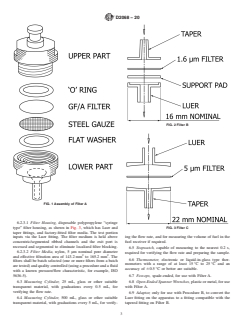
the filtration apparatus. Fig. 1 shows the assembly.
equations is applied. See Section 10, Calculation. See 5.6 for
6.2.1.2 Filter Media, glass fiber, 1.6 µm nominal pore
interpretation of results.
diameter, nominal 13 mm diameter and with an effective
2 2
filtration area of 63.6 mm to 78.6 mm . Filter media shall be
4. Summary of Test Method
batch selected to have a Gurley time (ISO 5636-5) of between
4.1 A test portion of the fuel to be analysed is passed at a
12.5 s and 13.4 s for 300 mL.
constant rate of flow (20 mL/min) through a specified filter
6.2.2 Filter B, for Procedure B.
medium. The pressure difference across the filter, and the
6.2.2.1 Filter Housing, disposable polypropylene “syringe
volume of fuel passing the filter, are monitored until the
type” with Luer and taper fittings, and factory-fitted filter
pressure reaches 105 kPa or the volume of fuel passing the
media. The filter, as shown in Fig. 2, is used with an adaptor
filter medium reaches 300 mL. The pressure (see 3.1.2.1) and
(6.9) to allow the test portion to input through the taper fitting
flow are then used to calculate the filter blocking tendency,
and exit from the Luer fitting. The filter medium is supported
where a low number indicates a good fuel (see 5.6).
by a coarse glass-fiber support pad as shown in Fig. 2. Filters
4.2 The glass fiber filters specified for Procedures A and B fitted with additional pre-filtration are not permitted and can
affect FBT results.
are both 1.6 µm nominal pore diameter; Filter B is a pre-
assembled encapsulated type. 6.2.2.2 Filter Media, glass fiber grade GF/A, 1.6 µm nomi-
nal pore diameter and effective filtration area of 95.0 mm to
4.3 Thepre-assemblednylonfilterspecifiedforProcedureC
113.1 mm . The filters shall be batch selected (one or more
hasa5µm nominal pore diameter.
filters from a batch are tested) and quality controlled (using a
5. Significance and Use
procedure and a fluid with a known pressure/flow
characteristic, for example, ISO 5636-5) for equivalence with
5.1 This test method is intended for use in evaluating the
the assembled Filter A.
cleanliness of middle distillate fuels, and biodiesel and bio-
6.2.3 Filter C, for Procedure C.
diesel blends for specifications and quality control purposes.
5.2 The filter media specified in the three procedures are all
suitableforthematerialsintheScope.Specificationscallingup 5
The sole source of supply of the Filter A housing, known to the committee at
this time is Millipore Cat No XX3001200, available from Millipore Corporation
this test method should state the procedure required.
Headquarters, 290 Concord Road, Billerica, MA 01821. If you are aware of
5.3 A change in filtration performance after storage or
alternative suppliers, please supply this information to ASTM International Head-
quarters. Your comments will receive careful consideration by a meeting of the
pretreatment can be indicative of changes of fuel condition.
responsible technical committee, which you may attend.
5.4 The filterability of fuels varies depending on filter
Whatman Grade GF/A, has been found satisfactory for this purpose.
The following equipment, as listed in RRSR: IP387/07 (see Footnote 10), was
porosity and structure and therefore results from this test
used to develop the precision statements; Seta MFT Multi Filtration Tester part
method might not correlate with full-scale filtration.
number 91600, Filter capsule “B” part number 91616-001 and Filter capsule “C”
part number 91620. Stanhope-Seta, Chertsey, Surrey, KT16 8AP, UK.This is not an
This adjunct has been withdrawn and is no longer available. endorsement or certification by ASTM.
D2068 − 20
FIG. 2 Filter B
FIG. 1 Assembly of Filter A
6.2.3.1 Filter Housing, disposable polypropylene “syringe
type” filter housing, as shown in Fig. 3, which has Luer and FIG. 3 Filter C
taper fittings, and factory-fitted filter media. The test portion
inputs via the Luer fitting. The filter medium is held above ing the flow rate, and for measuring the volume of fuel in the
concentric/segmented ribbed channels and the exit port is fuel receiver if required.
recessed and segmented to eliminate localized filter blocking.
6.5 Stopwatch, capable of measuring to the nearest 0.2 s,
6.2.3.2 Filter Media, nylon, 5 µm nominal pore diameter
required for verifying the flow rate and preparing the sample.
2 2
and effective filtration area of 143.2 mm to 165.2 mm . The
6.6 Thermometer, electronic or liquid-in-glass type ther-
filters shall be batch selected (one or more filters from a batch
mometers with a range of at least 15 °C to 25 °C and an
aretested)andqualitycontrolled(usingaprocedureandafluid
accuracy of 60.5 °C or better are suitable.
with a known pressure/flow characteristic, for example, ISO
5636-5). 6.7 Forceps, spade-ended, for use with Filter A.
6.3 Measuring Cylinder, 25 mL, glass or other suitable 6.8 Open-Ended Spanner Wrenches,plasticormetal,foruse
transparent material, with graduations every 0.5 mL, for with Filter A.
verifying the flow rate.
6.9 Adaptor, only for use with Procedure B, to convert the
6.4 Measuring Cylinder, 500 mL, glass or other suitable Luer fitting on the apparatus to a fitting compatible with the
transparent material, with graduations every 5 mL, for verify- tapered fitting on Filter B.
D2068 − 20
6.10 Anti-Splash Tubing, nylon or silicone rubber, approxi- grid pattern uppermost. The open-ended spanner wrenches
mately 4 mm inner diameter for Filters A and C, and 6 mm (6.8) may be used to assist in assembling or disassembling the
inner diameter for Filter B, to reduce splashing of the sample housing. Attach a suitable length (typically 80 mm to 90 mm)
in the fuel receiver beaker. of anti-splash tubing (6.10) to the outlet of the filter assembly.
NOTE 3—It is most important that the filter unit components are
7. Sampling
assembled in the exact configuration shown in Fig. 1.
7.1 Unless otherwise specified, samples shall be obtained in
NOTE 4—Over- or under-tightening of the FilterAassembly can lead to
accordance with Practices D4057, D4177, or other comparable erroneous results.
sampling practices.
8.4.2 Filter B (for Procedure B)—Attach a suitable length
7.1.1 Containers shall have been previously flushed three
(typically 80 mm to 90 mm) of anti-splash tubing (6.10)tothe
times with the product to be sampled.
outlet of the filter assembly.
7.2 Obtain at least 400 mLof a representative aliquot of the
8.4.2.1 Attach the adaptor (6.9) to the Luer fitting on the
sample to be tested in an epoxy-lined can or dark glass bottle. outlet of the apparatus.
8.4.3 Filter C (for Procedure C)—Attach a suitable length
7.3 If any undissolved water is visually apparent (as deter-
(typically 80 mm to 90 mm) of anti-splash tubing (6.10)tothe
mined by Test Method D4176 or D4860), discard and replace
outlet of the filter assembly.
with a fresh sample.
8.5 Rinse the fuel reservoir beaker with some of the product
8. Preparation of Apparatus
to be tested, and discard.
8.1 Verification:
8.6 Remove the adaptor if Procedure A or C is to be used.
8.1.1 Pressure and Temperature—Follow the manufactur-
er’s instructions for verifying that the pressure and temperature
9. Procedures A, B, and C
readings are in accordance with the tolerances given in A1.1.3
and 6.6, respectively. Verify the pressure reading, at ambient 9.1 General—Unless otherwise specified or required in
atmospheric pressure (0 kPa) and at approximately 100 kPa, at
9.1.7, the test specimen shall be prepared as described in 9.1.1
least every six months or if the apparatus has not been used for – 9.1.6.
the previous three months. Verify the temperature reading is
9.1.1 Measure the temperature (6.6) of the fuel in the
correct, at ambient temperature, at least every twelve months.
container, and adjust to 15 °C to 25 °C if necessary.
If the readings do not meet the specified tolerances in A1.1.3
9.1.2 Shake the fuel container vigorously for 120 s 65s,
and 6.6, calibrate the sensors (8.2.1).
and then allow to stand on a vibration-free surface for 300 s 6
8.1.2 Flow Rate—Follow the manufacturer’s instructions
15 s.
for verifying that the flow rate is 20 mL 6 1 mL/min through
9.1.3 Place at least 350 mL of the sample into the fuel
a filter assembly. The flow rate is verified by measuring the
reservoir beaker and check that the temperature (6.6) is still
volume pumped during a 15 min period, at least once a month,
within the range of 15 °C to 25 °C. Record the actual tempera-
using a suitable measuring cylinder (6.4). If the measured
ture. If any undissolved water is apparent in the fuel at this
volumeisbetween285 mLand315mLtheflowrateiscorrect.
stage, abandon the test and report the presence of water.
More frequent checks on the flow rate may be made by
9.1.4 Place the pump suction pipe into the reservoir beaker
measuring the volume during a 1 min period using a 25 mL
andrunthepump.Flushthesystemthroughwiththesampleby
measuring cylinder (6.3). If the measured volume is not
allowing approximately 20 mL of the sample to flow into the
between 19 mL and 21 mL, calibrate the pump (8.2.2).
receiver beaker. Stop the pump and discard any fuel from the
8.2 Calibration: fuel receiver beaker.
8.2.1 Pressure and Temperature—Follow the manufactur-
9.1.5 Testfuelshavinganextremelyhighblockingtendency
er’s instructions to calibrate the pressure at atmospheric pres- can cause the pressure reading to rise so rapidly at the
sure (0 kPa) and approximately 100 kPa, and temperature-
beginning of the test that the initial pressure requirement
measuring device at ambient temperature. cannot be met. If this is found to be the case after checking the
8.2.2 Flow Rate—Follow the manufacturer’s instructions to
pump and filter units, the requirement may be ignored, and this
set and lock the mechanical flow adjustment control on the fact reported in the form described in 11.2.
pump to give a flow rate of 20 mL 6 1 mL/min.
9.1.6 Usethestopwatchanda500mLmeasuringcylinderif
8.2.2.1 Afilter assembly shall be fitted when the flow rate is
the apparatus is not automated.
calibrated.
9.1.7 Samples subjected to specific pretreatment, that may
be specified in other test methods or procedures, shall follow
8.3 Apparatus Assembly—Assemble the apparatus as shown
the prescribed instructions, particularly the temperature
in Fig. A1.1, without the filter unit connected.
requirements, sample mixing, and flushing of the system. The
8.4 Filter Assembly—Assemble the filter appropriate to the
precision of this test method may not apply in such circum-
test procedure specified.
stances.
8.4.1 Filter
...
This document is not an ASTM standard and is intended only to provide the user of an ASTM standard an indication of what changes have been made to the previous version. Because
it may not be technically possible to adequately depict all changes accurately, ASTM recommends that users consult prior editions as appropriate. In all cases only the current version
of the standard as published by ASTM is to be considered the official document.
Designation: D2068 − 17 D2068 − 20
Standard Test Method for
Determining Filter Blocking Tendency
This standard is issued under the fixed designation D2068; the number immediately following the designation indicates the year of
original adoption or, in the case of revision, the year of last revision. A number in parentheses indicates the year of last reapproval. A
superscript epsilon (´) indicates an editorial change since the last revision or reapproval.
INTRODUCTION
This test method describes three procedures using different filter media. The result of any test is
dependent on the filter mandated in the procedure. If a specification requires a specific D2068
procedure, do not substitute a different procedure or filter without agreement from the specifier.
1. Scope*
1.1 This test method covers three procedures for the determination of the filter blocking tendency (FBT) and filterability of middle
distillate fuel oils and liquid fuels such as biodiesel and biodiesel blends. The three procedures and associated filter types are
2 2
applicable to fuels within the viscosity range of 1.3 mm to 6.0 mm6.0 mm /s at 40 °C.
NOTE 1—ASTM specification fuels falling within the scope of this test method are: Specification D396 Grades No 1 and 2; Specification D975 Grades
1-D, low sulfur 1-D and 2-D; Specification D2880 Grades 1-GT and 2-GT; Specification D6751.
1.2 This test method is not applicable to fuels that contain free (undissolved) water (see 7.3).
1.3 The values stated in SI units are to be regarded as standard. No other units of measurement are included in this standard.
1.4 This standard does not purport to address all of the safety concerns, if any, associated with its use. It is the responsibility
of the user of this standard to establish appropriate safety safety, health, and healthenvironmental practices and determine the
applicability of regulatory limitations prior to use.
1.5 This international standard was developed in accordance with internationally recognized principles on standardization
established in the Decision on Principles for the Development of International Standards, Guides and Recommendations issued
by the World Trade Organization Technical Barriers to Trade (TBT) Committee.
2. Referenced Documents
2.1 ASTM Standards:
D396 Specification for Fuel Oils
D975 Specification for Diesel Fuel
D2880 Specification for Gas Turbine Fuel Oils
D4057 Practice for Manual Sampling of Petroleum and Petroleum Products
D4176 Test Method for Free Water and Particulate Contamination in Distillate Fuels (Visual Inspection Procedures)
This test method is under the jurisdiction of ASTM Committee D02 on Petroleum Products, Liquid Fuels, and Lubricants and is the direct responsibility of Subcommittee
D02.14 on Stability Stability, Cleanliness and CleanlinessCompatibility of Liquid Fuels.
Current edition approved May 1, 2017Oct. 1, 2020. Published June 2017October 2020. Originally approved in 1997. Last previous edition approved in 20142017 as
D2068 – 14.D2068 – 17. DOI: 10.1520/D2068-17.10.1520/D2068-20.
For referenced ASTM standards, visit the ASTM website, www.astm.org, or contact ASTM Customer Service at service@astm.org. For Annual Book of ASTM Standards
volume information, refer to the standard’s Document Summary page on the ASTM website.
*A Summary of Changes section appears at the end of this standard
Copyright © ASTM International, 100 Barr Harbor Drive, PO Box C700, West Conshohocken, PA 19428-2959. United States
D2068 − 20
D4177 Practice for Automatic Sampling of Petroleum and Petroleum Products
D4860 Test Method for Free Water and Particulate Contamination in Middle Distillate Fuels (Clear and Bright Numerical
Rating)
D6300 Practice for Determination of Precision and Bias Data for Use in Test Methods for Petroleum Products, Liquid Fuels, and
Lubricants
D6426 Test Method for Determining Filterability of Middle Distillate Fuel Oils
D6708 Practice for Statistical Assessment and Improvement of Expected Agreement Between Two Test Methods that Purport
to Measure the Same Property of a Material
D6751 Specification for Biodiesel Fuel Blend Stock (B100) for Middle Distillate Fuels
2.2 ISO Standard:
ISO 5636-5 Paper and Board—Determination of Air Permeance and Air Resistance (Medium Range) Part 5 Gurley Method
2.3 ASTM Adjuncts:
D2PP, Determination of Precision and Bias Data for Use in Test Methods for Petroleum Products
CompTM, Standard Practice for Statistical Assessment and Improvement of the Expected Agreement between Two Test
Methods that Purport to Measure the Same Property of a Material
3. Terminology
3.1 Definitions of Terms Specific to This Standard:
3.1.1 filterability, n—of certain fuels, the relationship between the volume of sample filtered and the measured pressure increase
across the filter.
3.1.1.1 Discussion—
The filterability of the fuel can be assessed by recording the pressure when a specific volume of fuel has flowed through the filter,
or recording the volume when a specific pressure across the filter has been achieved. This assessment may be assisted by plotting
a volume versus pressure graph. See Appendix X1.
3.1.2 filter blocking tendency (FBT), n—of certain fuels, a calculated dimensionless value that defines the tendency of particulates
in a fuel to plug or block a filter.
3.1.2.1 Discussion—
The value is calculated using the pressure across the filter or the volume of fuel filtered at the end of the test. Depending on the
outcome of the test, one of two equations is applied. See Section 10, Calculation. See 5.6 for interpretation of results.
4. Summary of Test Method
4.1 A test portion of the fuel to be analysed is passed at a constant rate of flow (20 mL/min) through a specified filter medium.
The pressure difference across the filter, and the volume of fuel passing the filter, are monitored until the pressure reaches 105 kPa
or the volume of fuel passing the filter medium reaches 300 mL. The pressure (see 3.1.2.1) and flow are then used to calculate the
filter blocking tendency, where a low number indicates a good fuel (see 5.6).
4.2 The glass fiber filters specified for Procedures A and B are both 1.6 μm nominal pore diameter; Filter B is a pre-assembled
encapsulated type.
4.3 The pre-assembled nylon filter specified for Procedure C has a 5 μm nominal pore diameter.
5. Significance and Use
5.1 This test method is intended for use in evaluating the cleanliness of middle distillate fuels, and biodiesel and biodiesel blends
for specifications and quality control purposes.
5.2 The filter media specified in the three procedures are all suitable for the materials in the Scope. Specifications calling up this
test method should state the procedure required.
5.3 A change in filtration performance after storage or pretreatment can be indicative of changes of fuel condition.
Available from American National Standards Institute (ANSI), 25 W. 43rd St., 4th Floor, New York, NY 10036, http://www.ansi.org.
This adjunct has been withdrawn and is no longer available.
D2068 − 20
5.4 The filterability of fuels varies depending on filter porosity and structure and therefore results from this test method might not
correlate with full-scale filtration.
5.5 Causes of poor filterability in industrial/refinery filters include fuel degradation products, contaminants (including water)
picked up during storage or transfer, effects due to temperature or composition for bio fuels, incompatibility of commingled fuels,
or interaction of the fuel with the filter media. Any of these could correlate with orifice or filter system plugging, or both.
5.6 The results of the FBT test can range from 1 with a fuel with very good filterability, to over 100 for a fuel with poor filterability.
The selection of a single FBT number to define a pass or fail criteria is not possible as this will be dependent on the fuel type and
applications.
6. Apparatus
6.1 General—The apparatus, as described in Annex A1 and shown in Fig. A1.1, is available as a manufactured unit or can be
constructed from individual components.
6.2 Filter Media and Assemblies:
NOTE 2—Effective filtration areas were determined by measuring the diameter of the sediment in the centre of the filter media.
6.2.1 Filter A, for Procedure A.
6.2.1.1 Filter Housing, stainless steel, nominal 13 mm diameter with a Luer fitting at the top where it connects with the filtration
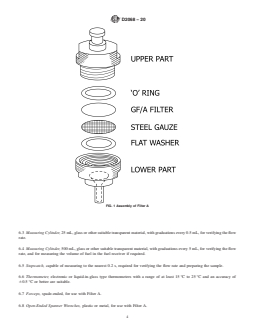
apparatus. Fig. 1 shows the assembly.
6.2.1.2 Filter Media, glass fiber, 1.6 μm nominal pore diameter, nominal 13 mm diameter and with an effective filtration area of
2 2
63.6 mm to 78.6 mm . Filter media shall be batch selected to have a Gurley time (ISO 5636-5) of between 12.5 s and 13.4 s for
300 mL.
6.2.2 Filter B, for Procedure B.
6.2.2.1 Filter Housing, disposable polypropylene “syringe type” with Luer and taper fittings, and factory-fitted filter media. The
filter, as shown in Fig. 2, is used with an adaptor (6.9) to allow the test portion to input through the taper fitting and exit from the
Luer fitting. The filter medium is supported by a coarse glass-fiber support pad as shown in Fig. 2. Filters fitted with additional
pre-filtration are not permitted and can affect FBT results.
2 2
6.2.2.2 Filter Media, glass fiber grade GF/A, 1.6 μm nominal pore diameter and effective filtration area of 95.0 mm to 113.1 mm .
The filters shall be batch selected (one or more filters from a batch are tested) and quality controlled (using a procedure and a fluid
with a known pressure/flow characteristic, for example, ISO 5636-5) for equivalence with the assembled Filter A.
6.2.3 Filter C, for Procedure C.
6.2.3.1 Filter Housing, disposable polypropylene “syringe type” filter housing, as shown in Fig. 3, which has Luer and taper
fittings, and factory-fitted filter media. The test portion inputs via the Luer fitting. The filter medium is held above
concentric/segmented ribbed channels and the exit port is recessed and segmented to eliminate localized filter blocking.
2 2
6.2.3.2 Filter Media, nylon, 5 μm nominal pore diameter and effective filtration area of 143.2 mm to 165.2 mm . The filters shall
be batch selected (one or more filters from a batch are tested) and quality controlled (using a procedure and a fluid with a known
pressure/flow characteristic, for example, ISO 5636-5).
The sole source of supply of the Filter A housing, known to the committee at this time is Millipore Cat No XX3001200, available from Millipore Corporation
Headquarters, 290 Concord Road, Billerica, MA 01821. If you are aware of alternative suppliers, please supply this information to ASTM International Headquarters. Your
comments will receive careful consideration by a meeting of the responsible technical committee, which you may attend.
Whatman Grade GF/A, has been found satisfactory for this purpose.
The following equipment, as listed in RRSR: IP 387/07 (see Footnote 10), was used to develop the precision statements; Seta MFT Multi Filtration Tester part number
91600, Filter capsule “B” part number 91616-001 and Filter capsule “C” part number 91620. Stanhope-Seta, Chertsey, Surrey, KT16 8AP, UK. This is not an endorsement
or certification by ASTM.
D2068 − 20
FIG. 1 Assembly of Filter A
6.3 Measuring Cylinder, 25 mL, glass or other suitable transparent material, with graduations every 0.5 mL, for verifying the flow
rate.
6.4 Measuring Cylinder, 500 mL, glass or other suitable transparent material, with graduations every 5 mL, for verifying the flow
rate, and for measuring the volume of fuel in the fuel receiver if required.
6.5 Stopwatch, capable of measuring to the nearest 0.2 s, required for verifying the flow rate and preparing the sample.
6.6 Thermometer, electronic or liquid-in-glass type thermometers with a range of at least 15 °C to 25 °C and an accuracy of
60.5 °C or better are suitable.
6.7 Forceps, spade-ended, for use with Filter A.
6.8 Open-Ended Spanner Wrenches, plastic or metal, for use with Filter A.
D2068 − 20
FIG. 2 Filter B
FIG. 3 Filter C
6.9 Adaptor, only for use with Procedure B, to convert the Luer fitting on the apparatus to a fitting compatible with the tapered
fitting on Filter B.
6.10 Anti-Splash Tubing, nylon or silicone rubber, approximately 4 mm inner diameter for Filters A and C, and 6 mm inner
diameter for Filter B, to reduce splashing of the sample in the fuel receiver beaker.
7. Sampling
7.1 Unless otherwise specified, samples shall be obtained in accordance with Practices D4057, D4177, or other comparable
sampling practices.
7.1.1 Containers shall have been previously flushed three times with the product to be sampled.
D2068 − 20
7.2 Obtain at least 400 mL of a representative aliquot of the sample to be tested in an epoxy-lined can or dark glass bottle.
7.3 If any undissolved water is visually apparent (as determined by Test Method D4176 or D4860), discard and replace with a
fresh sample.
8. Preparation of Apparatus
8.1 Verification:
8.1.1 Pressure and Temperature—Follow the manufacturer’s instructions for verifying that the pressure and temperature readings
are in accordance with the tolerances given in A1.1.3 and 6.6, respectively. Verify the pressure reading, at ambient atmospheric
pressure (0 kPa) and at approximately 100 kPa, at least every six months or if the apparatus has not been used for the previous
three months. Verify the temperature reading is correct, at ambient temperature, at least every twelve months. If the readings do
not meet the specified tolerances in A1.1.3 and 6.6, calibrate the sensors (8.2.1).
8.1.2 Flow Rate—Follow the manufacturer’s instructions for verifying that the flow rate is 20 mL 6 1 mL/min through a filter
assembly. The flow rate is verified by measuring the volume pumped during a 15 min period, at least once a month, using a suitable
measuring cylinder (6.4). If the measured volume is between 285 mL and 315 mL the flow rate is correct. More frequent checks
on the flow rate may be made by measuring the volume during a 1 min period using a 25 mL measuring cylinder (6.3). If the
measured volume is not between 19 mL and 21 mL, calibrate the pump (8.2.2).
8.2 Calibration:
8.2.1 Pressure and Temperature—Follow the manufacturer’s instructions to calibrate the pressure at atmospheric pressure (0 kPa)
and approximately 100 kPa, and temperature-measuring device at ambient temperature.
8.2.2 Flow Rate—Follow the manufacturer’s instructions to set and lock the mechanical flow adjustment control on the pump to
give a flow rate of 20 mL 6 1 mL/min.
8.2.2.1 A filter assembly shall be fitted when the flow rate is calibrated.
8.3 Apparatus Assembly—Assemble the apparatus as shown in Fig. A1.1, without the filter unit connected.
8.4 Filter Assembly—Assemble the filter appropriate to the test procedure specified.
8.4.1 Filter A (for Procedure A)—Assemble the filter as shown in Fig. 1 using a new filter medium handled with the forceps (6.7),
taking care not to damage the filter medium. Place the medium into the holder with the face marked with a grid pattern uppermost.
The open-ended spanner wrenches (6.8) may be used to assist in assembling or disassembling the housing. Attach a suitable length
(typically 80 mm to 90 mm) of anti-splash tubing (6.10) to the outlet of the filter assembly.
NOTE 3—It is most important that the filter unit components are assembled in the exact configuration shown in Fig. 1.
NOTE 4—Over- or under-tightening of the Filter A assembly can lead to erroneous results.
8.4.2 Filter B (for Procedure B)—Attach a suitable length (typically 80 mm to 90 mm) of anti-splash tubing (6.10) to the outlet
of the filter assembly.
8.4.2.1 Attach the adaptor (6.9) to the Luer fitting on the outlet of the apparatus.
8.4.3 Filter C (for Procedure C)—Attach a suitable length (typically 80 mm to 90 mm) of anti-splash tubing (6.10) to the outlet
of the filter assembly.
8.5 Rinse the fuel reservoir beaker with some of the product to be tested, and discard.
8.6 Remove the adaptor if Procedure A or C is to be used.
D2068 − 20
9. Procedures A, B, and C
9.1 General—Unless otherwise specified or required in 9.1.7, the test specimen shall be prepared as described in 9.1.1 – 9.1.6.
9.1.1 Measure the temperature (6.6) of the fuel in the container, and adjust to 15 °C to 25 °C if necessary.
9.1.2 Shake the fuel container vigorously for 120 s 6 5 s, and then allow to stand on a vibration-free surface for 300 s 6 15 s.
9.1.3 Place at least 350 mL of the sample into the fuel reservoir beaker and check that the temperature (6.6) is still within the range
of 15 °C to 25 °C. Record the actual temperature. If any undissolved water is apparent in the fuel at this stage, abandon the test
and report the presence of water.
9.1.4 Place the pump suction pipe into the reservoir beaker and run the pump. Flush the system through with the sample by
allowing approximately 20 mL of the sample to flow into the receiver beaker. Stop the pump and discard any fuel from the fuel
receiver beaker.
9.1.5 Test fuels having an extremely high blocking tendency can cause the pressure reading to rise so rapidly at the beginning of
the test that the initial pressure requirement cannot be met. If this is found to be the case after checking the pump and filter units,
the requirement may be ignored, and this fact reported in the form described in 11.2.
9.1.6 Use the stopwatch and a 500 mL measuring cylinder if the apparatus is not automated.
9.1.7 Samples subjected to sp
...