

ASTM D943-20
(Test Method)Standard Test Method for Oxidation Characteristics of Inhibited Mineral Oils
General Information
- Abstract
SIGNIFICANCE AND USE
5.1 This test method is widely used for specification purposes and is considered of value in estimating the oxidation stability of lubricants, especially those that are prone to water contamination. It should be recognized, however, that correlation between results of this method and the oxidation stability of a lubricant in field service may vary markedly with field service conditions and with various lubricants. The precision statement for this method was determined on steam turbine oils.
Note 1: Furthermore, in the course of testing a lubricant by this method, other signs of deterioration, such as sludge formation or catalyst coil corrosion, may appear that are not reflected in the calculated oxidation lifetime. The subcommittee responsible for this method is investigating the application of alternative criteria for evaluation of lubricants using this test apparatus. Test Method D4310 is now available for sludge measurement.
SCOPE
1.1 This test method covers the evaluation of the oxidation stability of inhibited steam-turbine oils in the presence of oxygen, water, and copper and iron metals at an elevated temperature. This test method is limited to a maximum testing time of 10 000 h. This test method is also used for testing other oils, such as hydraulic oils and circulating oils having a specific gravity less than that of water and containing rust and oxidation inhibitors.
1.2 The values stated in SI units are to be regarded as standard. No other units of measurement are included in this standard.
1.2.1 Exception—The values in parentheses in the figures are provided for information for those using old equipment based on non-SI units.
1.3 WARNING—Mercury has been designated by many regulatory agencies as a hazardous substance that can cause serious medical issues. Mercury, or its vapor, has been demonstrated to be hazardous to health and corrosive to materials. Use Caution when handling mercury and mercury-containing products. See the applicable product Safety Data Sheet (SDS) for additional information. The potential exists that selling mercury or mercury-containing products, or both, is prohibited by local or national law. Users must determine legality of sales in their location.
1.4 This standard does not purport to address all of the safety concerns, if any, associated with its use. It is the responsibility of the user of this standard to establish appropriate safety, health, and environmental practices and determine the applicability of regulatory limitations prior to use. For specific warning statements, see Section 7.
1.5 This international standard was developed in accordance with internationally recognized principles on standardization established in the Decision on Principles for the Development of International Standards, Guides and Recommendations issued by the World Trade Organization Technical Barriers to Trade (TBT) Committee.
- Status
- Published
- Publication Date
- 31-May-2020
- Technical Committee
- D02 - Petroleum Products, Liquid Fuels, and Lubricants
- Drafting Committee
- D02.09.0C - Oxidation of Turbine Oils
Overview
ASTM D943-20: Standard Test Method for Oxidation Characteristics of Inhibited Mineral Oils specifies a laboratory procedure for evaluating the oxidation stability of inhibited mineral oils, such as steam-turbine oils, in the presence of oxygen, water, and metal catalysts at elevated temperatures. The test is essential for assessing the resistance of lubricating oils to oxidation, an important factor in predicting product performance, maintenance schedules, and overall asset protection. This method is especially relevant for lubricants prone to water contamination and ensures compliance with specification requirements set by manufacturers and end-users.
Key Topics
- Oxidation Stability Assessment: The standard determines how well inhibited mineral oils, especially turbine, hydraulic, and circulating oils, resist oxidation - a key factor influencing lubricant service life and reliability.
- Test Parameters: Samples are exposed to oxygen, water, and iron and copper catalysts at 95°C, simulating accelerated aging. The test continues up to 10,000 hours or until the acid number reaches 2.0 mg KOH/g.
- Acid Number Monitoring: Acid number, representing oil degradation, is used as the primary indicator. Periodic sampling ensures accurate tracking of oxidation progress.
- Sample Applications: While originally developed for steam-turbine oils, the method is applicable to other inhibited mineral oils with a specific gravity less than water.
- Precision and Limitations: The method's repeatability and reproducibility are defined for a specific range and oil types. Actual field performance may differ due to operating conditions and oil formulations.
- Safety and Compliance: The standard provides comprehensive guidelines on apparatus handling, chemical safety (including mercury use), and regulatory adherence.
Applications
This test method serves a wide range of practical needs in the petroleum and lubricants industry:
- Turbine Oil Evaluation: Assesses the oxidation stability of steam-turbine and similar oils, supporting maintenance and performance prediction in power generation and industrial operations.
- Hydraulic and Circulating Oils: Enables suppliers and users to evaluate and compare inhibited hydraulic and circulating oils, helping ensure compliance with OEM and industry standards.
- Product Formulation and Quality Control: Assists manufacturers in designing and verifying oil formulations with adequate resistance to oxidation, critical for warranties and customer satisfaction.
- Contamination Resistance: Especially valuable for lubricants exposed to water, providing insight into how oils maintain performance in harsh service conditions.
- Asset Protection and Service Life Prediction: Facilitates proactive maintenance planning by predicting lubricant longevity before in-service degradation occurs.
- Regulatory and Specification Compliance: Supports procurement and supply chain operations by ensuring oils meet defined oxidation stability criteria.
Related Standards
To achieve a comprehensive evaluation of lubricating oil performance, ASTM D943-20 should be referenced alongside these related standards:
- ASTM D664: Test Method for Acid Number of Petroleum Products by Potentiometric Titration
- ASTM D4310: Test Method for Determination of Sludging and Corrosion Tendencies of Inhibited Mineral Oils
- ASTM D4057: Practice for Manual Sampling of Petroleum and Petroleum Products
- ASTM D3244: Practice for Utilization of Test Data to Determine Conformance with Specifications
- ASTM D5770, D3339: Methods for Acid Number Determination during Oxidation Testing
These standards provide unified protocols for lubricant sampling, testing, and evaluation, supporting robust quality management throughout the lubricant lifecycle.
Keywords: oxidation stability, inhibited mineral oils, turbine oil, hydraulic oil, oxidative degradation, acid number, ASTM D943, lubricant testing, asset protection, lubricant life prediction, oil quality control.
Relations
- Effective Date
- 01-Jan-2020
- Effective Date
- 01-May-2019
- Effective Date
- 01-Oct-2018
- Effective Date
- 01-May-2017
- Effective Date
- 01-Oct-2013
- Effective Date
- 01-May-2013
- Effective Date
- 15-Nov-2012
- Effective Date
- 01-Nov-2012
- Effective Date
- 01-Nov-2012
- Effective Date
- 15-Apr-2012
- Refers
ASTM D4057-06(2011) - Standard Practice for Manual Sampling of Petroleum and Petroleum Products - Effective Date
- 01-Jun-2011
- Effective Date
- 15-May-2011
- Effective Date
- 15-May-2011
- Effective Date
- 15-May-2011
- Effective Date
- 01-Oct-2009
Get Certified
Connect with accredited certification bodies for this standard

Element Materials Technology
Materials testing and product certification.

ABS Group Brazil
ABS Group certification services in Brazil.

ABS Quality Evaluations Inc.
American Bureau of Shipping quality certification.
Sponsored listings
Frequently Asked Questions
ASTM D943-20 is a standard published by ASTM International. Its full title is "Standard Test Method for Oxidation Characteristics of Inhibited Mineral Oils". This standard covers: SIGNIFICANCE AND USE 5.1 This test method is widely used for specification purposes and is considered of value in estimating the oxidation stability of lubricants, especially those that are prone to water contamination. It should be recognized, however, that correlation between results of this method and the oxidation stability of a lubricant in field service may vary markedly with field service conditions and with various lubricants. The precision statement for this method was determined on steam turbine oils. Note 1: Furthermore, in the course of testing a lubricant by this method, other signs of deterioration, such as sludge formation or catalyst coil corrosion, may appear that are not reflected in the calculated oxidation lifetime. The subcommittee responsible for this method is investigating the application of alternative criteria for evaluation of lubricants using this test apparatus. Test Method D4310 is now available for sludge measurement. SCOPE 1.1 This test method covers the evaluation of the oxidation stability of inhibited steam-turbine oils in the presence of oxygen, water, and copper and iron metals at an elevated temperature. This test method is limited to a maximum testing time of 10 000 h. This test method is also used for testing other oils, such as hydraulic oils and circulating oils having a specific gravity less than that of water and containing rust and oxidation inhibitors. 1.2 The values stated in SI units are to be regarded as standard. No other units of measurement are included in this standard. 1.2.1 Exception—The values in parentheses in the figures are provided for information for those using old equipment based on non-SI units. 1.3 WARNING—Mercury has been designated by many regulatory agencies as a hazardous substance that can cause serious medical issues. Mercury, or its vapor, has been demonstrated to be hazardous to health and corrosive to materials. Use Caution when handling mercury and mercury-containing products. See the applicable product Safety Data Sheet (SDS) for additional information. The potential exists that selling mercury or mercury-containing products, or both, is prohibited by local or national law. Users must determine legality of sales in their location. 1.4 This standard does not purport to address all of the safety concerns, if any, associated with its use. It is the responsibility of the user of this standard to establish appropriate safety, health, and environmental practices and determine the applicability of regulatory limitations prior to use. For specific warning statements, see Section 7. 1.5 This international standard was developed in accordance with internationally recognized principles on standardization established in the Decision on Principles for the Development of International Standards, Guides and Recommendations issued by the World Trade Organization Technical Barriers to Trade (TBT) Committee.
SIGNIFICANCE AND USE 5.1 This test method is widely used for specification purposes and is considered of value in estimating the oxidation stability of lubricants, especially those that are prone to water contamination. It should be recognized, however, that correlation between results of this method and the oxidation stability of a lubricant in field service may vary markedly with field service conditions and with various lubricants. The precision statement for this method was determined on steam turbine oils. Note 1: Furthermore, in the course of testing a lubricant by this method, other signs of deterioration, such as sludge formation or catalyst coil corrosion, may appear that are not reflected in the calculated oxidation lifetime. The subcommittee responsible for this method is investigating the application of alternative criteria for evaluation of lubricants using this test apparatus. Test Method D4310 is now available for sludge measurement. SCOPE 1.1 This test method covers the evaluation of the oxidation stability of inhibited steam-turbine oils in the presence of oxygen, water, and copper and iron metals at an elevated temperature. This test method is limited to a maximum testing time of 10 000 h. This test method is also used for testing other oils, such as hydraulic oils and circulating oils having a specific gravity less than that of water and containing rust and oxidation inhibitors. 1.2 The values stated in SI units are to be regarded as standard. No other units of measurement are included in this standard. 1.2.1 Exception—The values in parentheses in the figures are provided for information for those using old equipment based on non-SI units. 1.3 WARNING—Mercury has been designated by many regulatory agencies as a hazardous substance that can cause serious medical issues. Mercury, or its vapor, has been demonstrated to be hazardous to health and corrosive to materials. Use Caution when handling mercury and mercury-containing products. See the applicable product Safety Data Sheet (SDS) for additional information. The potential exists that selling mercury or mercury-containing products, or both, is prohibited by local or national law. Users must determine legality of sales in their location. 1.4 This standard does not purport to address all of the safety concerns, if any, associated with its use. It is the responsibility of the user of this standard to establish appropriate safety, health, and environmental practices and determine the applicability of regulatory limitations prior to use. For specific warning statements, see Section 7. 1.5 This international standard was developed in accordance with internationally recognized principles on standardization established in the Decision on Principles for the Development of International Standards, Guides and Recommendations issued by the World Trade Organization Technical Barriers to Trade (TBT) Committee.
ASTM D943-20 is classified under the following ICS (International Classification for Standards) categories: 75.100 - Lubricants, industrial oils and related products. The ICS classification helps identify the subject area and facilitates finding related standards.
ASTM D943-20 has the following relationships with other standards: It is inter standard links to ASTM D4310-20, ASTM E2877-12(2019), ASTM B1-13(2018), ASTM D664-11a(2017), ASTM B1-13, ASTM E1-13, ASTM B1-12, ASTM E2877-12, ASTM E2877-12e1, ASTM D3339-12, ASTM D4057-06(2011), ASTM D3339-11, ASTM D664-11, ASTM D5770-11, ASTM D4310-09. Understanding these relationships helps ensure you are using the most current and applicable version of the standard.
ASTM D943-20 is available in PDF format for immediate download after purchase. The document can be added to your cart and obtained through the secure checkout process. Digital delivery ensures instant access to the complete standard document.
Standards Content (Sample)
This international standard was developed in accordance with internationally recognized principles on standardization established in the Decision on Principles for the
Development of International Standards, Guides and Recommendations issued by the World Trade Organization Technical Barriers to Trade (TBT) Committee.
Designation: D943 − 20 BS 2000-280:1999
Standard Test Method for
Oxidation Characteristics of Inhibited Mineral Oils
This standard is issued under the fixed designation D943; the number immediately following the designation indicates the year of
original adoption or, in the case of revision, the year of last revision. A number in parentheses indicates the year of last reapproval. A
superscript epsilon (´) indicates an editorial change since the last revision or reapproval.
This standard has been approved for use by agencies of the U.S. Department of Defense.
1. Scope* Development of International Standards, Guides and Recom-
mendations issued by the World Trade Organization Technical
1.1 This test method covers the evaluation of the oxidation
Barriers to Trade (TBT) Committee.
stability of inhibited steam-turbine oils in the presence of
oxygen, water, and copper and iron metals at an elevated
2. Referenced Documents
temperature. This test method is limited to a maximum testing
time of 10 000 h.This test method is also used for testing other 2.1 ASTM Standards:
oils,suchashydraulicoilsandcirculatingoilshavingaspecific A510 Specification for General Requirements forWire Rods
gravitylessthanthatofwaterandcontainingrustandoxidation and Coarse Round Wire, Carbon Steel (Metric) A0510_
inhibitors. A0510M
B1 Specification for Hard-Drawn Copper Wire
1.2 The values stated in SI units are to be regarded as
D664 Test Method for Acid Number of Petroleum Products
standard. No other units of measurement are included in this
by Potentiometric Titration
standard.
D1193 Specification for Reagent Water
1.2.1 Exception—The values in parentheses in the figures
D3244 Practice for Utilization of Test Data to Determine
are provided for information for those using old equipment
Conformance with Specifications
based on non-SI units.
D3339 Test Method forAcid Number of Petroleum Products
1.3 WARNING—Mercury has been designated by many
by Semi-Micro Color Indicator Titration
regulatory agencies as a hazardous substance that can cause
D4057 Practice for Manual Sampling of Petroleum and
serious medical issues. Mercury, or its vapor, has been dem-
Petroleum Products
onstrated to be hazardous to health and corrosive to materials.
D4310 Test Method for Determination of Sludging and
Use Caution when handling mercury and mercury-containing
Corrosion Tendencies of Inhibited Mineral Oils
products. See the applicable product Safety Data Sheet (SDS)
D5770 Test Method for Semiquantitative Micro Determina-
for additional information. The potential exists that selling
tion of Acid Number of Lubricating Oils During Oxida-
mercury or mercury-containing products, or both, is prohibited
tion Testing
by local or national law. Users must determine legality of sales
E1 Specification for ASTM Liquid-in-Glass Thermometers
in their location.
E2877 Guide for Digital Contact Thermometers
1.4 This standard does not purport to address all of the 3
2.2 Energy Institute Standards:
safety concerns, if any, associated with its use. It is the
Specifications for IP Standard Thermometers
responsibility of the user of this standard to establish appro-
2.3 British Standard:
priate safety, health, and environmental practices and deter-
BS 1829
mine the applicability of regulatory limitations prior to use.
For specific warning statements, see Section 7.
3. Terminology
1.5 This international standard was developed in accor-
dance with internationally recognized principles on standard- 3.1 Definitions:
ization established in the Decision on Principles for the
For referenced ASTM standards, visit the ASTM website, www.astm.org, or
This test method is under the jurisdiction of ASTM Committee D02 on contact ASTM Customer Service at service@astm.org. For Annual Book of ASTM
Petroleum Products, Liquid Fuels, and Lubricants and is the direct responsibility of Standards volume information, refer to the standard’s Document Summary page on
Subcommittee D02.09.0C on Oxidation of Turbine Oils. the ASTM website.
CurrenteditionapprovedJune1,2020.PublishedJuly2020.Originallyapproved Available from Energy Institute, 61 New Cavendish St., London, W1G 7AR,
in 1947. Last previous edition approved in 2019 as D943 – 19. DOI: 10.1520/ U.K., http://www.energyinst.org.
D0943-20. Available from British Standards Institution (BSI), 389 Chiswick High Rd.,
In 1976, this test method ceased to be a joint ASTM-IP standard. London W4 4AL, U.K., http://www.bsigroup.com.
*A Summary of Changes section appears at the end of this standard
Copyright © ASTM International, 100 Barr Harbor Drive, PO Box C700, West Conshohocken, PA 19428-2959. United States
D943 − 20
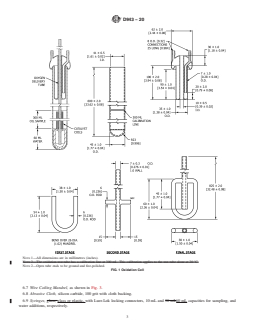
3.1.1 acid number, n—the quantity of a specified base, test cell from the sides is preferred. If a viewing window is
expressed in milligrams of potassium hydroxide per gram of included in the design, this viewing window shall be fitted with
sample, required to titrate a sample in a specified solvent to a a suitable opaque cover and be kept closed when no observa-
specified endpoint using a specified detection system. tion is being made.
6.2.1.2 If glass heating baths are used, the bath shall be
4. Summary of Test Method
wrapped with aluminum foil or other opaque material.
6.2.1.3 Bright light entering the test cell from directly
4.1 The oil sample is contacted with oxygen in the presence
overhead can be eliminated by use of an opaque shield.
of water and an iron-copper catalyst at 95 °C. The test
continues until the measured acid number of the oil is 2.0 mg
6.3 Flowmeter, with a capacity of at least 3 L⁄h of oxygen,
KOH/g or above. The number of test hours required for the oil
and an accuracy of 60.1 L⁄h.
to reach the measured acid number of 2.0 mg KOH/g is the
6.4 Heating Bath Thermometer—ASTM Solvents Distilla-
“oxidation lifetime.”
tion Thermometer having a range from 72 °C to 126 °C, and
conforming to the requirements for Thermometer 40C as
5. Significance and Use
prescribed in Specification E1, or for Thermometer 70C as
5.1 This test method is widely used for specification pur-
prescribed in Specifications for IP Standard Thermometers.
poses and is considered of value in estimating the oxidation
Alternatively,digitalcontactthermometerssuchasPRTs(plati-
stability of lubricants, especially those that are prone to water
num resistance thermometers), thermistors, or thermocouples
contamination. It should be recognized, however, that correla-
in accordance with Specification E2877 of equal or better
tion between results of this method and the oxidation stability
accuracy may be used.
of a lubricant in field service may vary markedly with field
6.5 Oxidation Cell Thermometer, having a range from
service conditions and with various lubricants. The precision
80 °C to 100 °C, graduated in 0.1 °C, total length—250 mm,
statement for this method was determined on steam turbine
stem diameter—6.0 mm to 7.0 mm, calibrated for 76 mm
oils.
6,7
immersion. Alternatively, digital contact thermometers such
NOTE 1—Furthermore, in the course of testing a lubricant by this
as PRTs, thermistors, or thermocouples in accordance with
method, other signs of deterioration, such as sludge formation or catalyst
Specification E2877 of equal or better accuracy may be used.
coilcorrosion,mayappearthatarenotreflectedinthecalculatedoxidation
lifetime. The subcommittee responsible for this method is investigating
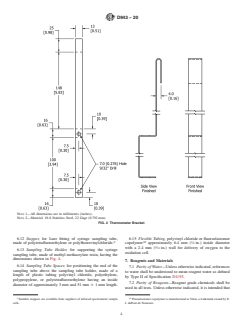
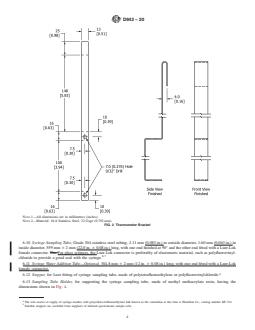
6.6 Thermometer Bracket—Optional, for holding the oxida-
theapplicationofalternativecriteriaforevaluationoflubricantsusingthis
tion cell thermometer, of 18-8 stainless steel, having the
test apparatus. Test Method D4310 is now available for sludge measure-
dimensions shown in Fig. 2. The thermometer is held in the
ment.
bracket by two fluoroelastomer O-rings of approximately
5 mm inside diameter. Alternatively, thin stainless steel wire
6. Apparatus
may be used.
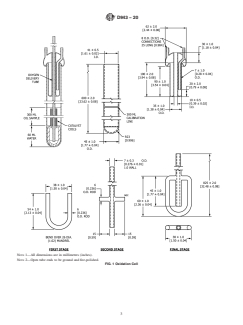
6.1 Oxidation Cell, of borosilicate glass, as shown in Fig. 1,
6.7 Wire Coiling Mandrel, as shown in Fig. 3.
consisting of a test tube, condenser, and oxygen delivery tube.
The test tube has a calibration line at 300 mL 6 1 mL. This
6.8 Abrasive Cloth, silicon carbide, 100 grit with cloth
calibration applies to the test tube alone using water at 20 °C.
backing.
6.2 Heating Bath, thermostatically controlled, capable of
6.9 Syringes, glass or plastic, with Luer-Lok locking
maintaining the oil sample in the oxidation cell at a tempera-
connectors, 10 mL and 60 mL capacities for sampling, and
ture of 95 °C 6 0.2 °C, fitted with a suitable stirring device to
water additions, respectively.
provide a uniform temperature throughout the bath, and large
6.10 Syringe Sampling Tube, Grade 304 stainless steel
enough to hold the desired number of oxidation cells immersed
tubing, 2.11 mm (0.083 in.) in outside diameter, 1.60 mm
in the heating bath to a depth of 390 mm 6 10 mm and in the
(0.063 in.) in inside diameter, 559 mm 6 2 mm (22.0 in. 6
heating liquid itself to a depth of 355 mm 6 10 mm.
0.08 in.) long, with one end finished at 90° and the other end
NOTE 2—Metal block heaters meeting the test method requirements
fittedwithaLuer-Lokfemaleconnector.Forglasssyringes,the
may also be used. It is not known what types of heating baths were used
Luer-Lok connector is preferably of elastomeric material, such
in developing the precision statement.
as polyfluorovinylchloride to provide a good seal with the
8,7
6.2.1 Studies have suggested that direct sunlight or artificial
syringe.
light may adversely influence the results of this test. To
6.11 Syringe Water Addition Tube—Optional, 304.8 mm 6
minimize effects of light exposure on the lubricant being
2 mm (12 in. 6 0.08 in.) long, with one end fitted with a
tested, light shall be excluded from the lubricant by one or
Luer-Lok female connector.
more of the following ways:
6.2.1.1 Use of heated liquid baths that are designed and
constructed of metal, or combinations of metals and other
The sole source of supply of the Brooklyn thermometer No. 21276-RM known
suitable opaque materials, that prevent light from entering the
to the committee at this time is the Brooklyn Thermometer Co., Farmingdale, NY.
If you are aware of alternative suppliers, please provide this information to
ASTM International Headquarters. Your comments will receive careful consider-
5 1
Supporting data (a summary of these results) have been filed at ASTM ation at a meeting of the responsible technical committee, which you may attend.
International Headquarters and may be obtained by requesting Research Report The sole source of supply of syringe needles with polychloro-trifluoroethylene
RR:D02-1365. Contact ASTM Customer Service at service@astm.org. hub known to the committee at this time is Hamilton Co., catalog number KF-714.
D943 − 20
NOTE 1—All dimensions are in millimetres (inches).
NOTE 2—Open tube ends to be ground and fire-polished.
FIG. 1 Oxidation Cell
D943 − 20
NOTE 1—All dimensions are in millimetres (inches).
NOTE 2—Material: 18-8 Stainless Steel, 22 Gage (0.792 mm).
FIG. 2 Thermometer Bracket
6.12 Stopper, for Luer fitting of syringe sampling tube, 6.15 Flexible Tubing, polyvinyl chloride or fluoroelastomer
9 10
made of polytetrafluoroethylene or polyfluorovinylchloride. copolymer approximately 6.4 mm ( ⁄4 in.) inside diameter
with a 2.4 mm ( ⁄32 in.) wall for delivery of oxygen to the
6.13 Sampling Tube Holder, for supporting the syringe
oxidation cell.
sampling tube, made of methyl methacrylate resin, having the
dimensions shown in Fig. 4.
7. Reagents and Materials
6.14 Sampling Tube Spacer, for positioning the end of the
7.1 Purity of Water—Unless otherwise indicated, references
sampling tube above the sampling tube holder, made of a
to water shall be understood to mean reagent water as defined
length of plastic tubing polyvinyl chloride, polyethylene,
by Type II of Specification D1193.
polypropylene, or polytetrafluoroethylene having an inside
7.2 Purity of Reagents—Reagent grade chemicals shall be
diameter of approximately 3 mm and 51 mm 6 1 mm length.
used in all tests. Unless otherwise indicated, it is intended that
9 10
Suitable stoppers are available from suppliers of infrared spectrometer sample Fluroelastomer copolymer is manufactured as Viton, a trademark owned by E.
cells. I. duPont de Nemours.
D943 − 20
NOTE 1—Dimensions are in millimetres (inches).
FIG. 3 Mandrel for Winding Catalyst Coils
D943 − 20
NOTE 1—Dimensions are in millimetres (inches).
FIG. 4 Sampling Tube Holder
all reagents conform to the specifications of the Committee on 7.3 Acetone, reagent grade. (Warning—Health hazard;
Analytical Reagents of the American Chemical Society where flammable.)
such specifications are available. Other grades may be used,
7.4 Catalyst Wires:
provided it is first ascertained that the reagent is of sufficiently 12
7.4.1 Low-Metalloid Steel Wire, 1.59 mm in diameter (No.
high purity to permit its use without lessening the accuracy of
16 Washburn and Moen Gage).
the determination.
7.4.2 Electrolytic Copper Wire, 1.63 mm in diameter (No.
16 Imperial Standard Wire Gage or No. 14 American Wire
ACS Reagent Chemicals, Specifications and Procedures for Reagents and
Standard-Grade Reference Materials, American Chemical Society, Washington, Carbon steel wire, soft bright annealed and free from rust, of Grade 1008 as
DC. For suggestions on the testing of reagents not listed by theAmerican Chemical described in Specification A510 is satisfactory. Similar wire conforming to BS 1829
Society, see Analar Standards for Laboratory Chemicals, BDH Ltd., Poole, Dorset, is also satisfactory. If these steels are not available, other equivalent steels may be
U.K., and the United States Pharmacopeia and National Formulary, U.S. Pharma- used, provided they are found to be satisfactory in comparative tests using Test
copeial Convention, Inc. (USPC), Rockville, MD. Method D943.
D943 − 20
of the same wire are 3.96 mm to 4.22 mm apart, center to center. The
Gage), 99.9 % purity, conforming to Specification B1. Soft
mandrel shown in Fig. 3 is designed to produce such a coil. Using this
copper wire of an equivalent grade may also be used.
mandrel, the iron wire is wound on a thread of 14.98 mm diameter, while
NOTE 3—Alternatively, suitably prepared catalyst coils may be pur- the copper wire is wound on a thread of 15.9 mm diameter. The smaller
diameter is to allow for springback of the steel wire after winding, so as
chased from a supplier.
to give 15.9 mm consistent inside diameter. Use of a very soft annealed
7.5 Detergent, water-soluble.
steel wire may allow use of identical thread diameters for the two wires.
Any arrangement that leads to the coil configuration described above is
7.6 n-Heptane, reagent grade. (Warning—Flammable.
satisfactory.
Harmful if inhaled.)
9.3 Catalyst Storage—The catalyst coil may be stored in a
7.7 Hydrochloric Acid, concentrated [36 % by mass (rela-
dry, inert atmosphere prior to use. A suitable procedure for
tive density 1.19)]. (Warning—Toxic and corrosive.)
catalyst storage is given in Appendix X1. Before use it should
7.8 Isopropyl Alcohol, reagent grade. (Warning—
be inspected to ensure that no corrosion products or contami-
Flammable.)
nating materials are present. For overnight storage (less than
24 h) the coil may be stored in n-Heptane.
7.9 Oxygen, 99.5 % minimum purity, with pressure regula-
9.3.1 n-Heptane used for catalyst storage must be free of
tion adequate to maintain a constant flow of gas through the
traces of water and corrosive materials. Redistilled n-Heptane
apparatus. The use of a two-stage pressure regulator on tank
conforming to 7.6 and stored in a tightly sealed bottle is
oxygen is recommended. (Warning—Vigorously accelerates
suitable.
combustion.)
9.4 Cleaning New Glassware—Wash new oxygen delivery
7.10 Cleaning Reagent, cleaning by a 24 h soak at room
13,7
tubes, condensers, and test tubes with a hot detergent solution
temperature either in Nochromix (Warning—Corrosive.
7,14
and rinse thoroughly with tap water. Clean the interiors of the
Health Hazard.) or in Micro solution.
test tubes, exteriors of the condensers, and both interiors and
8. Sampling
exteriors of the oxygen delivery tubes with cleaning reagent.
Rinse thoroughly with tap water until all cleaning solution is
8.1 Samples for this test can come from tanks, drums, small
removed. Rinse all parts with reagent water and allow to dry at
containers, or even operating equipment. Therefore, use the
room temperature or in an oven. The final reagent water rinse
applicable apparatus and techniques described in Practice
may be followed by an isopropyl alcohol rinse, or acetone
D4057.
rinse, optionally followed by dry air blowing, to hasten drying
8.2 For one single determination the minimum required
at room temperature.
sample size is 300 mL.
9.5 Cleaning Used Glassware—Immediately following ter-
9. Preparation of Apparatus
mination of a test, drain the oil completely from the test tube.
Rinse
...
This document is not an ASTM standard and is intended only to provide the user of an ASTM standard an indication of what changes have been made to the previous version. Because
it may not be technically possible to adequately depict all changes accurately, ASTM recommends that users consult prior editions as appropriate. In all cases only the current version
of the standard as published by ASTM is to be considered the official document.
Designation: D943 − 19 D943 − 20 BS 2000-280:1999
Standard Test Method for
Oxidation Characteristics of Inhibited Mineral Oils
This standard is issued under the fixed designation D943; the number immediately following the designation indicates the year of
original adoption or, in the case of revision, the year of last revision. A number in parentheses indicates the year of last reapproval. A
superscript epsilon (´) indicates an editorial change since the last revision or reapproval.
This standard has been approved for use by agencies of the U.S. Department of Defense.
1. Scope*
1.1 This test method covers the evaluation of the oxidation stability of inhibited steam-turbine oils in the presence of oxygen,
water, and copper and iron metals at an elevated temperature. This test method is limited to a maximum testing time of 10 000 h.
This test method is also used for testing other oils, such as hydraulic oils and circulating oils having a specific gravity less than
that of water and containing rust and oxidation inhibitors.
1.2 The values stated in SI units are to be regarded as standard. No other units of measurement are included in this standard.
1.2.1 Exception—The values in parentheses in the figures are provided for information for those using old equipment based on
non-SI units.
1.3 WARNING—Mercury has been designated by many regulatory agencies as a hazardous substance that can cause serious
medical issues. Mercury, or its vapor, has been demonstrated to be hazardous to health and corrosive to materials. Use Caution
when handling mercury and mercury-containing products. See the applicable product Safety Data Sheet (SDS) for additional
information. The potential exists that selling mercury or mercury-containing products, or both, is prohibited by local or national
law. Users must determine legality of sales in their location.
1.4 This standard does not purport to address all of the safety concerns, if any, associated with its use. It is the responsibility
of the user of this standard to establish appropriate safety, health, and environmental practices and determine the applicability of
regulatory limitations prior to use. For specific warning statements, see Section 7.
1.5 This international standard was developed in accordance with internationally recognized principles on standardization
established in the Decision on Principles for the Development of International Standards, Guides and Recommendations issued
by the World Trade Organization Technical Barriers to Trade (TBT) Committee.
2. Referenced Documents
2.1 ASTM Standards:
A510 Specification for General Requirements for Wire Rods and Coarse Round Wire, Carbon Steel (Metric) A0510_A0510M
B1 Specification for Hard-Drawn Copper Wire
D664 Test Method for Acid Number of Petroleum Products by Potentiometric Titration
D1193 Specification for Reagent Water
D3244 Practice for Utilization of Test Data to Determine Conformance with Specifications
D3339 Test Method for Acid Number of Petroleum Products by Semi-Micro Color Indicator Titration
D4057 Practice for Manual Sampling of Petroleum and Petroleum Products
D4310 Test Method for Determination of Sludging and Corrosion Tendencies of Inhibited Mineral Oils
D5770 Test Method for Semiquantitative Micro Determination of Acid Number of Lubricating Oils During Oxidation Testing
E1 Specification for ASTM Liquid-in-Glass Thermometers
E2877 Guide for Digital Contact Thermometers
2.2 Energy Institute Standards:
Specifications for IP Standard Thermometers
This test method is under the jurisdiction of ASTM Committee D02 on Petroleum Products, Liquid Fuels, and Lubricants and is the direct responsibility of Subcommittee
D02.09.0C on Oxidation of Turbine Oils.
Current edition approved Dec. 1, 2019June 1, 2020. Published January 2020July 2020. Originally approved in 1947. Last previous edition approved in 20182019 as
D943 – 18.D943 – 19. DOI: 10.1520/D0943-19.10.1520/D0943-20.
In 1976, this test method ceased to be a joint ASTM-IP standard.
For referenced ASTM standards, visit the ASTM website, www.astm.org, or contact ASTM Customer Service at service@astm.org. For Annual Book of ASTM Standards
volume information, refer to the standard’s Document Summary page on the ASTM website.
Available from Energy Institute, 61 New Cavendish St., London, W1G 7AR, U.K., http://www.energyinst.org.
*A Summary of Changes section appears at the end of this standard
Copyright © ASTM International, 100 Barr Harbor Drive, PO Box C700, West Conshohocken, PA 19428-2959. United States
D943 − 20
2.3 British Standard:
BS 1829
3. Terminology
3.1 Definitions:
3.1.1 acid number, n—the quantity of a specified base, expressed in milligrams of potassium hydroxide per gram of sample,
required to titrate a sample in a specified solvent to a specified endpoint using a specified detection system.
4. Summary of Test Method
4.1 The oil sample is contacted with oxygen in the presence of water and an iron-copper catalyst at 95 °C. The test continues
until the measured acid number of the oil is 2.0 mg KOH/g or above. The number of test hours required for the oil to reach the
measured acid number of 2.0 mg KOH/g is the “oxidation lifetime.”
5. Significance and Use
5.1 This test method is widely used for specification purposes and is considered of value in estimating the oxidation stability
of lubricants, especially those that are prone to water contamination. It should be recognized, however, that correlation between
results of this method and the oxidation stability of a lubricant in field service may vary markedly with field service conditions
and with various lubricants. The precision statement for this method was determined on steam turbine oils.
NOTE 1—Furthermore, in the course of testing a lubricant by this method, other signs of deterioration, such as sludge formation or catalyst coil
corrosion, may appear that are not reflected in the calculated oxidation lifetime. The subcommittee responsible for this method is investigating the
application of alternative criteria for evaluation of lubricants using this test apparatus. Test Method D4310 is now available for sludge measurement.
6. Apparatus
6.1 Oxidation Cell, of borosilicate glass, as shown in Fig. 1, consisting of a test tube, condenser, and oxygen delivery tube. The
test tube has a calibration line at 300 mL (maximum error 6 1 mL).mL. This calibration applies to the test tube alone using water
at 20 °C.
6.2 Heating Bath, thermostatically controlled, capable of maintaining the oil sample in the oxidation cell at a temperature of
95 °C 6 0.2 °C, fitted with a suitable stirring device to provide a uniform temperature throughout the bath, and large enough to
hold the desired number of oxidation cells immersed in the heating bath to a depth of 390 mm 6 10 mm and in the heating liquid
itself to a depth of 355 mm 6 10 mm.
NOTE 2—Metal block heaters meeting the test method requirements may also be used. It is not known what types of heating baths were used in
developing the precision statement.
6.2.1 Studies have suggested that direct sunlight or artificial light may adversely influence the results of this test. To minimize
effects of light exposure on the lubricant being tested, light shall be excluded from the lubricant by one or more of the following
ways:
6.2.1.1 Use of heated liquid baths that are designed and constructed of metal, or combinations of metals and other suitable
opaque materials, that prevent light from entering the test cell from the sides is preferred. If a viewing window is included in the
design, this viewing window shall be fitted with a suitable opaque cover and be kept closed when no observation is being made.
6.2.1.2 If glass heating baths are used, the bath shall be wrapped with aluminum foil or other opaque material.
6.2.1.3 Bright light entering the test cell from directly overhead can be eliminated by use of an opaque shield.
6.3 Flowmeter, with a capacity of at least 3 L ⁄h of oxygen, and an accuracy of 60.1 L ⁄h.
6.4 Heating Bath Thermometer—ASTM Solvents Distillation Thermometer having a range from 72 °C to 126 °C, and
conforming to the requirements for Thermometer 40C as prescribed in Specification E1, or for Thermometer 70C as prescribed
in Specifications for IP Standard Thermometers. Alternatively, digital contact thermometers such as PRTs (platinum resistance
thermometers), thermistors, or thermocouples in accordance with Specification E2877 of equal or better accuracy may be used.
6.5 Oxidation Cell Thermometer, having a range from 80 °C to 100 °C, graduated in 0.1 °C, total length—250 mm, stem
6,7
diameter—6.0 mm to 7.0 mm, calibrated for 76 mm immersion. Alternatively, digital contact thermometers such as PRTs,
thermistors, or thermocouples in accordance with Specification E2877 of equal or better accuracy may be used.
6.6 Thermometer Bracket—Optional, for holding the oxidation cell thermometer, of 18-8 stainless steel, having the dimensions
shown in Fig. 2. The thermometer is held in the bracket by two fluoroelastomer O-rings of approximately 5 mm inside diameter.
Alternatively, thin stainless steel wire may be used.
Available from British Standards Institution (BSI), 389 Chiswick High Rd., London W4 4AL, U.K., http://www.bsigroup.com.
Supporting data (a summary of these results) have been filed at ASTM International Headquarters and may be obtained by requesting Research Report RR:D02-1365.
Contact ASTM Customer Service at service@astm.org.
The sole source of supply of the Brooklyn thermometer No. 21276-RM known to the committee at this time is the Brooklyn Thermometer Co., Farmingdale, NY.
If you are aware of alternative suppliers, please provide this information to ASTM International Headquarters. Your comments will receive careful consideration at a
meeting of the responsible technical committee, which you may attend.
D943 − 20
NOTE 1—All dimensions are in millimetres (inches).
NOTE 2—The oxidation test tube has a calibration line at 300 mL. This calibration applies to the test tube alone at 20 °C.
NOTE 2—Open tube ends to be ground and fire-polished.
FIG. 1 Oxidation Cell
6.7 Wire Coiling Mandrel, as shown in Fig. 3.
6.8 Abrasive Cloth, silicon carbide, 100 grit with cloth backing.
6.9 Syringes, glass, glass or plastic, with Luer-Lok locking connectors, 10 mL and 50 mL60 mL capacities for sampling, and
water additions, respectively.
D943 − 20
NOTE 1—All dimensions are in millimetres (inches).
NOTE 2—Material: 18-8 Stainless Steel, 22 Gage (0.792 mm).
FIG. 2 Thermometer Bracket
6.10 Syringe Sampling Tube, Grade 304 stainless steel tubing, 2.11 mm (0.083 in.) in outside diameter, 1.60 mm (0.063 in.) in
inside diameter, 559 mm 6 2 mm (22.0 in. 6 0.08 in.) long, with one end finished at 90° and the other end fitted with a Luer-Lok
female connector. The For glass syringes, the Luer-Lok connector is preferably of elastomeric material, such as polyfluorovinyl-
8,7
chloride to provide a good seal with the syringe.
6.11 Syringe Water Addition Tube—Optional, 304.8 mm 6 2 mm (12 in. 6 0.08 in.) long, with one end fitted with a Luer-Lok
female connector.
6.12 Stopper, for Luer fitting of syringe sampling tube, made of polytetrafluoroethylene or polyfluorovinylchloride.
6.13 Sampling Tube Holder, for supporting the syringe sampling tube, made of methyl methacrylate resin, having the
dimensions shown in Fig. 4.
The sole source of supply of syringe needles with polychloro-trifluoroethylene hub known to the committee at this time is Hamilton Co., catalog number KF-714.
Suitable stoppers are available from suppliers of infrared spectrometer sample cells.
D943 − 20
NOTE 1—Dimensions are in millimetres (inches).
FIG. 3 Mandrel for Winding Catalyst Coils
D943 − 20
NOTE 1—Dimensions are in millimetres (inches).
FIG. 4 Sampling Tube Holder
6.14 Sampling Tube Spacer, for positioning the end of the sampling tube above the sampling tube holder, made of a length of
plastic tubing polyvinyl chloride, polyethylene, polypropylene, or polytetrafluoroethylene having an inside diameter of
approximately 3 mm and 51 mm 6 1 mm length.
6.15 Flexible Tubing, polyvinyl chloride or Viton® fluoroelastomer copolymer approximately 6.4 mm ( ⁄4 in.) inside diameter
with a 2.4 mm ( ⁄32 in.) wall for delivery of oxygen to the oxidation cell.
7. Reagents and Materials
7.1 Purity of Water—Unless otherwise indicated, references to water shall be understood to mean reagent water as defined by
Type II of Specification D1193.
Fluroelastomer copolymer is manufactured as Viton, a trademark owned by E. I. duPont de Nemours.
D943 − 20
7.2 Purity of Reagents—Reagent grade chemicals shall be used in all tests. Unless otherwise indicated, it is intended that all
reagents conform to the specifications of the Committee on Analytical Reagents of the American Chemical Society where such
specifications are available. Other grades may be used, provided it is first ascertained that the reagent is of sufficiently high purity
to permit its use without lessening the accuracy of the determination.
7.3 Acetone, reagent grade. (Warning—Health hazard; flammable.)
7.4 Catalyst Wires:
7.4.1 Low-Metalloid Steel Wire, 1.59 mm in diameter (No. 16 Washburn and Moen Gage).
7.4.2 Electrolytic Copper Wire, 1.63 mm in diameter (No. 16 Imperial Standard Wire Gage or No. 14 American Wire Gage),
99.9 % purity, conforming to Specification B1. Soft copper wire of an equivalent grade may also be used.
NOTE 3—Alternatively, suitably prepared catalyst coils may be purchased from a supplier.
7.5 Detergent, water-soluble.
7.6 n-Heptane, reagent grade. (Warning—Flammable. Harmful if inhaled.)
7.7 Hydrochloric Acid, concentrated [36 [36 % by mass % (relative density 1.19)]. (Warning—Toxic and corrosive.)
7.8 Isopropyl Alcohol, reagent grade. (Warning—Flammable.)
7.9 Oxygen, 99.5 % minimum purity, with pressure regulation adequate to maintain a constant flow of gas through the apparatus.
The use of a two-stage pressure regulator on tank oxygen is recommended. (Warning—Vigorously accelerates combustion.)
13,7
7.10 Cleaning Reagent, cleaning by a 24–h24 h soak at room temperature either in Nochromix (Warning—Corrosive.
7,14
Health Hazard.) or in Micro solution.
8. Sampling
8.1 Samples for this test can come from tanks, drums, small containers, or even operating equipment. Therefore, use the
applicable apparatus and techniques described in Practice D4057.
8.2 For one single determination the minimum required sample size is 300 mL.
9. Preparation of Apparatus
9.1 Cleaning Catalyst—Immediately prior to winding a catalyst coil, clean a 3.00 m 6 0.01 m length of iron wire and an equal
length of copper wire with wads of absorbent cotton wet with n-Heptane and follow by abrasion with abrasive cloth until a fresh
metal surface is exposed. Then wipe with dry absorbent cotton until all loose particles of metal and abrasive have been removed.
In subsequent operations handle the catalyst wires with clean gloves (cotton, rubber, or plastic) to prevent contact with the skin.
9.2 Preparation of Catalyst Coil—Twist the iron and copper wires tightly together at one end for three turns and then wind them
simultaneously alongside each other on a threaded mandrel (Fig. 3), inserting the iron wire in the deeper thread. Remove the coil
from the mandrel, twist the free ends of the iron and copper wires together for three turns, and bend the twisted ends to conform
to the shape of the spiral coil. The overall length of the finished coil should be 225 mm 6 5 mm. If necessary, the coil may be
stretched to give the required length (Note 3 and Note 4.)
NOTE 4—The finished catalyst coil is a double spiral of copper and iron wire, 225 mm 6 5 mm overall length and 15.9 mm to 16.5 mm inside diameter.
The turns of wire are evenly spaced, and two consecutive turns of the same wire are 3.96 mm to 4.22 mm apart, center to center. The mandrel shown
in Fig. 3 is designed to produce such a coil. Using this mandrel, the iron wire is wound on a thread of 14.98 mm diameter, while the copper wire is wound
on a thread of 15.9 mm diameter. The smaller diameter is to allow for springback of the steel wire after winding, so as to give 15.9 mm consistent inside
diameter. Use of a very soft annealed steel wire may allow use of identical thread diameters for the two wires. Any arrangement that leads to the coil
configuration described above is satisfactory.
9.3 Catalyst Storage—The catalyst coil may be stored in a dry, inert atmosphere prior to use. A suitable procedure for catalyst
storage is given in Appendix X1. Before use it should be inspected to ensure that no corrosion products or contaminating materials
are present. For overnight storage (less than 24 h) the coil may be stored in n-Heptane.
9.3.1 n-Heptane used for catalyst storage must be free of traces of water and corrosive materials. Redistilled n-Heptane
conforming to 7.6 and stored in a tightly sealed bottle is suitable.
9.4 Cleaning New Glassware—Wash new oxygen delivery tubes, condensers, and test tubes with a hot detergent solution and
rinse thoroughly with tap water. Clean the interiors of the test tubes, exteriors of the condensers, and both interiors and exteriors
ACS Reagent Chemicals, Specifications and Procedures for Reagents and Standard-Grade Reference Materials, American Chemical Society, Washington, DC. For
sug
...