

ASTM D2062-03(2021)
(Test Method)Standard Test Methods for Operability of Zippers
General Information
- Abstract
SIGNIFICANCE AND USE
4.1 The significance of specific tests is discussed in the appropriate sections.
4.2 These test methods are considered satisfactory for acceptance testing of commercial shipments of zippers because the methods have been used extensively in the trade for this purpose, even though current estimates of between-laboratory precision are quite large in some cases.
4.2.1 If there are differences of practical significance between reported test results for two laboratories (or more), comparative test should be performed to determine if there is a statistical bias between them, using competent statistical assistance. As a minimum, the test samples should be used that are as homogeneous as possible, that are drawn from the material from which the disparate test results were obtained, and that are randomly assigned in equal numbers to each laboratory for testing. Other materials with established test values may be used for this purpose. The test results from the two laboratories should be compared using a statistical test for unpaired data, at a probability level chosen prior to the testing series. If a bias is found, either its cause must be found and corrected, or future test results must be adjusted in consideration of the known bias.
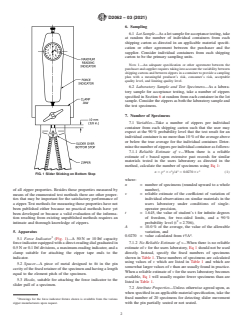
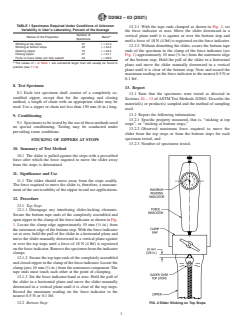
FIG. 1 Slider Sticking on Bottom Stop
4.3 The method(s) in the standard along with those in Test Methods D2051, D2052, D2053, D2054, D2057, D2058, D2059/D2059M, D2060, and D2061 are a collection of proven test methods. They can be used as aids in the evaluation of zippers without the need for a thorough knowledge of zippers. The enumerated test methods do not provide for the evaluation of all zipper properties. Besides those properties measured by means of the enumerated test methods there are other properties that may be important for the satisfactory performance of a zipper. Test methods for measuring those properties have not been published either because no practical methods have yet been developed or because a valid evaluation ...
SCOPE
1.1 These test methods cover procedures for determining the following characteristics of zippers:
Sections
Opening and Closing of Zippers
14 – 17
Separator Functioning of Zippers
18 – 22
Sticking of Zippers at Stops
10 – 13
1.2 This standard does not purport to address all of the safety concerns, if any, associated with its use. It is the responsibility of the user of this standard to establish appropriate safety, health, and environmental practices and determine the applicability of regulatory limitations prior to use.
1.3 This international standard was developed in accordance with internationally recognized principles on standardization established in the Decision on Principles for the Development of International Standards, Guides and Recommendations issued by the World Trade Organization Technical Barriers to Trade (TBT) Committee.
- Status
- Published
- Publication Date
- 30-Jun-2021
- Technical Committee
- D13 - Textiles
- Drafting Committee
- D13.54 - Subassemblies
Overview
ASTM D2062-03(2021) – Standard Test Methods for Operability of Zippers is an internationally recognized standard developed by ASTM International. This standard outlines testing procedures used to evaluate the operability and performance characteristics of zippers in commercial and consumer products. The test methods specified in ASTM D2062 are extensively used across the zipper manufacturing supply chain for acceptance testing and quality assurance of zipper products.
The procedures provide manufacturers, buyers, and laboratories with reliable, standardized methods for evaluating zipper functionality, supporting consistent quality in a variety of end-use applications.
Key Topics
ASTM D2062-03(2021) covers test methods for determining:
- Opening and Closing Force: The amount of force required to open and close a zipper, reflecting the ease of use in practical applications.
- Sticking at Stops: Measurement of resistance encountered at the top and bottom stops, indicating the potential for slider sticking or jamming.
- Separator Function: Assessment of the zipper's ability to separate correctly when the slider and other components are correctly aligned.
Additional testing guidelines include:
- Sampling procedures: Ensuring that test specimens are randomly selected to provide statistically meaningful results.
- Statistical guidance: Methods for evaluating laboratory-to-laboratory precision and addressing sources of variation or bias.
- Reporting requirements: Clear documentation of testing procedures, observations, and results to enable traceability and repeatability.
These robust procedures support consistent zipper operability testing and are intended for use even when users have limited technical knowledge of zipper construction.
Applications
ASTM D2062-03(2021) applies to a wide range of practical scenarios, including:
- Quality control and acceptance testing: Facilitating the inspection of commercial zipper shipments and verifying compliance with customer or industry specifications.
- Product development: Enabling designers and engineers in apparel, luggage, outdoor gear, and automotive sectors to assess zipper performance during prototyping and selection phases.
- Troubleshooting: Providing objective test methods to investigate reports of zipper malfunctions or performance concerns in finished products.
- Third-party testing and certification: Supporting independent laboratories that need a standardized basis for verifying zipper operability.
By using the test methods in ASTM D2062, organizations can minimize product failures, improve customer satisfaction, and ensure compliance with industry and regulatory expectations.
Related Standards
ASTM D2062-03(2021) is part of a suite of standards addressing zipper testing, including:
- ASTM D2051: Durability of Finish of Zippers to Laundering
- ASTM D2052: Colorfastness of Zippers to Drycleaning
- ASTM D2053: Colorfastness of Zippers to Light
- ASTM D2054: Colorfastness of Zipper Tapes to Crocking
- ASTM D2057: Colorfastness of Zippers to Laundering
- ASTM D2058: Durability of Finish of Zippers to Drycleaning
- ASTM D2059/D2059M: Resistance of Zippers to Salt Spray (Fog)
- ASTM D2060: Measurement of Zipper Dimensions
- ASTM D2061: Strength Tests for Zippers
For terminology related to textiles and zippers, refer to:
- ASTM D123: Terminology Relating to Textiles
- ASTM D2050: Terminology Relating to Subassemblies Used in the Manufacture of Textiles
Keywords: zipper operability, ASTM D2062, zipper test methods, quality control, zipper performance, textile standards, slider sticking, separator functioning, zipper opening force
Relations
- Effective Date
- 01-Mar-2017
- Effective Date
- 15-Sep-2015
- Effective Date
- 01-Sep-2015
- Effective Date
- 01-Apr-2015
- Effective Date
- 01-Feb-2014
- Effective Date
- 15-Jun-2013
- Effective Date
- 15-Jun-2013
- Effective Date
- 15-May-2013
- Effective Date
- 01-Feb-2012
- Effective Date
- 01-Feb-2012
- Effective Date
- 01-Jan-2011
- Effective Date
- 01-Jan-2011
- Effective Date
- 01-Jun-2010
- Effective Date
- 01-Jun-2010
- Effective Date
- 01-Jun-2010
Frequently Asked Questions
ASTM D2062-03(2021) is a standard published by ASTM International. Its full title is "Standard Test Methods for Operability of Zippers". This standard covers: SIGNIFICANCE AND USE 4.1 The significance of specific tests is discussed in the appropriate sections. 4.2 These test methods are considered satisfactory for acceptance testing of commercial shipments of zippers because the methods have been used extensively in the trade for this purpose, even though current estimates of between-laboratory precision are quite large in some cases. 4.2.1 If there are differences of practical significance between reported test results for two laboratories (or more), comparative test should be performed to determine if there is a statistical bias between them, using competent statistical assistance. As a minimum, the test samples should be used that are as homogeneous as possible, that are drawn from the material from which the disparate test results were obtained, and that are randomly assigned in equal numbers to each laboratory for testing. Other materials with established test values may be used for this purpose. The test results from the two laboratories should be compared using a statistical test for unpaired data, at a probability level chosen prior to the testing series. If a bias is found, either its cause must be found and corrected, or future test results must be adjusted in consideration of the known bias. FIG. 1 Slider Sticking on Bottom Stop 4.3 The method(s) in the standard along with those in Test Methods D2051, D2052, D2053, D2054, D2057, D2058, D2059/D2059M, D2060, and D2061 are a collection of proven test methods. They can be used as aids in the evaluation of zippers without the need for a thorough knowledge of zippers. The enumerated test methods do not provide for the evaluation of all zipper properties. Besides those properties measured by means of the enumerated test methods there are other properties that may be important for the satisfactory performance of a zipper. Test methods for measuring those properties have not been published either because no practical methods have yet been developed or because a valid evaluation ... SCOPE 1.1 These test methods cover procedures for determining the following characteristics of zippers: Sections Opening and Closing of Zippers 14 – 17 Separator Functioning of Zippers 18 – 22 Sticking of Zippers at Stops 10 – 13 1.2 This standard does not purport to address all of the safety concerns, if any, associated with its use. It is the responsibility of the user of this standard to establish appropriate safety, health, and environmental practices and determine the applicability of regulatory limitations prior to use. 1.3 This international standard was developed in accordance with internationally recognized principles on standardization established in the Decision on Principles for the Development of International Standards, Guides and Recommendations issued by the World Trade Organization Technical Barriers to Trade (TBT) Committee.
SIGNIFICANCE AND USE 4.1 The significance of specific tests is discussed in the appropriate sections. 4.2 These test methods are considered satisfactory for acceptance testing of commercial shipments of zippers because the methods have been used extensively in the trade for this purpose, even though current estimates of between-laboratory precision are quite large in some cases. 4.2.1 If there are differences of practical significance between reported test results for two laboratories (or more), comparative test should be performed to determine if there is a statistical bias between them, using competent statistical assistance. As a minimum, the test samples should be used that are as homogeneous as possible, that are drawn from the material from which the disparate test results were obtained, and that are randomly assigned in equal numbers to each laboratory for testing. Other materials with established test values may be used for this purpose. The test results from the two laboratories should be compared using a statistical test for unpaired data, at a probability level chosen prior to the testing series. If a bias is found, either its cause must be found and corrected, or future test results must be adjusted in consideration of the known bias. FIG. 1 Slider Sticking on Bottom Stop 4.3 The method(s) in the standard along with those in Test Methods D2051, D2052, D2053, D2054, D2057, D2058, D2059/D2059M, D2060, and D2061 are a collection of proven test methods. They can be used as aids in the evaluation of zippers without the need for a thorough knowledge of zippers. The enumerated test methods do not provide for the evaluation of all zipper properties. Besides those properties measured by means of the enumerated test methods there are other properties that may be important for the satisfactory performance of a zipper. Test methods for measuring those properties have not been published either because no practical methods have yet been developed or because a valid evaluation ... SCOPE 1.1 These test methods cover procedures for determining the following characteristics of zippers: Sections Opening and Closing of Zippers 14 – 17 Separator Functioning of Zippers 18 – 22 Sticking of Zippers at Stops 10 – 13 1.2 This standard does not purport to address all of the safety concerns, if any, associated with its use. It is the responsibility of the user of this standard to establish appropriate safety, health, and environmental practices and determine the applicability of regulatory limitations prior to use. 1.3 This international standard was developed in accordance with internationally recognized principles on standardization established in the Decision on Principles for the Development of International Standards, Guides and Recommendations issued by the World Trade Organization Technical Barriers to Trade (TBT) Committee.
ASTM D2062-03(2021) is classified under the following ICS (International Classification for Standards) categories: 61.040 - Headgear. Clothing accessories. Fastening of clothing. The ICS classification helps identify the subject area and facilitates finding related standards.
ASTM D2062-03(2021) has the following relationships with other standards: It is inter standard links to ASTM D123-17, ASTM D123-15b, ASTM D123-15a, ASTM D123-15, ASTM D2060-14, ASTM D123-13ae1, ASTM D123-13a, ASTM D123-13, ASTM D123-12e1, ASTM D123-12, ASTM D2050-11, ASTM D2050-11e1, ASTM D2060-00(2010), ASTM D2052-05(2010), ASTM D2054-99(2010). Understanding these relationships helps ensure you are using the most current and applicable version of the standard.
ASTM D2062-03(2021) is available in PDF format for immediate download after purchase. The document can be added to your cart and obtained through the secure checkout process. Digital delivery ensures instant access to the complete standard document.
Standards Content (Sample)
This international standard was developed in accordance with internationally recognized principles on standardization established in the Decision on Principles for the
Development of International Standards, Guides and Recommendations issued by the World Trade Organization Technical Barriers to Trade (TBT) Committee.
Designation: D2062 − 03 (Reapproved 2021)
Standard Test Methods for
Operability of Zippers
This standard is issued under the fixed designation D2062; the number immediately following the designation indicates the year of
original adoption or, in the case of revision, the year of last revision. A number in parentheses indicates the year of last reapproval. A
superscript epsilon (´) indicates an editorial change since the last revision or reapproval.
1. Scope D2058 Test Method for Durability of Finish of Zippers to
Drycleaning
1.1 These test methods cover procedures for determining
D2059/D2059M Test Method for Resistance of Zippers to
the following characteristics of zippers:
Salt Spray (Fog)
Sections
D2060 Test Methods for Measuring Zipper Dimensions
D2061 Test Methods for Strength Tests for Zippers
Opening and Closing of Zippers 14–17
Separator Functioning of Zippers 18–22
Sticking of Zippers at Stops 10–13
3. Terminology
1.2 This standard does not purport to address all of the
3.1 Definitions:
safety concerns, if any, associated with its use. It is the
3.1.1 For definitions of zipper terms used in these test
responsibility of the user of this standard to establish appro-
methods, refer to Terminology D2050. For definitions of other
priate safety, health, and environmental practices and deter-
textile terminology used in these test methods, refer to Termi-
mine the applicability of regulatory limitations prior to use.
nology D123.
1.3 This international standard was developed in accor-
dance with internationally recognized principles on standard-
4. Significance and Use
ization established in the Decision on Principles for the
Development of International Standards, Guides and Recom- 4.1 The significance of specific tests is discussed in the
mendations issued by the World Trade Organization Technical appropriate sections.
Barriers to Trade (TBT) Committee.
4.2 These test methods are considered satisfactory for ac-
ceptance testing of commercial shipments of zippers because
2. Referenced Documents
the methods have been used extensively in the trade for this
2.1 ASTM Standards:
purpose, even though current estimates of between-laboratory
D123 Terminology Relating to Textiles
precision are quite large in some cases.
D2050 Terminology Relating to Subassemblies Used in the
4.2.1 If there are differences of practical significance be-
Manufacture of Textiles
tween reported test results for two laboratories (or more),
D2051 Test Method for Durability of Finish of Zippers to
comparative test should be performed to determine if there is a
Laundering
statistical bias between them, using competent statistical assis-
D2052 Test Method for Colorfastness of Zippers to Dry-
tance. As a minimum, the test samples should be used that are
cleaning
as homogeneous as possible, that are drawn from the material
D2053 Test Method for Colorfastness of Zippers to Light
from which the disparate test results were obtained, and that
D2054 Test Method for Colorfastness of Zipper Tapes to
are randomly assigned in equal numbers to each laboratory for
Crocking
testing. Other materials with established test values may be
D2057 Test Method for Colorfastness of Zippers to Laun-
used for this purpose.The test results from the two laboratories
dering
should be compared using a statistical test for unpaired data, at
a probability level chosen prior to the testing series. If a bias is
found, either its cause must be found and corrected, or future
These test methods are under the jurisdiction of ASTM Committee D13 on
test results must be adjusted in consideration of the known
Textiles and are the direct responsibility of Subcommittee D13.54 on Subassem-
bias.
blies. The methods were developed in cooperation with the Slide Fastener Assn.,
Inc.
4.3 The method(s) in the standard along with those in Test
Current edition approved July 1, 2021. Published July 2021. Originally approved
Methods D2051, D2052, D2053, D2054, D2057, D2058,
in 1961. Last previous edition approved in 2014 as D2062 – 03(2014). DOI:
10.1520/D2062-03R21.
D2059/D2059M, D2060, and D2061 are a collection of proven
For referenced ASTM standards, visit the ASTM website, www.astm.org, or
test methods. They can be used as aids in the evaluation of
contact ASTM Customer Service at service@astm.org. For Annual Book of ASTM
zippers without the need for a thorough knowledge of zippers.
Standards volume information, refer to the standard’s Document Summary page on
the ASTM website. The enumerated test methods do not provide for the evaluation
Copyright © ASTM International, 100 Barr Harbor Drive, PO Box C700, West Conshohocken, PA 19428-2959. United States
D2062 − 03 (2021)
6. Sampling
6.1 LotSample—Asalotsampleforacceptancetesting,take
at random the number of individual containers from each
shipping carton as directed in an applicable material specifi-
cation or other agreement between the purchaser and the
supplier. Consider individual containers from each shipping
carton to be the primary sampling units.
NOTE 1—An adequate specification or other agreement between the
purchaserandsupplierrequirestakingintoaccountthevariabilitybetween
shipping cartons and between zippers in a container to provide a sampling
plan with a meaningful producer’s risk, consumer’s risk, acceptable
quality level, and limiting quality level.
6.2 Laboratory Sample and Test Specimens—As a labora-
tory sample for acceptance testing, take a number of zippers
specified in Section 6 at random from each container in the lot
sample. Consider the zippers as both the laboratory sample and
the test specimens.
7. Number of Specimens
7.1 Variables—Take a number of zippers per individual
container from each shipping carton such that the user may
expect at the 90 % probability level that the test result for an
individual container is no more than 10 % of the average above
or below the true average for the individual container. Deter-
minethenumberofzippersperindividualcontainerasfollows:
7.1.1 Reliable Estimate of v—When there is a reliable
estimate of v based upon extensive past records for similar
materials tested in the users laboratory as directed in the
method, calculate the number of specimens using Eq 1:
2 2 2 2
n 5 ~t 3v !/A 5 0.0270 3v (1)
FIG. 1 Slider Sticking on Bottom Stop
where:
n = number of specimens (rounded upward to a whole
of all zipper properties. Besides those properties measured by
number),
v = reliable estimate of the coefficient of variation of
means of the enumerated test methods there are other proper-
ties that may be important for the satisfactory performance of individual observations on similar materials in the
users laboratory under conditions of single-
a zipper. Test methods for measuring those properties have not
been published either because no practical methods have yet operator precision,
t = 1.645, the value of student’s t for infinite degrees
been developed or because a valid evaluation of the informa-
of freedom, for two-sided limits, and a 90 %
tion resulting from existing unpublished methods requires an
probability level (t = 2.706),
intimate and thorough knowledge of zippers.
A = 10.0 % of the average, the value of the allowable
variation, and
5. Apparatus
2 2
0.0270 = value calculated from t /A .
5.1 Force Indicator (Fig. 1)—A 50 N or 10 lbf capacity
force indicator equipped with a direct-reading dial graduated in 7.1.2 No Reliable Estimate of v—When there is no reliable
0.5 N or 0.1 lbf divisions, a maximum-reading indicator, and a estimate of v for the users laboratory, Eq 1 should not be used
clamp suitable for attaching the zipper tape ends to the directly. Instead, specify the fixed numbers of specimens
indicator. shown in Table 1. These numbers of specimens are calculated
using values of v which are listed in Table 1 and which are
5.2 Spacer—A piece of metal designed to fit in the pin
somewhat larger values of v than are usually found in practice.
cavity of the fixed retainer of the specimen and having a length
When a reliable estimate of v for the users laboratory becomes
equal to the element pitch of the specimen.
available, Eq 1 will usually require fewer specimens than are
5.3 Hooks, suitable for attaching the force indicator to the
listed in Table 1.
slider pull of a specimen.
7.2 Attribute Properties—Unless otherwise agreed upon, as
when specified in an applicable material specification, take the
fixed number of 20 specimens for detecting slider movement
Drawings for the force indicator fixture shown is available from the various
zipper manufacturers upon request. with the pin partially seated or not seated.
D2062 − 03 (2021)
TABLE 1 Specimens Required Under Conditions of Unknown
12.2.1 With the tape ends clamped as shown in Fig. 2, set
Variability in User’s Laboratory, Percent of the Average
the force indicator at zero. Move the slider downward in a
Number of
A vertical plane until it is against or over the bottom stop and
Names of the Properties Basis
Specimens
until a force of 18 N (4 lbf) is registered on the force indicator.
Sticking at top stops 47 ν = 41.3
12.2.2 Without disturbing the slider, secure the bottom tape
Sticking at bottom stops 32 ν = 34.4
Opening zipper 15 ν = 23.4 ends of the specimen in the clamp of the force indicator (see
Closing zipper 27 ν = 31.1 3
Fig. 1) approximately 10 mm ( ⁄8 in.) from the outermost edge
Force to move slider, pin fully seated 43 ν = 39.5
of the bottom stop. Hold the pull of the slider in a horizontal
A
The values of ν in Table 1 are somewhat larger than will usually be found in
plane and move the slider manually downward in a vertical
practice (see 7.1.2).
plane until it is clear of the bottom stop. Note and record the
maximum reading on the force indicator to the nearest 0.5 N or
0.1 lbf.
8. Test Specimen
13. Report
8.1 Each test specimen shall consist of a completely as-
13.1 State that the specimens were tested as directed in
sembled zipper, except that for the opening and closing
Sections10–13 ofASTM Test Methods D2062. Describe the
method, a length of chain with an appropriate slider may be
material(s) or product(s) sampled and the method of sampling
used. Use a zipper or chain not less than 150 mm (6 in.) long.
used.
13.2 Report the following information:
9. Conditioning
13.2.1 Specific property measured, that is, “sticking at top
9.1 Specimens to be tested by the use of these methods need
stops”, or “sticking at bottom stops,”
no special conditioning. Testing may be conducted under
13.2.2 Observed maximum force required to move the
prevailing room conditions.
slider from the top stops or from the bottom stops for each
specimen tested, and
STICKING OF ZIPPERS AT STOPS
13.2.3 Number of specimens tested.
10. Summary of Test Method
10.1 The slider is pulled against the stops with a prescribed
force after which the force required to move the slider away
from the stops is determined.
11. Significance and Use
11.1 The slider should move away from the stops readily.
The force required to move the slider is, therefore, a measure-
ment of the serviceability of the zipper in end use applications.
12. Procedure
12.1 Top Stop:
12.1.1 Disengage any interfering slider-locking elements.
Secure the bottom tape ends of the completely assembled and
open zipper in the clamp of the force indicator as shown in Fig.
1. Locate the clamp edge approximately 10 m
...