

ASTM D7261-22
(Test Method)Standard Test Method for Determining Water Separation Characteristics of Diesel Fuels by Portable Separometer
General Information
- Abstract
SIGNIFICANCE AND USE
5.1 This test method provides a measure of the presence of surfactants in diesel fuels, and can be performed in the field or in a laboratory. Like Test Method D3948 used for jet fuel, this test method can detect traces of some refinery treating chemicals left in fuel. It can also detect surface active substances added to or picked up by the fuel during handling from point of production to point of use.
5.2 Certain additives, which can act as weak surfactants, give a slightly reduced DSEP rating. Other substances which are strong surfactants give much lower DSEP ratings.
5.3 This test method recommends use of the D cell coalescer when testing ULSD that contains less than 1 % biodiesel content. The DB cell coalescer should be used when testing B1-B20 blends. Weak surfactants, with slightly reduced DSEP ratings, do not significantly affect the ability of filter separators to separate free water from the fuel. Strong surfactants give a much lower DSEP rating and adversely affect the ability of filter separators to separate free water from the fuel.
5.4 Results from this test method do not have a known relationship to the rate of water settling in tanks.
5.5 The Micro-Separometer instrument has a measurement range from 50 to 100. Values obtained outside of those limits are undefined and invalid.
Note 2: In the event a value greater than 100 is obtained, there is a good probability that light transmittance was reduced by material contained in the fuel used to set the 100 reference level. The material was subsequently removed during the coalescing portion of the test, thus, the processed fuel had a higher light transmittance than the fuel sample used to obtain the 100 reference level resulting in the final rating measuring in excess of 100.
SCOPE
1.1 This test method covers a rapid portable means for field and laboratory use to rate the ability of diesel fuels (both neat and those containing additives) to release entrained or emulsified water when passed through fiberglass coalescing material.
1.2 This test method is applicable to diesel fuels such as Specification D975 Grade No. 1-D and Grade No. 2-D of all sulfur levels, Specification D7467 biodiesel blends B6-B20, and MIL-DTL-16884, naval distillate fuel (NATO F-76).
Note 1: This test method is similar to Test Method D3948 which is applicable to aviation turbine fuels.
1.3 The values stated in SI units are to be regarded as standard. No other units of measurement are included in this standard.
1.4 This standard does not purport to address all of the safety concerns, if any, associated with its use. It is the responsibility of the user of this standard to establish appropriate safety, health, and environmental practices and determine the applicability of regulatory limitations prior to use.
1.5 This international standard was developed in accordance with internationally recognized principles on standardization established in the Decision on Principles for the Development of International Standards, Guides and Recommendations issued by the World Trade Organization Technical Barriers to Trade (TBT) Committee.
- Status
- Published
- Publication Date
- 30-Jun-2022
- Technical Committee
- D02 - Petroleum Products, Liquid Fuels, and Lubricants
- Drafting Committee
- D02.14 - Stability, Cleanliness and Compatibility of Liquid Fuels
Buy Documents
ASTM D7261-22 - Standard Test Method for Determining Water Separation Characteristics of Diesel Fuels by Portable Separometer
REDLINE ASTM D7261-22 - Standard Test Method for Determining Water Separation Characteristics of Diesel Fuels by Portable Separometer
Overview
ASTM D7261-22, Standard Test Method for Determining Water Separation Characteristics of Diesel Fuels by Portable Separometer, is a key ASTM standard for evaluating how well diesel fuels release water when subjected to coalescing filtration. This rapid, portable test method is applicable both in the laboratory and in the field, making it an essential tool for quality control of diesel fuels, including those with additives and biodiesel blends. The procedure is designed to detect the presence of surfactants and other surface-active substances that can negatively impact water separation during storage, transport, and use.
Key Topics
- Surfactant Detection: The test method provides a reliable means to detect traces of refinery treating chemicals and other surface-active contaminants that can be introduced during production, storage, or transportation of diesel fuel.
- Diesel Separability (DSEP) Rating: Fuels are rated based on their ability to separate water, using a numerical scale from 50 to 100, with higher values indicating cleaner fuel with fewer surfactants.
- Coalescer Selection: The standard outlines the appropriate use of D cell coalescers for ultra-low sulfur diesel (ULSD) with less than 1% biodiesel and DB cell coalescers for biodiesel blends (B1-B20).
- Portable Testing: The method can be conducted using a Micro-Separometer instrument, making it suitable for both field and laboratory environments.
- No Direct Correlation to Tank Water Settling: The results from ASTM D7261 do not establish a direct relationship to water settling rates in storage tanks but focus on filter separator performance.
Applications
ASTM D7261-22 has vital applications across the fuel industry:
- Quality Assurance in Fuel Production: Used by refineries and terminals to ensure outgoing diesel fuels meet required water separation standards, preventing downstream equipment issues.
- Field Testing During Distribution: Enables rapid on-site testing at various stages, such as terminals, tank farms, or point-of-use locations, to identify contamination and mitigate risks of filter separator malfunction.
- Biodiesel Blend Management: Provides a practical method for monitoring water separation in diesel fuels containing up to 20% biodiesel (B6-B20), addressing specific filtration challenges associated with renewable fuel content.
- Maintenance of Naval and Military Fuels: Supports quality assessment for naval distillate fuel (NATO F-76) and other critical applications where reliable water separation is essential.
- Additive Compatibility Studies: Aids in assessing the impact of additives or potential contaminants on the water separation capability of diesel fuels.
Related Standards
Several standards complement or are referenced by ASTM D7261-22:
- ASTM D975: Standard Specification for Diesel Fuel Oils - core specification for most diesel fuels tested under D7261.
- ASTM D7467: Specification for Diesel Fuel Oil, Biodiesel Blend (B6 to B20) - relevant for biodiesel blend applications.
- ASTM D3948: Test Method for Determining Water Separation Characteristics of Aviation Turbine Fuels by Portable Separometer - a similar method for jet fuels.
- ASTM D1193: Specification for Reagent Water - establishes quality requirements for water used in the test.
- ASTM D4057 and D4177: Practices for manual and automatic sampling of petroleum products, ensuring representative fuel samples.
- ASTM D4176 and D4860: Test methods for detecting free water and particulate contamination in distillate fuels, supporting overall fuel cleanliness assessment.
Practical Value
Proper application of ASTM D7261-22 increases operational reliability by helping fuel suppliers, distributors, and users ensure their diesel fuels maintain optimal water separation characteristics. This reduces risk of water-induced engine or filter issues, ensures regulatory compliance, and supports overall fuel system integrity. Frequent use of this standard enables industries to quickly identify problems, implement corrective actions, and assure high-quality fuel delivery from production to end-use.
Keywords: ASTM D7261, diesel fuel, water separation, portable separometer, surfactant detection, DSEP rating, fuel quality, biodiesel blends, coalescer, Micro-Separometer, fuel testing standards.
Relations
- Effective Date
- 01-Mar-2024
- Refers
ASTM D4175-23a - Standard Terminology Relating to Petroleum Products, Liquid Fuels, and Lubricants - Effective Date
- 15-Dec-2023
- Effective Date
- 15-Dec-2023
- Effective Date
- 01-Dec-2023
- Effective Date
- 01-Oct-2023
- Refers
ASTM D4175-23e1 - Standard Terminology Relating to Petroleum Products, Liquid Fuels, and Lubricants - Effective Date
- 01-Jul-2023
- Effective Date
- 01-Jun-2020
- Effective Date
- 01-Jan-2020
- Effective Date
- 01-Dec-2019
- Effective Date
- 01-May-2019
- Effective Date
- 01-Feb-2019
- Effective Date
- 15-Dec-2018
- Effective Date
- 01-Dec-2018
- Effective Date
- 01-Oct-2018
- Effective Date
- 01-May-2018
Buy Documents
ASTM D7261-22 - Standard Test Method for Determining Water Separation Characteristics of Diesel Fuels by Portable Separometer
REDLINE ASTM D7261-22 - Standard Test Method for Determining Water Separation Characteristics of Diesel Fuels by Portable Separometer
Get Certified
Connect with accredited certification bodies for this standard

Element Materials Technology
Materials testing and product certification.

ABS Group Brazil
ABS Group certification services in Brazil.

ABS Quality Evaluations Inc.
American Bureau of Shipping quality certification.
Sponsored listings
Frequently Asked Questions
ASTM D7261-22 is a standard published by ASTM International. Its full title is "Standard Test Method for Determining Water Separation Characteristics of Diesel Fuels by Portable Separometer". This standard covers: SIGNIFICANCE AND USE 5.1 This test method provides a measure of the presence of surfactants in diesel fuels, and can be performed in the field or in a laboratory. Like Test Method D3948 used for jet fuel, this test method can detect traces of some refinery treating chemicals left in fuel. It can also detect surface active substances added to or picked up by the fuel during handling from point of production to point of use. 5.2 Certain additives, which can act as weak surfactants, give a slightly reduced DSEP rating. Other substances which are strong surfactants give much lower DSEP ratings. 5.3 This test method recommends use of the D cell coalescer when testing ULSD that contains less than 1 % biodiesel content. The DB cell coalescer should be used when testing B1-B20 blends. Weak surfactants, with slightly reduced DSEP ratings, do not significantly affect the ability of filter separators to separate free water from the fuel. Strong surfactants give a much lower DSEP rating and adversely affect the ability of filter separators to separate free water from the fuel. 5.4 Results from this test method do not have a known relationship to the rate of water settling in tanks. 5.5 The Micro-Separometer instrument has a measurement range from 50 to 100. Values obtained outside of those limits are undefined and invalid. Note 2: In the event a value greater than 100 is obtained, there is a good probability that light transmittance was reduced by material contained in the fuel used to set the 100 reference level. The material was subsequently removed during the coalescing portion of the test, thus, the processed fuel had a higher light transmittance than the fuel sample used to obtain the 100 reference level resulting in the final rating measuring in excess of 100. SCOPE 1.1 This test method covers a rapid portable means for field and laboratory use to rate the ability of diesel fuels (both neat and those containing additives) to release entrained or emulsified water when passed through fiberglass coalescing material. 1.2 This test method is applicable to diesel fuels such as Specification D975 Grade No. 1-D and Grade No. 2-D of all sulfur levels, Specification D7467 biodiesel blends B6-B20, and MIL-DTL-16884, naval distillate fuel (NATO F-76). Note 1: This test method is similar to Test Method D3948 which is applicable to aviation turbine fuels. 1.3 The values stated in SI units are to be regarded as standard. No other units of measurement are included in this standard. 1.4 This standard does not purport to address all of the safety concerns, if any, associated with its use. It is the responsibility of the user of this standard to establish appropriate safety, health, and environmental practices and determine the applicability of regulatory limitations prior to use. 1.5 This international standard was developed in accordance with internationally recognized principles on standardization established in the Decision on Principles for the Development of International Standards, Guides and Recommendations issued by the World Trade Organization Technical Barriers to Trade (TBT) Committee.
SIGNIFICANCE AND USE 5.1 This test method provides a measure of the presence of surfactants in diesel fuels, and can be performed in the field or in a laboratory. Like Test Method D3948 used for jet fuel, this test method can detect traces of some refinery treating chemicals left in fuel. It can also detect surface active substances added to or picked up by the fuel during handling from point of production to point of use. 5.2 Certain additives, which can act as weak surfactants, give a slightly reduced DSEP rating. Other substances which are strong surfactants give much lower DSEP ratings. 5.3 This test method recommends use of the D cell coalescer when testing ULSD that contains less than 1 % biodiesel content. The DB cell coalescer should be used when testing B1-B20 blends. Weak surfactants, with slightly reduced DSEP ratings, do not significantly affect the ability of filter separators to separate free water from the fuel. Strong surfactants give a much lower DSEP rating and adversely affect the ability of filter separators to separate free water from the fuel. 5.4 Results from this test method do not have a known relationship to the rate of water settling in tanks. 5.5 The Micro-Separometer instrument has a measurement range from 50 to 100. Values obtained outside of those limits are undefined and invalid. Note 2: In the event a value greater than 100 is obtained, there is a good probability that light transmittance was reduced by material contained in the fuel used to set the 100 reference level. The material was subsequently removed during the coalescing portion of the test, thus, the processed fuel had a higher light transmittance than the fuel sample used to obtain the 100 reference level resulting in the final rating measuring in excess of 100. SCOPE 1.1 This test method covers a rapid portable means for field and laboratory use to rate the ability of diesel fuels (both neat and those containing additives) to release entrained or emulsified water when passed through fiberglass coalescing material. 1.2 This test method is applicable to diesel fuels such as Specification D975 Grade No. 1-D and Grade No. 2-D of all sulfur levels, Specification D7467 biodiesel blends B6-B20, and MIL-DTL-16884, naval distillate fuel (NATO F-76). Note 1: This test method is similar to Test Method D3948 which is applicable to aviation turbine fuels. 1.3 The values stated in SI units are to be regarded as standard. No other units of measurement are included in this standard. 1.4 This standard does not purport to address all of the safety concerns, if any, associated with its use. It is the responsibility of the user of this standard to establish appropriate safety, health, and environmental practices and determine the applicability of regulatory limitations prior to use. 1.5 This international standard was developed in accordance with internationally recognized principles on standardization established in the Decision on Principles for the Development of International Standards, Guides and Recommendations issued by the World Trade Organization Technical Barriers to Trade (TBT) Committee.
ASTM D7261-22 is classified under the following ICS (International Classification for Standards) categories: 75.160.20 - Liquid fuels. The ICS classification helps identify the subject area and facilitates finding related standards.
ASTM D7261-22 has the following relationships with other standards: It is inter standard links to ASTM D6300-24, ASTM D4175-23a, ASTM D975-23a, ASTM D6300-23a, ASTM D7467-23, ASTM D4175-23e1, ASTM D7467-20a, ASTM D7467-20, ASTM D6300-19a, ASTM D7467-19, ASTM D975-19, ASTM D7467-18b, ASTM D975-18a, ASTM D7467-18a, ASTM D7467-18. Understanding these relationships helps ensure you are using the most current and applicable version of the standard.
ASTM D7261-22 is available in PDF format for immediate download after purchase. The document can be added to your cart and obtained through the secure checkout process. Digital delivery ensures instant access to the complete standard document.
Standards Content (Sample)
This international standard was developed in accordance with internationally recognized principles on standardization established in the Decision on Principles for the
Development of International Standards, Guides and Recommendations issued by the World Trade Organization Technical Barriers to Trade (TBT) Committee.
Designation: D7261 − 22
Standard Test Method for
Determining Water Separation Characteristics of Diesel
Fuels by Portable Separometer
This standard is issued under the fixed designation D7261; the number immediately following the designation indicates the year of
original adoption or, in the case of revision, the year of last revision. A number in parentheses indicates the year of last reapproval. A
superscript epsilon (´) indicates an editorial change since the last revision or reapproval.
1. Scope* D4057 Practice for Manual Sampling of Petroleum and
Petroleum Products
1.1 This test method covers a rapid portable means for field
D4175 Terminology Relating to Petroleum Products, Liquid
and laboratory use to rate the ability of diesel fuels (both neat
Fuels, and Lubricants
and those containing additives) to release entrained or emulsi-
D4176 Test Method for FreeWater and Particulate Contami-
fied water when passed through fiberglass coalescing material.
nation in Distillate Fuels (Visual Inspection Procedures)
1.2 This test method is applicable to diesel fuels such as
D4177 Practice for Automatic Sampling of Petroleum and
Specification D975 Grade No. 1-D and Grade No. 2-D of all
Petroleum Products
sulfur levels, Specification D7467 biodiesel blends B6-B20,
D4306 Practice for Aviation Fuel Sample Containers for
and MIL-DTL-16884, naval distillate fuel (NATO F-76).
Tests Affected by Trace Contamination
NOTE 1—This test method is similar to Test Method D3948 which is
D4860 Test Method for FreeWater and Particulate Contami-
applicable to aviation turbine fuels.
nation in Middle Distillate Fuels (Clear and Bright Nu-
1.3 The values stated in SI units are to be regarded as
merical Rating)
standard. No other units of measurement are included in this
D6300 Practice for Determination of Precision and Bias
standard.
Data for Use in Test Methods for Petroleum Products,
1.4 This standard does not purport to address all of the Liquid Fuels, and Lubricants
safety concerns, if any, associated with its use. It is the
D6426 Test Method for Determining Filterability of Middle
responsibility of the user of this standard to establish appro- Distillate Fuel Oils
priate safety, health, and environmental practices and deter-
D7467 Specification for Diesel Fuel Oil, Biodiesel Blend
mine the applicability of regulatory limitations prior to use. (B6 to B20)
1.5 This international standard was developed in accor-
2.2 Military Standard:
dance with internationally recognized principles on standard-
MIL-DTL-16884 Fuel, Naval Distillate
ization established in the Decision on Principles for the
Development of International Standards, Guides and Recom-
3. Terminology
mendations issued by the World Trade Organization Technical
3.1 Definitions:
Barriers to Trade (TBT) Committee.
3.1.1 For definitions of terms used in this test method, refer
to Terminology D4175.
2. Referenced Documents
4 4
3.1.2 reference fluid, n—in MSEP and DSEP , [diesel
2.1 ASTM Standards:
separability] water separability tests a reference fluid base to
D975 Specification for Diesel Fuel
which a prescribed quantity of a known surface active agent
D1193 Specification for Reagent Water
has been added.
D3948 TestMethodforDeterminingWaterSeparationChar-
3.1.2.1 Discussion—The known surface active agent is typi-
acteristicsofAviationTurbineFuelsbyPortableSeparom-
cally bis-2-ethylhexyl sodium sulfosuccinate, commonly re-
eter
ferred to as AOT, dissolved in toluene.
1 3.1.3 strong surfactant, n—in petroleum fuels,surfaceactive
This test method is under the jurisdiction of ASTM Committee D02 on
Petroleum Products, Liquid Fuels, and Lubricants and is the direct responsibility of material that disarms filter separator elements, allowing water
Subcommittee D02.14 on Stability, Cleanliness and Compatibility of Liquid Fuels.
to pass.
Current edition approved July 1, 2022. Published August 2022. Originally
approved in 2006. Last previous edition approved in 2017 as D7261 – 17. DOI:
10.1520/D7261-22.
2 3
For referenced ASTM standards, visit the ASTM website, www.astm.org, or Available for electronic download at ASSIST Quick Search (http://
contact ASTM Customer Service at service@astm.org. For Annual Book of ASTM quicksearch.dla.mil).
Standards volume information, refer to the standard’s Document Summary page on MSEP and DSEP are registered trademarks of EMCEE Electronics, Inc, 520
the ASTM website. Cypress Ave., Venice, FL 34285.
*A Summary of Changes section appears at the end of this standard
Copyright © ASTM International, 100 Barr Harbor Drive, PO Box C700, West Conshohocken, PA 19428-2959. United States
D7261 − 22
3.1.3.1 Discussion—Strong surfactants can be refinery pro- 5. Significance and Use
cess chemicals left in the fuel or contaminants introduced
5.1 This test method provides a measure of the presence of
during transportation of the fuel.
surfactants in diesel fuels, and can be performed in the field or
3.1.4 surfactant, n—in petroleum fuels, surface active ma- in a laboratory. Like Test Method D3948 used for jet fuel, this
test method can detect traces of some refinery treating chemi-
terial (or surface active agent) that could disarm (deactivate)
filter separator (coalescing) elements so that free water is not cals left in fuel. It can also detect surface active substances
removed from the fuel in actual service. added to or picked up by the fuel during handling from point
of production to point of use.
3.1.4.1 Discussion—Technically, surfactants affect the inter-
facial tension between water and fuel which affects the
5.2 Certain additives, which can act as weak surfactants,
tendency of water to coalesce into droplets.
give a slightly reduced DSEP rating. Other substances which
are strong surfactants give much lower DSEP ratings.
3.1.5 weak surfactant, n—in petroleum fuels, surface active
material, typically certain types of additives such as static
5.3 This test method recommends use of the D cell co-
dissipator additive, that does not adversely affect the perfor-
alescer when testing ULSD that contains less than 1 % bio-
mance of filter separator elements in actual service.
diesel content. The DB cell coalescer should be used when
testing B1-B20 blends.Weak surfactants, with slightly reduced
3.2 Definitions of Terms Specific to This Standard:
DSEP ratings, do not significantly affect the ability of filter
3.2.1 DSEP rating, n—the diesel separability rating of
separators to separate free water from the fuel. Strong surfac-
diesel fuel as measured by this test method.
tants give a much lower DSEP rating and adversely affect the
3.2.1.1 Discussion—DSEP ratings are only valid within the
ability of filter separators to separate free water from the fuel.
range of 50 to 100, with ratings at the upper end of the range
5.4 Results from this test method do not have a known
indicating a clean fuel with little or no contamination by
surfactants, which is expected to show good water-separating relationship to the rate of water settling in tanks.
properties when passed through a filter-separator (coalescing
5.5 The Micro-Separometer instrument has a measurement
type filter) in actual service; see 14.1.
range from 50 to 100. Values obtained outside of those limits
are undefined and invalid.
3.2.2 reference fluid base, n—a distillate diesel fuel that has
NOTE 2—In the event a value greater than 100 is obtained, there is a
been cleaned in a prescribed manner to remove all surface-
good probability that light transmittance was reduced by material con-
active contaminants (agents), and having a minimum DSEP
tained in the fuel used to set the 100 reference level. The material was
rating of 97.
subsequently removed during the coalescing portion of the test, thus, the
3.2.2.1 Discussion—The reference fluid base should be a
processed fuel had a higher light transmittance than the fuel sample used
to obtain the 100 reference level resulting in the final rating measuring in
diesel fuel typical of fuels to be tested.
excess of 100.
3.3 Abbreviations:
6. Interferences
3.3.1 ac—alternating current
6.1 Any suspended particles, whether solids or water drop-
3.3.2 AOT—Aerosol OT (see 8.1)
lets or haze, in a fuel sample will interfere with this test
3.3.3 C/S—collect sample
method, which utilizes light transmission of a fuel sample after
3.3.4 dc—direct current
emulsification with water and subsequent coalescence.
3.3.5 DSEP—diesel separability
6.2 Some non-hydrocarbon components such as
oxygenates, especially alcohols, or emulsified water have not
3.3.6 MSEP—Micro-Separometer
been verified for this test method and will likely interfere.
4. Summary of Test Method
7. Apparatus
4.1 A 50 mL water/fuel sample emulsion is created in a 6,7
7.1 A Micro-Separometer instrument is used to perform
syringe using a high-speed mixer. The emulsion is then
the test. The unit is portable and self-contained, capable of
expelled from the syringe at a programmed rate through a
operating on an internal rechargeable battery pack or being
standard fiberglass coalescer and the effluent is analyzed for
connected to an ac power source using power cords which are
uncoalesced water by a light transmission measurement.
available for various voltages. Connection to an ac power
4.2 The results are reported on a 0-to-100 scale to the source will provide power to the unit and affect battery
nearest whole number, however the effective range of the test
equipment is from 50 to 100. High ratings indicate that water
The sole source of supply of the apparatus (Model 1140 Micro-Separometer,
is easily coalesced, implying that the fuel is relatively free of
Mark V Deluxe and Mark X) known to the committee at this time is EMCEE
surfactants.
Electronics, Inc., 520 CypressAve.,Venice, FL34285 www.emcee-electronics.com.
If you are aware of alternative suppliers, please provide this information to ASTM
4.3 A test can be performed in 5 min to 10 min.
International Headquarters. Your comments will receive careful consideration at a
meeting of the responsible technical committee, which you may attend.
The Model 1140 Micro-Separometers Mark III and Mark V Standard versions
may also be used, but they are no longer supported by the manufacturer. For
Micro-Separometer is a trademark of EMCEE Electronics, Inc, 520 Cypress operating procedures using these instruments, the user is referred to Test Method
Ave., Venice, FL 34285. D3948–87.
D7261 − 22
FIG. 1 Micro-Separometer Mark V Deluxe and Associated Control Panel
recharge. The accessories can be packed in the cover of the 8.3 Expendable Materials needed to perform the test are
lockable case. There are two versions of the Micro- shown in Fig. 3 and consist of the following:
Separometer: the Mark V Deluxe and the upgraded version, 8.3.1 Syringe Plug, (A)—A plastic plug used to stopper the
Mark X. syringe during the clean and emulsion cycles.
8.3.2 Syringe, (Barrel (B) and Plunger (C))—A disposable
NOTE 3—An extensive study was performed to verify that the Mark X
50 mL plastic syringe.
Micro-Separometer gives equivalent results to the Mark V Deluxe
8.3.3 Vials, (D), 25 mm outside diameter vial premarked for
Micro-Separometer. See Research Report RR:D02-1647.
proper alignment in the turbidimeter well.
7.1.1 The Emcee Model 1140 Micro-Separometer Mark V
8.3.4 DCell or DBCell Coalescer, (E) an expendable,
Deluxe and associated control panel are shown in Fig. 1.
pre-calibrated aluminum coalescer cell with a tapered end to fit
NOTE 4—Of the lettered (A-G) push buttons on the Mark V Deluxe,
the syringe. It is labeled in a white background with black
only the D push button is applicable to this test method.
lettering:
7.1.2 The Emcee Model 1140 Micro-Separometer Mark X
DCELL®, DIESEL FUEL, D7261
and associated control panel are shown in Fig. 2. Table 1 lists
DBCELL®, DIESEL FUEL, D7261
the manual and audio operating characteristics of the instru-
8.3.4.1 In order for a coalescer to be acceptable for this test
ment.
method, it shall have passed factory calibration tests for air
flow and leakage.
NOTE 5—Of the lettered push buttons that select the test mode, only the
8.3.5 Disposable Plastic Pipet Tip (F)—Used with an auto-
DIESEL push button is applicable to this test method.
matic 50 µL hand pipet (Fig. 3, G).
7.1.3 Both the Mark V Deluxe and Mark X Micro-
8.3.6 Container (H)—A clean container of double-distilled
Separometers have the emulsifier located on the right side of
water (8.7).
the raised panel and the syringe drive mechanism on the left
8.4 Reference Fluid Base—A surfactant-free, clean, distil-
side. The control panel containing the operating controls (push
buttons) is mounted on the fixed panel in the left side of the late diesel fuel which is used to verify proper operation and is
prepared in the manner described in Annex A1 (see 3.2.2).
case. A circuit breaker located on the control panel provides
protection for the ac power circuit. The turbidimeter is located (Warning—Flammable. Vapor harmful.)
underthemaincontrolpanelandconsistsofawellinwhichthe
8.5 Reference Fluid—(Warning—Flammable. Vapor harm-
sample vial is placed, a light source, and a photocell.
ful.) A fluid used for checking the operational performance of
7.2 Beaker, Catch Pan, or Plastic Container—(Supplied the Micro-Separometer instrument), consisting of increasing
concentrations(0 mL⁄Lto1.6mL/L)ofdispersingagentadded
with each Micro-Separometer) used to receive the waste fuel
during the coalescence period of the test. to the reference fluid base. The DSEP ratings for this range of
concentrations appear in Tables 2-5. The reference fluids are
7.3 Pipet—An automatic 50 µL hand pipet (supplied with
prepared and tested as described in Sections 12 and 13.
each Micro-Separometer) designed to accept a disposable
8.6 Toluene, ACS reagent grade. (Warning—Flammable.
plastic tip.
Vapor harmful.)
8. Reagents and Materials
8.7 Water,clean,double-distilledandsurfactant-free:D1193
8.1 Aerosol OT, (AOT), solid (100 % dry) bis-2-ethylhexyl
Type IV reagent water, re-distilled. In practice, re-distillation
sodium sulfosuccinate.
of commercial distilled water has proven to be satisfactory.
8.2 Dispersing Agent—Toluene solution (Warning—
Flammable. Vapor harmful.) containing 1 mg of Aerosol OT
A new syringe, pipet tip, test sample vial, syringe plug, DCell coalescer or
per milliliter of toluene.
DBCell coalescer (trademarked) and double distilled water are used in each test.
These expendable materials are available from Emcee Electronics, Inc. in a kit,
termedtheDCellorDBCellMicro-SeparometerSixPack(trademarked),containing
Supporting data have been filed at ASTM International Headquarters and may supplies for six tests (Fig. 4).
beobtainedbyrequestingResearchReportRR:D02-1647.ContactASTMCustomer The term “DCell” “DBCell” and logo are registered trademarks of EMCEE
Service at service@astm.org. Electronics, Inc, 520 Cypress Ave., Venice, FL 34285.
D7261 − 22
FIG. 2 Micro-Separometer Mark X and Control Panel
TABLE 1 Manual and Audio Operating Characteristics of the Emcee Model 1140 Micro-Separometer Instrument for
Mode D/Diesel Operation
Available Test Mode(s) Function Mark V Deluxe Mark X
Test Mode - Select Mode D
Depress D push button Diesel push button
Syringe Drive Not required Not required
Speed Selection Not required Not required
Clean Cycle
Depress START push button CLEAN 1
CLEAN 2
Initiate Automatic Test Sequence
Depress START push button RUN push button
Cancel Automatic Sequence
Depress RESET push button RESET push button
1st Meter Read
1st Meter Adjust Depress ARROW push buttons Not required
2nd Meter Read
2nd Meter Adjust Depress ARROW push buttons Not required
Collect Sample Short Tone and C/S Short Tone and C/S
Annunciator Lamp Illuminates Annunciator Lamp Illuminates
3rd Meter Read
Record Measurement Pulsed Tone Sounds5sinto3rdMeter Read Steady tone
FIG. 3 Test Supplies and Small Parts
FIG. 4 Six Pack and Test Accessories
8.7.1 Useofwaterotherthandouble-distilledwater(suchas
tap water) will render test results invalid.
10.2 Open the case, and raise the right panel until com-
pletely vertical and locked in place.
9. Hazards
10.2.1 If ac power is available, connect the power cord.
9.1 The primary hazard in this test method is the flamma-
NOTE 6—The Micro-Separometer can be purchased with or without an
bility of the fuels that are tested. Take suitable precautions to
internal battery pack.
avoid sparks, flames or sources of ignition.
10.2.2 If the internal battery power is used, ensure that the
9.2 Minimize worker exposure to breathing fuel vapors.
batteriesarechargedsufficientlytoperformthedesirednumber
of tests.
10. Preparation of Apparatus
NOTE 7—Low battery power on the Mark V Deluxe instrument is
10.1 Locate the instrument on a clean workbench in an area
indicated when the power lamp does not illuminate. The Mark X will
where the temperature is between 18 °C and 29 °C and does
display an ERR-06 indicating a LO BAT condition, indicating that the
not vary more than 63 °C. battery is not sufficiently charged to run a test. To recharge the battery,
D7261 − 22
TABLE 2 Expected Performance for Reference Fluids—ULSD (1-s) tones will also sound. The Mark X ERROR ALERT indicator
Using the D Cell
illuminates and ERR-03 is displayed.An occasional out-of-tolerance alert
may be experienced due to some intermittent condition, which probably
D Cell ULSD
will not be indicative of instrument failure. However, repeated alerts are
Concentration of AOT Average DSEP Rating Standard Deviation
cause for returning the instrument to the factory for adjustment.
(mg/L)
0 96.4 1.93
0.3 90.3 2.21
11. Sampling and Sample Preparation
0.6 82.4 4.08
0.9 75.2 4.83
11.1 Rinsethesamplecontainerthreetimeswiththeproduct
1.2 72.6 3.29
tobesampledbeforecollectingthesample.Collectasampleof
at least 1 L, and preferably about 3 L, in a clean container in
accordance with Practice D4057 or D4177.
TABLE 3 Expected Performance for Reference Fluids—Marine
Diesel using the D Cell
NOTE 10—Test method results are known to be sensitive to trace
D Cell Marine Diesel
contamination from sampling containers. For recommended sampling
Concentration of AOT Average DSEP Rating Standard Deviation
containers, refer to Practice D4306. Special precautions concerning
(mg/L)
sample containers and sampling technique are discussed in Appendix X1.
0 98.2 1.47
Extremecareandcleanlinessarerequiredintakingsampleseitherdirectly
0.6 80.8 2.24
into the test syringe or into a sample container.
1.2 67.7 3.75
11.1.1 Before pouring the test sample from the container,
wipe the container outlet thoroughly with a clean, lintless
TABLE 4 Expected Performance for Reference Fluids—B5 using
wiper; pour the test sample into a clean beaker or directly into
theDBCell
the barrel of the test syringe.
DB Cell B5
Concentration of AOT Average DSEP Rating Standard Deviation
11.2 (Warning—Do not, under any circumstances, prefilter
(mg/L)
the test fuel. The filter media can remove the very materials,
0 99.6 0.73
0.3 97.5 1.68
surfactants,thatthetestmethodisdesignedtodetect.Ifthetest
0.6 91.2 3.19
fuel is contaminated with particulate matter, allow such mate-
0.9 85.3 3.77
1.2 83.5 4.79 rials to settle out of the fuel before testing. Test methods such
as D4176, D4860, and D6426 may be used to determine the
quality and cleanliness of the sample.)
TABLE 5 Expected Performance for Reference Fluids—B20 using
NOTE 11—If a sample does not clear up after being allowed to stand for
theDBCell
a period of time, the sample cannot be tested by this test method (6.1).
DB Cell B20
11.3 Ifthesampleisnotwithinthetesttemperaturelimitsof
Concentration of AOT Average DSEP Rating Standard Deviation
(mg/L) 18 °C to 29 °C, allow the sample to stand or place the sample
0 99.4 0.73
container in a water bath until the temperature is within the
0.3 95.8 1.65
prescribed limits. The preferred temperature for testing is
0.6 88.8 3.47
0.9 81.4 4.41
approximately 23 °C.
1.2 72.4 5.59
12. Calibration and Verification
12.1 The instrument is calibrated at the factory by using
connect the instrument to an ac power source for at least 16 h (full charge)
prior to use. Approximately 25 tests can then be performed. inhouse test equipment.
10.2.3 Turn the Mark V Deluxe and Mark X instruments on
12.2 Instrument performance, especially for field use, may
by depressing the switch (push button) marked ON.
be verified by performing DSEP tests using a dilution of the
dispersing agent (as prepared in 8.3), a reference fluid base (as
NOTE 8—The on-power indicator light will alternately pulse on and off
when the instrument is connected to an ac power source and will stay on
prepared in Annex A1), and double-distilled water.
continuously when operated by the battery pack (dc power source).
12.2.1 Prepare a 10:1 dilution by diluting 10 mLof dispers-
Flickering of the power indicator light, during any portion of a test
ing agent (8.2) with 90 mL of toluene.
sequence being performed using battery power, indicates that recharging
is necessary.
NOTE 12—Since 1 mL of dilution is equal to 0.1 mL of dispersing
10.3 Have ready a supply of syringes, syringe plugs, vials,
agent, 50 µL of dilution is equal to 0.1 mL⁄L when added to 50 mL of
reference fluid base. The 0.1 mL⁄L of dispersing agent corresponds to
DCell or DBCell coalescers, the pipet and pipet tips, and a
even multiples of the concentration levels listed in Table 2.
clean container of double-distilled water.
NOTE 9—Syringe drive travel times during the coalescing test period
12.2.2 Use the 50 µL pipet (8.3.5) to add increments of
wereinitiallycalibratedatthefactoryforeachmodeofoperationandhave
0.1 mL⁄L of dispersing agent to reference fluid base.
a significant bearing on the final test results. Syringe drive travel times
12.2.3 Perform DSEPtests with several reference fluids and
exceeding the upper limit will cause the final results to measure high;
conversely, travel times below the lower limit will cause the final results
double-distilled water (8.7) according to Section 13.
to measure low. Mark V Deluxe and Mark X instruments have self-check
12.2.4 Compare the DSEP ratings to the values listed in
circuitry to detect out-of-tolerance syringe drive travel times.The MarkV
Table 2 for the particular concentration of dispersing agent
Deluxe alert indicator lamp (marked SYR) illuminates and depending on
the degree (more than 3 s) of the out-of-tolerance condition, three short used.
D7261 − 22
TABLE 6 Test Sequence (Mode D Operation)
Time
Micro-Separometer
min:s
Operator Activity
Action
Test Sequence (Time) Elapsed Time
Start sequence Depress start switch 0 0
Pulsed tone Prepare for meter read 0:04 0:04
Meter on Full-scale adjustment 1 0:10 0:14
Emulsifier on Observe emulsification 0:30 0:44
No activity Place emulsified sample into syringe drive 0:30 1:14
Pulsed tone Prepare for meter reading 0:04 1:18
Meter on Full-scale adjustment 2 0:10 1:28
Syringe drive Coalescence period 0:45 2:13
Starts down Collect sample
No activity Place sample into turbidimeter well 0:56 3:09
Steady tone Prepare for meter reading 0:04 3:13
Meter on Read results 0:05 3:18
One second tone Record results 0:05 3:23
12.3 If the results do not fall within the range of limits (Warning—Donotoperatethemixerwithouthavingasyringe
shown in Table 2, the reference fluid shall be discarded and a with fuel in place. The mixer bearings depend on the fuel for
fresh quantity of reference fluid prepared and the verification lubrication.)
repeated.
13.2.4 At the end of the first clean cycle, when the mixer
motor stops, remove the syringe barrel from the emulsifier,
12.4 If repeated verification tests give out-of-tolerance test
discard the fuel, and drain the syringe thoroughly.
results, return the instrument to the factory for adjustment and
13.2.5 Add 50 mL 6 1
...
This document is not an ASTM standard and is intended only to provide the user of an ASTM standard an indication of what changes have been made to the previous version. Because
it may not be technically possible to adequately depict all changes accurately, ASTM recommends that users consult prior editions as appropriate. In all cases only the current version
of the standard as published by ASTM is to be considered the official document.
Designation: D7261 − 17 D7261 − 22
Standard Test Method for
Determining Water Separation Characteristics of Diesel
Fuels by Portable Separometer
This standard is issued under the fixed designation D7261; the number immediately following the designation indicates the year of
original adoption or, in the case of revision, the year of last revision. A number in parentheses indicates the year of last reapproval. A
superscript epsilon (´) indicates an editorial change since the last revision or reapproval.
1. Scope*
1.1 This test method covers a rapid portable means for field and laboratory use to rate the ability of diesel fuels (both neat and
those containing additives) to release entrained or emulsified water when passed through fiberglass coalescing material.
1.2 This test method is applicable to diesel fuels such as Specification D975 Grade No. 1-D and Grade No. 2-D of all sulfur levels,
Specification D7467 biodiesel blends B6-B20, and MIL-DTL-16884, naval distillate fuel (NATO F-76).
NOTE 1—This test method is similar to Test Method D3948 which is applicable to aviation turbine fuels.
1.3 The values stated in SI units are to be regarded as standard. No other units of measurement are included in this standard.
1.4 This standard does not purport to address all of the safety concerns, if any, associated with its use. It is the responsibility
of the user of this standard to establish appropriate safety, health, and environmental practices and determine the applicability of
regulatory limitations prior to use.
1.5 This international standard was developed in accordance with internationally recognized principles on standardization
established in the Decision on Principles for the Development of International Standards, Guides and Recommendations issued
by the World Trade Organization Technical Barriers to Trade (TBT) Committee.
2. Referenced Documents
2.1 ASTM Standards:
D975 Specification for Diesel Fuel
D1193 Specification for Reagent Water
D3948 Test Method for Determining Water Separation Characteristics of Aviation Turbine Fuels by Portable Separometer
D4057 Practice for Manual Sampling of Petroleum and Petroleum Products
D4175 Terminology Relating to Petroleum Products, Liquid Fuels, and Lubricants
D4176 Test Method for Free Water and Particulate Contamination in Distillate Fuels (Visual Inspection Procedures)
D4177 Practice for Automatic Sampling of Petroleum and Petroleum Products
D4306 Practice for Aviation Fuel Sample Containers for Tests Affected by Trace Contamination
D4860 Test Method for Free Water and Particulate Contamination in Middle Distillate Fuels (Clear and Bright Numerical
Rating)
This test method is under the jurisdiction of ASTM Committee D02 on Petroleum Products, Liquid Fuels, and Lubricants and is the direct responsibility of Subcommittee
D02.14 on on Stability, Cleanliness and Compatibility of Liquid Fuels.
Current edition approved Dec. 1, 2017July 1, 2022. Published January 2018August 2022. Originally approved in 2006. Last previous edition approved in 20142017 as
D7261 – 14.D7261 – 17. DOI: 10.1520/D7261-17.10.1520/D7261-22.
For referenced ASTM standards, visit the ASTM website, www.astm.org, or contact ASTM Customer Service at service@astm.org. For Annual Book of ASTM Standards
volume information, refer to the standard’s Document Summary page on the ASTM website.
*A Summary of Changes section appears at the end of this standard
Copyright © ASTM International, 100 Barr Harbor Drive, PO Box C700, West Conshohocken, PA 19428-2959. United States
D7261 − 22
D6300 Practice for Determination of Precision and Bias Data for Use in Test Methods for Petroleum Products, Liquid Fuels, and
Lubricants
D6426 Test Method for Determining Filterability of Middle Distillate Fuel Oils
D7224 Test Method for Determining Water Separation Characteristics of Kerosine-Type Aviation Turbine Fuels Containing
Additives by Portable Separometer
D7467 Specification for Diesel Fuel Oil, Biodiesel Blend (B6 to B20)
2.2 Military Standard:
MIL-DTL-16884 Fuel, Naval Distillate
3. Terminology
3.1 For definitions of terms used in this test method that are not shown below, refer to Test Methods D3948 and D7224.
3.1 Definitions:
3.1.1 For definitions of terms used in this test method, refer to Terminology D4175.
4 4
3.1.2 reference fluid, n—in MSEP and DSEP , [diesel separability] water separability tests a reference fluid base to which a
prescribed quantity of a known surface active agent has been added.
3.1.2.1 Discussion—
The known surface active agent is typically bis-2-ethylhexyl sodium sulfosuccinate, commonly referred to as AOT, dissolved in
toluene.
3.1.3 strong surfactant, n—in petroleum fuels, surface active material that disarms filter separator elements, allowing water to pass.
3.1.3.1 Discussion—
Strong surfactants can be refinery process chemicals left in the fuel or contaminants introduced during transportation of the fuel.
3.1.4 surfactant, n—in petroleum fuels, surface active material (or surface active agent) that could disarm (deactivate) filter
separator (coalescing) elements so that free water is not removed from the fuel in actual service.
3.1.4.1 Discussion—
Technically, surfactants affect the interfacial tension between water and fuel which affects the tendency of water to coalesce into
droplets.
3.2.3 strong surfactant, n—in petroleum fuels, surface active material that disarms filter separator elements, allowing water to pass.
3.2.3.1 Discussion—
Strong surfactants can be refinery process chemicals left in the fuel or contaminants introduced during transportation of the fuel.
3.1.5 weak surfactant, n—in petroleum fuels, surface active material, typically certain types of additives such as static dissipator
additive, that does not adversely affect the performance of filter separator elements in actual service.
3.2 Definitions of Terms Specific to This Standard:
3.2.1 DSEP rating, n—the diesel separability rating of diesel fuel as measured by this test method.
3.2.1.1 Discussion—
DSEP ratings are only valid within the range of 50 to 100, with ratings at the upper end of the range indicating a clean fuel with
little or no contamination by surfactants, which is expected to show good water-separating properties when passed through a
filter-separator (coalescing type filter) in actual service; see 14.1.
3.2.2 reference fluid base, n—a distillate diesel fuel that has been cleaned in a prescribed manner to remove all surface-active
contaminants (agents), and having a minimum DSEP rating of 97.
3.2.2.1 Discussion—
The reference fluid base should be a diesel fuel typical of fuels to be tested.
3.3 Abbreviations:
3.3.1 ac—alternating current
Available for electronic download at ASSIST Quick Search (http://quicksearch.dla.mil).
MSEP and DSEP are registered trademarks of EMCEE Electronics, Inc, 520 Cypress Ave., Venice, FL 34285.
D7261 − 22
3.3.2 AOT—Aerosol OT (see 8.1)
3.3.3 C/S—collect sample
3.3.4 dc—direct current
3.3.5 DSEP—diesel separability
3.3.6 MSEP—Micro-Separometer
4. Summary of Test Method
4.1 A 50 mL water/fuel sample emulsion is created in a syringe using a high-speed mixer. The emulsion is then expelled from the
syringe at a programmed rate through a standard fiberglass coalescer and the effluent is analyzed for uncoalesced water by a light
transmission measurement.
4.2 The results are reported on a 0-to-100 scale to the nearest whole number, however the effective range of the test equipment
is from 50 to 100. High ratings indicate that water is easily coalesced, implying that the fuel is relatively free of surfactants.
4.3 A test can be performed in 5 min to 10 min.
5. Significance and Use
5.1 This test method provides a measure of the presence of surfactants in diesel fuels, and can be performed in the field or in a
laboratory. Like Test Method D3948 used for jet fuel, this test method can detect traces of some refinery treating chemicals left
in fuel. It can also detect surface active substances added to or picked up by the fuel during handling from point of production to
point of use.
5.2 Certain additives, which can act as weak surfactants, give a slightly reduced DSEP rating. Other substances which are strong
surfactants give much lower DSEP ratings.
5.3 This test method recommends use of the D cell coalescer when testing ULSD that contains less than 1 % biodiesel content.
The DB cell coalescer should be used when testing B1-B20 blends. Weak surfactants, with slightly reduced DSEP ratings, do not
significantly affect the ability of filter separators to separate free water from the fuel. Strong surfactants give a much lower DSEP
rating and adversely affect the ability of filter separators to separate free water from the fuel.
5.4 Results from this test method do not have a known relationship to the rate of water settling in tanks.
5.5 The Micro-Separometer instrument has a measurement range from 50 to 100. Values obtained outside of those limits are
undefined and invalid.
NOTE 2—In the event a value greater than 100 is obtained, there is a good probability that light transmittance was reduced by material contained in the
fuel used to set the 100 reference level. The material was subsequently removed during the coalescing portion of the test, thus, the processed fuel had
a higher light transmittance than the fuel sample used to obtain the 100 reference level resulting in the final rating measuring in excess of 100.
6. Interferences
6.1 Any suspended particles, whether solids or water droplets or haze, in a fuel sample will interfere with this test method, which
utilizes light transmission of a fuel sample after emulsification with water and subsequent coalescence.
6.2 Some non-hydrocarbon components such as oxygenates, especially alcohols, or emulsified water have not been verified for
this test method and will likely interfere.
Micro-Separometer is a trademark of EMCEE Electronics, Inc, 520 Cypress Ave., Venice, FL 34285.
D7261 − 22
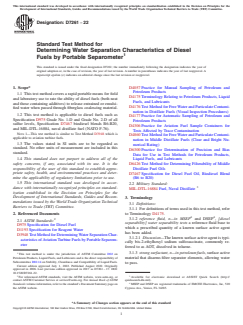
FIG. 1 Micro-Separometer Mark V Deluxe and Associated Control Panel
7. Apparatus
6,7
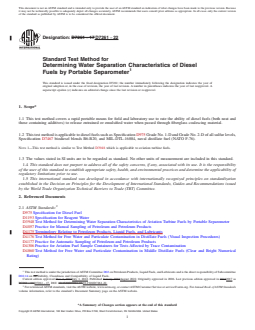
7.1 A Micro-Separometer instrument is used to perform the test. The unit is portable and self-contained, capable of operating
on an internal rechargeable battery pack or being connected to an ac power source using power cords which are available for
various voltages. Connection to an ac power source will provide power to the unit and affect battery recharge. The accessories can
be packed in the cover of the lockable case. There are two versions of the Micro-Separometer: the Mark V Deluxe and the upgraded
version, Mark X.
NOTE 3—An extensive study was performed to verify that the Mark X Micro-Separometer gives equivalent results to the Mark V Deluxe
Micro-Separometer. See Research Report RR:D02-1647.
7.1.1 The Emcee Model 1140 Micro-Separometer Mark V Deluxe and associated control panel are shown in Fig. 1.
NOTE 4—Of the lettered (A-G) push buttons on the Mark V Deluxe, only the D push button is applicable to this test method.
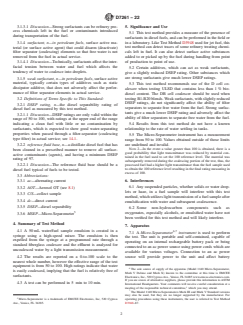
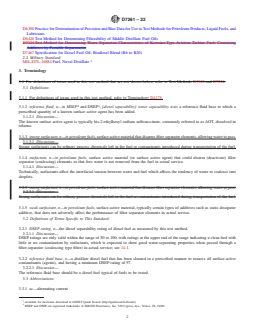
7.1.2 The Emcee Model 1140 Micro-Separometer Mark X and associated control panel are shown in Fig. 2. Table 1 lists the
manual and audio operating characteristics of the instrument.
NOTE 5—Of the lettered push buttons that select the test mode, only the DIESEL push button is applicable to this test method.
7.1.3 Both the Mark V Deluxe and Mark X Micro-Separometers have the emulsifier located on the right side of the raised panel
and the syringe drive mechanism on the left side. The control panel containing the operating controls (push buttons) is mounted
on the fixed panel in the left side of the case. A circuit breaker located on the control panel provides protection for the ac power
circuit. The turbidimeter is located under the main control panel and consists of a well in which the sample vial is placed, a light
source, and a photocell.
7.2 Beaker, Catch Pan, or Plastic Container—(Supplied with each Micro-Separometer) used to receive the waste fuel during the
coalescence period of the test.
7.3 Pipet—An automatic 50 μL hand pipet (supplied with each Micro-Separometer) designed to accept a disposable plastic tip.
8. Reagents and Materials
8.1 Aerosol OT, (AOT), solid (100 % dry) bis-2-ethylhexyl sodium sulfosuccinate.
The sole source of supply of the apparatus (Model 1140 Micro-Separometer, Mark V Deluxe and Mark X) known to the committee at this time is EMCEE Electronics,
Inc., 520 Cypress Ave., Venice, FL 34285 www.emcee-electronics.com. If you are aware of alternative suppliers, please provide this information to ASTM International
Headquarters. Your comments will receive careful consideration at a meeting of the responsible technical committee, which you may attend.
The Model 1140 Micro-Separometers Mark III and Mark V Standard versions may also be used, but they are no longer supported by the manufacturer. For operating
procedures using these instruments, the user is referred to Test Method D3948–87.
Supporting data have been filed at ASTM International Headquarters and may be obtained by requesting Research Report RR:D02-1647. Contact ASTM Customer
Service at service@astm.org.
D7261 − 22
FIG. 2 Micro-Separometer Mark X and Control Panel
TABLE 1 Manual and Audio Operating Characteristics of the Emcee Model 1140 Micro-Separometer Instrument for
Mode D/Diesel Operation
Available Test Mode(s) Function Mark V Deluxe Mark X
Test Mode - Select Mode D
Depress D push button Diesel push button
Syringe Drive Not required Not required
Speed Selection Not required Not required
Clean Cycle
Depress START push button CLEAN 1
CLEAN 2
Initiate Automatic Test Sequence
Depress START push button RUN push button
Cancel Automatic Sequence
Depress RESET push button RESET push button
1st Meter Read
1st Meter Adjust Depress ARROW push buttons Not required
2nd Meter Read
2nd Meter Adjust Depress ARROW push buttons Not required
Collect Sample Short Tone and C/S Short Tone and C/S
Annunciator Lamp Illuminates Annunciator Lamp Illuminates
3rd Meter Read
Record Measurement Pulsed Tone Sounds 5 s into 3rd Meter Read Steady tone
8.2 Dispersing Agent—Toluene solution (Warning—Flammable. Vapor harmful.) containing 1 mg of Aerosol OT per milliliter of
toluene.
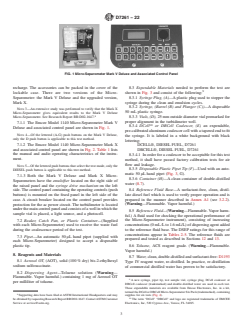
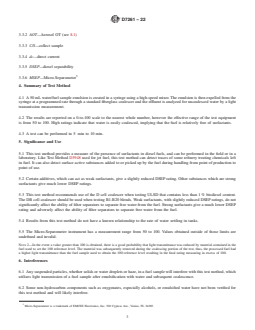
8.3 Expendable Materials needed to perform the test are shown in Fig. 3 and consist of the following:
8.3.1 Syringe Plug, (A)—A plastic plug used to stopper the syringe during the clean and emulsion cycles.
8.3.2 Syringe, (Barrel (B) and Plunger (C))—A disposable 50 mL plastic syringe.
8.3.3 Vials, (D), 25 mm outside diameter vial premarked for proper alignment in the turbidimeter well.
8.3.4 DCell or DBCell Coalescer, (E) an expendable, pre-calibrated aluminum coalescer cell with a tapered end to fit the syringe.
It is labeled in a white background with black lettering:
DCELL®, DIESEL FUEL, D7261
DBCELL®, DIESEL FUEL, D7261
8.3.4.1 In order for a coalescer to be acceptable for this test method, it shall have passed factory calibration tests for air flow and
leakage.
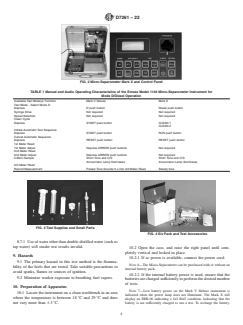
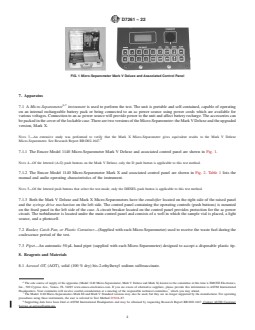
A new syringe, pipet tip, test sample vial, syringe plug, DCell coalescer or DBCell coalescer (trademarked) and double distilled water are used in each test. These
expendable materials are available from Emcee Electronics, Inc. in a kit, termed the DCell or DBCell Micro-Separometer Six Pack (trademarked), containing supplies for
six tests (Fig. 4).
The term “DCell” “DBCell” and logo are registered trademarks of EMCEE Electronics, Inc, 520 Cypress Ave., Venice, FL 34285.
D7261 − 22
FIG. 3 Test Supplies and Small Parts
FIG. 4 Six Pack and Test Accessories
8.3.5 Disposable Plastic Pipet Tip (F)—Used with an automatic 50 μL hand pipet (Fig. 3, G).
8.3.6 Container (H)—A clean container of double-distilled water (8.7).
8.4 Reference Fluid Base—A surfactant-free, clean, distillate diesel fuel which is used to verify proper operation and is prepared
in the manner described in Annex A1 (see 3.3.23.2.2). (Warning—Flammable. Vapor harmful.)
8.5 Reference Fluid—(Warning—Flammable. Vapor harmful.) A fluid used for checking the operational performance of the
Micro-Separometer instrument), consisting of increasing concentrations (0 mL ⁄L to 1.6 mL/L) of dispersing agent added to the
reference fluid base. The DSEP ratings for this range of concentrations appear in Tables 2-5. The reference fluids are prepared and
tested as described in Sections 12 and 13.
8.6 Toluene, ACS reagent grade. (Warning—Flammable. Vapor harmful.)
8.7 Water, clean, double-distilled and surfactant-free: D1193 Type IV reagent water, re-distilled. In practice, re-distillation of
commercial distilled water has proven to be satisfactory.
8.7.1 Use of water other than double-distilled water (such as tap water) will render test results invalid.
9. Hazards
9.1 The primary hazard in this test method is the flammability of the fuels that are tested. Take suitable precautions to avoid sparks,
flames or sources of ignition.
9.2 Minimize worker exposure to breathing fuel vapors.
10. Preparation of Apparatus
10.1 Locate the instrument on a clean workbench in an area where the temperature is between 18 °C and 29 °C and does not vary
more than 63 °C.
D7261 − 22
TABLE 2 Expected Performance for Reference Fluids—ULSD
Using the D Cell
D Cell ULSD
Concentration of AOT Average DSEP Rating Standard Deviation
(mg/L)
0 96.4 1.93
0.3 90.3 2.21
0.6 82.4 4.08
0.9 75.2 4.83
1.2 72.6 3.29
TABLE 3 Expected Performance for Reference Fluids—Marine
Diesel using the D Cell
D Cell Marine Diesel
Concentration of AOT Average DSEP Rating Standard Deviation
(mg/L)
0 98.2 1.47
0.6 80.8 2.24
1.2 67.7 3.75
TABLE 4 Expected Performance for Reference Fluids—B5 using
the DB Cell
DB Cell B5
Concentration of AOT Average DSEP Rating Standard Deviation
(mg/L)
0 99.6 0.73
0.3 97.5 1.68
0.6 91.2 3.19
0.9 85.3 3.77
1.2 83.5 4.79
TABLE 5 Expected Performance for Reference Fluids—B20 using
the DB Cell
DB Cell B20
Concentration of AOT Average DSEP Rating Standard Deviation
(mg/L)
0 99.4 0.73
0.3 95.8 1.65
0.6 88.8 3.47
0.9 81.4 4.41
1.2 72.4 5.59
10.2 Open the case, and raise the right panel until completely vertical and locked in place.
10.2.1 If ac power is available, connect the power cord.
NOTE 6—The Micro-Separometer can be purchased with or without an internal battery pack.
10.2.2 If the internal battery power is used, ensure that the batteries are charged sufficiently to perform the desired number of tests.
NOTE 7—Low battery power on the Mark V Deluxe instrument is indicated when the power lamp does not illuminate. The Mark X will display an ERR-06
indicating a LO BAT condition, indicating that the battery is not sufficiently charged to run a test. To recharge the battery, connect the instrument to an
ac power source for at least 16 h (full charge) prior to use. Approximately 25 tests can then be performed.
10.2.3 Turn the Mark V Deluxe and Mark X instruments on by depressing the switch (push button) marked ON.
NOTE 8—The on-power indicator light will alternately pulse on and off when the instrument is connected to an ac power source and will stay on
continuously when operated by the battery pack (dc power source). Flickering of the power indicator light, during any portion of a test sequence being
performed using battery power, indicates that recharging is necessary.
D7261 − 22
10.3 Have ready a supply of syringes, syringe plugs, vials, DCell or DBCell coalescers, the pipet and pipet tips, and a clean
container of double-distilled water.
NOTE 9—Syringe drive travel times during the coalescing test period were initially calibrated at the factory for each mode of operation and have a
significant bearing on the final test results. Syringe drive travel times exceeding the upper limit will cause the final results to measure high; conversely,
travel times below the lower limit will cause the final results to measure low. Mark V Deluxe and Mark X instruments have self-check circuitry to detect
out-of-tolerance syringe drive travel times. The Mark V Deluxe alert indicator lamp (marked SYR) illuminates and depending on the degree (more than
3 s) of the out-of-tolerance condition, three short (1-s) tones will also sound. The Mark X ERROR ALERT indicator illuminates and ERR-03 is displayed.
An occasional out-of-tolerance alert may be experienced due to some intermittent condition, which probably will not be indicative of instrument failure.
However, repeated alerts are cause for returning the instrument to the factory for adjustment.
11. Sampling and Sample Preparation
11.1 Rinse the sample container three times with the product to be sampled before collecting the sample. Collect a sample of at
least 1 L, and preferably about 3 L, in a clean container in accordance with Practice D4057 or D4177.
NOTE 10—Test method results are known to be sensitive to trace contamination from sampling containers. For recommended sampling containers, refer
to Practice D4306. Special precautions concerning sample containers and sampling technique are discussed in Appendix X1. Extreme care and cleanliness
are required in taking samples either directly into the test syringe or into a sample container.
11.1.1 Before pouring the test sample from the container, wipe the container outlet thoroughly with a clean, lintless wiper; pour
the test sample into a clean beaker or directly into the barrel of the test syringe.
11.2 (Warning—Do not, under any circumstances, prefilter the test fuel. The filter media can remove the very materials,
surfactants, that the test method is designed to detect. If the test fuel is contaminated with particulate matter, allow such materials
to settle out of the fuel before testing. Test methods such as D4176, D4860, and D6426 may be used to determine the quality and
cleanliness of the sample.)
NOTE 11—If a sample does not clear up after being allowed to stand for a period of time, the sample cannot be tested by this test method (6.1).
11.3 If the sample is not within the test temperature limits of 18 °C to 29 °C, allow the sample to stand or place the sample
container in a water bath until the temperature is within the prescribed limits. The preferred temperature for testing is
approximately 23 °C.
12. Calibration and Verification
12.1 The instrument is calibrated at the factory by using inhouse test equipment.
12.2 Instrument performance, especially for field use, may be verified by performing DSEP tests using a dilution of the dispersing
agent (as prepared in 8.3), a reference fluid base (as prepared in Annex A1), and double-distilled water.
12.2.1 Prepare a 10:1 dilution by diluting 10 mL of dispersing agent (8.2) with 90 mL of toluene.
NOTE 12—Since 1 mL of dilution is equal to 0.1 mL of dispersing agent, 50 μL of dilution is equal to 0.1 mL ⁄L when added to 50 mL of reference fluid
base. The 0.1 mL ⁄L of dispersing agent corresponds to even multiples of the concentration levels listed in Table 2.
12.2.2 Use the 50 μL pipet (8.3.5) to add increments of 0.1 mL ⁄L of dispersing agent to reference fluid base.
12.2.3 Perform DSEP tests with several reference fluids and double-distilled water (8.7) according to Section 13.
12.2.4 Compare the DSEP ratings to the values listed in Table 2 for the particular concentration of dispersing agent used.
12.3 If the results do not fall within the range of limits shown in Table 2, the reference fluid shall be discarded and a fresh quantity
of reference fluid prepared and the verification repeated.
12.4 If repeated verification tests give out-of-tolerance test results, return the instrument to the factory for adjustment and
recalibration.
D7261 − 22
TABLE 6 Test Sequence (Mode D Operation)
Time
Micro-Separometer
min:s
Operator Activity
Action
Test Sequence (Time) Elapsed Time
Start sequence Depress start switch 0 0
Pulsed tone Prepare for meter read 0:04 0:04
Meter on Full-scale adjustment 1 0:10 0:14
Emulsifier on Observe emulsification 0:30 0:44
No activity Place emulsified sample into syringe drive 0:30 1:14
Pulsed tone Prepare for meter reading 0:04 1:18
Meter on Full-scale adjustment 2 0:10 1:28
Syringe drive Coalescence period 0:45 2:13
Starts down Collect sample
No activity Place sample into turbidimeter well 0:56 3:09
Steady tone Prepare for meter reading 0:04 3:13
Meter on Read results 0:05 3:18
One second tone Record results 0:05 3:23
13. Procedure
13.1 Select Mode D (Mark V Deluxe) or DIESEL (Mark X) operation.
13.1.1 Depress push button D or DIESEL for Mode D operation.
NOTE 13—Sequential illumination of the push buttons will cease and the depressed push button will stay lit. The correct syringe drive speed is set
automatically.
13.2 To remove any contaminants from the syringe barrel and stirrer, run two 50 mL portions of the fuel to be tested through the
mixing system in clean cycles, as follows.
13.2.1 Remove the plunger from a new 50 mL syringe and wipe the tip using a clean, l
...