

ASTM D6434-12(2018)
(Guide)Standard Guide for the Selection of Test Methods for Flexible Polypropylene Geomembranes
General Information
- Abstract
SIGNIFICANCE AND USE
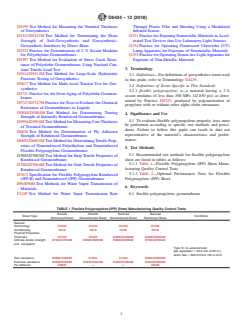
4.1 To evaluate flexible polypropylene properly, tests must be performed according to specific test methods and procedures. Failure to follow this guide can result in data not representative of the material's characteristics and performance.
SCOPE
1.1 This guide covers recommendations for the selection of appropriate test methods for flexible polypropylene sheet used in geomembrane applications to provide consistency in data reporting.
1.2 This guide includes test methods for three types of flexible polypropylene geomembranes, including smooth nonreinforced sheet, textured nonreinforced sheet, and scrim-reinforced sheet.
1.3 This guide is intended to aid all personnel involved in the selection, manufacture, installation, or evaluation of flexible polypropylene geomembrane sheet.
1.4 This standard does not purport to address all of the safety concerns, if any, associated with its use. It is the responsibility of the user of this standard to establish appropriate safety, health, and environmental practices and determine the applicability of regulatory limitations prior to use.
1.5 This international standard was developed in accordance with internationally recognized principles on standardization established in the Decision on Principles for the Development of International Standards, Guides and Recommendations issued by the World Trade Organization Technical Barriers to Trade (TBT) Committee.
- Status
- Published
- Publication Date
- 30-Apr-2018
- Technical Committee
- D35 - Geosynthetics
- Drafting Committee
- D35.10 - Geomembranes


Overview
ASTM D6434-12(2018), titled Standard Guide for the Selection of Test Methods for Flexible Polypropylene Geomembranes, provides recommendations for selecting appropriate test methods when evaluating flexible polypropylene (fPP) sheet materials used in geomembrane applications. Developed by ASTM International, this guide is essential for ensuring that the physical, mechanical, and endurance properties of flexible polypropylene geomembranes are assessed consistently and accurately. The standard addresses smooth nonreinforced sheets, textured nonreinforced sheets, and scrim-reinforced sheets, guiding personnel involved in selection, manufacturing, installation, and evaluation.
Key Topics
- Selection of Test Methods: The guide outlines how to choose suitable test procedures for flexible polypropylene geomembranes to ensure reliable and reproducible test data.
- Types of Geomembranes Covered: Recommendations are included for:
- Smooth nonreinforced sheet
- Textured nonreinforced sheet
- Scrim-reinforced sheet
- Quality Control and Performance Testing: The guide identifies tests relevant to both manufacturing quality control and optional performance assessment, referencing a wide array of ASTM test methods.
- Data Consistency: Following this guide is crucial for producing data that accurately represents the characteristics and performance of fPP geomembranes.
Applications
Flexible polypropylene geomembranes are widely used as containment barriers in a variety of environmental, civil, and geotechnical applications, including:
- Landfill Liners and Covers: Ensuring containment of waste materials and prevention of leachate migration.
- Water Containment: Used in reservoirs, canals, and ponds where chemical and UV resistance are required.
- Mining Operations: As liners for heap leach pads and tailings impoundments to control seepage and protect groundwater.
- Wastewater Treatment: Serving as lining systems in lagoons and tanks exposed to aggressive chemical environments.
- Agricultural Use: For lining irrigation ponds and containment basins.
By specifying and conducting the recommended test methods, project stakeholders can be confident in the durability, chemical resistance, flexural properties, and physical integrity of fPP geomembrane materials.
Related Standards
ASTM D6434-12(2018) draws upon numerous related ASTM standards to cover testing of various properties. Some of the key referenced standards include:
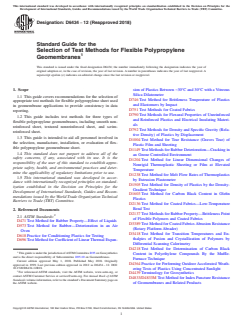
- ASTM D5199: Test Method for Measuring Thickness of Geosynthetics
- ASTM D6693: Test Method for Tensile Properties of Nonreinforced Polyethylene and Flexible Polypropylene
- ASTM D5884: Test Method for Tearing Strength of Reinforced Geomembranes
- ASTM D4833: Test Method for Index Puncture Resistance
- ASTM D5321: Test Method for Determining the Shear Strength of Soil-Geosynthetic and Geosynthetic-Geosynthetic Interfaces
- ASTM D1603: Test Method for Carbon Black Content in Olefin Plastics
- ASTM E96: Test Method for Water Vapor Transmission Rate
- ASTM D4439: Terminology for Geosynthetics
These and other referenced standards provide the basis for comprehensive testing as recommended in ASTM D6434.
Practical Value
By following ASTM D6434-12(2018), users ensure that testing of flexible polypropylene geomembranes is consistent, reliable, and internationally recognized. This reduces the risk of material selection errors, supports regulatory compliance, and contributes to the overall quality and longevity of critical containment systems.
Keywords: ASTM D6434, flexible polypropylene geomembranes, test methods, quality control, geomembrane testing, reinforced geomembranes, geosynthetics, containment liner standards.
Relations
- Effective Date
- 01-May-2018
- Effective Date
- 01-Mar-2024
- Effective Date
- 01-Feb-2024
- Refers
ASTM D1238-23a - Standard Test Method for Melt Flow Rates of Thermoplastics by Extrusion Plastometer - Effective Date
- 15-Nov-2023
- Effective Date
- 15-Nov-2023
- Effective Date
- 01-Nov-2023
- Effective Date
- 01-Nov-2023
- Effective Date
- 01-Jun-2020
- Effective Date
- 01-Jun-2020
- Effective Date
- 01-Jun-2020
- Effective Date
- 01-Apr-2020
- Effective Date
- 01-Feb-2020
- Effective Date
- 01-Feb-2020
- Effective Date
- 15-Oct-2019
- Effective Date
- 01-Jul-2019
Get Certified
Connect with accredited certification bodies for this standard

DIBt (Deutsches Institut für Bautechnik)
German Institute for Building Technology.
DIN CERTCO
DIN Group product certification.

Aboma Certification B.V.
Specialized in construction, metal, and transport sectors.
Sponsored listings
Frequently Asked Questions
ASTM D6434-12(2018) is a guide published by ASTM International. Its full title is "Standard Guide for the Selection of Test Methods for Flexible Polypropylene Geomembranes". This standard covers: SIGNIFICANCE AND USE 4.1 To evaluate flexible polypropylene properly, tests must be performed according to specific test methods and procedures. Failure to follow this guide can result in data not representative of the material's characteristics and performance. SCOPE 1.1 This guide covers recommendations for the selection of appropriate test methods for flexible polypropylene sheet used in geomembrane applications to provide consistency in data reporting. 1.2 This guide includes test methods for three types of flexible polypropylene geomembranes, including smooth nonreinforced sheet, textured nonreinforced sheet, and scrim-reinforced sheet. 1.3 This guide is intended to aid all personnel involved in the selection, manufacture, installation, or evaluation of flexible polypropylene geomembrane sheet. 1.4 This standard does not purport to address all of the safety concerns, if any, associated with its use. It is the responsibility of the user of this standard to establish appropriate safety, health, and environmental practices and determine the applicability of regulatory limitations prior to use. 1.5 This international standard was developed in accordance with internationally recognized principles on standardization established in the Decision on Principles for the Development of International Standards, Guides and Recommendations issued by the World Trade Organization Technical Barriers to Trade (TBT) Committee.
SIGNIFICANCE AND USE 4.1 To evaluate flexible polypropylene properly, tests must be performed according to specific test methods and procedures. Failure to follow this guide can result in data not representative of the material's characteristics and performance. SCOPE 1.1 This guide covers recommendations for the selection of appropriate test methods for flexible polypropylene sheet used in geomembrane applications to provide consistency in data reporting. 1.2 This guide includes test methods for three types of flexible polypropylene geomembranes, including smooth nonreinforced sheet, textured nonreinforced sheet, and scrim-reinforced sheet. 1.3 This guide is intended to aid all personnel involved in the selection, manufacture, installation, or evaluation of flexible polypropylene geomembrane sheet. 1.4 This standard does not purport to address all of the safety concerns, if any, associated with its use. It is the responsibility of the user of this standard to establish appropriate safety, health, and environmental practices and determine the applicability of regulatory limitations prior to use. 1.5 This international standard was developed in accordance with internationally recognized principles on standardization established in the Decision on Principles for the Development of International Standards, Guides and Recommendations issued by the World Trade Organization Technical Barriers to Trade (TBT) Committee.
ASTM D6434-12(2018) is classified under the following ICS (International Classification for Standards) categories: 91.100.50 - Binders. Sealing materials. The ICS classification helps identify the subject area and facilitates finding related standards.
ASTM D6434-12(2018) has the following relationships with other standards: It is inter standard links to ASTM D6434-12, ASTM E96/E96M-24, ASTM D4439-24, ASTM D1238-23a, ASTM E96/E96M-23, ASTM D5617-23, ASTM D5884/D5884M-23, ASTM F1249-20, ASTM D5397-20, ASTM D4833/D4833M-07(2020), ASTM D1204-14(2020), ASTM D4218-20, ASTM D1603-20, ASTM D5397-19a, ASTM D5321/D5321M-19. Understanding these relationships helps ensure you are using the most current and applicable version of the standard.
ASTM D6434-12(2018) is available in PDF format for immediate download after purchase. The document can be added to your cart and obtained through the secure checkout process. Digital delivery ensures instant access to the complete standard document.
Standards Content (Sample)
This international standard was developed in accordance with internationally recognized principles on standardization established in the Decision on Principles for the
Development of International Standards, Guides and Recommendations issued by the World Trade Organization Technical Barriers to Trade (TBT) Committee.
Designation: D6434 − 12 (Reapproved 2018)
Standard Guide for the
Selection of Test Methods for Flexible Polypropylene
Geomembranes
This standard is issued under the fixed designation D6434; the number immediately following the designation indicates the year of
original adoption or, in the case of revision, the year of last revision.Anumber in parentheses indicates the year of last reapproval.A
superscript epsilon (´) indicates an editorial change since the last revision or reapproval.
1. Scope sion of Plastics Between −30°C and 30°C with aVitreous
Silica Dilatometer
1.1 This guide covers recommendations for the selection of
D746Test Method for Brittleness Temperature of Plastics
appropriate test methods for flexible polypropylene sheet used
and Elastomers by Impact
in geomembrane applications to provide consistency in data
D751Test Methods for Coated Fabrics
reporting.
D790Test Methods for Flexural Properties of Unreinforced
1.2 This guide includes test methods for three types of
and Reinforced Plastics and Electrical Insulating Materi-
flexible polypropylene geomembranes, including smooth non-
als
reinforced sheet, textured nonreinforced sheet, and scrim-
D792Test Methods for Density and Specific Gravity (Rela-
reinforced sheet.
tive Density) of Plastics by Displacement
1.3 This guide is intended to aid all personnel involved in
D1004Test Method for Tear Resistance (Graves Tear) of
the selection, manufacture, installation, or evaluation of flex-
Plastic Film and Sheeting
ible polypropylene geomembrane sheet.
D1149TestMethodsforRubberDeterioration—Crackingin
1.4 This standard does not purport to address all of the
an Ozone Controlled Environment
safety concerns, if any, associated with its use. It is the
D1204Test Method for Linear Dimensional Changes of
responsibility of the user of this standard to establish appro-
Nonrigid Thermoplastic Sheeting or Film at Elevated
priate safety, health, and environmental practices and deter-
Temperature
mine the applicability of regulatory limitations prior to use.
D1238Test Method for Melt Flow Rates of Thermoplastics
1.5 This international standard was developed in accor-
by Extrusion Plastometer
dance with internationally recognized principles on standard-
D1505Test Method for Density of Plastics by the Density-
ization established in the Decision on Principles for the
Gradient Technique
Development of International Standards, Guides and Recom-
D1603Test Method for Carbon Black Content in Olefin
mendations issued by the World Trade Organization Technical
Plastics
Barriers to Trade (TBT) Committee.
D2136Test Method for Coated Fabrics—Low-Temperature
Bend Test
2. Referenced Documents
D2137TestMethodsforRubberProperty—BrittlenessPoint
2.1 ASTM Standards:
of Flexible Polymers and Coated Fabrics
D471Test Method for Rubber Property—Effect of Liquids
D3389Test Method for Coated FabricsAbrasion Resistance
D573Test Method for Rubber—Deterioration in an Air
(Rotary Platform Abrader)
Oven
D3418Test Method for Transition Temperatures and En-
D618Practice for Conditioning Plastics for Testing
thalpies of Fusion and Crystallization of Polymers by
D696TestMethodforCoefficientofLinearThermalExpan-
Differential Scanning Calorimetry
D4218Test Method for Determination of Carbon Black
ThisguideisunderthejurisdictionofASTMCommitteeD35onGeosynthetics
Content in Polyethylene Compounds By the Muffle-
and is the direct responsibility of Subcommittee D35.10 on Geomembranes.
Furnace Technique
Current edition approved May 1, 2018. Published May 2018. Originally
D4364Practice for Performing OutdoorAccelerated Weath-
approved in 1999. Last previous edition approved in 2012 as D6434–12. DOI:
10.1520/D6434-12R18.
ering Tests of Plastics Using Concentrated Sunlight
For referenced ASTM standards, visit the ASTM website, www.astm.org, or
D4439Terminology for Geosynthetics
contact ASTM Customer Service at service@astm.org. For Annual Book of ASTM
D4833/D4833MTest Method for Index Puncture Resistance
Standards volume information, refer to the standard’s Document Summary page on
the ASTM website. of Geomembranes and Related Products
Copyright © ASTM International, 100 Barr Harbor Drive, PO Box C700, West Conshohocken, PA 19428-2959. United States
D6434 − 12 (2018)
D5199Test Method for Measuring the Nominal Thickness Through Plastic Film and Sheeting Using a Modulated
of Geosynthetics Infrared Sensor
D5321/D5321MTest Method for Determining the Shear G151PracticeforExposingNonmetallicMaterialsinAccel-
Strength of Soil-Geosynthetic and Geosynthetic- erated Test Devices that Use Laboratory Light Sources
Geosynthetic Interfaces by Direct Shear G154Practice for Operating Fluorescent Ultraviolet (UV)
D5323Practice for Determination of 2 % Secant Modulus Lamp Apparatus for Exposure of Nonmetallic Materials
for Polyethylene Geomembranes G155Practice for Operating XenonArc LightApparatus for
D5397Test Method for Evaluation of Stress Crack Resis- Exposure of Non-Metallic Materials
tance of Polyolefin Geomembranes Using Notched Con-
3. Terminology
stant Tensile Load Test
D5514/D5514MTest Method for Large-Scale Hydrostatic
3.1 Definitions—Fordefinitionsofgeosyntheticstermsused
Puncture Testing of Geosynthetics
in this guide, refer to Ter
...