


Unlocking Productivity: Key Standards for Industrial Process Measurement and Control
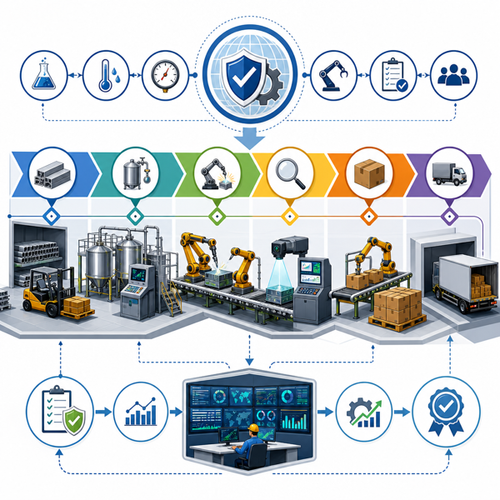
Unlocking Productivity: Key Standards for Industrial Process Measurement and Control
Industrial process measurement and control standards form the backbone of smart manufacturing and digital transformation strategies. As businesses worldwide race to modernize with connected systems and embrace Industry 4.0, the need for interoperable, secure, and scalable integration is more vital than ever. In this article, we explore four foundational standards that every manufacturing organization should know: EN IEC 62264-2:2026, EN IEC 62541-14:2026, EN IEC 62541-3:2026, and EN IEC 62541-9:2026. Together, these documents provide the architecture, data models, and communication protocols necessary to harmonize operations from the shop floor to the enterprise level, ultimately empowering businesses to achieve higher productivity, robust security, and seamless scaling.
Overview / Introduction
In the world of modern manufacturing, process measurement and industrial control systems are the nerve center of automation. Integrating complex machinery, software, and IT systems requires more than just good hardware—it demands common frameworks, interfaces, and communication protocols that everyone can trust. This is where international standards become essential.
Industrial process measurement and control standards provide the shared language and methodology that enable devices, platforms, and teams to work together—often across multiple sites, companies, or even continents. Without these standards, factories risk inefficiency, errors, security vulnerabilities, regulatory non-compliance, and lost opportunities for innovation.
This article will help you:
- Understand four leading international standards (EN IEC 62264-2:2026, EN IEC 62541-14:2026, EN IEC 62541-3:2026, EN IEC 62541-9:2026)
- Learn how these standards support enterprise integration, industrial communication, address space modeling, and advanced alarms/conditions
- Explore why adopting these standards is critical for introducing new technologies, ensuring productivity, maintaining cybersecurity, and supporting business scalability
- Gain actionable guidance on implementation and compliance
You don’t need to be a technical expert—a basic understanding of manufacturing systems is enough to see how these documents can set your business up for success.
Detailed Standards Coverage
EN IEC 62264-2:2026 – Enterprise-Control System Integration: Object Models & Relationships
Enterprise-Control System Integration - Part 2: Object Models and Relationships for Interfaces Between Manufacturing Operations and Business Functions
EN IEC 62264-2:2026 sets the gold standard for integrating manufacturing operations systems with enterprise business functions. It addresses how information is exchanged between Level 3 (manufacturing operations) and Level 4 (business systems) in the classic enterprise hierarchy. The standard defines a comprehensive suite of object models—conceptual frameworks that determine how data, roles, resources, and events are represented so they can flow reliably between the manufacturing floor and higher-level business applications.
Key requirements and specifications:
- Focuses on information models to enable integration rather than prescribing physical or logical data models
- Provides an interface framework that reduces risk, cost, and error during system implementation
- Encompasses models for resources, operations, events, records, locations, tests, and measurement uncertainties
- Facilitates mapping from other standards by providing conceptual-level semantics
- Includes mechanisms for interface extension to future-proof implementations
Who should comply:
- Manufacturers aiming for IT/OT (Information Technology/Operational Technology) integration
- ERP/MES vendors and integrators
- Industrial engineers designing large-scale process automation
Practical implications: Implementing EN IEC 62264-2:2026 enables clear, consistent data exchange between systems such as MES (Manufacturing Execution Systems) and ERP (Enterprise Resource Planning), reducing integration headaches and manual translation. The result is a smooth, real-time information flow across departments—from raw material logistics to finished product tracking and corporate reporting.
Notable features:
- Addition of object models for interactive event communications, spatial/location definitions, and operations tests
- Defined measurement uncertainty attributes for increased reliability
- Updated conventions for object roles, names, and relationships for better transparency
- Clear alignment with the latest versions of related standards (such as OPC UA models)
Key highlights:
- Enables seamless integration between business and operations systems
- Reduces manual data handling, cuts costs, and minimizes errors
- Future-proofs interfaces with extensible models and conceptual mappings
Access the full standard:View EN IEC 62264-2:2026 on iTeh Standards
EN IEC 62541-14:2026 – OPC Unified Architecture: PubSub (Publish-Subscribe Pattern)
OPC Unified Architecture - Part 14: PubSub
EN IEC 62541-14:2026 introduces the Publish-Subscribe (PubSub) communication model to OPC Unified Architecture (OPC UA), complementing the traditional client-server paradigm. The PubSub approach revolutionizes how data and events are distributed: instead of single-request/single-response communication, publishers transmit updates on availability, and many subscribers receive data simultaneously. This model is particularly effective for integrating sensors, controllers, analytics, and cloud platforms—key players in the Industrial Internet of Things (IIoT).
Key requirements and specifications:
- Defines PubSub concepts, configuration parameters, and transport protocols (including UDP, Ethernet, AMQP, MQTT)
- Supports both real-time, device-level networking and IT/cloud-based data distribution
- Introduces a comprehensive configuration model for managing PubSub entities (publishers, subscribers, topics, security groups)
- Implements advanced security: message and transport security, key management, and group-based access controls
- Extends support for quantity and unit metadata, and precise value handling (ValuePrecision)
Who should comply:
- Automation suppliers and integrators building or upgrading OPC UA-based networks
- Device, sensor, controller, and SCADA (Supervisory Control and Data Acquisition) manufacturers
- IT/OT architects enabling smart factory infrastructure and IIoT deployments
Practical implications: PubSub-based OPC UA networks deliver unmatched scalability and flexibility, allowing thousands of devices to report in real time without cumbersome point-to-point connections. This is pivotal for predictive maintenance, cloud-based analytics, and time-sensitive industrial applications. Enhanced security ensures trust, while standardized configuration enables easy scaling and interoperability.
Notable features:
- Addition of a “Quantity Model” for automated engineering unit conversion
- Enhanced rules for value precision across data types
- Flexible, protocol-agnostic message transport for edge, on-premise, and cloud
- Advanced support for Low Latency and High Throughput industrial operations
Key highlights:
- Enables massive scalability for IIoT and smart manufacturing environments
- Drastically simplifies system integration and device onboarding
- Provides strong, consistent security across diverse device networks
Access the full standard:View EN IEC 62541-14:2026 on iTeh Standards
EN IEC 62541-3:2026 – OPC Unified Architecture: Address Space Model
OPC Unified Architecture - Part 3: Address Space Model
EN IEC 62541-3:2026 provides the meta-model underlying all OPC UA information models. It defines the structure and semantics of the OPC UA AddressSpace—a virtual container that describes all Nodes (objects, variables, methods, events, etc.) in an OPC UA system. This is crucial for making systems self-descriptive, discoverable, and integrable at scale.
Key requirements and specifications:
- Defines Nodes, NodeClasses, attributes, and the relationships (references, event sources, hierarchy)
- Establishes modeling rules for both object-oriented and data-centric structures (objects, variables, methods, datatypes, views)
- Adds new concepts and elements: interfaces, AddIns, method meta data, storage and configuration constants, non-volatile storage, and currency support
- Clarifies subtyping, instantiation, and event management
- Supports complex layering and extension for system interoperability
Who should comply:
- System integrators and device vendors creating OPC UA servers/clients
- Industrial software developers building digital twins, analytics, or custom OPC UA extensions
- Automation engineers architecting future-ready control systems
Practical implications: A well-modeled AddressSpace ensures every component—whether a robot arm or a sensor—can be mapped, discovered, and used by any compatible tool or application. EN IEC 62541-3:2026 thus simplifies vertical and horizontal data integration, supports advanced analytics, and enables automated diagnostics, all while promoting best practices for system modularity and openness.
Notable features:
- Rich, object-oriented structure for all plant data and behavior
- Addition of interfaces, AddIns, and relationship/reference types for extensibility
- Explicit support for non-volatile and configuration data management
- Consistent handling of events and permissions (roles, access levels)
Key highlights:
- Foundation for scalable, future-proof OPC UA deployments
- Reduces integration effort by establishing a universal information model
- Enables self-describing, discoverable industrial assets and systems
Access the full standard:View EN IEC 62541-3:2026 on iTeh Standards
EN IEC 62541-9:2026 – OPC Unified Architecture: Alarms and Conditions
OPC Unified Architecture - Part 9: Alarms and Conditions
EN IEC 62541-9:2026 establishes how alarms and conditions are represented within the OPC UA framework. This standard defines structured models for states, severity, comments, suppression, event categorization, and metrics for alarms, supporting sophisticated alarm management and rigorous operational safety. By standardizing how alarms and process conditions are handled, the document builds a strong foundation for incident detection, responsive action, and plant safety.
Key requirements and specifications:
- Specifies the OPC UA Information Model for alarms and acknowledgeable conditions
- Supports advanced alarm categorization, group management, suppression, shelving, auditing, and alarm history/metrics
- Designed in accordance with global alarm management philosophies (IEC 62682, ISA 18.2)
- Includes mappings to classic OPC A&E systems and integration with existing infrastructures
- Adds parameters for comments, alarm state variables for summary displays, methods for group member retrieval, severities, and filtering improvements
Who should comply:
- Plant managers and safety officers requiring advanced alarm management
- Manufacturers/operators in regulated industries (chemical, energy, pharmaceuticals, oil & gas)
- SCADA/HMI and automation systems vendors needing consistent, auditable alarm architectures
Practical implications: Using this standard, plants achieve uniformity in alarm and condition handling, allow for tailored alarm filtering, and compile reliable alarm history. This helps prevent alarm overload, support operator effectiveness, ensure regulatory compliance, and improve incident analysis.
Notable features:
- Enhanced alarm state tracking, group management, and diagnostics
- Support for auditing, alarm metrics, and summary visualization
- Mappings for smooth migration from legacy alarm and events systems
Key highlights:
- Ensures plant-wide alarm consistency, safety, and traceability
- Simplifies compliance with international alarm management requirements
- Allows seamless integration with modern SCADA, MES, and digital dashboards
Access the full standard:View EN IEC 62541-9:2026 on iTeh Standards
Industry Impact & Compliance
Why Are Industrial Measurement and Control Standards So Critical?
In an era of exponential technological growth, industrial process measurement and control standards are foundational for building safe, efficient, and scalable operations. Their impact includes:
- Seamless interoperability: Standards guarantee that devices, software, and teams can communicate—regardless of vendor or technical environment.
- Faster technology adoption: As Industry 4.0, IIoT, and cloud-based systems become the norm, standardized models reduce the risk, cost, and lead time of deploying new solutions.
- Regulatory compliance: Standards help fulfill legal, environmental, and safety requirements with auditable, best-practice procedures.
- Enhanced security: Consistent implementation of security protocols, encryption, and access controls helps organizations defend against cyber threats.
- Greater productivity and scaling: Automation and visibility powered by standards let businesses expand capacity and geographic reach with minimal friction.
Compliance Considerations
- Planning: Assess your current system architecture—identify the levels and interfaces where standards like EN IEC 62264-2 and OPC UA models apply.
- Gap analysis: Compare current interfaces, data models, and alarm systems against standard requirements.
- Documentation: Maintain configuration records, data exchange definitions, and security policies aligned with the standards.
- Audit readiness: Prepare for both internal and external reviews by adopting standards-based logging, history, and diagnostics.
- Training: Educate teams on standard requirements to ensure correct implementation and long-term adherence.
Risks of Non-Compliance
- Increased integration costs and longer project timelines
- Security vulnerabilities and exposure to industrial cyber threats
- Missed opportunities for digital transformation or process optimization
- Difficulty achieving regulatory approval or passing audits
- Higher risk of safety incidents or production outages due to inconsistent alarm handling
Implementation Guidance
Approaching Implementation
- Establish Internal Champions: Assign champions (e.g., automation engineers, IT/OT architects, quality managers) to oversee adoption.
- Evaluate Legacy Systems: Conduct a thorough review of current legacy and proprietary interfaces—identify upgrade priorities.
- Leverage Vendor Support: Work with vendors who support EN IEC 62264-2 and OPC UA (including PubSub, address space, and alarms modules).
- Adopt Modular Upgrades: Focus on integrating standards component by component (e.g., start with alarms & conditions, then migrate address space modeling).
- Integrate Cybersecurity: Always implement security considerations in tandem with new standards. This reduces risk and ensures future compliance.
- Plan for Extensions and Scaling: Use standards’ extension mechanisms to future-proof your investment and prepare for scaling.
Best Practices
- Align project goals with international standard requirements from the start
- Use open, well-documented protocols—avoid vendor lock-in
- Incorporate staff training into rollout e.g., OPC UA seminars, alarm management workshops
- Test integration scenarios using digital twins or simulation tools
- Maintain rigorous documentation, especially for interface configuration and alarm management
- Monitor for updates to standards and plan regular reviews for compliance
Resources for Organizations
- Technical documentation and implementation guides from iTeh Standards
- Industry webinars and training events on OPC UA and enterprise integration
- Case studies showcasing successful migrations or system upgrades
- Community and industry groups focused on smart manufacturing standards
Conclusion / Next Steps
The journey to operational excellence in manufacturing today is powered by standards like EN IEC 62264-2:2026, EN IEC 62541-14:2026, EN IEC 62541-3:2026, and EN IEC 62541-9:2026. Adopting these specifications not only ensures compliance and safety but also opens the door to seamless integration, unprecedented productivity, and the agility required for rapid scaling and innovation.
Key takeaways:
- Industrial process measurement and control standards are essential for any manufacturer aiming for digital transformation, scaling, and security.
- The four standards reviewed here cover core pillars: enterprise integration, flexible communication, unified address modeling, and advanced alarms management.
- Compliance delivers competitive advantage, smoother upgrades, reduced risk, and global interoperability.
Recommendation: Begin with a standards gap analysis, prioritize the interfaces and models most relevant to your business, and work with experienced partners or vendors to implement these globally recognized frameworks.
Stay informed about developments in these critical standards—explore in-depth documentation at iTeh Standards and position your business at the forefront of modern manufacturing.
Categories
- Latest News
- New Arrivals
- Generalities
- Services and Management
- Natural Sciences
- Health Care
- Environment
- Metrology and Measurement
- Testing
- Mechanical Systems
- Fluid Systems
- Manufacturing
- Energy and Heat
- Electrical Engineering
- Electronics
- Telecommunications
- Information Technology
- Image Technology
- Precision Mechanics
- Road Vehicles
- Railway Engineering
- Shipbuilding
- Aircraft and Space
- Materials Handling
- Packaging
- Textile and Leather
- Clothing
- Agriculture
- Food technology
- Chemical Technology
- Mining and Minerals
- Petroleum
- Metallurgy
- Wood technology
- Glass and Ceramics
- Rubber and Plastics
- Paper Technology
- Paint Industries
- Construction
- Civil Engineering
- Military Engineering
- Entertainment