


Space Systems and Operations: Key Standards for Risk Mitigation, Quality, and Scale
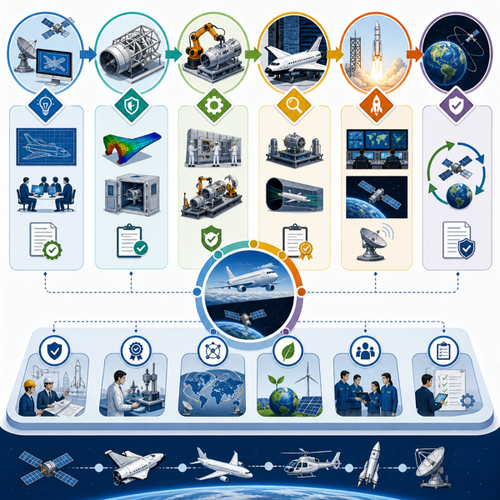
Space systems and operations are at the core of today’s rapidly evolving aerospace sector. As commercial space launches, satellite constellations, and new forms of in-orbit activity abound, robust international standards are more crucial than ever. In this article, we dive deep into four essential standards shaping the industry: from failure analysis at launch facilities to safe deployment of small spacecraft, precise solar cell calibration, and comprehensive collision avoidance protocols. Adopting these standards isn’t merely a matter of compliance—they are essential tools for enhancing security, productivity, and scalability in any modern space program.
Overview / Introduction
The aerospace and space systems sector continues to expand, with space commercialization, satellites for communication and earth observation, and an increasing focus on sustainable, safe operations in orbit. Each of these activities introduces significant technical and operational challenges. The key to addressing these challenges lies in the adoption of internationally recognized standards.
Space standards provide a universal language and clear guidelines for:
- Risk management and mitigation
- Quality assurance and uniformity
- Protecting assets against failure and environmental hazards
- Ensuring interoperability among international partners and supply chains
- Facilitating scaling and deployment of new space technologies
This article covers four pivotal international standards in space systems and operations. You'll learn what each standard covers, their core requirements, real-world implications, and how they collectively set the foundation for secure, scalable, and productive space activity.
Detailed Standards Coverage
ISO 16159:2025 - Launch Pad and Integration Site Failure Analysis
Space systems — Launch pad and integration site — Facility, system and equipment failure analysis
Modern launch pad and integration site operations demand continuous improvement and constant vigilance. ISO 16159:2025 lays out globally accepted procedures to identify, analyze, and prevent failures in the facilities, systems, and equipment essential for launch vehicle operations. The standard specifies:
- Failures during acceptance testing or routine operation
- Step-by-step processes for rigorous investigation and root cause analysis
- Creation and maintenance of uniform failure analysis records
- Communication of corrective and preventive actions across teams
Organizations involved in launch site management, ground operations, and system integration for both public and commercial launches must adhere to ISO 16159. Implementing these procedures ensures high safety standards, prevents costly asset loss or downtime, and aligns teams on a predictable, data-driven approach to troubleshooting.
Key requirements include:
- Rules for systematically investigating and identifying failure causes
- Developing and enforcing corrective actions that prevent failure recurrence
- Maintaining uniform, accessible records to inform future investigations
- Cross-functional collaboration between developers, operators, and maintainers
By applying ISO 16159:2025, businesses gain insight into facility and hardware resilience, support incident prevention, and build a safety-driven culture that is increasingly demanded by both regulators and commercial clients.
Key highlights:
- Structured process for root-cause analysis at launch facilities
- Enables reliable preventative measures and corrective actions
- Supports the safe operation of public and commercial launches
Access the full standard:View ISO 16159:2025 on iTeh Standards
ISO 19683:2026 - Qualification and Acceptance Tests for Small Spacecraft
Space systems — Design qualification and acceptance tests of small spacecraft and units
The surge in mini-, micro-, nano-, pico-, and femto-satellites—including CubeSats—demands a new level of rigor for design qualification and acceptance testing. ISO 19683:2026 provides the authoritative baseline for ensuring these new-space assets meet the reliability, performance, and safety requirements demanded by a competitive and rapidly changing market.
This standard specifies:
- Comprehensive test methods and minimum requirements for design qualification and acceptance
- Guidelines for both hardware-based and system-level qualification
- Detailed test item lists, including functional, mission, TID (Total Ionization Dose), SEE (Single Event Effect), ESD (Electrostatic Discharge), and EMC (Electromagnetic Compatibility) tests
- Criteria for test plans, documentation, and reporting
- Tailoring procedures for unique satellite configurations
Target users include satellite developers, integrators, contract manufacturers, and commercial spacecraft operators—especially those working with non-traditional satellite programs or innovating beyond legacy spacecraft design.
By applying ISO 19683:2026, organizations can ensure that:
- Small satellites are robustly tested against relevant environmental and operational hazards
- Documentation and traceability are built into each test phase
- Risks inherent in novel space technologies are reduced, enabling safer, more scalable deployments
Key highlights:
- Covers all major categories of small spacecraft (including CubeSats)
- Comprehensive test workflows—from functional to environmental and EMC
- Focuses on both design qualification and operational acceptance
Access the full standard:View ISO 19683:2026 on iTeh Standards
ISO 20256:2026 - Calibration Procedures for Space Solar Cells
Space systems — Solar cells — Calibration procedures
Precision and reliability in space power generation depend on the accurate calibration of solar cells. ISO 20256:2026 defines uniform requirements and procedures for calibrating both primary and secondary reference solar cells under the air mass zero (AM0) spectrum, accounting for both single-junction and cutting-edge multi-junction cell designs.
This standard encompasses:
- Conditions and test setups for consistent solar cell calibration
- Requirements for temperature measurement, calibration traceability, and device marking
- Procedures for using absolute cavity radiometers and other reference-grade instruments
- Robust data recording, calibration sheet formats, and device care protocols
- Special consideration for extreme accuracy required in the harsh space environment
Space vehicle integrators, solar array manufacturers, and testing labs will find ISO 20256:2026 crucial for meeting energy system reliability, mission longevity, and compatibility requirements.
Outcomes of implementing this standard include:
- Enhanced power system efficiency and predictability
- Harmonized calibration practices across supplier chains, improving interoperability
- Reduced risk of in-orbit power system failure due to calibration errors
Key highlights:
- Standardizes calibration under AM0 spectral conditions
- Addresses single-junction and multi-junction solar cells
- Includes procedures for reference cell selection, handling, and traceability
Access the full standard:View ISO 20256:2026 on iTeh Standards
ISO 23705:2026 - Collision Avoidance for Orbiting Objects
Space systems — Identifying, evaluating and avoiding collisions between orbiting objects
With the growth of satellite constellations and the continued accumulation of space debris, the risk of in-orbit collisions is at an all-time high. ISO 23705:2026 delivers a comprehensive framework for:
- Systematic perception and evaluation of potential collisions
- Data requirements and management for collision risk assessment
- Risk evaluation metrics, including probability and consequence estimation
- The process and requirements for executing collision avoidance maneuvers (CAM)
- Guidance for both SSA (Space Situational Awareness) service providers and spacecraft operators
This standard is a must for:
- Satellite fleet operators (public and commercial)
- Organizations involved in conjunction analysis and space traffic coordination
- Regulators and agencies overseeing space operation safety
Adherence to ISO 23705 ensures:
- Effective transfer and coordination of positional and status data between agencies and international partners
- Minimization of the risk of catastrophic on-orbit collisions
- Improved operational sustainability as the orbital environment grows even more crowded
Key highlights:
- End-to-end workflow: detection, evaluation, and avoidance
- Clearly defined data exchange and decision thresholds
- Supports regulatory compliance and best-practice space safety operations
Access the full standard:View ISO 23705:2026 on iTeh Standards
Industry Impact & Compliance
The space industry’s ability to thrive rests on two pillars: effective risk management and scalable, quality-assured innovation. These standards bring measurable value through:
- Minimizing unplanned downtime and catastrophic events (e.g., launch failures, in-orbit collisions)
- Enhancing interoperability between commercial, governmental, and international stakeholders
- Enabling reliable scaling of novel technologies (CubeSats, mega-constellations, reusable launch concepts)
- Providing a competitive edge by demonstrating adherence to internationally recognized best practices
Organizations that implement these standards see direct benefits in:
- Productivity: Fewer disruptions from failures or operational issues, smoother certification and partner integration processes
- Security: Robust data exchange, pre-emptive hazard identification, and uniform response protocols
- Scalability: Easier adoption of next-generation technologies, streamlined acceptance testing, and simplified system integration
Risks of non-compliance include increased liability, higher insurance and operational costs, reputational damage, and potential loss of market opportunities due to exclusion from globally harmonized programs and supply chains.
Implementation Guidance
Common Implementation Approaches
- Gap Analysis: Assess existing systems against standard requirements, identifying gaps in procedures, documentation, and technical controls
- Training and Awareness: Educate engineering, quality, and operational teams on the specifics of the relevant standard(s)
- Process Integration: Embed standard procedures (e.g. failure investigations, acceptance testing, collision avoidance workflow) into regular operations
- Automation: Where possible, use digital recordkeeping and analysis tools to streamline compliance tracking and reporting
- Continuous Improvement: Establish feedback loops and lessons-learned databases to support iterative enhancements
Best Practices
- Involve cross-functional teams (engineering, operations, QA) in standards implementation projects
- Use standard-aligned templates and checklists for testing, analysis, and reporting activities
- Leverage external resources and third-party audits to benchmark compliance
- Foster partnerships with international entities to ensure alignment (especially important for collision risk data sharing and calibration chain integrity)
Resources for Organizations
- iTeh Standards’ online catalog (standards.iteh.ai) for official standard documentation and guidance
- International forums and working groups for sector-specific implementation discussions
- Digital tools for automated recordkeeping and failure-tracking
- Standard-specific training modules for engineers, operators, and compliance managers
Conclusion / Next Steps
Space systems and operations have never been more central to modern infrastructure, commerce, and security. Four core ISO standards—addressing failure analysis, qualification and acceptance, power system calibration, and collision risk management—form the backbone of modern best practices in the industry.
By embedding these standards in everyday work, organizations can:
- Lower operational risk and boost reliability
- Demonstrate quality and gain trust with partners, regulators, and end users
- Accelerate scaling and deployment of new space technologies
- Stay competitive amid growing global demands for safety, interoperability, and sustainability
Explore the full set of up-to-date international space systems standards at iTeh Standards and take the first step to robust, scalable, and secure space operations.
Categories
- Latest News
- New Arrivals
- Generalities
- Services and Management
- Natural Sciences
- Health Care
- Environment
- Metrology and Measurement
- Testing
- Mechanical Systems
- Fluid Systems
- Manufacturing
- Energy and Heat
- Electrical Engineering
- Electronics
- Telecommunications
- Information Technology
- Image Technology
- Precision Mechanics
- Road Vehicles
- Railway Engineering
- Shipbuilding
- Aircraft and Space
- Materials Handling
- Packaging
- Textile and Leather
- Clothing
- Agriculture
- Food technology
- Chemical Technology
- Mining and Minerals
- Petroleum
- Metallurgy
- Wood technology
- Glass and Ceramics
- Rubber and Plastics
- Paper Technology
- Paint Industries
- Construction
- Civil Engineering
- Military Engineering
- Entertainment