

ASTM D6413/D6413M-22
(Test Method)Standard Test Method for Flame Resistance of Textiles (Vertical Test)
General Information
- Abstract
SIGNIFICANCE AND USE
5.1 This test method determines the response of textiles to a standard ignition source, deriving measurement values for afterflame time, afterglow time, and char length.
5.2 The vertical flame resistance, as determined by this test method, only relates to a specified flame exposure and application time.
5.3 This test method maintains the specimen in a static, draft-free, vertical position and does not involve movement except that resulting from the exposure.
5.4 Test Method D6413 has been adopted from Federal Test Standard No. 191A method 5903.1, which has been used for many years in acceptance testing. The between-laboratory precision of this test method has not been established. Refer to Section 14 for single-laboratory precision.
5.4.1 If there are differences or practical significance between reported test results for two laboratories (or more), comparative tests should be performed to determine if there is a statistical bias between them, using competent statistical assistance. As a minimum, the test samples used should be as homogeneous as possible, that are drawn from the material from which the disparate test results are obtained, and that are assigned randomly in equal numbers to each laboratory for testing. Other materials with established test values may be used for this purpose. The test results from the two laboratories should be compared using a statistical test for unpaired data, at a probability level chosen prior to the testing series. If a bias is found, either its cause must be found and corrected, or future test results must be adjusted in consideration on the known bias.
SCOPE
1.1 This test method is used to measure the vertical flame resistance of textiles.
1.1.1 As a part of the measure of flame resistance, afterflame and afterglow characteristics are evaluated.
1.2 This standard is used to measure and describe the response of materials, products, or assemblies to heat and flame under controlled conditions, but does not by itself incorporate all factors required for fire hazard or fire risk assessment of the materials, products, or assemblies under actual fire conditions.
1.3 Fire testing is inherently hazardous. Adequate safeguards for personnel and property shall be employed in conducting these tests.
1.4 The values stated in either SI units or inch-pound units are to be regarded separately as standard. The values stated in each system may not be exact equivalents; therefore, each system shall be used independently of the other. Combining values from the two systems may result in non-conformance with the standard.
1.5 This standard does not purport to address all of the safety concerns, if any, associated with its use. It is the responsibility of the user of this standard to establish appropriate safety, health, and environmental practices and determine the applicability of regulatory limitations prior to use.
1.6 This international standard was developed in accordance with internationally recognized principles on standardization established in the Decision on Principles for the Development of International Standards, Guides and Recommendations issued by the World Trade Organization Technical Barriers to Trade (TBT) Committee.
- Status
- Published
- Publication Date
- 14-Aug-2022
- Technical Committee
- D13 - Textiles
- Drafting Committee
- D13.52 - Flammability
Overview
ASTM D6413/D6413M-22: Standard Test Method for Flame Resistance of Textiles (Vertical Test) is a widely recognized standard established by ASTM International. This test method measures the flame resistance of textile materials under controlled laboratory conditions by subjecting textile specimens to a standard ignition source and observing their burning behavior. Key values obtained include afterflame time, afterglow time, and char length, which reflect how textiles respond to direct flame exposure.
The vertical flame test described in ASTM D6413 is essential for evaluating and comparing the flame resistance properties of different textiles and textile assemblies. It is especially significant for industries where fire safety is paramount, such as protective clothing, upholstery, and public transportation interiors.
Key Topics
- Flame Resistance Measurement: The standard evaluates textiles’ resistance in a vertical orientation by exposing a static sample to a controlled flame, then measuring:
- Afterflame time: How long the material continues to burn after the flame is removed.
- Afterglow time: The duration the material glows post-burning, after the removal of the ignition source.
- Char length: The length of the damaged area, determined by a specified force applied to the sample.
- Controlled Test Conditions: The test specimen is maintained in a draft-free, vertical position, ensuring consistent and repeatable results.
- Precision and Bias: While the standard provides guidelines for laboratory testing, it acknowledges that between-laboratory precision has not been fully established. It recommends statistical comparison if results from different labs vary.
- Safety Considerations: The method addresses hazards associated with open flame and combustion gases, mandating appropriate laboratory safety measures.
- Standardization: Results are given separately in SI and inch-pound units, but these should not be intermixed for compliance purposes.
Applications
ASTM D6413/D6413M-22 is vital in product development, quality control, and regulatory compliance involving flame-resistant textiles. Key application areas include:
- Personal Protective Equipment (PPE): Manufacturers of garments for firefighters, industrial workers, and military personnel use this standard to ensure fabrics meet flame resistance requirements.
- Textile Manufacturing: Facilitates comparisons of different fabric treatments, fiber blends, and constructions to improve flame resistance.
- Public and Institutional Use: Ensures textiles used in schools, hospitals, vehicles, and public buildings meet safety codes.
- Quality Assurance Testing: Used by third-party testing laboratories to verify that products conform to industry and regulatory standards before reaching the market.
- Specification and Procurement: Provides a benchmark for specifying minimum flame resistance properties in purchasing contracts for textiles.
Related Standards
ASTM D6413/D6413M-22 is complemented by several related standards that provide additional context, terminology, and measurement procedures:
- ASTM D123: Terminology Relating to Textiles
- ASTM D1776: Practice for Conditioning and Testing Textiles
- ASTM D3776/D3776M: Test Methods for Mass Per Unit Area (Weight) of Fabric
- ASTM D4391: Terminology Relating to the Burning Behavior of Textiles
- ASTM E176: Terminology of Fire Standards
- ISO 13943: Fire Safety Vocabulary
By adhering to ASTM D6413/D6413M-22, manufacturers, testing laboratories, and regulatory agencies can consistently measure and report the flame resistance of textiles, supporting safer environments across a broad range of industries.
Relations
- Effective Date
- 01-Jan-2024
- Effective Date
- 15-Dec-2018
- Effective Date
- 01-May-2018
- Effective Date
- 01-Mar-2018
- Effective Date
- 15-Jul-2017
- Effective Date
- 01-Mar-2017
- Effective Date
- 15-Feb-2016
- Effective Date
- 15-Feb-2016
- Effective Date
- 15-Sep-2015
- Effective Date
- 01-Sep-2015
- Effective Date
- 01-Aug-2015
- Effective Date
- 01-Aug-2015
- Effective Date
- 01-Apr-2015
- Effective Date
- 01-Feb-2015
- Effective Date
- 01-Oct-2014
Get Certified
Connect with accredited certification bodies for this standard

Control Union Certifications
Global certification for agriculture and sustainability.

Hohenstein Institut
Textile testing and certification.

Bureau Veritas Bangladesh
Bureau Veritas certification services in Bangladesh.
Sponsored listings
Frequently Asked Questions
ASTM D6413/D6413M-22 is a standard published by ASTM International. Its full title is "Standard Test Method for Flame Resistance of Textiles (Vertical Test)". This standard covers: SIGNIFICANCE AND USE 5.1 This test method determines the response of textiles to a standard ignition source, deriving measurement values for afterflame time, afterglow time, and char length. 5.2 The vertical flame resistance, as determined by this test method, only relates to a specified flame exposure and application time. 5.3 This test method maintains the specimen in a static, draft-free, vertical position and does not involve movement except that resulting from the exposure. 5.4 Test Method D6413 has been adopted from Federal Test Standard No. 191A method 5903.1, which has been used for many years in acceptance testing. The between-laboratory precision of this test method has not been established. Refer to Section 14 for single-laboratory precision. 5.4.1 If there are differences or practical significance between reported test results for two laboratories (or more), comparative tests should be performed to determine if there is a statistical bias between them, using competent statistical assistance. As a minimum, the test samples used should be as homogeneous as possible, that are drawn from the material from which the disparate test results are obtained, and that are assigned randomly in equal numbers to each laboratory for testing. Other materials with established test values may be used for this purpose. The test results from the two laboratories should be compared using a statistical test for unpaired data, at a probability level chosen prior to the testing series. If a bias is found, either its cause must be found and corrected, or future test results must be adjusted in consideration on the known bias. SCOPE 1.1 This test method is used to measure the vertical flame resistance of textiles. 1.1.1 As a part of the measure of flame resistance, afterflame and afterglow characteristics are evaluated. 1.2 This standard is used to measure and describe the response of materials, products, or assemblies to heat and flame under controlled conditions, but does not by itself incorporate all factors required for fire hazard or fire risk assessment of the materials, products, or assemblies under actual fire conditions. 1.3 Fire testing is inherently hazardous. Adequate safeguards for personnel and property shall be employed in conducting these tests. 1.4 The values stated in either SI units or inch-pound units are to be regarded separately as standard. The values stated in each system may not be exact equivalents; therefore, each system shall be used independently of the other. Combining values from the two systems may result in non-conformance with the standard. 1.5 This standard does not purport to address all of the safety concerns, if any, associated with its use. It is the responsibility of the user of this standard to establish appropriate safety, health, and environmental practices and determine the applicability of regulatory limitations prior to use. 1.6 This international standard was developed in accordance with internationally recognized principles on standardization established in the Decision on Principles for the Development of International Standards, Guides and Recommendations issued by the World Trade Organization Technical Barriers to Trade (TBT) Committee.
SIGNIFICANCE AND USE 5.1 This test method determines the response of textiles to a standard ignition source, deriving measurement values for afterflame time, afterglow time, and char length. 5.2 The vertical flame resistance, as determined by this test method, only relates to a specified flame exposure and application time. 5.3 This test method maintains the specimen in a static, draft-free, vertical position and does not involve movement except that resulting from the exposure. 5.4 Test Method D6413 has been adopted from Federal Test Standard No. 191A method 5903.1, which has been used for many years in acceptance testing. The between-laboratory precision of this test method has not been established. Refer to Section 14 for single-laboratory precision. 5.4.1 If there are differences or practical significance between reported test results for two laboratories (or more), comparative tests should be performed to determine if there is a statistical bias between them, using competent statistical assistance. As a minimum, the test samples used should be as homogeneous as possible, that are drawn from the material from which the disparate test results are obtained, and that are assigned randomly in equal numbers to each laboratory for testing. Other materials with established test values may be used for this purpose. The test results from the two laboratories should be compared using a statistical test for unpaired data, at a probability level chosen prior to the testing series. If a bias is found, either its cause must be found and corrected, or future test results must be adjusted in consideration on the known bias. SCOPE 1.1 This test method is used to measure the vertical flame resistance of textiles. 1.1.1 As a part of the measure of flame resistance, afterflame and afterglow characteristics are evaluated. 1.2 This standard is used to measure and describe the response of materials, products, or assemblies to heat and flame under controlled conditions, but does not by itself incorporate all factors required for fire hazard or fire risk assessment of the materials, products, or assemblies under actual fire conditions. 1.3 Fire testing is inherently hazardous. Adequate safeguards for personnel and property shall be employed in conducting these tests. 1.4 The values stated in either SI units or inch-pound units are to be regarded separately as standard. The values stated in each system may not be exact equivalents; therefore, each system shall be used independently of the other. Combining values from the two systems may result in non-conformance with the standard. 1.5 This standard does not purport to address all of the safety concerns, if any, associated with its use. It is the responsibility of the user of this standard to establish appropriate safety, health, and environmental practices and determine the applicability of regulatory limitations prior to use. 1.6 This international standard was developed in accordance with internationally recognized principles on standardization established in the Decision on Principles for the Development of International Standards, Guides and Recommendations issued by the World Trade Organization Technical Barriers to Trade (TBT) Committee.
ASTM D6413/D6413M-22 is classified under the following ICS (International Classification for Standards) categories: 13.220.40 - Ignitability and burning behaviour of materials and products; 59.080.30 - Textile fabrics. The ICS classification helps identify the subject area and facilitates finding related standards.
ASTM D6413/D6413M-22 has the following relationships with other standards: It is inter standard links to ASTM E176-24, ASTM E176-18a, ASTM D4391-18, ASTM E176-18, ASTM D3776/D3776M-09a(2017), ASTM D123-17, ASTM D4391-16e1, ASTM D4391-16, ASTM D123-15b, ASTM D123-15a, ASTM E176-15a, ASTM E176-15ae1, ASTM D123-15, ASTM E176-15, ASTM E176-14c. Understanding these relationships helps ensure you are using the most current and applicable version of the standard.
ASTM D6413/D6413M-22 is available in PDF format for immediate download after purchase. The document can be added to your cart and obtained through the secure checkout process. Digital delivery ensures instant access to the complete standard document.
Standards Content (Sample)
This international standard was developed in accordance with internationally recognized principles on standardization established in the Decision on Principles for the
Development of International Standards, Guides and Recommendations issued by the World Trade Organization Technical Barriers to Trade (TBT) Committee.
Designation: D6413/D6413M − 22
Standard Test Method for
Flame Resistance of Textiles (Vertical Test)
This standard is issued under the fixed designation D6413/D6413M; the number immediately following the designation indicates the
year of original adoption or, in the case of revision, the year of last revision. A number in parentheses indicates the year of last
reapproval. A superscript epsilon (´) indicates an editorial change since the last revision or reapproval.
1. Scope D1776 Practice for Conditioning and Testing Textiles
D3776/D3776M Test Methods for Mass Per Unit Area
1.1 This test method is used to measure the vertical flame
(Weight) of Fabric
resistance of textiles.
D4391 Terminology Relating to The Burning Behavior of
1.1.1 As a part of the measure of flame resistance, after-
Textiles
flame and afterglow characteristics are evaluated.
E176 Terminology of Fire Standards
1.2 This standard is used to measure and describe the
2.2 ISO Standard
responseofmaterials,products,orassembliestoheatandflame
ISO 13943 Fire safety
under controlled conditions, but does not by itself incorporate
all factors required for fire hazard or fire risk assessment of the
3. Terminology
materials, products, or assemblies under actual fire conditions.
3.1 char length—in measuring flame resistance of textiles,
1.3 Fire testing is inherently hazardous. Adequate safe-
the distance from the fabric edge, which is directly exposed to
guards for personnel and property shall be employed in
the flame to the furthest point of visible fabric damage after a
conducting these tests.
specified tearing force has been applied.
1.4 The values stated in either SI units or inch-pound units
3.2 The following terms are relevant to this standard:
are to be regarded separately as standard. The values stated in
afterflame, after-flame time, afterglow time, flame application
each system may not be exact equivalents; therefore, each
time, melting.
system shall be used independently of the other. Combining
3.3 Fortermsrelatedtotheburningbehavioroftextiles,see
values from the two systems may result in non-conformance
Terminology D4391.
with the standard.
3.4 For terminology related to fire issues other than burning
1.5 This standard does not purport to address all of the
behavior of textiles, see Terminology E176 and ISO 13943. In
safety concerns, if any, associated with its use. It is the
case of conflict, the terminology in E176 will prevail.
responsibility of the user of this standard to establish appro-
priate safety, health, and environmental practices and deter-
3.5 For other terms related to textiles, see Terminology
mine the applicability of regulatory limitations prior to use.
D123.
1.6 This international standard was developed in accor-
4. Summary of Test Method
dance with internationally recognized principles on standard-
ization established in the Decision on Principles for the
4.1 A specimen is positioned vertically above a controlled
Development of International Standards, Guides and Recom-
flame and exposed for a specified period of time. The flame
mendations issued by the World Trade Organization Technical
then is removed, and afterflame time and afterglow time are
Barriers to Trade (TBT) Committee.
measured.
4.2 Char length is measured under a specified force.
2. Referenced Documents
4.3 Any evidence of melting or dripping is noted.
2.1 ASTM Standards:
D123 Terminology Relating to Textiles
5. Significance and Use
1 5.1 This test method determines the response of textiles to a
This test method is under the jurisdiction ofASTM Committee D13 on Textiles
and is the direct responsibility of Subcommittee D13.52 on Flammability. standard ignition source, deriving measurement values for
Current edition approved Aug. 15, 2022. Published November 2022. Originally
afterflame time, afterglow time, and char length.
approved in 1999. Last previous edition approved in 2015 as D6413/D6413M – 15.
DOI: 10.1520/D6413_D6413M-22.
For referenced ASTM standards, visit the ASTM website, www.astm.org, or
contact ASTM Customer Service at service@astm.org. For Annual Book of ASTM Available from International Organization for Standardization (ISO), ISO
Standards volume information, refer to the standard’s Document Summary page on Central Secretariat, Chemin de Blandonnet 8, CP 401, 1214 Vernier, Geneva,
the ASTM website. Switzerland, https://www.iso.org.
Copyright © ASTM International, 100 Barr Harbor Drive, PO Box C700, West Conshohocken, PA 19428-2959. United States
D6413/D6413M − 22
5.2 The vertical flame resistance, as determined by this test assistance. As a minimum, the test samples used should be as
method, only relates to a specified flame exposure and appli- homogeneous as possible, that are drawn from the material
cation time.
from which the disparate test results are obtained, and that are
assigned randomly in equal numbers to each laboratory for
5.3 This test method maintains the specimen in a static,
testing. Other materials with established test values may be
draft-free, vertical position and does not involve movement
used for this purpose.The test results from the two laboratories
except that resulting from the exposure.
should be compared using a statistical test for unpaired data, at
5.4 Test Method D6413 has been adopted from Federal Test
a probability level chosen prior to the testing series. If a bias is
Standard No. 191A method 5903.1, which has been used for
found, either its cause must be found and corrected, or future
many years in acceptance testing. The between-laboratory
test results must be adjusted in consideration on the known
precision of this test method has not been established. Refer to
bias.
Section 14 for single-laboratory precision.
5.4.1 If there are differences or practical significance be-
6. Apparatus
tween reported test results for two laboratories (or more),
comparative tests should be performed to determine if there is 6.1 Test Cabinet and Accessories, fabricated in accordance
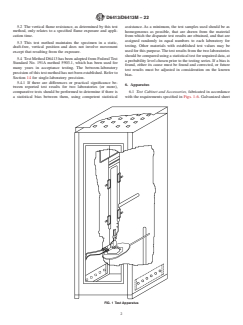
a statistical bias between them, using competent statistical with the requirements specified in Figs. 1-6. Galvanized sheet
FIG. 1 Test Apparatus
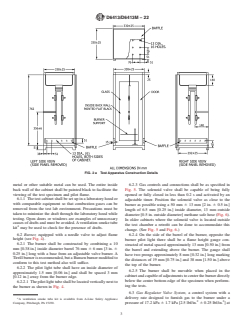
D6413/D6413M − 22
FIG. 2 a Test Apparatus Construction Details
metal or other suitable metal can be used. The entire inside 6.2.3 Gas controls and connections shall be as specified in
back wall of the cabinet shall be painted black to facilitate the Fig. 5. The solenoid valve shall be capable of being fully
viewing of the test specimen and pilot flame.
opened or fully closed in less than 0.2 s and activated by an
6.1.1 The test cabinet shall be set up in a laboratory hood or
adjustable timer. Position the solenoid valve as close to the
with comparable equipment so that combustion gases can be
burner as possible using a 50 mm 6 13 mm [2 in. 6 0.5 in.]
removed from the test lab environment. Precautions must be
length of 6.5 mm [0.25 in.] inside diameter, 13 mm outside
taken to minimize the draft through the laboratory hood while
diameter [0.5 in. outside diameter] methane safe hose (Fig. 6).
testing. Open doors or windows are examples of unnecessary
In older cabinets where the solenoid valve is located outside
causes of drafts and must be avoided.Aventilation smoke tube
the test chamber a retrofit can be done to accommodate this
kit may be used to check for the presence of drafts.
change. (See Fig. 5 and Fig. 6.)
6.2 Burner, equipped with a needle valve to adjust flame
6.2.4 On the side of the barrel of the burner, opposite the
height (see Fig. 4).
burner pilot light there shall be a flame height gauge con-
6.2.1 The burner shall be constructed by combining a 10
structed of metal spaced approximately 13 mm [0.50 in.] from
mm [0.38 in.] inside diameter barrel 76 mm 66mm[3in. 6
the barrel and extending above the burner. The gauge shall
0.25 in.] long with a base from an adjustable valve burner. A
have two prongs approximately 8 mm [0.32 in.] long marking
Tirrillburnerisrecommended,butaBunsenburnermodifiedto
the distances of 19 mm [0.75 in.] and 38 mm [1.50 in.] above
conform to this test method also will suffice.
the top of the burner.
6.2.2 The pilot light tube shall have an inside diameter of
6.2.5 The burner shall be movable when placed in the
approximately 1.5 mm [0.06 in.] and shall be spaced 3 mm
cabinetandcapableofadjustmentstocentertheburnerdirectly
[0.12 in.] away from the burner edge.
below the center bottom edge of the specimen when perform-
6.2.2.1 Thepilotlighttubeshallbelocatedverticallynextto
ing the tests.
the burner as shown in Fig. 4.
6.3 Gas Regulator Valve System, a control system with a
4 delivery rate designed to furnish gas to the burner under a
A ventilation smoke tube kit is available from A-Line Safety Appliance
2 2
Company, Pittsburgh, PA 15230. pressure of 17.2 kPa 6 1.7 kPa [2.5 lbf/in. 6 0.25 lbf/in.]at
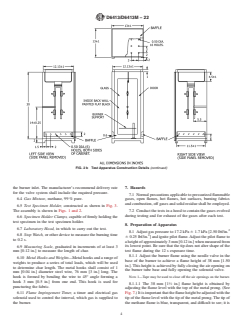
D6413/D6413M − 22
FIG. 2 b Test Apparatus Construction Details (continued)
the burner inlet. The manufacturer’s recommend delivery rate 7. Hazards
for the valve system shall include the required pressure.
7.1 Normalprecautionsapplicabletopressurizedflammable
6.4 Gas Mixture, methane, 99 % pure.
gases, open flames, hot flames, hot surfaces, burning fabrics
and combustion, off gases and solid residue shall be employed.
6.5 Test Specimen Holder, constructed as shown in Fig. 3.
The assembly is shown in Figs. 1 and 2. 7.2 Conduct the tests in a hood to contain the gases evolved
during testing and for exhaust of the gases after each test.
6.6 Specimen Holder Clamps, capable of firmly holding the
test specimen in the test specimen holder.
8. Preparation of Apparatus
6.7 Laboratory Hood, in which to carry out the test.
8.1 Adjust gas pressure to 17.2 kPa 6 1.7 kPa [2.50 lbf/in.
6.8 Stop Watch, or other device to measure the burning time
6 0.25 lbf/in. ] and ignite pilot flame.Adjust the pilot flame to
to 0.2 s.
aheightofapproximately3mm[0.12in.]whenmeasuredfrom
its lowest point. Be sure that the tip does not alter shape of the
6.9 Measuring Scale, graduated in increments of at least 3
test flame during the 12 s exposure time.
mm [0.12 in.] to measure the length of char.
8.1.1 Adjust the burner flame using the needle valve in the
6.10 Metal Hooks and Weights—Metal hooks and a range of
base of the burner to achieve a flame height of 38 mm [1.50
weights to produce a series of total loads, which will be used
in.]. This height is achieved by fully closing the air opening on
to determine char length. The metal hooks shall consist of 1
the burner tube base and fully opening the solenoid valve.
mm [0.04 in.] diameter steel wire, 76 mm [3 in.] long. The
hook is formed by bending the wire to 45° angle forming a
NOTE 1—Tape may be used to close off the air openings on the burner.
hook 3 mm [0.5 in.] from one end. This hook is used for
8.1.1.1 The 38 mm [1 ⁄2 in.] flame height is obtained by
puncturing the fabric.
adjusting the flame level with the top of the metal prong. (See
6.11 Flame Impingement Timer, a timer and electrical gas Fig.7.)Itisimportantthattheflameheightbeadjustedwiththe
solenoid used to control the interval, which gas is supplied to tip of the flame level with the tip of the metal prong. The tip of
the burner. the methane flame is blue, transparent, and difficult to see; it is
D6413/D6413M − 22
FIG. 3 a Specimen Holder Construction Details
more easily seen if there is no light on the flame, for example 9.3 Test Specimens—From each laboratory sampling unit,
in a darkened room. An easy way to accomplish this is by cut five lengthwise and five widthwise test specimens 76 mm
turning off all nearby lights. [3.0 in.] by 300 mm [12 in.]. For woven fabrics, the long
8.1.2 Position the burner so that the middle of the lower dimensions are cut parallel to the warp yarns for lengthwise
edgeofthespecimenholderiscentered19mm[0.75in.]above tests and parallel to the filling yarns for widthwise tests. Take
the burner. lengthwise specimens from different positions across the width
of the fabric. Consider the long direction as the direction of the
NOTE 2—It may be necessary to turn off nearby lights to make sure of
test. Label to mainta
...
This document is not an ASTM standard and is intended only to provide the user of an ASTM standard an indication of what changes have been made to the previous version. Because
it may not be technically possible to adequately depict all changes accurately, ASTM recommends that users consult prior editions as appropriate. In all cases only the current version
of the standard as published by ASTM is to be considered the official document.
Designation: D6413/D6413M − 15 D6413/D6413M − 22
Standard Test Method for
Flame Resistance of Textiles (Vertical Test)
This standard is issued under the fixed designation D6413/D6413M; the number immediately following the designation indicates the
year of original adoption or, in the case of revision, the year of last revision. A number in parentheses indicates the year of last
reapproval. A superscript epsilon (´) indicates an editorial change since the last revision or reapproval.
1. Scope
1.1 This test method is used to measure the vertical flame resistance of textiles.
1.1.1 As a part of the measure of flame resistance, afterflame and afterglow characteristics are evaluated.
1.2 This standard shall be is used to measure and describe the response of materials, products, or assemblies to heat and flame
under controlled laboratory conditions and shall not be used to describe or appraise theconditions, but does not by itself incorporate
all factors required for fire hazard or fire risk assessment of the materials, products, or assemblies under actual fire conditions.
1.3 Fire testing is inherently hazardous. Adequate safeguards for personnel and property shall be employed in conducting these
tests.
1.4 The values stated in either SI units or inch-pound units are to be regarded separately as standard. The values stated in each
system may not be exact equivalents; therefore, each system shall be used independently of the other. Combining values from the
two systems may result in non-conformance with the standard.
1.5 This standard does not purport to address all of the safety concerns, if any, associated with its use. It is the responsibility
of the user of this standard to establish appropriate safety safety, health, and healthenvironmental practices and determine the
applicability of regulatory limitations prior to use.
1.6 This international standard was developed in accordance with internationally recognized principles on standardization
established in the Decision on Principles for the Development of International Standards, Guides and Recommendations issued
by the World Trade Organization Technical Barriers to Trade (TBT) Committee.
2. Referenced Documents
2.1 ASTM Standards:
D123 Terminology Relating to Textiles
D1776 Practice for Conditioning and Testing Textiles
D3776/D3776M Test Methods for Mass Per Unit Area (Weight) of Fabric
D4391 Terminology Relating to The Burning Behavior of Textiles
E176 Terminology of Fire Standards
This test method is under the jurisdiction of ASTM Committee D13 on Textiles and is the direct responsibility of Subcommittee D13.52 on Flammability.
Current edition approved June 1, 2015Aug. 15, 2022. Published July 2015November 2022. Originally approved in 1999. Last previous edition approved in 20132015 as
D6413/D6413M – 13b.D6413/D6413M – 15. DOI: 10.1520/D6413_D6413M-15.10.1520/D6413_D6413M-22.
For referenced ASTM standards, visit the ASTM website, www.astm.org, or contact ASTM Customer Service at service@astm.org. For Annual Book of ASTM Standards
volume information, refer to the standard’s Document Summary page on the ASTM website.
Copyright © ASTM International, 100 Barr Harbor Drive, PO Box C700, West Conshohocken, PA 19428-2959. United States
D6413/D6413M − 22
2.2 ISO Standard
ISO 13943 Fire safety
3. Terminology
3.1 char length—in measuring flame resistance of textiles, the distance from the fabric edge, which is directly exposed to the flame
to the furthest point of visible fabric damage after a specified tearing force has been applied.
3.2 The following terms are relevant to this standard: afterflame, after-flame time, afterglow time, flame application time, melting.
3.3 For terms relatingrelated to the burning behavior of textiles, see Terminology D4391.
3.1.1 The following terms are relevant to this standard.
3.1.1.1 afterflame, n—persistent flaming of a material after the ignition source has been removed.
3.1.1.2 after-flame time, n—the length of time for which a material continues to flame after the ignition source has been removed.
3.1.1.3 afterglow time, n—the time afterglow continues after the removal of the ignition source and the cessation of flaming.
3.1.1.4 char length, n—in measuring flame resistance of textiles, the distance from the fabric edge, which is directly exposed to
the flame to the furthest point of visible fabric damage after a specified tearing force has been applied.
3.1.1.5 flame application time, n—the time interval for which the ignition flame is applied to a material.
3.1.1.6 melting, n—a liquification of material under the influence of heat.
3.4 For terminology related to fire issues other than burning behavior of textiles, see Terminology E176 and ISO 13943. In case
of conflict, the terminology in E176 will prevail.
3.5 For all terminologyother terms related to textiles, refer to see Terminology D123.
4. Summary of Test Method
4.1 A specimen is positioned vertically above a controlled flame and exposed for a specified period of time. The flame then is
removed, and afterflame time and afterglow time are measured.
4.2 Char length is measured under a specified force.
4.3 Any evidence of melting or dripping is noted.
5. Significance and Use
5.1 This test method determines the response of textiles to a standard ignition source, deriving measurement values for afterflame
time, afterglow time, and char length.
5.2 The vertical flame resistance, as determined by this test method, only relates to a specified flame exposure and application
time.
5.3 This test method maintains the specimen in a static, draft-free, vertical position and does not involve movement except that
resulting from the exposure.
Available from International Organization for Standardization (ISO), ISO Central Secretariat, Chemin de Blandonnet 8, CP 401, 1214 Vernier, Geneva, Switzerland,
https://www.iso.org.
D6413/D6413M − 22
5.4 Test Method D6413 has been adopted from Federal Test Standard No. 191A method 5903.1, which has been used for many
years in acceptance testing. The between-laboratory precision of this test method has not been established. Refer to Section 14 for
single-laboratory precision.
5.4.1 If there are differences or practical significance between reported test results for two laboratories (or more), comparative tests
should be performed to determine if there is a statistical bias between them, using competent statistical assistance. As a minimum,
the test samples used should be as homogeneous as possible, that are drawn from the material from which the disparate test results
are obtained, and that are assigned randomly in equal numbers to each laboratory for testing. Other materials with established test
values may be used for this purpose. The test results from the two laboratories should be compared using a statistical test for
unpaired data, at a probability level chosen prior to the testing series. If a bias is found, either its cause must be found and corrected,
or future test results must be adjusted in consideration on the known bias.
6. Apparatus
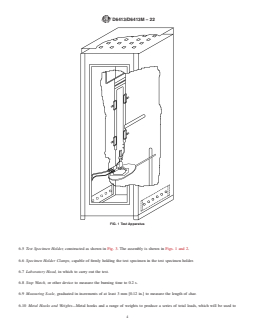
6.1 Test Cabinet and Accessories, fabricated in accordance with the requirements specified in Figs. 1-6. Galvanized sheet metal
or other suitable metal can be used. The entire inside back wall of the cabinet shall be painted black to facilitate the viewing of
the test specimen and pilot flame.
6.1.1 The test cabinet shall be set up in a laboratory hood or with comparable equipment so that combustion gases can be removed
from the test lab environment. Precautions must be taken to minimize the draft through the laboratory hood while testing. Open
doors or windows are examples of unnecessary causes of drafts and must be avoided. A ventilation smoke tube kit may be used
to check for the presence of drafts.
6.2 Burner, equipped with a needle valve to adjust flame height (see Fig. 4).
6.2.1 The burner shall be constructed by combining a 10 mm [0.38 in.] inside diameter barrel 76 mm 6 6 mm [3 in. 6 0.25 in.]
long with a base from an adjustable valve burner. A Tirrill burner is recommended, but a Bunsen burner modified to conform to
this test method also will suffice.
6.2.2 The pilot light tube shall have an inside diameter of approximately 1.5 mm [0.06 in.] and shall be spaced 3 mm [0.12 in.]
away from the burner edge.
6.2.2.1 The pilot light tube shall be located vertically next to the burner as shown in Fig. 4.
6.2.3 Gas controls and connections shall be as specified in Fig. 5. The solenoid valve shall be capable of being fully opened or
fully closed in less than 0.2 s and activated by an adjustable timer. Position the solenoid valve as close to the burner as possible
using a 50 mm 6 13 mm [2 in. 6 0.5 in.] length of 6.5 mm [0.25 in.] inside diameter, 13 mm outside diameter [0.5 in. outside
diameter] methane safe hose (Fig. 6). In older cabinets where the solenoid valve is located outside the test chamber a retrofit can
be done to accommodate this change. (See Fig. 5 and Fig. 6.)
6.2.4 On the side of the barrel of the burner, opposite the burner pilot light there shall be a flame height gagegauge constructed
of metal spaced approximately 13 mm [0.50 in.] from the barrel and extending above the burner. The gagegauge shall have two
prongs approximately 8 mm [0.32 in.] long marking the distances of 19 mm [0.75 in.] and 38 mm [1.50 in.] above the top of the
burner.
6.2.5 The burner shall be movable when placed in the cabinet and capable of adjustments to center the burner directly below the
center bottom edge of the specimen when performing the tests.
6.3 Gas Regulator Valve System, a control system with a delivery rate designed to furnish gas to the burner under a pressure of
2 2
17.2 kPa 6 1.7 kPa [2.5 lbf/in. 6 0.25 lbf/in. ] at the burner inlet. The manufacturer’s recommend delivery rate for the valve
system shall include the required pressure.
6.4 Gas Mixture, methane, 99 % pure.
A ventilation smoke tube kit is available from A-Line Safety Appliance Company, Pittsburgh, PA 15230.
D6413/D6413M − 22
FIG. 1 Test Apparatus
6.5 Test Specimen Holder, constructed as shown in Fig. 3. The assembly is shown in Figs. 1 and 2.
6.6 Specimen Holder Clamps, capable of firmly holding the test specimen in the test specimen holder.
6.7 Laboratory Hood, in which to carry out the test.
6.8 Stop Watch, or other device to measure the burning time to 0.2 s.
6.9 Measuring Scale, graduated in increments of at least 3 mm [0.12 in.] to measure the length of char.
6.10 Metal Hooks and Weights—Metal hooks and a range of weights to produce a series of total loads, which will be used to
D6413/D6413M − 22
FIG. 2 a Test Apparatus Construction Details
determine char length. The metal hooks shall consist of 1-mm [0.04-in.] 1 mm [0.04 in.] diameter steel wire, 76 mm [3 in.] long.
The hook is formed by bending the wire to 45° angle forming a hook 3 mm [0.5 in.] from one end. This hook is used for puncturing
the fabric.
6.11 Flame Impingement Timer, a timer and electrical gas solenoid used to control the interval, which gas is supplied to the burner.
7. Hazards
7.1 Normal precautions applicable to pressurized flammable gases, open flames, hot flames, hot surfaces, burning fabrics and
combustion, off gases and solid residue shall be employed.
7.2 Conduct the tests in a hood to contain the gases evolved during testing and for exhaust of the gases after each test.
8. Preparation of Apparatus
2 2
8.1 Adjust gas pressure to 17.2 kPa 6 1.7 kPa [2.506 [2.50 lbf/in. 6 0.25 lbf/in. ] and ignite pilot flame. Adjust the pilot flame
to a height of approximately 3 mm [0.12 in.] when measured from its lowest point. Be sure that the tip does not alter shape of the
test flame during the 12 s exposure time.
8.1.1 Adjust the burner flame using the needle valve in the base of the burner to achieve a flame height of 38 mm [1.50 in.]. This
height is achieved by fully closing the air opening on the burner tube base and fully opening the solenoid valve.
NOTE 1—Tape may be used to close off the air openings on the burner.
D6413/D6413M − 22
FIG. 2 b Test Apparatus Construction Details (continued)
8.1.1.1 The 38-mm 38 mm [1 ⁄2- in.] flame height is obtained by adjusting the flame level with the top of the metal prong. (See
Fig. 7.) It is important that the flame height be adjusted with the tip of the flame level with the tip of the metal prong. The tip of
the methane flame is blue, transparent, and difficult to see; it is more easily seen if there is no light on the flame, for example in
a darkened room. An easy way to accomplish this is by turning off all nearby lights.
8.1.2 Position the burner so that the middle of the lower edge of the specimen holder is centered 19 mm [0.75 in.] above the burner.
NOTE 2—It may be necessary to turn off nearby
...