

ASTM D4434/D4434M-21
(Specification)Standard Specification for Poly(Vinyl Chloride) Sheet Roofing
General Information
- Abstract
ABSTRACT
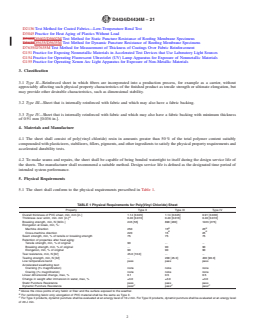
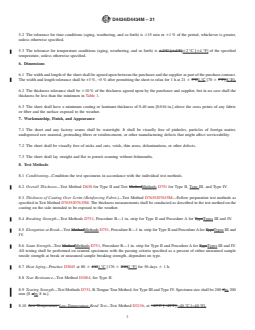
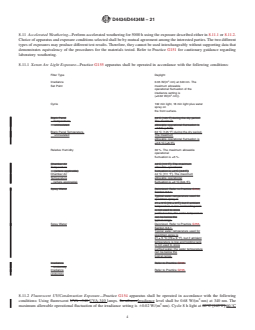
This specification covers flexible fiber- or fabric-reinforced sheet made from poly(vinyl chloride) resin as the primary polymer intended for use in single-ply roofing membranes exposed to the weather. The sheet shall contain. In-place roof system design criteria such as fire resistance, material compatibility, wind uplift resistance, in-situ shrinkage, among others, are beyond the scope of this specification. The physical requirements for which the sheet materials shall be tested on and shall conform accordingly to are as follows: overall thickness and thickness over scrim; tensile strength at break; breaking strength; elongation at break; seam strength; retention of properties after heat aging; tear resistance and tearing strength; low temperature bend; cracking and crazing after accelerated weathering test; linear dimensional change; change in weight after immersion in water; and static and dynamic puncture resistance.
SCOPE
1.1 This specification covers flexible sheet made from poly(vinyl chloride) resin as the primary polymer intended for use in single-ply roofing membranes exposed to the weather. The sheet shall contain reinforcing fibers or reinforcing fabrics.
1.2 The tests and property limits used to characterize the sheet are values intended to ensure minimum quality for the intended purpose. In-place roof system design criteria, such as fire resistance, material compatibility, wind uplift resistance, in-situ shrinkage, among others, are factors that must be considered but are beyond the scope of this specification.
1.3 The values stated in either SI units or inch-pound units are to be regarded separately as standard. The values stated in each system may not be exact equivalents; therefore, each system shall be used independently of the other. Combining values from the two systems may result in nonconformance with the standard.
1.4 This standard does not purport to address all of the safety concerns, if any, associated with its use. It is the responsibility of the user of this standard to establish appropriate safety, health, and environmental practices and determine the applicability of regulatory limitations prior to use.
1.5 This international standard was developed in accordance with internationally recognized principles on standardization established in the Decision on Principles for the Development of International Standards, Guides and Recommendations issued by the World Trade Organization Technical Barriers to Trade (TBT) Committee.
- Status
- Published
- Publication Date
- 31-Dec-2020
- Technical Committee
- D08 - Roofing and Waterproofing
- Drafting Committee
- D08.18 - Nonbituminous Organic Roof Coverings
Buy Documents

ASTM D4434/D4434M-21 - Standard Specification for Poly(Vinyl Chloride) Sheet Roofing
REDLINE ASTM D4434/D4434M-21 - Standard Specification for Poly(Vinyl Chloride) Sheet Roofing
Overview
ASTM D4434/D4434M-21: Standard Specification for Poly(Vinyl Chloride) Sheet Roofing provides internationally recognized requirements for flexible, fiber- or fabric-reinforced PVC sheet materials used in single-ply roofing membranes. These roofing sheets are designed for exposure to weather and are primarily composed of poly(vinyl chloride) (PVC) resin, along with plasticizers, stabilizers, fillers, and pigments for enhanced durability and performance. The standard helps ensure that products meet minimum quality, consistency, and performance levels, facilitating trust among manufacturers, suppliers, and end users in the roofing and construction industries.
Key Topics
- Material Composition: Requires that the roofing sheet consists of more than 50% PVC resin, with other permitted ingredients such as plasticizers, stabilizers, and reinforcements.
- Physical Properties: Details testing requirements for thickness, tensile strength, elongation, seam strength, tear resistance, dimensional stability, weathering resistance, and puncture resistance.
- Types of Reinforcement:
- Type II: Reinforced with fibers as a carrier for added dimensional stability.
- Type III: Internally fabric-reinforced with or without a fabric backing.
- Type IV: Fabric-reinforced sheets with a minimum thickness requirement.
- Testing and Quality Assurance: Specifies mandatory laboratory test methods for physical and mechanical properties, referencing key ASTM test methods for assessment.
- Product Marking and Packaging: Outlines requirements for clear identification and packaging to ensure traceability and safe transport.
Applications
ASTM D4434/D4434M-21 is widely applied across the building and construction industry, serving as a critical reference for:
- Commercial and Industrial Roofing: Used extensively for waterproofing in low-slope (flat) roofing systems, ensuring protection against weather and mechanical stresses.
- New Construction and Renovation: Supports both new roofing projects and refurbishment of existing roof systems, due to the flexibility and adaptability of PVC membranes.
- Specification and Procurement: Assists architects, engineers, contractors, and facility managers in specifying high-quality, tested, and reliable PVC single-ply roofing products for diverse projects.
- Regulatory Compliance: Enables manufacturers and suppliers to demonstrate compliance with internationally accepted quality standards.
- Quality Control: Helps ensure the installation of roofing materials that meet standardized minimum requirements for performance and durability.
Related Standards
ASTM D4434/D4434M-21 references several other pertinent testing and material standards, which may be relevant for comprehensive evaluation and specification in roofing projects:
- ASTM D570: Test Method for Water Absorption of Plastics
- ASTM D638: Test Method for Tensile Properties of Plastics
- ASTM D751: Test Methods for Coated Fabrics
- ASTM D1004: Test Method for Tear Resistance of Plastic Film and Sheeting
- ASTM D1204: Test Method for Linear Dimensional Changes of Nonrigid Thermoplastic Sheeting or Film at Elevated Temperature
- ASTM D2136: Low-Temperature Bend Test for Coated Fabrics
- ASTM D3045: Practice for Heat Aging of Plastics Without Load
- ASTM D5602/D5602M: Test Method for Static Puncture Resistance of Roofing Membrane Specimens
- ASTM D5635/D5635M: Test Method for Dynamic Puncture Resistance of Roofing Membrane Specimens
- ASTM D7635/D7635M: Measurement of Thickness of Coatings Over Fabric Reinforcement
- ASTM G151/G154/G155: Practices for Exposure of Nonmetallic Materials to Various Laboratory Light Sources
By adhering to ASTM D4434/D4434M-21, stakeholders can ensure that poly(vinyl chloride) sheet roofing products will perform reliably while meeting globally recognized standards for quality and safety in the roofing sector.
Keywords: ASTM D4434, PVC sheet roofing, poly(vinyl chloride) membrane, single-ply roofing, roofing materials standards, puncture resistance, tensile strength, building and construction standards, ASTM roofing, quality assurance.
Relations
- Effective Date
- 01-Apr-2020
- Effective Date
- 01-Nov-2018
- Effective Date
- 01-Aug-2018
- Effective Date
- 01-Mar-2014
- Effective Date
- 01-Dec-2012
- Effective Date
- 15-Feb-2011
- Effective Date
- 15-Feb-2011
- Effective Date
- 01-Jun-2010
- Effective Date
- 15-May-2010
- Effective Date
- 01-Apr-2010
- Effective Date
- 15-Mar-2010
- Effective Date
- 01-Jul-2009
- Refers
ASTM D1004-09 - Standard Test Method for Tear Resistance (Graves Tear) of Plastic Film and Sheeting - Effective Date
- 01-May-2009
- Refers
ASTM D1004-08 - Standard Test Method for Tear Resistance (Graves Tear) of Plastic Film and Sheeting - Effective Date
- 01-Nov-2008
- Effective Date
- 01-Nov-2008
Buy Documents
ASTM D4434/D4434M-21 - Standard Specification for Poly(Vinyl Chloride) Sheet Roofing
REDLINE ASTM D4434/D4434M-21 - Standard Specification for Poly(Vinyl Chloride) Sheet Roofing
Get Certified
Connect with accredited certification bodies for this standard

DIBt (Deutsches Institut für Bautechnik)
German Institute for Building Technology.
DIN CERTCO
DIN Group product certification.

Aboma Certification B.V.
Specialized in construction, metal, and transport sectors.
Sponsored listings
Frequently Asked Questions
ASTM D4434/D4434M-21 is a technical specification published by ASTM International. Its full title is "Standard Specification for Poly(Vinyl Chloride) Sheet Roofing". This standard covers: ABSTRACT This specification covers flexible fiber- or fabric-reinforced sheet made from poly(vinyl chloride) resin as the primary polymer intended for use in single-ply roofing membranes exposed to the weather. The sheet shall contain. In-place roof system design criteria such as fire resistance, material compatibility, wind uplift resistance, in-situ shrinkage, among others, are beyond the scope of this specification. The physical requirements for which the sheet materials shall be tested on and shall conform accordingly to are as follows: overall thickness and thickness over scrim; tensile strength at break; breaking strength; elongation at break; seam strength; retention of properties after heat aging; tear resistance and tearing strength; low temperature bend; cracking and crazing after accelerated weathering test; linear dimensional change; change in weight after immersion in water; and static and dynamic puncture resistance. SCOPE 1.1 This specification covers flexible sheet made from poly(vinyl chloride) resin as the primary polymer intended for use in single-ply roofing membranes exposed to the weather. The sheet shall contain reinforcing fibers or reinforcing fabrics. 1.2 The tests and property limits used to characterize the sheet are values intended to ensure minimum quality for the intended purpose. In-place roof system design criteria, such as fire resistance, material compatibility, wind uplift resistance, in-situ shrinkage, among others, are factors that must be considered but are beyond the scope of this specification. 1.3 The values stated in either SI units or inch-pound units are to be regarded separately as standard. The values stated in each system may not be exact equivalents; therefore, each system shall be used independently of the other. Combining values from the two systems may result in nonconformance with the standard. 1.4 This standard does not purport to address all of the safety concerns, if any, associated with its use. It is the responsibility of the user of this standard to establish appropriate safety, health, and environmental practices and determine the applicability of regulatory limitations prior to use. 1.5 This international standard was developed in accordance with internationally recognized principles on standardization established in the Decision on Principles for the Development of International Standards, Guides and Recommendations issued by the World Trade Organization Technical Barriers to Trade (TBT) Committee.
ABSTRACT This specification covers flexible fiber- or fabric-reinforced sheet made from poly(vinyl chloride) resin as the primary polymer intended for use in single-ply roofing membranes exposed to the weather. The sheet shall contain. In-place roof system design criteria such as fire resistance, material compatibility, wind uplift resistance, in-situ shrinkage, among others, are beyond the scope of this specification. The physical requirements for which the sheet materials shall be tested on and shall conform accordingly to are as follows: overall thickness and thickness over scrim; tensile strength at break; breaking strength; elongation at break; seam strength; retention of properties after heat aging; tear resistance and tearing strength; low temperature bend; cracking and crazing after accelerated weathering test; linear dimensional change; change in weight after immersion in water; and static and dynamic puncture resistance. SCOPE 1.1 This specification covers flexible sheet made from poly(vinyl chloride) resin as the primary polymer intended for use in single-ply roofing membranes exposed to the weather. The sheet shall contain reinforcing fibers or reinforcing fabrics. 1.2 The tests and property limits used to characterize the sheet are values intended to ensure minimum quality for the intended purpose. In-place roof system design criteria, such as fire resistance, material compatibility, wind uplift resistance, in-situ shrinkage, among others, are factors that must be considered but are beyond the scope of this specification. 1.3 The values stated in either SI units or inch-pound units are to be regarded separately as standard. The values stated in each system may not be exact equivalents; therefore, each system shall be used independently of the other. Combining values from the two systems may result in nonconformance with the standard. 1.4 This standard does not purport to address all of the safety concerns, if any, associated with its use. It is the responsibility of the user of this standard to establish appropriate safety, health, and environmental practices and determine the applicability of regulatory limitations prior to use. 1.5 This international standard was developed in accordance with internationally recognized principles on standardization established in the Decision on Principles for the Development of International Standards, Guides and Recommendations issued by the World Trade Organization Technical Barriers to Trade (TBT) Committee.
ASTM D4434/D4434M-21 is classified under the following ICS (International Classification for Standards) categories: 91.100.50 - Binders. Sealing materials. The ICS classification helps identify the subject area and facilitates finding related standards.
ASTM D4434/D4434M-21 has the following relationships with other standards: It is inter standard links to ASTM D1204-14(2020), ASTM D7635/D7635M-18, ASTM D3045-18, ASTM D1204-14, ASTM G154-12, ASTM D5602/D5602M-11, ASTM D5635/D5635M-11, ASTM D7635/D7635M-10, ASTM D638-10, ASTM G151-10, ASTM D3045-92(2010), ASTM G151-09, ASTM D1004-09, ASTM D1004-08, ASTM D1204-08. Understanding these relationships helps ensure you are using the most current and applicable version of the standard.
ASTM D4434/D4434M-21 is available in PDF format for immediate download after purchase. The document can be added to your cart and obtained through the secure checkout process. Digital delivery ensures instant access to the complete standard document.
Standards Content (Sample)
This international standard was developed in accordance with internationally recognized principles on standardization established in the Decision on Principles for the
Development of International Standards, Guides and Recommendations issued by the World Trade Organization Technical Barriers to Trade (TBT) Committee.
Designation:D4434/D4434M −21
Standard Specification for
Poly(Vinyl Chloride) Sheet Roofing
This standard is issued under the fixed designation D4434/D4434M; the number immediately following the designation indicates the
year of original adoption or, in the case of revision, the year of last revision. A number in parentheses indicates the year of last
reapproval. A superscript epsilon (´) indicates an editorial change since the last revision or reapproval.
This standard has been approved for use by agencies of the U.S. Department of Defense.
1. Scope D638Test Method for Tensile Properties of Plastics
D751Test Methods for Coated Fabrics
1.1 This specification covers flexible sheet made from
D1004Test Method for Tear Resistance (Graves Tear) of
poly(vinyl chloride) resin as the primary polymer intended for
Plastic Film and Sheeting
use in single-ply roofing membranes exposed to the weather.
D1204Test Method for Linear Dimensional Changes of
Thesheetshallcontainreinforcingfibersorreinforcingfabrics.
Nonrigid Thermoplastic Sheeting or Film at Elevated
1.2 The tests and property limits used to characterize the
Temperature
sheet are values intended to ensure minimum quality for the
D2136Test Method for Coated Fabrics—Low-Temperature
intended purpose. In-place roof system design criteria, such as
Bend Test
fire resistance, material compatibility, wind uplift resistance,
D3045Practice for Heat Aging of Plastics Without Load
in-situ shrinkage, among others, are factors that must be
D5602/D5602MTest Method for Static Puncture Resistance
considered but are beyond the scope of this specification.
of Roofing Membrane Specimens
1.3 The values stated in either SI units or inch-pound units D5635/D5635MTest Method for Dynamic Puncture Resis-
tance of Roofing Membrane Specimens
are to be regarded separately as standard. The values stated in
each system may not be exact equivalents; therefore, each D7635/D7635MTestMethodforMeasurementofThickness
of Coatings Over Fabric Reinforcement
system shall be used independently of the other. Combining
values from the two systems may result in nonconformance G151PracticeforExposingNonmetallicMaterialsinAccel-
erated Test Devices that Use Laboratory Light Sources
with the standard.
G154Practice for Operating Fluorescent Ultraviolet (UV)
1.4 This standard does not purport to address all of the
Lamp Apparatus for Exposure of Nonmetallic Materials
safety concerns, if any, associated with its use. It is the
G155Practice for Operating XenonArc LightApparatus for
responsibility of the user of this standard to establish appro-
Exposure of Non-Metallic Materials
priate safety, health, and environmental practices and deter-
mine the applicability of regulatory limitations prior to use.
3. Classification
1.5 This international standard was developed in accor-
3.1 Type II—Reinforced sheet in which fibers are incorpo-
dance with internationally recognized principles on standard-
rated into a production process, for example as a carrier,
ization established in the Decision on Principles for the
without appreciably affecting such physical property charac-
Development of International Standards, Guides and Recom-
teristics of the finished product as tensile strength or ultimate
mendations issued by the World Trade Organization Technical
elongation, but may provide other desirable characteristics,
Barriers to Trade (TBT) Committee.
such as dimensional stability.
2. Referenced Documents
3.2 Type III—Sheet that is internally reinforced with fabric
2.1 ASTM Standards:
and which may also have a fabric backing.
D570Test Method for Water Absorption of Plastics
3.3 Type IV—Sheet that is internally reinforced with fabric
and which may also have a fabric backing with minimum
thickness of 0.91 mm [0.036 in.].
This specification is under the jurisdiction of ASTM Committee D08 on
RoofingandWaterproofingandisthedirectresponsibilityofSubcommitteeD08.18
on Nonbituminous Organic Roof Coverings.
4. Materials and Manufacture
Current edition approved Jan. 1, 2021. Published January 2021. Originally
4.1 The sheet shall consist of poly(vinyl chloride) resin in
approved in 1985. Last previous edition approved in 2015 as D4434/D4434M–15.
DOI: 10.1520/D4434_D4434M-21.
amounts greater than 50% of the total polymer content
For referenced ASTM standards, visit the ASTM website, www.astm.org, or
suitably compounded with plasticizers, stabilizers, fillers,
contact ASTM Customer Service at service@astm.org. For Annual Book of ASTM
pigments,andotheringredientstosatisfythephysicalproperty
Standards volume information, refer to the standard’s Document Summary page on
the ASTM website. requirements and accelerated durability tests.
Copyright © ASTM International, 100 Barr Harbor Drive, PO Box C700, West Conshohocken, PA 19428-2959. United States
D4434/D4434M−21
4.2 Tomakeseamsandrepairs,thesheetshallbecapableof 7.2 The sheet shall be visually free of nicks and cuts, voids,
being bonded watertight to itself during the design service life thin areas, delaminations, or other defects.
of the sheets. The manufacturer shall recommend a suitable
7.3 The sheet shall lay straight and flat to permit seaming
method. Design service life is defined as the designated time
without fishmouths.
period of intended system performance.
8. Test Methods
5. Physical Requirements
8.1 Conditioning—Condition the test specimens in accor-
5.1 The sheet shall conform to the physical requirements
dance with the individual test methods.
prescribed in Table 1.
8.2 Overall Thickness—Test Method D638 for Type II and
5.2 The tolerance for time conditions (aging, weathering,
Test Methods D751 for Type II, Type III, and Type IV.
and so forth) is 615 min or 61% of the period, whichever is
greater, unless otherwise specified.
8.3 Thickness of Coating Over Scrim (Reinforcing
Fabric)—Test Method D7635/D7635M—Follow preparation
5.3 The tolerance for temperature conditions (aging,
test methods as specified inTest Method D7635/D7635M.The
weathering, and so forth) is 62°C [64°F] of the specified
thickness measurements shall be conducted as described in the
temperature, unless otherwise specified.
test method on the coating on the side intended to be exposed
6. Dimensions to the weather.
6.1 The width and length of the sheet shall be agreed upon 8.4 Breaking Strength—Test Methods D751, Procedure
between the purchaser and the supplier as part of the purchase B—1in.stripforTypeIIandProcedureAforTypesIIIandIV.
contract. The width and length tolerance shall be +3%, −0%
8.5 Elongation at Break—Test Methods D751, Procedure
after permitting the sheet to relax for1hat21 6 3°C [70 6
B—1in.stripforTypeIIandProcedureAforTypesIIIandIV.
5°F].
8.6 Seam Strength—Test Methods D751, Procedure B—1
6.2 Thethicknesstoleranceshallbe 610%ofthethickness
in. strip for Type II and Procedure A for Types III and IV. All
agreed upon by the purchaser and supplier, but in no case shall
testing shall be performed on seamed specimens with the
the thickness be less than the minimum in Table 1.
passing criteria specified as a percent of either unseamed
6.3 The sheet shall have a minimum coating or laminant sample tensile strength at break or unseamed sample breaking
thickness of 0.40 mm [0.016 in.] above the cross points of any strength, dependent on type.
fabric or fiber and the surface exposed to the weather.
8.7 HeatAging—PracticeD3045at80 61°C[176 62°F]
for 56 days 61h.
7. Workmanship, Finish, and Appearance
8.8 Tear Resistance—Test Method D1004, for Type II.
7.1 The sheet and any factory seams shall be watertight. It
shall be visually free of pinholes, particles of foreign matter, 8.9 Tearing Strength—Test Methods D751, B-Tongue Tear
undispersed raw material, protruding fibers or reinforcement, Method, for Type III and Type IV. Specimen size shall be 200
or other manufacturing defects that might affect serviceability. by 200 mm [8 by 8 in.].
TABLE 1 Physical Requirements for Poly(Vinyl Chloride) She
...
This document is not an ASTM standard and is intended only to provide the user of an ASTM standard an indication of what changes have been made to the previous version. Because
it may not be technically possible to adequately depict all changes accurately, ASTM recommends that users consult prior editions as appropriate. In all cases only the current version
of the standard as published by ASTM is to be considered the official document.
Designation: D4434/D4434M − 15 D4434/D4434M − 21
Standard Specification for
Poly(Vinyl Chloride) Sheet Roofing
This standard is issued under the fixed designation D4434/D4434M; the number immediately following the designation indicates the
year of original adoption or, in the case of revision, the year of last revision. A number in parentheses indicates the year of last
reapproval. A superscript epsilon (´) indicates an editorial change since the last revision or reapproval.
This standard has been approved for use by agencies of the U.S. Department of Defense.
1. Scope
1.1 This specification covers flexible sheet made from poly(vinyl chloride) resin as the primary polymer intended for use in
single-ply roofing membranes exposed to the weather. The sheet shall contain reinforcing fibers or reinforcing fabrics.
1.2 The tests and property limits used to characterize the sheet are values intended to ensure minimum quality for the intended
purpose. In-place roof system design criteria, such as fire resistance, material compatibility, wind uplift resistance, in-situ
shrinkage, among others, are factors that must be considered but are beyond the scope of this specification.
1.3 The values stated in either SI units or inch-pound units are to be regarded separately as standard. The values stated in each
system may not be exact equivalents; therefore, each system shall be used independently of the other. Combining values from the
two systems may result in non-conformancenonconformance with the standard.
1.4 This standard may involve hazardous materials, operations, and equipment. This standard does not purport to address all of
the safety concerns, if any, associated with its use. It is the responsibility of the user of this standard to establish appropriate safety
and health practices and determine the applicability of regulatory limitation prior to use.
1.4 This standard does not purport to address all of the safety concerns, if any, associated with its use. It is the responsibility
of the user of this standard to establish appropriate safety, health, and environmental practices and determine the applicability of
regulatory limitations prior to use.
1.5 This international standard was developed in accordance with internationally recognized principles on standardization
established in the Decision on Principles for the Development of International Standards, Guides and Recommendations issued
by the World Trade Organization Technical Barriers to Trade (TBT) Committee.
2. Referenced Documents
2.1 ASTM Standards:
D570 Test Method for Water Absorption of Plastics
D638 Test Method for Tensile Properties of Plastics
D751 Test Methods for Coated Fabrics
D1004 Test Method for Tear Resistance (Graves Tear) of Plastic Film and Sheeting
D1204 Test Method for Linear Dimensional Changes of Nonrigid Thermoplastic Sheeting or Film at Elevated Temperature
This specification is under the jurisdiction of ASTM Committee D08 on Roofing and Waterproofing and is the direct responsibility of Subcommittee D08.18 on
Nonbituminous Organic Roof Coverings.
Current edition approved Dec. 1, 2015Jan. 1, 2021. Published January 2016January 2021. Originally approved in 1985. Last previous edition approved in 20122015 as
D4434/D4434M – 12.D4434/D4434M – 15. DOI: 10.1520/D4434_D4434M-15.10.1520/D4434_D4434M-21.
For referenced ASTM standards, visit the ASTM website, www.astm.org, or contact ASTM Customer Service at service@astm.org. For Annual Book of ASTM Standards
volume information, refer to the standard’s Document Summary page on the ASTM website.
Copyright © ASTM International, 100 Barr Harbor Drive, PO Box C700, West Conshohocken, PA 19428-2959. United States
D4434/D4434M − 21
D2136 Test Method for Coated Fabrics—Low-Temperature Bend Test
D3045 Practice for Heat Aging of Plastics Without Load
D5602D5602/D5602M Test Method for Static Puncture Resistance of Roofing Membrane Specimens
D5635D5635/D5635M Test Method for Dynamic Puncture Resistance of Roofing Membrane Specimens
D7635/D7635M Test Method for Measurement of Thickness of Coatings Over Fabric Reinforcement
G151 Practice for Exposing Nonmetallic Materials in Accelerated Test Devices that Use Laboratory Light Sources
G154 Practice for Operating Fluorescent Ultraviolet (UV) Lamp Apparatus for Exposure of Nonmetallic Materials
G155 Practice for Operating Xenon Arc Light Apparatus for Exposure of Non-Metallic Materials
3. Classification
3.1 Type II—Reinforced sheet in which fibers are incorporated into a production process, for example as a carrier, without
appreciably affecting such physical property characteristics of the finished product as tensile strength or ultimate elongation, but
may provide other desirable characteristics, such as dimensional stability.
3.2 Type III—Sheet that is internally reinforced with fabric and which may also have a fabric backing.
3.3 Type IV—Sheet that is internally reinforced with fabric and which may also have a fabric backing with minimum thickness
of 0.91 mm [0.036 in.].
4. Materials and Manufacture
4.1 The sheet shall consist of poly(vinyl chloride) resin in amounts greater than 50 % of the total polymer content suitably
compounded with plasticizers, stabilizers, fillers, pigments, and other ingredients to satisfy the physical property requirements and
accelerated durability tests.
4.2 To make seams and repairs, the sheet shall be capable of being bonded watertight to itself during the design service life of
the sheets. The manufacturer shall recommend a suitable method. Design service life is defined as the designated time period of
intended system performance.
5. Physical Requirements
5.1 The sheet shall conform to the physical requirements prescribed in Table 1.
TABLE 1 Physical Requirements for Poly(Vinyl Chloride) Sheet
Property Type II Type III Type IV
Overall thickness of PVC sheet, min, mm [in.] 1.14 [0.045] 1.14 [0.045] 0.91 [0.036]
A
Thickness over scrim, min. mm [in.] 0.40 [0.016] 0.40 [0.016] 0.40 [0.016]
Breaking strength, min, N [lbf/in.] 245 [55] 890 [200] 1223 [275]
Elongation at break, min, %:
B B
Machine direction 250 15 25
B B
Cross-machine direction 220 15 25
Seam strength, min, % of tensile or breaking strength 75 75 75
Retention of properties after heat aging:
Tensile strength, min, % of original 90 . .
Breaking strength, min, % of original . 90 90
Elongation, min, % of original 90 90 90
Tear resistance, min, N [lbf] 45.0 [10.0] . .
Tearing strength, min, N [lbf] . 200 [45.0] 400 [90.0]
Low temperature bend pass pass pass
Accelerated weathering test:
Cracking (7× magnification) none none none
Crazing (7× magnification) none none none
Linear dimensional change, max, % 0.1 0.5 0.5
Change in weight after immersion in water, max, % ±3.0 ±3.0 ±3.0
Static Puncture Resistance pass pass pass
C C C
Dynamic Puncture Resistance pass pass pass
A
Above the cross points of any fabric or fiber and the surface exposed to the weather.
B
For reinforcing fabric only; elongation of PVC material shall be the same as Type II.
C
For Type II products, dynamic puncture shall be evaluated at an energy level of 10 J min. For Type III products, dynamic puncture shall be evaluated at an energy level
of 20 J min.
D4434/D4434M − 21
5.2 The tolerance for time conditions (aging, weathering, and so forth) is 615 min or 61 % of the period, whichever is greater,
unless otherwise specified.
5.3 The tolerance for temperature conditions (aging, weathering, and so forth) is 62°C [64°F]62 °C [64 °F] of the specified
temperature, unless otherwise specified.
6. Dimensions
6.1 The width and length of the sheet shall be agreed upon between the purchaser and the supplier as part of the purchase contract.
The width and length tolerance shall be +3 %, −0 % after permitting the sheet to relax for 1 h at 21 6 3°C3 °C [70 6 5°F].5 °F].
6.2 The thickness tolerance shall be 610 % of the thickness agreed upon by the purchaser and supplier, but in no case shall the
thickness be less than the minimum in Table 1.
6.3 The sheet shall have a minimum coating or laminant thickness of 0.40 mm [0.016 in.] above the cross points of any fabric
or fiber and the surface exposed to the weather.
7. Workmanship, Finish, and Appearance
7.1 The sheet and any factory seams shall be watertight. It shall be visually free of pinholes, particles of foreign matter,
undispersed raw material, protruding fibers or reinforcement, or other manufacturing defects that might affect serviceability.
7.2 The sheet shall be visually free of nicks and cuts, voids, thin areas, delaminations, or other defects.
7.3 The sheet shall lay straight and flat to permit seaming
...